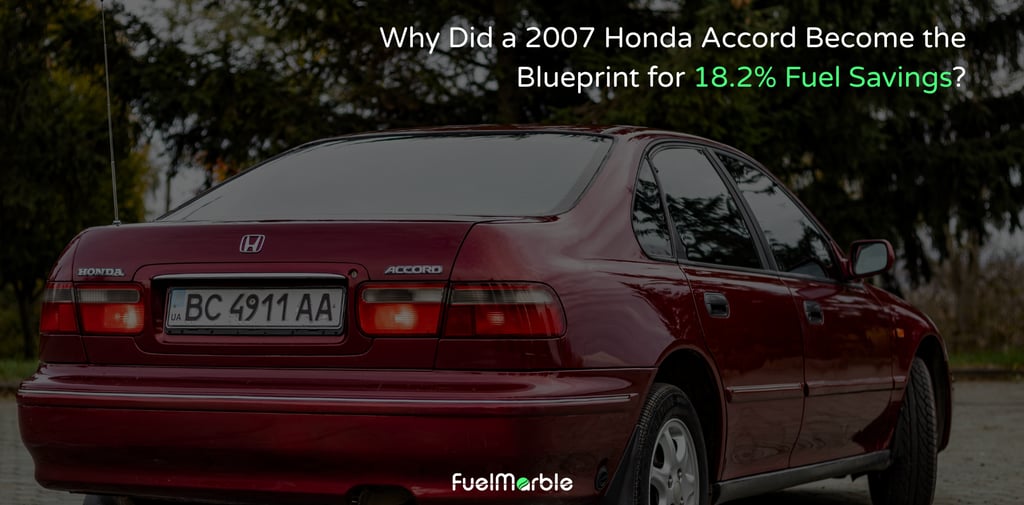
18% Fuel Efficiency Improvement After Retrofitting a 2007 Honda Accord
FUELMARBLE TEST
1/6/20264 min read


The Chinese independent vehicle test
As fuel prices remain volatile and fleet operating costs continue to rise, improving fuel efficiency in existing vehicles has become a priority for governments, fleet operators, and sustainability-focused organisations. While long-term electrification strategies are advancing, a significant portion of the global vehicle fleet will remain powered by internal combustion engines for years to come.
In this context, real-world, independently verified fuel-efficiency testing is essential.
Laboratory simulations alone are no longer sufficient; decision-makers increasingly require data generated under regulatory-grade testing conditions that reflect real vehicle operation.
In April 2019, such a test was conducted in Qinhuangdao, Hebei Province, China. The test evaluated FuelMarble—a fuel-efficiency enhancement technology. To better understand the mechanism behind the results discussed below, readers may wish to review the science of fuel enhancement, which explains how the technology physically alters fuel structure to improve combustion. The test used government-certified inspection procedures and emissions testing equipment, with the primary objective being to assess whether retrofitting an older vehicle could measurably improve fuel economy (km/L).
This article presents a structured and transparent analysis of the test, explaining what was tested, how it was measured, and what the results demonstrate.
All fuel consumption and emissions measurements were conducted using government-approved inspection methods typically applied to regulatory vehicle compliance testing in China.
Why independent vehicle testing matters for fuel efficiency?
Fuel savings claims are often met with skepticism—and rightly so. Real-world fuel economy can be influenced by numerous variables, including driver behaviour, traffic conditions, vehicle condition, and measurement methodology.
For this reason, independent verification using government-approved testing facilities is critical for establishing technical credibility and decision-making confidence.
The Qinhuangdao FuelMarble test is particularly relevant because:
Official standards were used: The test followed China’s GB18285-2005 and DB13/1801-2013 regulatory inspection standards.
Before-and-after (A/B) testing was applied: Measurements were taken immediately before and after installation on the same vehicle.
Results were independently verified: All results were recorded and stamped by the Qinhuangdao Shi’ao Motor Vehicle Inspection Co., Ltd.
This structure significantly reduces uncertainty and strengthens the reliability of the findings.
Fuel efficiency results: 18% improvement


Primary Outcome of the Test
The central focus of the Qinhuangdao test was fuel economy. Rather than relying on modelled estimates, the test measured actual distance travelled and fuel consumed under controlled inspection conditions.
Measured Results
Baseline (Before FuelMarble installation):
The vehicle travelled 195 km using 17.23 litres of fuel, equivalent to 11.32 km/L.
After FuelMarble installation:
The vehicle travelled 366 km using 27.40 litres of fuel, equivalent to 13.36 km/L.
Result
This represents an 18% improvement in fuel efficiency (km/L).
All “Before” and “After” results were recorded:
On the same vehicle
At the same inspection facility
Using identical procedures
With FuelMarble as the only variable introduced
For fleet operators, an 18% improvement in km/L directly translates into lower fuel consumption per kilometre. While retrofitting offers immediate mechanical gains, it is most effective when part of a broader strategy; managers seeking to maximize operational savings should also consider implementing other proven ways to boost fleet fuel efficiency alongside technical upgrades.
Importantly, this test demonstrates that meaningful fuel-efficiency gains are possible even in high-mileage, aging internal combustion engine vehicles, without mechanical engine modifications or vehicle replacement.
Emissions reduction: A secondary effect of improved combustion efficiency
While fuel efficiency was the primary focus of the test, exhaust emissions were measured to assess whether improved combustion efficiency produced additional environmental benefits.
Nitrogen Oxides (NOx)
Under simulated load conditions:
Before: 1.32 g/km
After: 0.03 g/km
This corresponds to a 97.7% reduction in measured NOx emissions under loaded driving conditions.
Carbon Monoxide (CO)
During low-idle testing (representative of stop-start traffic):
Before: 0.15% volumetric concentration
After: 0.01% volumetric concentration
This represents a 93% reduction in CO output at idle, indicating more complete combustion.
Hydrocarbons (HC)
During high-idle testing:
Before: 24 × 10⁻⁶
After: 15 × 10⁻⁶
This reflects a 37.5% reduction in unburnt hydrocarbons, further supporting improved fuel utilisation.
These emissions reductions were not the primary objective of the retrofit, but are consistent with the underlying principle that more efficient combustion produces less waste and fewer harmful by-products.
Methodology: Regulatory-Grade Measurement Protocols
To ensure data integrity and comparability, the test used standard government inspection methods rather than experimental or proprietary testing techniques.
Two official inspection modes were applied:
Dual Idle Speed Method: Used to measure Carbon Monoxide (CO) and Hydrocarbon (HC) concentrations while the vehicle is stationary.
Simple Transient Loaded Mode: Used to measure Nitrogen Oxides (NOx), CO, and HC under simulated driving load.
All measurements were conducted on the Shi’ao Line 5 detection line using recognized exhaust gas analyzers (Model MQW-50A), consistent with regulatory vehicle inspection procedures in China.
Alignment with other FuelMarble field tests
The Qinhuangdao results align with findings from other real-world FuelMarble tests. A notable comparison is the Jakarta traffic test analysis, which demonstrated similar emission reductions under heavily congested urban conditions, validating the technology's effectiveness across different geographies and operating environments.
This correlation supports the interpretation that FuelMarble enhances fuel reactivity and combustion efficiency, allowing more energy to be extracted from the same volume of fuel.
Responsible interpretation of results
Several contextual factors should be considered:
Vehicle age: The test vehicle was manufactured in 2007. Older engines with accumulated carbon deposits often show more pronounced improvements from combustion optimisation technologies.
Operating conditions: Results reflect specific environmental parameters during testing, including ambient temperatures of approximately 17–22°C.
Technology positioning: FuelMarble is not a substitute for electrification. It functions as a transitional efficiency solution for existing fleets that cannot yet be replaced.
Actual results may vary depending on vehicle condition, duty cycle, and operating environment.
Conclusion
The 2019 Qinhuangdao independent vehicle test provides regulatory-grade, independently verified evidence that retrofitting an older internal combustion engine vehicle with FuelMarble can deliver meaningful fuel-efficiency gains.
Key outcomes include:
Fuel efficiency: An 18% improvement in km/L, directly reducing fuel consumed per kilometre.
Secondary emissions benefits: NOx reduced by over 97%, CO by 93%, and HC by 37% under inspection conditions.
For fleet operators, policymakers, and sustainability-focused organisations, these findings demonstrate that improving fuel efficiency in the existing vehicle stock remains one of the most immediately actionable pathways to reducing both operating costs and environmental impact—while longer-term vehicle transition strategies continue to develop.
Frequently Asked Questions about the China Test
Designed to Go Further
Contact
FuelMarble © 2026. All rights reserved.

Delivery
Household
Marine
FuelMarble, 124 City Road, London, EC1V 2NX