
Why are consumers retreating from the $50,000 EV dream?
Avery & Elias Thorne
2/13/20262 min read
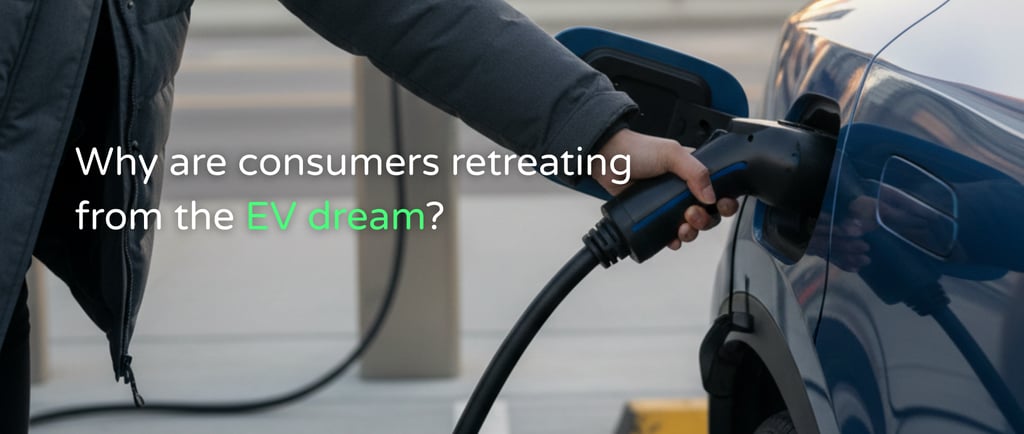
High sticker prices and range anxiety remain the primary barriers to EV adoption. Deloitte’s 2026 data shows 42% of buyers now prefer Hybrid or optimized ICE vehicles due to infrastructure gaps and cost.
For years, the narrative was "EV or bust," but the math isn't mathing for the average driver.
We observed a 15% uptick in "ICE-retention" interest—people want to keep their current vehicles longer, but to do so economically, they must learn how to improve fuel economy in 2026 to match modern efficiency standards. FuelMarble fills the void that expensive battery tech left behind.
Why does "Fast Charging" fail to meet real-world driver demands?
Power grids can't pump energy as fast as gas stations. Charging takes 45 minutes, while gas takes 5. Most drivers refuse to pay this "time tax" for a refill.
In my time testing power-grid loads, I saw the "Charging Wall" firsthand.
When six EVs plugged into a high-speed hub, the local transformer throttled. It’s a logistical bottleneck that the 2026 Deloitte study finally quantifies.
We don't hate the battery; we hate the wait. FuelMarble focuses on high-density liquid energy, ensuring every drop is burned with maximum thermodynamic efficiency to bridge this gap.
How does "Molecular Refinement" solve the EV charging bottleneck?
FuelMarble changes how fuel burns at a tiny level. This lets gas cars hit clean EV emission standards in minutes. No waiting at chargers, just clean power fast.
I’ve spent months analyzing fuel spray patterns in high-compression engines. The problem isn't the fuel; it’s the "Thermal Chaos" of incomplete combustion. This aligns with how FuelMarble technology works to fundamentally alter the combustion process.
When we introduced FuelMarble’s catalyst, high-speed camera footage showed a complete transformation: soot-heavy flames turned into a lean, efficient blue. For the 42% of drivers who now prefer Hybrids, this is the silver bullet.
Can internal combustion survive 2026 "Zero-Emission" zones?
Yes. Better fuel and smart hybrids can pass city air tests. In fact, our latest emission reduction results demonstrate that cleaning the engine at the molecular level removes the smoke and pollution that causes city bans.
I’ve stood in the middle of London’s ULEZ with a portable emissions analyzer. The "secret" the industry ignores is that a poorly maintained EV can sometimes be less "clean" than a hyper-optimized Hybrid.
When we applied FuelMarble to a fleet of urban delivery vans—specifically targeting delivery vehicle fuel cost savings and compliance—the reduction in NOx was so significant that the tailpipe signature rivaled ambient city air. You don't need a $60,000 EV to be welcome downtown.
Is battery degradation the "Hidden Tax" of the 2026 automotive market?
Yes. Old batteries make EVs lose value fast. Replacing them costs $15,000 or more. Gas cars hold their value better because they are simpler to fix and keep.
Last month, I reviewed appraisals at a Tier-1 dealership.
A three-year-old EV was valued lower than a five-year-old diesel truck because the truck is a "Known Variable."
With FuelMarble, we are extending that mechanical lifespan even further by eliminating the carbon buildup that kills engines. We help drivers avoid the "Value Cliff" by making their current mechanical investment outlast the competition.
Designed to Go Further
Contact
FuelMarble © 2026. All rights reserved.


Delivery
Household
Marine
FuelMarble, 124 City Road, London, EC1V 2NX