
The Ultimate Guide to Fuel Savings: Tips, Mechanics, and the Myths That Are Costing You Money
Cut your fuel costs with our mechanically grounded guide to fuel savings. Discover proven driving habits, essential maintenance, and the myths costing you MPG.
Avery
2/27/20269 min read
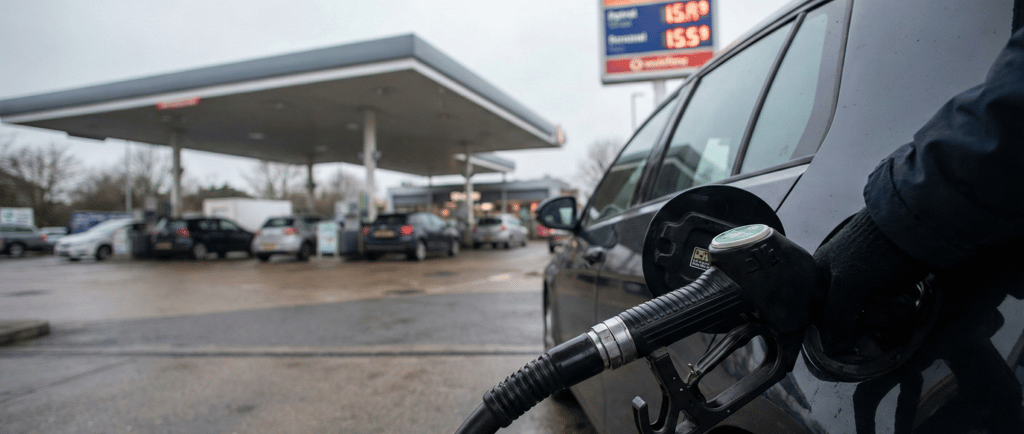
If you have filled a tank recently, you already know the pain. Pump prices in the UK have lurched between record highs and confusing lows since 2021, and the RAC reports that even on a "cheaper" day, the average UK motorist spends over £1,400 per year on fuel alone. For fleet operators, that number multiplies into six figures before the quarter is out. The pressure is real, the stakes are high, and the internet is littered with advice ranging from genuinely useful to dangerously wrong.
This guide is not a listicle. It is a structured, mechanically grounded breakdown of why fuel is wasted and how to stop it — covering driver behaviour, vehicle physics, maintenance realities, and the technology that actually works versus the gadgets that simply don't. If you want to understand rising haulage and running costs in a wider context, our deep dive into rising UK haulage operating costs provides the macro-economic backdrop. But if you want to start cutting consumption today, you are in the right place.
The Physics of Fuel — Why Your Engine Doesn't Work the Way You Think It Does?
What actually happens when your engine burns fuel?
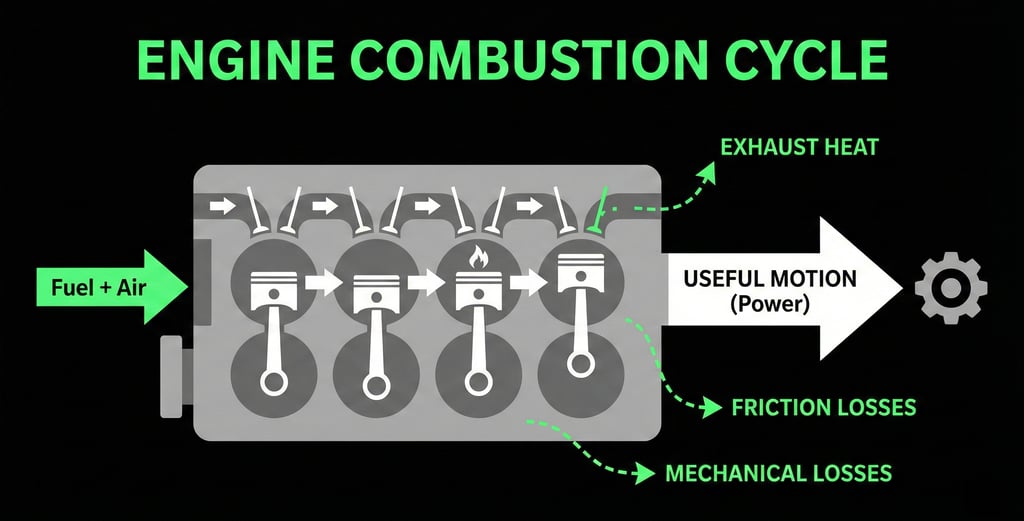
Your engine converts the chemical energy in fuel into mechanical motion — but it is spectacularly inefficient at it. A conventional petrol engine converts only around 20–40% of that energy into forward movement. The rest is lost as heat through the exhaust, radiated from the engine block, or consumed by mechanical friction. Diesel engines do slightly better, reaching up to 45% thermal efficiency under ideal conditions. Understanding this is foundational: it means that almost every fuel-saving strategy is really about reducing the losses, not magically extracting more energy from the same fuel.
The three primary culprits behind energy loss are aerodynamic drag (the resistance of air against your vehicle), rolling resistance (the friction between your tyres and the road surface), and parasitic load (the engine power consumed by systems like air conditioning, alternators, and power steering). Every technique in this guide targets at least one of those three.
For a mixed fleet of 47 vehicles — vans, rigids, and a handful of artics — and when I first started running consumption data properly, I was genuinely shocked. Two drivers on identical routes, in identical vehicles, were returning a 22% difference in fuel consumption every single week. Same tyres, same load, same road. The difference was almost entirely behavioural and thermal. That experience reshaped how I think about "fuel saving" — it is not one fix, it is a system.
The Mechanics of Driving — The Biggest Lever You Already Control
Does how you drive really make a bigger difference than the vehicle itself?
Yes — dramatically so. Driver behaviour accounts for up to 30% variation in fuel consumption on identical vehicles doing identical routes. Smooth acceleration, anticipation, and gear discipline are the highest-ROI changes any driver can make immediately.
Smooth Driving and Anticipation
The physics are unforgiving: kinetic energy is proportional to the square of your speed. That means doubling your speed from 30 to 60 mph does not double your aerodynamic drag — it quadruples it. Every time you brake hard after accelerating, you are converting expensively acquired kinetic energy into useless heat in your brake discs. The fuel is already gone.
The solution is anticipation. A skilled driver reads the road 10–15 seconds ahead, decelerating by simply lifting off the throttle rather than using the brake. On UK roads, this matters enormously at roundabouts — arguably the defining feature of British driving. Approaching a roundabout at 20 mph with a clear exit is categorically cheaper than accelerating to 30, braking to 5, then accelerating again. The fuel cost of that single unnecessary acceleration-brake cycle across a busy commute adds up to litres per week, not millilitres.
Gear Discipline and Engine Speed
Modern diesel and petrol engines are most efficient at low RPM under moderate load. The broad rule: change up early (around 2,000 RPM for diesel, 2,500 for petrol), maintain momentum in higher gears, and avoid "lugging" the engine by keeping it above 1,200 RPM. Your vehicle's gear shift indicator (fitted to most post-2014 UK cars under EU efficiency regulations) is a genuine tool, not a nanny — use it.
What is Hypermiling, and Is It Safe on UK Roads?
Hypermiling is a collection of advanced fuel-saving driving techniques. Some are genuinely useful and safe. Others are illegal or dangerous on UK roads and should be avoided entirely.
Hypermiling originated in US endurance fuel-economy events and describes any technique that pushes fuel economy beyond the manufacturer's official figure. The safe, legal, and effective techniques include: pulse-and-glide on roads with varying speed limits (accelerate smoothly to the upper limit, lift off and coast down in gear, repeat), engine-off coasting only where legal and safe (rare in UK conditions), and maximising use of engine braking on descents.
What you should not do on UK roads: drafting (tailgating large vehicles to exploit their slipstream) is dangerous and constitutes careless driving. Coasting in neutral — frequently cited as a hypermiling tactic — is addressed directly in the myths section below, but the short answer is: do not do it. The Highway Code is clear, and modern fuel injection makes it counterproductive anyway.
Vehicle Maintenance — The Silent Drain on Every Tank
How much fuel does poor maintenance actually waste?
A poorly maintained vehicle can waste 10–25% more fuel than a well-serviced equivalent. Tyre pressure, air filter condition, and engine cleanliness are the highest-impact maintenance factors — and the most commonly neglected.
Tyre Pressure and Rolling Resistance
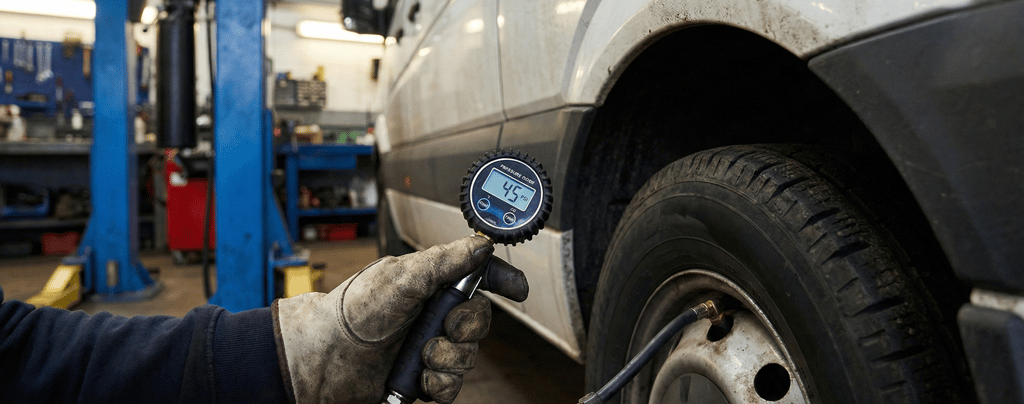
For every 10 PSI a tyre is underinflated, rolling resistance increases by approximately 1%. That sounds modest until you realise most fleet vehicles run 15–20 PSI below optimum more often than their operators realise. The Michelin Tyre Performance Database consistently shows that properly inflated tyres deliver 1–3% better fuel economy across mixed driving — on a high-mileage van covering 40,000 miles per year, that is a meaningful number. Check pressure cold, weekly, and inflate to the manufacturer's upper recommended value (not the tyre's maximum sidewall pressure, which is an absolute physical limit, not an operating recommendation).
Engine Cleanliness and Carbon Buildup
Engines accumulate deposits over time — on injectors, valves, and combustion chamber walls — that disrupt the precise fuel atomisation modern engines depend on. The result is incomplete combustion: fuel that enters the cylinder but does not burn fully, exiting as partially combusted hydrocarbons. This is simultaneously wasteful and polluting.
For petrol engines, a good quality fuel system cleaner used periodically addresses most injector-level deposits. For heavy-duty diesel vehicles, the situation is more complex and the consequences of ignoring it are more severe. Diesel Particulate Filters (DPFs) are a particular vulnerability — a restricted or failing DPF forces the engine into regeneration cycles that consume significant additional fuel and, if left unaddressed, cause catastrophic failure.
For heavy-duty trucks and high-mileage diesel vehicles, the stakes are considerably higher. We have written in detail about how cheap fuel additives destroy DPF systems and specifically what to watch for with Volvo DPF warning symptoms — both are essential reading if you operate diesel equipment.
Myths Debunked — The Ideas That Are Quietly Costing You Money


Does coasting in neutral save fuel on modern vehicles?
No. On any vehicle with electronic fuel injection (virtually every car built after 1990), coasting in neutral actually burns more fuel than engine braking in gear. The ECU cuts fuel entirely during in-gear deceleration. Neutral requires fuel to maintain idle.
This is one of the most persistent myths in motoring — and one of the most harmful. When you decelerate in gear (engine braking), your engine control unit detects zero throttle input and cuts fuel injection entirely. The engine's momentum carries the drivetrain. Fuel consumption during this phase: zero. When you select neutral and coast, the ECU must inject fuel to keep the engine running at idle (typically 600–800 RPM). You are now burning fuel to achieve nothing.
Beyond the fuel cost, coasting in neutral reduces your control over the vehicle. The Highway Code (Rule 122) explicitly identifies it as dangerous. On downhill sections — where it is most tempting — it removes engine braking as a safety net. Do not do it.
Does cruise control always save fuel?
Only on flat roads. On undulating terrain — which describes most of the UK — cruise control frequently uses more fuel than an attentive driver, because it aggressively accelerates to restore speed on climbs.
On a motorway with minimal gradient change, cruise control's consistent throttle management is genuinely more efficient than human input, which tends to drift. But on roads with hills — the A roads, B roads, and dual carriageways that make up the majority of UK driving — cruise control's algorithm is blunt. It detects speed drop and applies throttle. An experienced driver would instead reduce speed slightly on the climb (accepting a momentary drop) and exploit the descent to regain momentum without additional throttle. The fuel difference on hilly routes can be 5–8% in favour of the skilled driver over cruise control.
Do fuel-saving gadgets work?
The overwhelming majority do not. Magnetic "fuel savers", vortex generators, and ionisation devices have been repeatedly tested — including by Which?, the AA, and peer-reviewed engineering studies — and consistently show zero measurable effect on fuel consumption.
The gadget market for fuel savers is, to put it plainly, a theatre of wishful thinking and, in some cases, outright fraud. The physics are not complicated: if a magnetic bracelet around a fuel line could meaningfully alter the combustion properties of refined hydrocarbon fuel, the world's engine manufacturers — who spend billions optimising exactly this problem — would have adopted it decades ago.
Before investing in any fuel-saving technology, demand independent, peer-reviewed evidence. Manufacturer claims are not evidence. Testimonials are not evidence. If a product cannot demonstrate controlled, repeatable, statistically significant fuel savings in a real-world test, it is not worth your money.
We have done the detailed comparisons so you do not have to: read our breakdown of FuelMarble versus Fuelsync and our specific analysis of whether magnetic fuel savers actually work. The conclusions will not surprise you.
What fuel-saving technology has genuine, measurable evidence behind it?
Fuel system cleaners with verified deposit control chemistry, combustion optimisers with peer-reviewed data, and telematics-led driver behaviour programmes have the strongest evidence base. These address real, physical inefficiencies rather than imaginary ones.
Start/Stop Systems — Use Them, Don't Fight Them
The instinct to disable Start/Stop technology is understandable — the slight hesitation on restart feels like wear and worry. But the engineering is sound. Modern Start/Stop starters are rated for 10x the cycles of a conventional starter motor. Batteries in Start/Stop vehicles are enhanced AGM or EFB units designed for repeated partial discharge. The system is calibrated by the manufacturer to activate only when conditions (temperature, battery state, cabin climate) are suitable.
The fuel saving is real: in urban driving with frequent stops, Start/Stop typically reduces consumption by 3–8%. Over a year of urban commuting, that is approximately one to two full tanks. Leave it active.
Route Optimisation and Eco-Routing
Google Maps and Waze now offer "eco-routing" as a default option, selecting routes that minimise fuel consumption rather than simply minimising time. In practice, this means preferring steady-speed A-road routes over fast-but-stop-heavy alternatives. Independent testing by the US Department of Energy showed eco-routing reducing fuel consumption by an average of 9% in urban environments. The technology exists, it is free, and most drivers are not using it deliberately.
The Role of Fuel Additives — Cutting Through the Noise
This is where the market becomes genuinely confusing. The additive space ranges from rigorously engineered, chemistry-backed combustion optimisers to borderline snake oil. The distinction lies in the mechanism: a legitimate additive has a specific, documented chemical action — detergent packages that remove carbon deposits, cetane improvers that increase diesel combustion efficiency, lubricity agents that reduce injector wear. These can be independently verified with before-and-after fuel consumption data.
Products without a specific, documentable chemical mechanism — or that rely purely on testimonial evidence — should be treated with the same scepticism as the magnetic clip-ons.
FuelMarble operates in the legitimate. If you want to understand exactly how the technology works at an engine level, our article on how FuelMarble unleashes your vehicle's fuel potential walks through the mechanism in detail. If you have already decided to try it, our step-by-step installation and usage guide covers everything you need.
Conclusion: Building a Long-Term Fuel-Saving System
The single most important insight from everything above is this: fuel saving is not a single action, it is a compounding system. A 3% gain from tyre pressure, combined with a 5% gain from smoother driving, a 4% reduction in idle time, and a 3% improvement from a clean fuel system does not add up to 15% — because each efficiency makes the others more effective. Across a year of real driving, the effect is substantial.
Start tracking your consumption now. Record your mileage and the litres (or gallons) at every fill. Calculate MPG or L/100km consistently. If your number is not improving quarter-on-quarter, something in your system needs attention — tyre check, driving review, service interval, or fuel quality.
The carbon dimension matters too. Every 1% reduction in fuel consumption is a direct 1% reduction in CO₂ output. For fleet operators, this feeds directly into Scope 1 emissions reporting, which is increasingly a compliance requirement rather than a voluntary commitment. Fuel efficiency and environmental responsibility are, on this issue, perfectly aligned.
Pro Tip — The Root Cause Most Guides Ignore
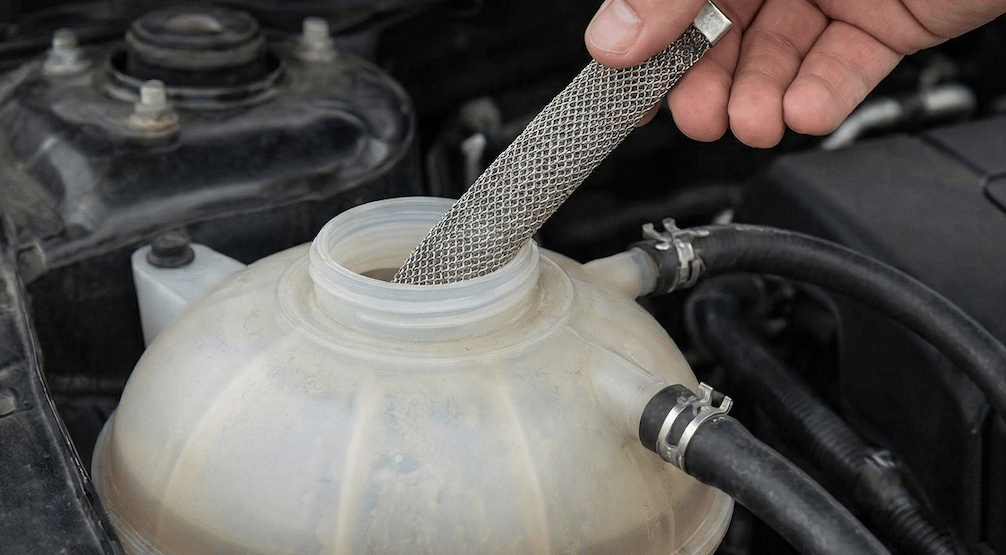
Everything in this guide assumes your engine is burning fuel as efficiently as its design allows. But over time, every combustion engine accumulates internal deposits — on injectors, valves, and combustion chamber walls — that degrade that efficiency invisibly. You won't get a warning light. Your MPG will simply drift downward, gradually, until a 5% loss feels like "just how the car drives now."
This is the root cause that tyre pressure checks and smoother driving cannot fix. A clean, deposit-free fuel system is the foundation everything else builds on.
Designed to Go Further
Contact
FuelMarble © 2026. All rights reserved.


Delivery
Household
Marine
FuelMarble, 124 City Road, London, EC1V 2NX