
UK Haulage & Logistics 2026: The Complete Industry Guide
HAULAGE INSIGHTS
Sienna Vance
12/22/20255 min read
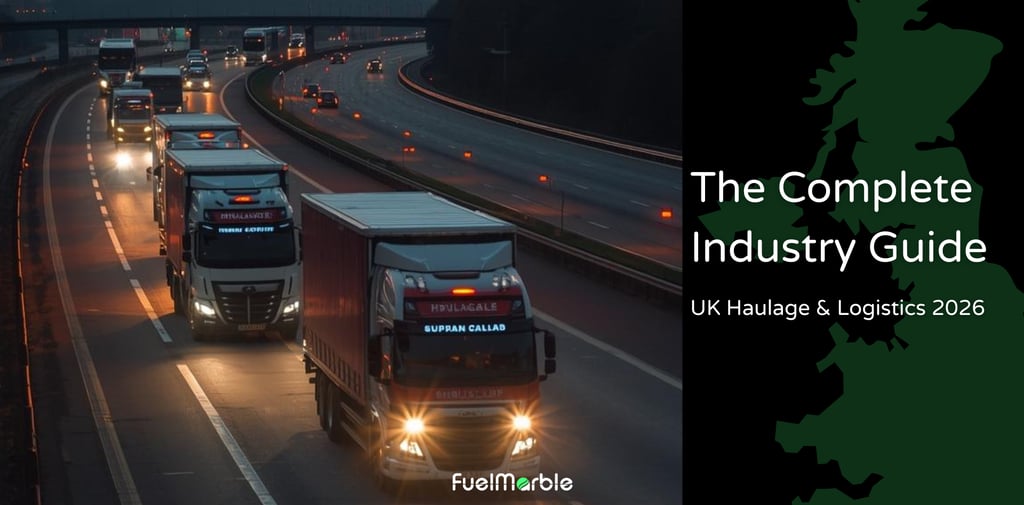
Haulage is the physical engine of the UK supply chain. Whether it is raw materials for manufacturing or retail products for high streets, road haulage remains the dominant mode of transport, responsible for moving approximately 82% of all goods moved within the UK as of 2024. [Source: UK Gov]
As we enter 2026, the industry is evolving rapidly under the weight of new safety regulations (London DVS), tight profit margins, and a push toward decarbonisation. This guide breaks down exactly what haulage is, how it functions, and the critical trends shaping the market today.
Introduction: Haulage is the backbone of the UK Economy
What is haulage?
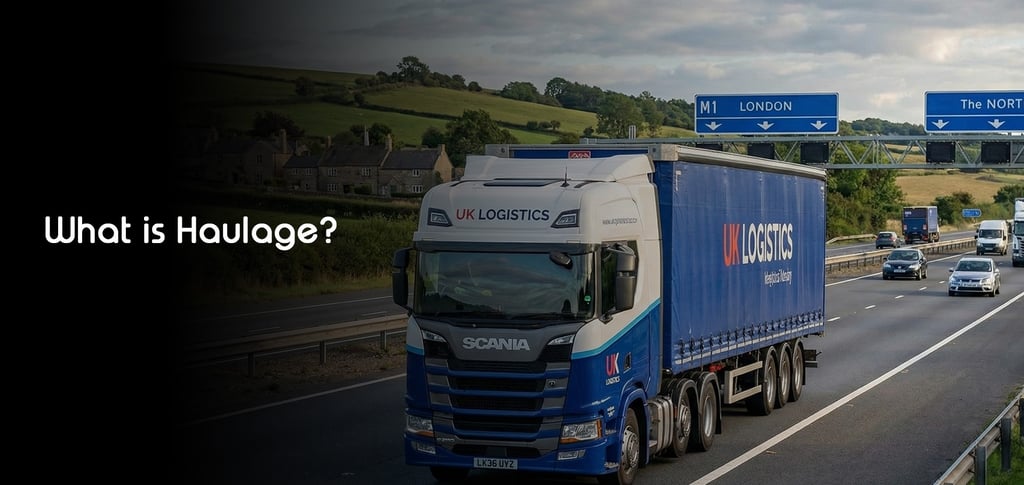
Haulage refers to the commercial transport of goods—usually in bulk—by road or rail. In the UK, the term is almost exclusively used to describe Road Freight Transport using Heavy Goods Vehicles (HGVs). Learn more about What is HGV?
Key Characteristics:
Scale: It deals with large loads (pallets, shipping containers, machinery), not individual parcel couriers.
Infrastructure: It relies on a network of distribution centers (RDCs), ports, and motorways.
Execution: It is the operational act of moving cargo from one Point to another.
Haulage vs. Logistics: What is the difference?
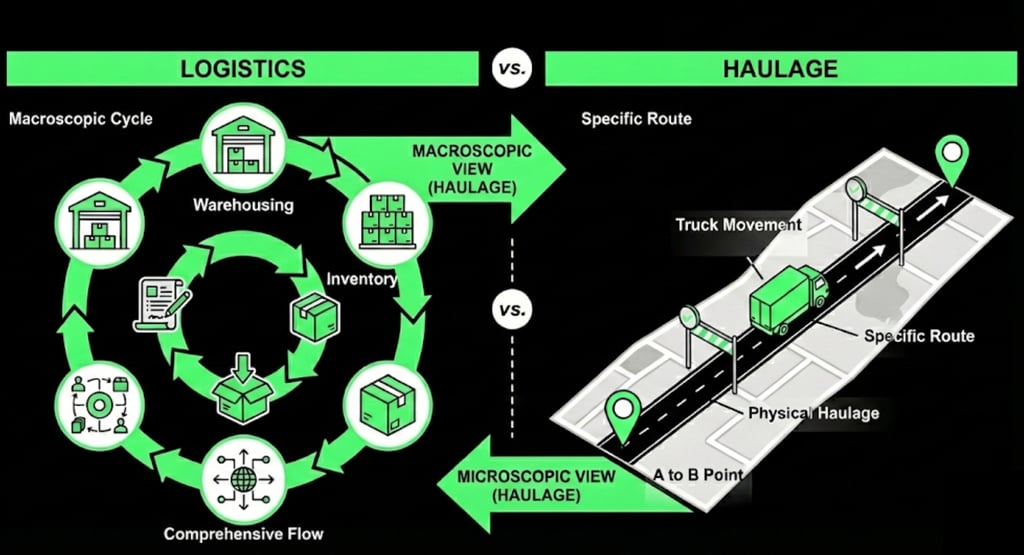
Haulage is the physical transportation of goods, primarily focused on execution tasks such as driving, loading, and vehicle maintenance. Logistics, on the other hand, is the broader management of the entire supply chain flow, encompassing strategic elements like inventory management, warehousing, packaging, and data analysis. Essentially, Haulage acts as 'The Wheels, ' responsible for moving the load, while Logistics serves as 'The Brains, ' deciding why and when it moves. Although it is common to confuse the two, they are distinct disciplines.
Major types of haulage services
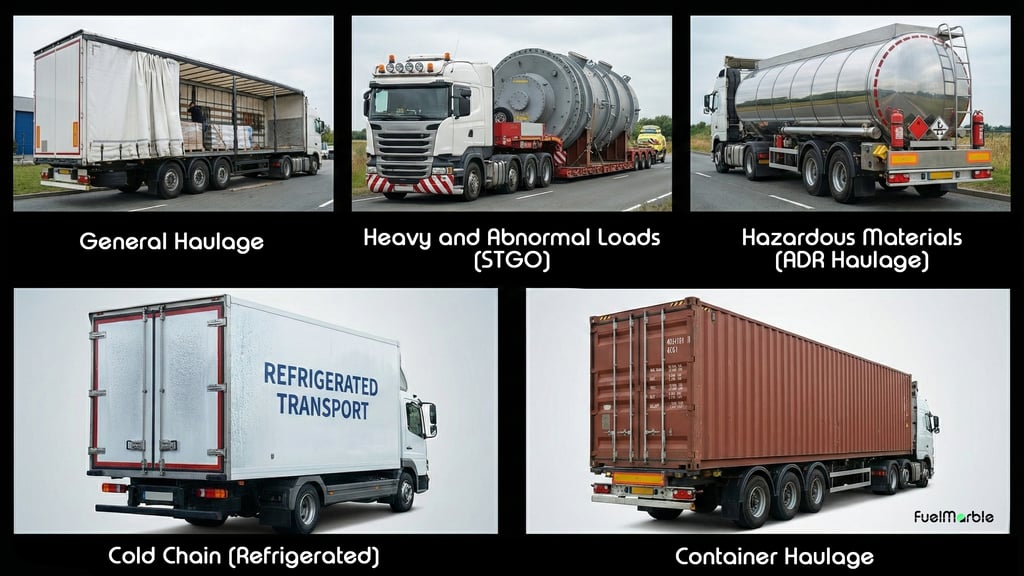
Haulage is highly specialized. The vehicle and license required depend entirely on the cargo.
General Haulage
The most common form of transport for non-hazardous commercial goods (retail stock, textiles, building materials).
Vehicles: Curtain-siders (tautliners) and box vans.
Capacity: Typically up to 44 tonnes Gross Vehicle Weight (GVW).
Operations: Relies on "backloads" (return loads) to maximize efficiency and reduce empty running. Additionally, equipping trucks with Japanese fuel efficiency boosters for large vehicles and fleets helps offset the high fuel consumption typical of these 44-tonne operations.
Heavy and Abnormal Loads (STGO)
Known as "Abnormal Loads," this covers cargo exceeding standard legal dimensions (over 44,000kg, 2.9m width, or 18.65m length).
Examples: Wind turbine blades, bridge sections, heavy plant machinery.
Regulation: Governed by the Special Types General Order (STGO).
Complexity: Often requires police notification, private escorts, and route surveys.
Hazardous Materials (ADR Haulage)
Transporting dangerous goods requires compliance with ADR Regulations (European Agreement concerning the International Carriage of Dangerous Goods by Road).
Classes: Explosives, gases, flammable liquids, and corrosives.
Safety: Drivers must hold a valid ADR Licence and vehicles must carry specific safety equipment (spill kits, fire extinguishers) and orange hazard plating.
Cold Chain (Refrigerated)
The transport of temperature-sensitive goods where an unbroken "cold chain" is vital.
Sectors: Supermarkets (fresh food), Pharmaceuticals (vaccines).
Tech: Vehicles ("Reefers") use active cooling units and telematics to monitor temperature in real-time.
Container Haulage
Container Haulage is the link between global shipping and domestic roads.
Hubs: Ports like Felixstowe, Southampton, and London Gateway.
Equipment: Skeletal trailers with twist-locks designed to carry 20ft and 40ft intermodal containers.
State of the market: 2025 data & 2026 outlook for haulage sector
The UK haulage sector enters 2026 in a "high-compliance, low-margin" environment. Below are the finalized statistics from 2025 defining the current landscape.
Key statistics
Freight Volume Recovery: UK port freight tonnage recovered in the rolling year to September 2025, reaching 426.1 million tonnes (+2%). This growth was driven largely by a 34% surge in container traffic and strong Ro-Ro (Roll-on/Roll-off) figures, despite a 13% drop in liquid bulk. [Source: Department for Transport (DfT): Port Freight Quarterly Statistics: July to September 2025. (Released Dec 2025).]
Green Growth: Registration of zero-emission HGVs (eHGVs) quadrupled in Q3 2025, reaching a record 2.4% market share. While eHGVs are gaining traction, many fleets are also focusing on immediate emission reduction results through retrofitted technologies to meet sustainability targets before full fleet renewal. [ Source: Hatmill / Opus Business Advisory: Transport Cost Management & Insolvency Report 2025.]
Profit Margins: Financial pressure remains intense. According to the RHA Cost Movement Survey (2025), average pre-tax profit margins are hovering around a critically thin 2%. This leaves operators with almost no buffer for error. Consequently, implementing 5 guaranteed ways to boost fleet fuel efficiency in 2025 has moved from a "nice-to-have" to a financial necessity. [Source: Road Haulage Association (RHA): Annual Cost Movement Survey 2025 & Cost Tables 2026. (Costs +5.91%, Margins ~2%).]
Operating Costs: The cost of running a truck continues to outpace inflation. The RHA reports that operating costs (excluding fuel) rose by 5.91% entering 2026, driven by higher insurance premiums, tyre costs, and vehicle maintenance.
Critical challenges for 2026
1. The "Progressive Safe System" (London DVS)
As of May 4, 2025, the grace period for London’s Direct Vision Standard (DVS) ended. [ Source: Transport for London (TfL): Direct Vision Standard (DVS) Phase 2 Grace Period Deadline (May 4, 2025). ]
The Rule: All HGVs over 12 tonnes entering Greater London with a 0–2 star rating must have the Progressive Safe System (PSS) fitted.
The Consequence: Non-compliant trucks now face immediate Penalty Charge Notices (PCNs). For 2026 operations, PSS compliance is a mandatory barrier to entry for London logistics.
2. The structural driver shortage
The workforce crisis has deepened. According to Logistics UK, the active HGV driver workforce contracted by 1.9% to approximately 293,700 at the start of 2025. [ Source: Logistics UK: Skills and Employment Report 2025.]
Demographics: With the average driver age exceeding 51, the industry faces a "retirement cliff."
The Gap: A shortfall of approximately 40,000–60,000 drivers persists, driving up wage costs and recruitment difficulties.
How to choose a haulage partner?
To select a haulage partner in 2026, follow this prioritization hierarchy:
Prioritize Reliability and Protection: Start by verifying they hold a valid Operator’s Licence and comprehensive Goods in Transit (GIT) insurance (covering current cargo value under RHA conditions).
Assess Industry Compliance: Look for FORS Silver/Gold accreditation, which is now critical for compliance with new DVS rules regarding urban and construction deliveries.
Evaluate Stability & Value: Rather than seeking the cheapest option, check their credit stability to guard against failure (vital given tight 2% margins).
Confirm Sustainability: Ensure they operate Euro VI or electric fleets to avoid passing on ULEZ/CAZ charges in major cities.
The Future: Haulage trends to watch in 2026
The industry is pivoting toward sustainability and efficiency.
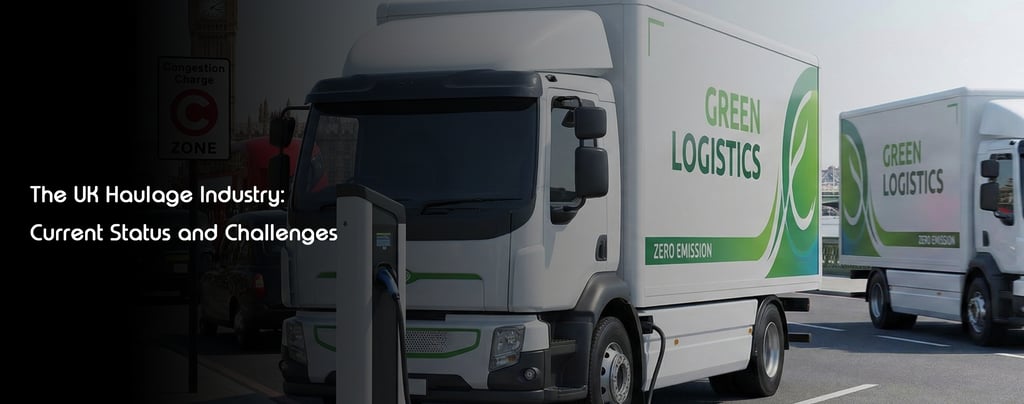
Electric Transition: With the 2035/2040 diesel bans looming, more fleets are trialing electric trucks for "last-mile" and regional work.
Hydrogen Trials: For heavy, long-haul transport, hydrogen fuel cell pilots are expanding under the government's ZERFD program.
CBAM Preparation: The Carbon Border Adjustment Mechanism legislation is finalizing. By 2027, importers will need rigorous carbon data; smart hauliers are setting up these reporting frameworks in 2026.
Combustion Tech: Aftermarket devices like FuelMarble enhance thermal stability to reduce fuel burn.
AI Routing: Algorithms that consolidate loads to reduce "empty running" miles.
Automation: While fully autonomous trucks are years away, "Platooning" (convoys of wirelessly linked trucks) and Level 2 driver-assist systems (lane keeping, auto-braking) are already improving safety and reducing fatigue.
Summary
Haulage remains the lifeblood of the UK economy. However, 2026 will be a year where only the most efficient, compliant, and technologically advanced operators thrive. Whether you are a shipper or a haulier, understanding these shifts—from DVS compliance to the electric transition—is essential for success.
Frequently Asked Questions about Haulage
Designed to Go Further
Contact
FuelMarble © 2026. All rights reserved.


Delivery
Household
Marine
FuelMarble, 124 City Road, London, EC1V 2NX