
The Ultimate Haulage Terminology Guide 2026
HAULAGE INSIGHTS
Sienna Vance
12/31/20258 min read
What is the difference between Haulage and Trucking?
The main difference between haulage and trucking is geographical: 'Haulage' is used in the UK/Ireland, while 'Trucking' is the standard term in the US and Australia.:
Haulage (UK & Ireland): Refers to the business of transporting goods. Drivers work for "haulage companies" or "hauliers." The term covers everything from local vans to long-distance heavy transport.
Trucking (US, Canada, Australia): The standard term in North America and Oceania. Drivers are "truckers" and work for "trucking companies" or "carriers."
What is the difference between a Lorry and a Truck?
Lorry is the specific British term for a large vehicle intended for transporting goods. Truck is the American (and international) standard.
UK: Lorry (Large commercial vehicle), Truck (Can refer to smaller pickups or be used interchangeably).
US/Canada/Australia: Truck (Universal term).
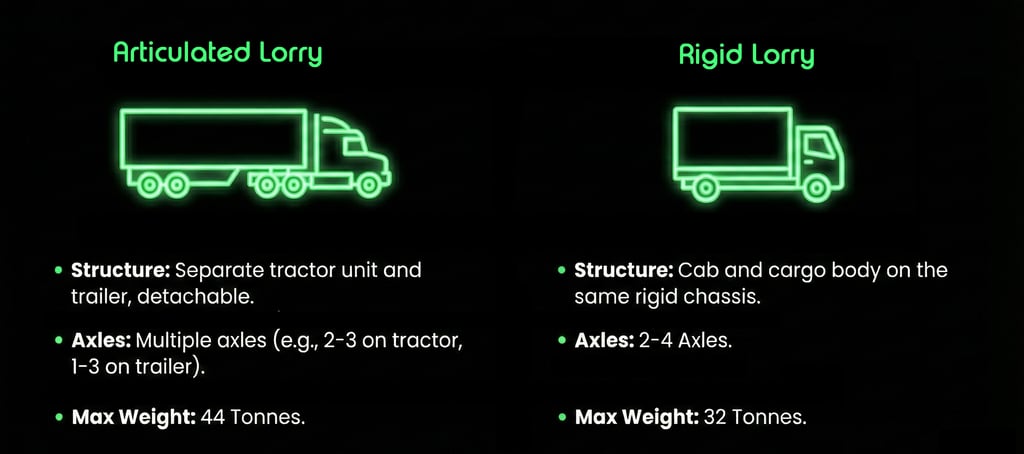
What are an Articulated Lorry (Artic) and a Rigid Lorry, and what is their difference?
An articulated lorry (or "artic") is a tractor unit with a detachable semi-trailer. The two parts are connected via a pivoting joint.
US: Semi-truck, Tractor-Trailer, or 18-Wheeler
Australia: Prime Mover with a semi-trailer
A rigid lorry is a truck where the cab and the cargo area are fixed onto the same chassis (one solid unit).
US: Straight Truck or Box Truck
What is an HGV?
HGV stands for Heavy Goods Vehicle. It is the official UK and EU classification for any truck with a gross weight exceeding 3.5 tonnes. Because these vehicles consume significant resources, operators often utilize specific fuel efficiency boosters for large vehicles and fleets to maintain profitability. You may also see the term LGV (Large Goods Vehicle). In modern UK licensing, LGV and HGV are interchangeable, though HGV is the commonly spoken term.
US: Heavy Duty Truck (Class 7 or 8, typically over 26,000 lbs GVWR).
Australia: Heavy Vehicle (over 4.5 tonnes).
In the world of haulage (the UK term for freight transport by road), grasping key terminology is crucial as the industry becomes increasingly global. A term used in one country can mean something entirely different in another.
This comprehensive guide answers the most common questions about haulage terminology, focusing on UK terms and their equivalents in the US, Canada, Australia, and Ireland. If you are looking for a broader strategic overview of the industry beyond just definitions, you might want to explore our complete guide to UK haulage and logistics alongside this glossary.
Key Takeaways: 2026 Guide:
Geography Dictates Terminology: "Haulage" and "Lorry" are standard in the UK & Ireland, while "Trucking" and "Truck" are used in the US, Canada, and Australia.
Vehicle Configurations: An "Artic" (UK) is equivalent to a "Semi-Truck" (US) or "Prime Mover" (Aus), whereas a "Rigid" lorry is known as a "Box Truck" or "Straight Truck" internationally.
Weight Limits Matter: Confusing GVW (current laden weight) with GVWR/MAM (maximum legal weight rating) is a common cause of fines; always know the difference.
Compliance Tools Vary: Fatigue management is tracked via Tachographs in the UK/EU and ELDs (Electronic Logging Devices) in North America.
Global Engine Standards: While emission fluids are universal, they have different names: it is AdBlue in Europe/Aus and DEF (Diesel Exhaust Fluid) in the US.
What are B-Doubles and Road Trains?
These are specific high-capacity vehicle configurations, primarily found in Australia.
B-Double: A prime mover (tractor) pulling two semi-trailers connected by a B-coupling.
Road Train: A massive combination of a tractor unit pulling three or more trailers. Common in the Australian Outback but illegal in the UK and most of the US (except for specific "Triples" allowed in some western states).
Key Engine Terminology: What is combustion, 4-stroke cycle?
In the world of haulage, you don't need to be a mechanic to manage a fleet, but understanding the core terms is useful. Most HGVs and Semi-trucks rely on Internal Combustion Engines (ICE). Here are the terms you will hear most often:
Combustion: Simply put, this is the process of burning fuel to release energy. Unlike petrol cars, diesel truck engines use highly compressed hot air to ignite the fuel without a spark plug.
4-Stroke Cycle: This is the standard operating rhythm of a commercial truck engine. You may hear mechanics refer to the four stages: Intake, Compression, Power, and Exhaust. This cycle is repeated thousands of times per minute to turn the wheels.
Intake (Breathing In): The piston moves down, creating a vacuum that sucks air into the cylinder.
Efficiency Note: Restrictions here (dirty filters) starve the engine of oxygen.
Compression (Squeezing): The piston moves up, compressing the air tightly. This friction heats the air to over 500°C.
Combustion ( The Power Stroke):
Diesel is injected into this super-heated air.
Ignition: It explodes instantly without a spark plug.
Expansion: This is where the magic happens. The expanding gases force the piston down with immense power.
Optimization: This is a critical stage where advancements are made. For instance, understanding how fuel enhancement technology works reveals how improving the chemical reaction ensures the fuel burns completely and evenly to maximize the downward force rather than being wasted as soot.
Exhaust (Breathing Out): The piston moves up again, pushing the burnt gases (Carbon Dioxide and particulate matter) out of the tailpipe. Managing these outputs is crucial for environmental compliance, and you can see tangible emission reduction results when combustion is optimized upstream.
What is the difference between GVW and GVWR?
Misunderstanding these acronyms can lead to fines or safety hazards.
GVW (Gross Vehicle Weight): The actual weight of the vehicle and its load at a specific moment in time. In the UK, this is often referred to as the vehicle's laden weight.
GVWR (Gross Vehicle Weight Rating): The maximum weight the vehicle is certified to weigh by the manufacturer. You cannot legally exceed this number. In the UK/EU, this is often called the MAM (Maximum Authorised Mass).
Who rules the roads? International Regulatory Bodies and Compliance
If you operate internationally, you must be aware of the entity that enforces the rules.
United Kingdom (UK)
DVSA (Driver and Vehicle Standards Agency): The body responsible for road safety, HGV testing (MOTs), and roadside enforcement.
Road Haulage Association (RHA): Offers legal interpretation of haulage regulations, industry-standard terminology guidance, and operator-focused training and compliance resources.
Logistics UK: Represents logistics operators across road, rail, sea, and air. Its terminology guides and policy documents are widely referenced across the UK and EU logistics sector.
Fleet Operator Recognition Scheme (FORS): A voluntary accreditation scheme that is increasingly recognised across international supply chains as a benchmark for fleet safety, environmental performance, and operational excellence.
O-Licence: The "Operator’s Licence" required to run a commercial haulage business.
United States (US)
FMCSA (Federal Motor Carrier Safety Administration): The agency regulating the trucking industry.
Australia
NHVR (National Heavy Vehicle Regulator): The centralized regulator for all vehicles over 4.5 tonnes GVM.
Electronic Work Diary: The Australian equivalent of an ELD for fatigue management.
What is Axle Weight, Tare Weight, Payload, Ton, and Tonne?
Axle Weight: This is the weight transmitted to the road by all wheels on a single axle. UK guidance defines axle weight as “the total weight transmitted to the road by all wheels on one axle”.
Every country has maximum axle load limits to protect infrastructure.Example limits:
• US: up to 17,000 lbs (single axle, federal standard)
• EU/UK: up to 10 tonnes for freight vehicles
When loading, operators must consider both gross vehicle weight and axle weight, as even legal total loads can cause violations if too much weight is borne on one axle.
Tare Weight / Unladen Weight: This is the empty weight of the vehicle, without cargo or passengers.
In the UK, the legal term is unladen weight, as defined by GOV.UK.
In the US, it's often called curb weight (for cars) or tare (for trucks).
This figure is crucial for calculating payload capacity.
Payload: The difference between a vehicle’s GVW and its unladen weight is the payload — the actual weight of the cargo being transported.
Example: A truck with GVW of 18 tonnes and unladen weight of 10 tonnes has an 8-tonne payload capacity.
Ton vs. Tonne: Don’t confuse metric and imperial units:
UK/EU: 1 tonne = 1,000 kg = approx. 2,204 lbs (used for all commercial vehicle specs)
US: 1 short ton = 2,000 lbs = approx. 907 kg (common in freight weight discussions)
Long Ton (historical UK): 2,240 lbs (~1,016 kg), largely phased out in commerce
Canada and Australia both officially use metric tonnes, though local vernacular (e.g. "ton") may vary in casual use
Always confirm which unit is being used, especially in cross-border contracts, as 44 tonnes in the UK equals roughly 48.5 US short tons.
What is Tachograph, ELD, HOS, CPC, O-License, DOT?
Monitoring driver fatigue is a crucial aspect of commercial transport. While rules exist globally, the tools vary by region.
Tachograph (UK/EU): In these regions, tachographs record a driver’s activity, including driving and rest times, becoming standard since the mid-2000s. Drivers refer to this as “my tacho,” though the term is not used in North America.
O-Licence: The "Operator’s Licence" required to run a commercial haulage business.
ELD (US/Canada): Mandated in 2017, ELDs replaced paper logbooks for interstate drivers. These devices track engine data and ensure Hours of Service (HOS) compliance. Drivers might call them “e-logs.”
Hours of Service (HOS): Refers to driver time regulations, with specific limits differing between the US and UK/EU. Each enforces fatigue management uniquely.
Driver CPC (UK/EU): Required certification for professional drivers in Europe, covering ongoing training, unlike the US's Entry-Level Driver Training.
MOT (UK): All HGVs must pass an annual MOT (Ministry of Transport) test to be legally operated on UK roads. It checks mechanical safety, emissions, and compliance with roadworthiness standards. The MOT is a cornerstone of the UK's vehicle inspection regime.
DOT Inspection (US): In the United States, commercial trucks must undergo an annual DOT inspection, conducted by certified inspectors to ensure the vehicle meets federal safety regulations. While not called an MOT, it serves the same purpose—enforcing road safety compliance.
Provincial Inspections (Canada): In Canada, vehicle inspection rules are handled by provinces. Most require annual or semi-annual inspections for heavy vehicles, with certificates often referred to as Safety Inspection Stickers.
State-Based Inspections (Australia): Australia enforces vehicle inspections at the state level. For example, NSW and Victoria require annual or periodic inspections for certain heavy vehicles, while other states may apply different intervals. Inspections ensure roadworthiness and compliance with NHVR standards.
ADR (UK/EU): The ADR certificate is required for drivers transporting dangerous goods by road in the UK and EU. It refers to the European Agreement concerning the International Carriage of Dangerous Goods by Road. Drivers must pass training and hold documentation proving their qualification.
Hazmat Endorsement (US): In the United States, transporting hazardous materials requires a Hazmat Endorsement on a CDL (Commercial Driver’s License). Drivers must undergo a background check, pass a knowledge test, and follow strict labelling and documentation procedures.
TDG Certification (Canada): Canada’s Transportation of Dangerous Goods (TDG) regulations govern the handling and movement of hazardous materials. Drivers must complete TDG training and carry certificates proving compliance when transporting regulated substances.
Dangerous Goods Licence (Australia): In Australia, the transport of dangerous goods is regulated by state authorities under a national framework. Drivers must hold a Dangerous Goods Driver Licence, complete certified training, and carry appropriate paperwork while operating.
Haulage Terminology Glossary


Frequently Asked Questions about Haulage Terminology
Designed to Go Further
Contact
FuelMarble © 2026. All rights reserved.


Delivery
Household
Marine
FuelMarble, 124 City Road, London, EC1V 2NX