Haulage Costs Are Rising: The Real Reason Your Fuel Bill Keeps Growing — and What to Do About It
Page Summary
Fuel is the second-largest operating cost in UK haulage — and the one with the most available margin for improvement. This article provides the cost structure context behind the complete guide to how UK fleet managers actually cut diesel costs. While driver costs, insurance, and compliance expenses are largely fixed in the short term, fuel efficiency is directly controllable through the thermal management of the combustion process — the core subject of our diesel fleet fuel efficiency guide for UK operators.
UK haulage operators are facing a compound cost environment. Driver employment costs continue rising with HGV driver shortages and minimum wage increases. Insurance premiums climb with vehicle complexity and claims history. Euro VI compliance adds aftertreatment maintenance to the bill. And fuel — despite short-term price movements — shows a long-term upward structural trend.
Most fleet operators respond by negotiating fuel contracts, monitoring idling, and training drivers in eco-driving techniques. These are real levers — but none of them address the largest single source of waste in the system: the gap between the theoretical energy in the fuel and the mechanical energy that actually reaches the wheels.
This article opens that gap and shows what can be done about it.
The Full HGV Cost Structure: Where the Money Actually Goes
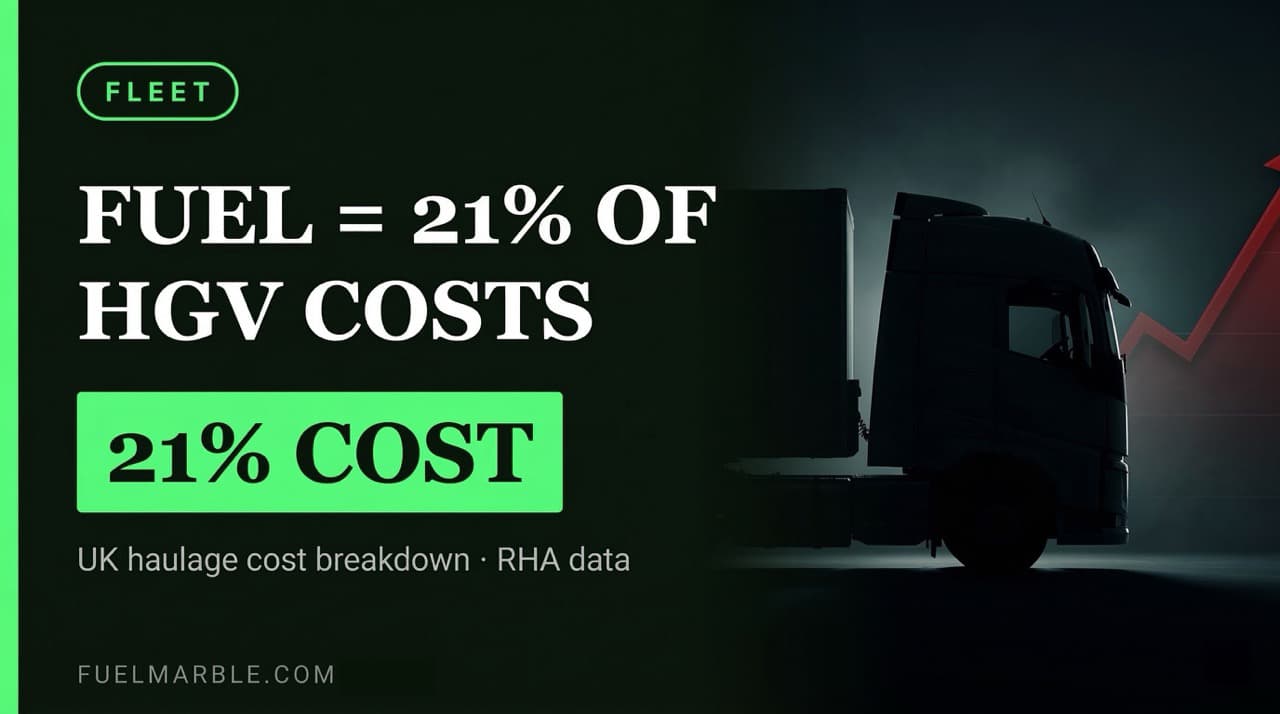
Understanding the haulage cost problem starts with understanding where costs actually sit. The pie chart below shows the approximate cost share for a 44-tonne HGV based on RHA Cost Tables 2026 data.
Hover slices · click legend to toggle
Approximate split based on RHA Cost Tables 2026 data.
That 21% is directly reducible — a coolant-based combustion device verified to cut diesel consumption by 10–22% across HGV and fleet applications addresses the thermal waste that fuel cards and driver training cannot touch.
The cost structure reveals two important facts:
For specific MPG and cost-per-mile benchmarks by vehicle class, the UK HGV fuel consumption benchmarks 2026 gives you the RHA 2024 baseline figures to compare your fleet against.
First, fuel (21%) is the largest variable cost in the fleet P&L. Driver employment (31%) is largely fixed once you have a driver — wages are what they are, and the driver shortage means reducing headcount is not a viable cost lever for most operators. Insurance, depreciation, finance, and overhead are also largely fixed in the short term.
Fuel is the exception. It varies with every kilometre driven — and, critically, it varies with how efficiently each kilometre is driven in a thermal sense.
Second, the combination of maintenance and fuel (31% together) represents the most controllable combined block. Reducing fuel consumption through improved combustion also reduces the soot load reaching the DPF, which reduces active regeneration frequency, which reduces the additional fuel burned during regeneration cycles (1–3% per regen event). Fuel efficiency improvement and DPF maintenance reduction are the same intervention — they compound.
Why Your Fuel Bill Keeps Growing
Haulage operators often observe that their fuel costs grow even in years when pump prices are stable or declining. There are three structural reasons for this.
Reason 1 — Combustion efficiency degrades over time. Engine components wear. Injectors develop inconsistencies. EGR valves accumulate carbon deposits. The combustion process that was at factory specification on day one gradually becomes less efficient. A vehicle consuming 3% more fuel than its specification is costing money on every kilometre, but the signal is buried in fleet averages and monthly fuel invoices.
Reason 2 — Thermal efficiency is invisible in the P&L. The gap between the theoretical energy in diesel and the mechanical energy reaching the wheels — roughly 55–60% waste in a diesel engine — does not appear as a line item. It appears as the fuel bill itself. The fuel bill is treated as a given, when in fact a significant portion of it is recoverable.
Reason 3 — Diesel prices trend upward structurally. Short-term price movements obscure the long-term trend. Fleet operators who have run the same routes with the same vehicles over five or ten years consistently find their fuel bills growing even in periods of price stability, because volume increases or efficiency degradation compounds the base cost.
The solution to all three is the same: improve the thermal efficiency of the combustion process so that each litre of diesel produces more useful work.
The Fastest Lever: Why Combustion Efficiency Beats Every Other Option
Fleet operators typically reach for several cost-reduction levers before addressing combustion efficiency:
| Lever | Typical saving | Speed | Limitations |
|---|---|---|---|
| Fuel contract negotiation | 1–3p/L | Slow (months) | Supplier relationship risk |
| Driver eco-training | 3–5% | Medium | Behaviour, not engineering |
| Route optimisation | 2–8% | Medium | Constrained by delivery requirements |
| Vehicle replacement (Euro VI) | 10–20% MPG vs older | Slow (years, high CAPEX) | Capital cost, depreciation |
| Combustion improvement (FuelMarble) | 10–22% | Fast (days) | None (no modification required) |
Combustion improvement through FuelMarble can be applied to every vehicle in an existing fleet immediately, without capital expenditure on new vehicles, without renegotiating supplier contracts, and without depending on driver behaviour change.

The documented efficiency gains — 18–22% in field testing, 10% used as a conservative base case for ROI calculations — exceed what most operators achieve through any other single intervention. And because FuelMarble's mechanism is thermal rather than chemical, it compounds with other improvements rather than replacing them.
The Thermal Waste Problem: Where 55% of Your Fuel Disappears
A diesel engine at peak efficiency converts approximately 40–45% of the fuel's chemical energy into forward motion. The remaining 55–60% leaves as waste heat — primarily through the exhaust (approximately 40% of total fuel energy) and through the engine block itself (approximately 20%).
One of the primary mechanisms responsible for this waste is the thermal boundary layer — a thin vapour film that forms between the coolant and the metal engine wall when the coolant's surface tension is too high. This film insulates the engine wall from direct contact with liquid coolant. Heat builds up in the cylinder wall rather than transferring efficiently to the coolant circuit.
The consequence is a cascade:
- Hotter engine wall → hotter incoming charge air
- Hotter charge air → less dense air (fewer oxygen molecules per stroke)
- Less dense charge air → less complete combustion (more unburned fuel exits as HC in exhaust)
- Less complete combustion → more fuel required for the same power output
Addressing the thermal boundary layer addresses the root of this cascade — not the symptoms.
Addressing the thermal waste gap at source — rather than through purchasing or behavioural interventions — is possible through a coolant-based combustion device that permanently improves heat transfer efficiency across every engine in your fleet, with verified savings of 10–20% and payback in under 32 days on a 44T HGV.
FuelMarble's Impact on the Haulage Cost Structure
FuelMarble is placed in the coolant reservoir. Its ultra-hydrophilic mineral surface (contact angle: 4°, measured at Kurume Institute of Technology) reduces the coolant's surface tension, eliminating the thermal boundary layer at the engine wall.
The measured outcomes:
- 8–12°C reduction in cylinder head temperature (Kurume Institute data)
- ~7% increase in water viscosity (measurable change in coolant behaviour)
- 18–22% fuel efficiency improvement in field testing across multiple vehicle types
For a 44-tonne HGV covering 150,000 km per year:
| Fuel spend | FuelMarble saving (10%) | Saving (18%) |
|---|---|---|
| £60,000/year | £6,000/year | £10,800/year |
| £80,000/year | £8,000/year | £14,400/year |
| £100,000/year | £10,000/year | £18,000/year |
FuelMarble L for an HGV is £519 per unit. At a conservative 10% efficiency gain on a £60,000 fuel bill, payback occurs in approximately 32 days. After payback, every pound saved is net operating profit.
For fleet-specific calculations, use the FuelMarble fuel calculator or see the fleet profitability guide for the full P&L analysis.
For context on how FuelMarble also reduces DPF maintenance frequency and aftertreatment costs, see the heavy-duty truck maintenance guide.
Conclusion: The Cost of Inaction Is Compounding
Haulage costs are rising structurally — but the response cannot be limited to renegotiating contracts and training drivers. Those levers are exhausted for most operators. The next frontier is the engine itself: specifically, the thermal efficiency of the combustion process that has been treated as fixed when it is, in fact, controllable.
The framework for taking control of fuel costs in a haulage fleet:
- Measure per vehicle, not per fleet — identify which vehicles are consuming more than their benchmark and why
- Address mechanical root causes — EGR valves, fuel injectors, Low-SAPS oil specification
- Manage operational factors — idling, tyre pressure, routing
- Improve combustion at the source — eliminate the thermal boundary layer, increase charge air density, capture the 10–22% efficiency available through better combustion conditions
Each step delivers more than the last. The fleet that completes all four is not just more efficient — it is structurally protected against the rising cost environment that every UK haulage operator is facing.
Related reading:
- Global Haulage Trends 2026
- The Complete Guide to UK Haulage and Logistics 2026
- 5 Guaranteed Ways to Boost Fleet Fuel Efficiency in 2026
- Is the UK Diesel Lorry Ban Real?
Calculate your fleet's potential saving — or shop FuelMarble for your HGV fleet.
Related Articles
Avery leads FuelMarble's UK operations and strategic direction. With a background spanning fleet economics, regulatory compliance, and macro fuel market trends, Avery oversees commercial partnerships, product positioning, and the company's growth across European markets.
Ready to Improve Your Fuel Efficiency?
FuelMarble delivers up to 15% fuel efficiency improvement. Simple drop-in install.