
Is the UK Diesel Lorry Ban Real?
Panic over the Diesel Lorry Ban? Don't be. We debunk the rumors, clarify government policy on new HGV sales, and outline the real timeline for UK hauliers.
HAULAGE NEWS
Sienna Vance
1/19/20263 min read
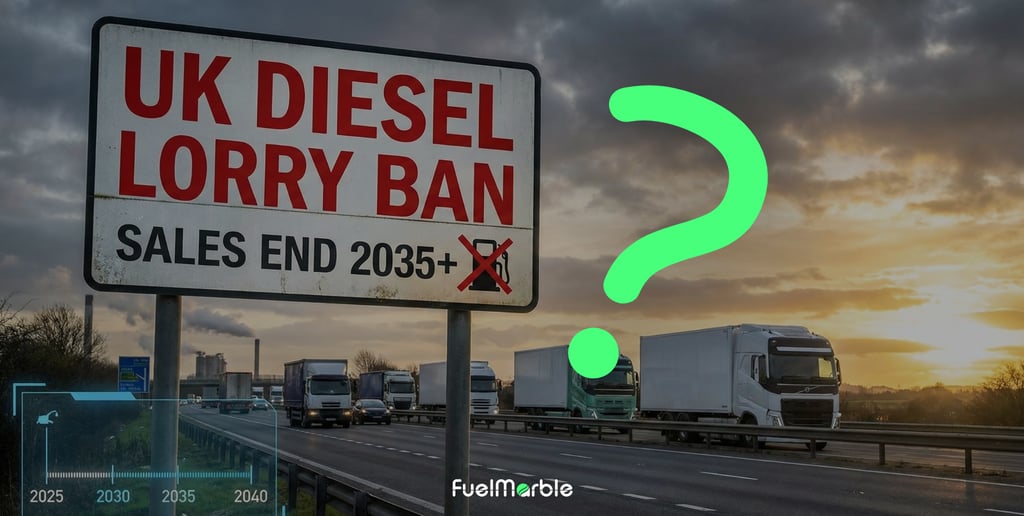
Recent media reports have triggered widespread alarm regarding a "total ban" on diesel lorries in the UK. However, a detailed review of government consultations and Road Haulage Association (RHA) policy papers confirms these claims are misleading.
There is no ban on existing diesel fleets.
The current legislative framework focuses solely on phasing out the sale of new fossil-fuel vehicles in the 2030s, prioritizing a "technology-neutral" transition over an immediate prohibition.
This guide clarifies the distinction between sensational headlines and actual logistics policy.
Is the UK government banning existing diesel lorries?
No, there is no immediate or retrospective ban on operating existing diesel lorries.
Current government proposals and consultations are strictly focused on setting a future end date for the sale of new petrol and diesel HGVs. Existing fleets are expected to remain legal and operational for many years to come, allowing for a gradual lifecycle replacement rather than a forced removal .
The Reality vs. The Headlines While outlets like The Sun and GB News have framed this as a sudden prohibition, the policy reality is much slower and more pragmatic.
The Claim: "Diesel lorries will be banned outright."
The Fact: The ban applies only to the sale of new units, likely phasing in during the late 2030s.
The Outcome: Operators do not need to scrap viable vehicles immediately.
What is actually being proposed for UK Haulage?
The government is consulting on a "Technology Neutral" transition timeline.
Instead of a hard stop, the Department for Transport is looking at a phased approach to Net Zero that encourages—but does not yet mandate—alternative fuels like hydrogen or battery electric vehicles (BEVs) . To fully understand how these proposals interact with broader industry shifts, it is helpful to review the complete guide to UK haulage and logistics in 2026, which breaks down the regulatory landscape in detail.
Key Policy Pillars:
Future Sales Only: Restrictions apply to the showroom, not the road.
Long Lead Times: The transition timeline stretches well into the 2030s.
Pragmatic Decarbonization: The RHA and other bodies emphasize reducing emissions through efficiency now, rather than waiting for perfect electric infrastructure.
Why are fleet operators worried about "Stranded Assets"?
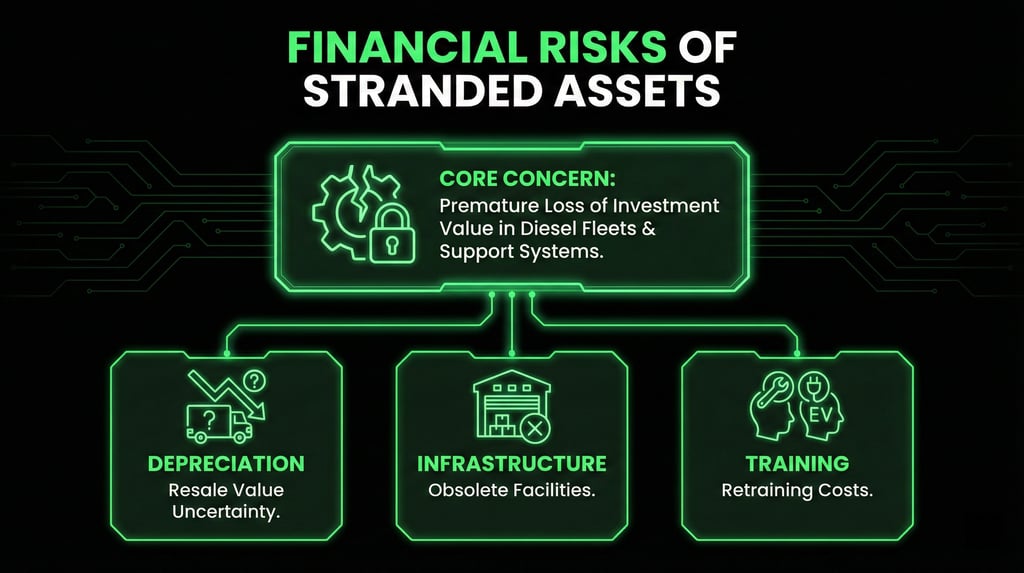
Operators fear their capital investments will lose value before their economic lifespan ends.
The anxiety in the sector is driven by the risk of stranded assets—compounded by the fact that haulage costs are rising globally—threatening the viability of long-term contracts priced based on traditional diesel economics.
The Financial Risks Include:
Depreciation: Will diesel trucks have resale value in 5 years?
Infrastructure: Wasted investment in diesel-specific workshops.
Training: The cost of retraining drivers for EV/Hydrogen systems.
Note: While these fears are valid, the current policy suggests that diesel infrastructure will remain necessary and valuable for at least another 15–20 years to service the legacy fleet.
How can fleets mitigate "Transition Risk" today?
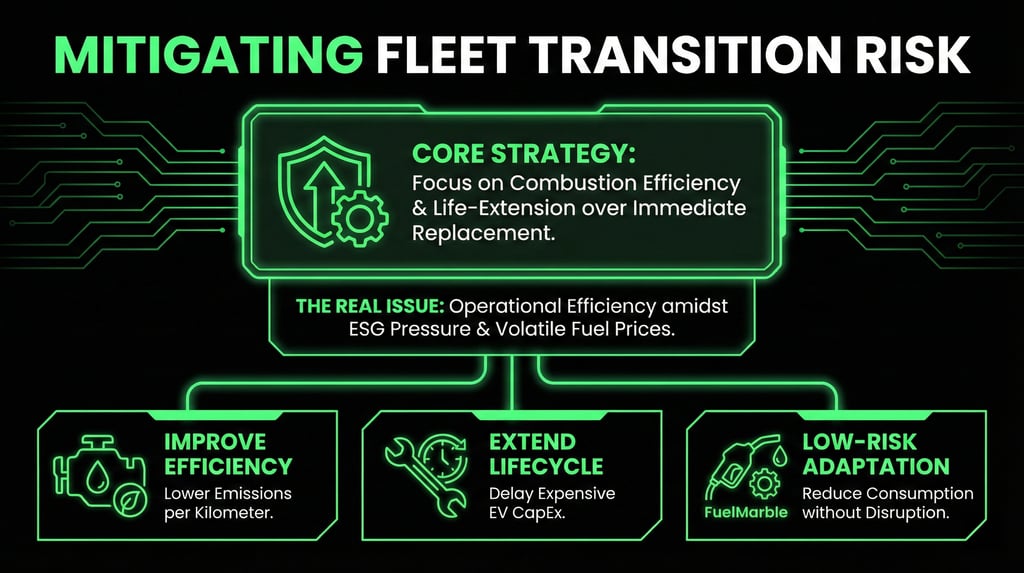
Focus on combustion efficiency and life-extension rather than immediate replacement.
The smartest move for operators right now is to ignore the "ban" rhetoric and focus on the real issue: operational efficiency. Increasing pressure from ESG requirements and volatile fuel prices means the risk isn't that diesel will be banned, but that inefficient diesel will become too expensive to run.
Actionable Steps for 2026:
Improve Efficiency: Implement proven strategies, such as those outlined in our article on 5 guaranteed ways to boost fleet fuel efficiency, to lower emissions per kilometer immediately.
Extend Lifecycle: Maintain existing assets to delay the need for expensive EV capital expenditure.
Low-Risk Adaptation: Solutions like FuelMarble allow fleets to reduce consumption without the disruption of switching fuel types entirely.
Strategic Pivot:
It is not about jumping straight to electric. It is about "buying time intelligently" by making your current diesel fleet as clean and cheap to run as possible.
Conclusion: Facts Over Fear
There is no overnight diesel lorry ban.
There is no forced replacement of your current fleet. However, the direction of travel is undeniably toward Net Zero. The operators who will thrive are those who stop reacting to sensationalist headlines and start optimizing their current assets for the long transition ahead.
Are you concerned about the efficiency of your current diesel assets?
Contact FuelMarble today for a grounded conversation on how to reduce your fuel spend and emissions without disrupting your operations.
Frequently Asked Questions about Diesel Lorry Ban
Designed to Go Further
Contact
FuelMarble © 2026. All rights reserved.


FuelMarble, 124 City Road, London, EC1V 2NX