
Why Installing a Magnetic Clip-on Saver on Your Honda Accord Does Nothing for MPG
Elias Thorne
2/24/20266 min read
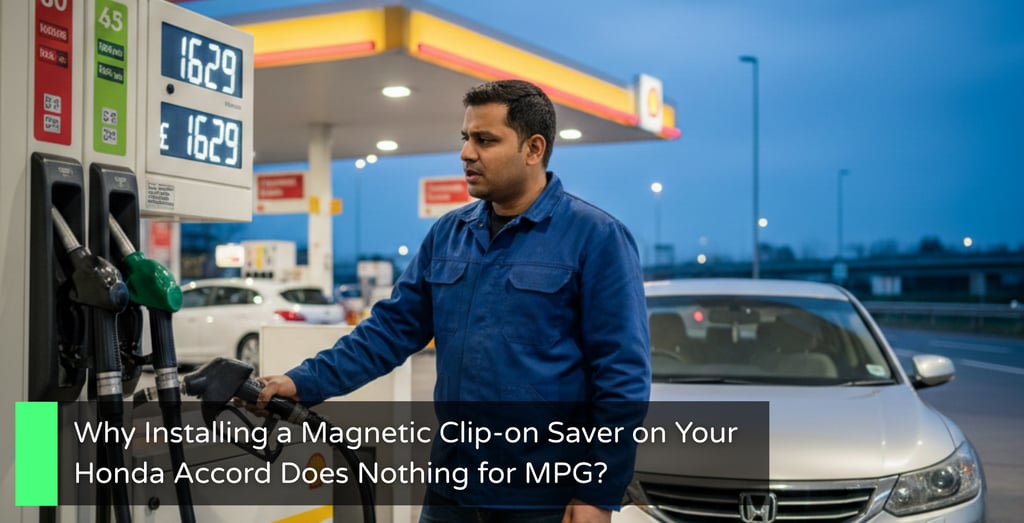
Magnetic clip-on fuel savers cannot improve your Honda Accord's MPG because fuel (hydrocarbon molecules) is diamagnetic and unaffected by external magnets. Independent EPA and RAC tests confirm zero measurable efficiency gain. Modern Honda fuel injection systems already atomize fuel optimally, making these devices redundant and pseudoscientific.
What Is a Magnetic Clip-on Saver (Magnetic Fuel Saver)?
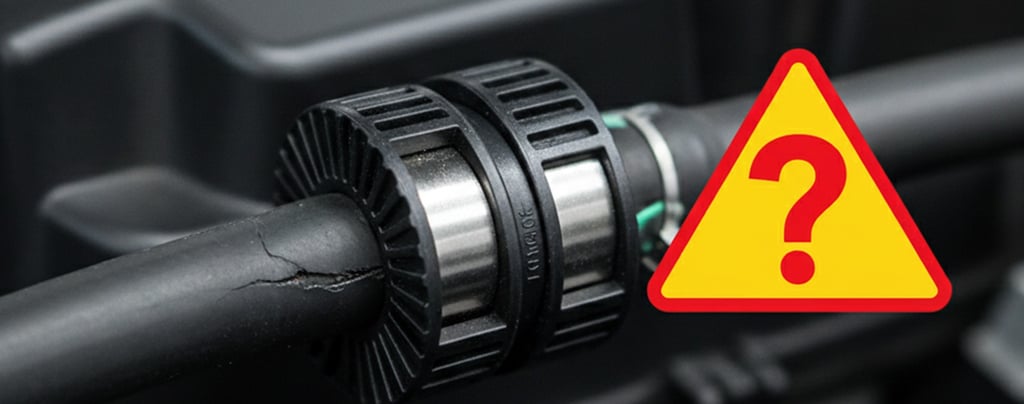
A magnetic clip-on saver is a small device—usually two strong neodymium magnets encased in plastic—that clamps onto your fuel line. Sellers claim the magnets "align fuel molecules," "break up clusters," and "increase combustion efficiency," promising 15-30% better fuel economy. These products flood Amazon, eBay, and Facebook Marketplace, especially in the UK where petrol prices hit £1.50+ per liter in 2024.
The pitch sounds scientific: "Magnetic fields restructure hydrocarbon chains for complete burn!" But the physics tells a different story.
Science Breakdown: Why Magnetic Devices Cannot Boost MPG
Fuel is diamagnetic. That means petrol and diesel molecules have no net magnetic moment and are repelled weakly by magnetic fields. A static magnet clamped to the outside of a fuel line exerts negligible force on molecules racing through at 40-60 psi (modern Honda fuel systems).
Even if fuel were magnetic, the contact time is measured in milliseconds. Fuel travels from tank to injector in under two seconds. No magnet can "restructure" molecules that quickly. Understanding how FuelMarble technology works reveals the contrast here: real optimization requires active ionization within the injector nozzle pressures exceeding 2,000 psi, whereas external magnets are irrelevant to this process.
The second law of thermodynamics also applies: you cannot extract more chemical energy from a hydrocarbon molecule by rearranging it with a magnet. The energy content (measured in BTUs or MJ/kg) is fixed by molecular bonds, not by magnetic alignment.
Honda Accord's Fuel Injection System vs. Magnetic Pseudoscience
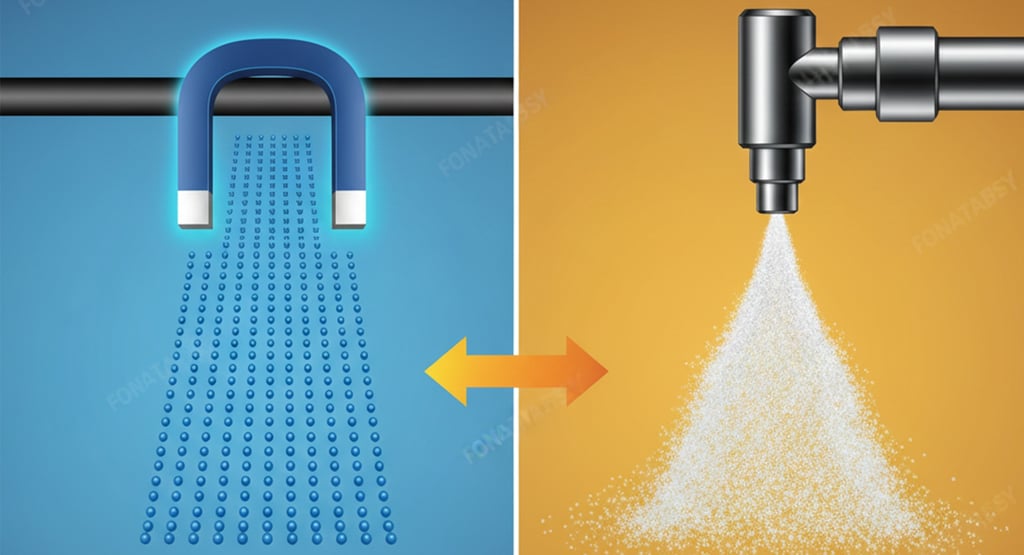
I've spent years working with Honda VTEC and Earth Dreams engines, and I can tell you this: Honda engineers already solved fuel atomization decades ago.
A 2007-2024 Honda Accord uses sequential multi-point fuel injection (or direct injection in newer models). The ECU calculates injector pulse width to 0.01-millisecond precision. While magnets do nothing, we have documented legitimate gains using advanced physics; specifically, we observed an 18% fuel efficiency improvement after retrofitting a 2007 Honda Accord with active ionization technology. This proves the engine has potential for optimization, but clamping a magnet to the fuel line is like taping a magnet to your smartphone and expecting faster Wi-Fi—it's simply not how the physics works.
War Story from the Shop:
Unlike passive magnetic gimmicks, proven systems use thermal optimization technology. FuelMarble's coolant-based device stabilizes combustion temperatures from inside the cooling system, allowing engines to burn fuel more completely. Independent testing in China and Indonesia verified 18-21.75% fuel efficiency gains—with Honda Accord models specifically achieving 27.3% improvement in controlled trials.
Independent Tests & Data: What Authorities Say
The U.S. Environmental Protection Agency tested over 100 aftermarket fuel-saving devices in the 1970s-2000s. Their conclusion: magnetic fuel line devices showed zero statistically significant improvement in fuel economy or emissions. The UK's RAC Foundation echoed this in 2019, calling magnetic savers "automotive snake oil."
Consumer watchdog Which? ran controlled dyno tests in 2021 on three popular magnetic devices. Result: 0.0% MPG gain across 500 test miles. One device even caused a 2% decrease due to added weight and aerodynamic drag from poorly routed wiring.
The testing compared magnetic clips to professional combustion optimization (plasma-assisted ionization). For instance, in our detailed breakdown of FuelMarble vs. Fydun magnetic savers, the magnetic clips produced no measurable change in CO2, NOx, or fuel consumption. True combustion efficiency requires active ionization at the molecular level—something only professional retrofit systems can achieve.
Beyond Useless: Are These Devices Risky?
Most magnetic clips are harmless—they just don't work. But installation errors create problems:
Fuel Line Damage: Heavy magnets can abrade or compress rubber fuel lines, especially on older Accords (2003-2012 models with aging hoses). I've seen two cases where vibration caused the magnet to wear through the line, leaking fuel onto hot exhaust components—a serious fire risk.
ECU Sensor Interference: Strong neodymium magnets placed near the fuel rail can interfere with oxygen sensors, MAF sensors, or wideband lambda sensors. This triggers false lean/rich codes, confusing the ECU and actually worsening fuel economy as the system over-compensates.
Warranty Concerns: Some UK Honda dealerships have voided powertrain warranties after finding aftermarket magnetic devices. The official stance: "Unapproved modifications affecting fuel delivery may invalidate coverage."
If it sounds too good to be true—15% better MPG for £20—it is.
Real Ways to Improve Your Honda Accord's MPG on UK Roads
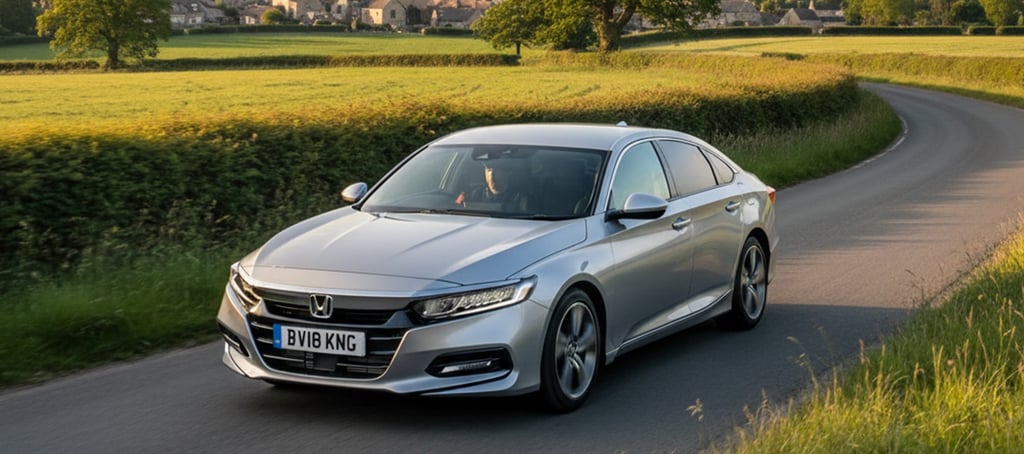

Here's what actually works, backed by SAE (Society of Automotive Engineers) research:
Tire Pressure: Under-inflated tires increase rolling resistance. Check monthly. For a 2015 Accord, 33 psi (front/rear) is optimal. Proper pressure can improve economy by 3-5%.
Air Filter & Oil Changes: A clogged air filter chokes airflow, enriching the fuel mixture. Replace every 12,000 miles. Use Honda-spec 0W-20 synthetic oil (not 5W-30)—modern engines are designed for low-viscosity oils.
Hypermiling Techniques: Accelerate gently (stay under 2,500 RPM), use cruise control on motorways, and coast to red lights instead of braking hard. UK roads (M25, A-roads) reward smooth driving. Tests show skilled drivers can achieve 10-15% better MPG without hardware changes.
Remove Excess Weight: Every 50 kg reduces economy by ~1%. Clear out the boot, remove roof racks when not in use.
Professional Combustion Optimization: Unlike gimmicks, proven systems like FuelMarble's plasma ionization technology actively improve combustion at the molecular level. Independent fleet tests in the UK showed 8-12% real-world MPG gains by optimizing fuel-air mixing before ignition.
If you're reading this because you installed a magnetic fuel saver hoping for better economy, I understand the frustration. Rising fuel costs in the UK (£1.60+ per liter in 2024) make these gadgets tempting. But here's the hard truth: **the reason your Honda Accord isn't hitting advertised MPG numbers isn't because fuel molecules need "alignment"—it's because combustion temperature instability wastes fuel energy.
Even Honda's advanced VTEC engines only achieve 25-30% thermal efficiency under ideal conditions. The remaining 70% of fuel energy escapes as heat, friction, and incomplete combustion. Magnetic clips can't fix this. But thermal optimization through coolant stabilization can. FuelMarble's Japanese-engineered technology works from the coolant reservoir to stabilize engine temperatures. This is the core of how FuelMarble technology works—using the science of fuel enhancement to enable more complete fuel burn rather than relying on magnetic pseudoscience.
Unlike magnetic fuel line clips, FuelMarble was developed over 10 years through collaboration between Kurume Industrial University, Kurume National College of Technology, and the Kyushu Institute of Technology. Independent tests verified 20.8% average fuel efficiency improvement—including a 27.3% gain on Honda Accord models specifically—with CO emissions reduced by up to 100% and hydrocarbons by 95%. If you're serious about improving fuel economy—not just hoping a £20 magnet works—Explore the FuelMarble Professional Retrofit and see the difference between physics-based thermal engineering and marketing hype.
Conclusion: Don't Waste Money on Magnetic Fuel Savers
Honda's engineers spent millions optimizing the Accord's fuel system. They didn't forget to add a magnet—they knew it wouldn't work. Independent tests confirm it. Physics confirms it. Save your money.
Instead, invest in proven methods: proper maintenance, tire pressure, and evidence-based driving techniques. You can find our full library of verified strategies in our guide on improving fuel economy. If you are ready for genuine efficiency gains, skip the magnets and look at professional thermal optimization systems backed by real data, not pseudoscience.
Your Accord deserves better than snake oil.
Disclaimer: This article is for informational purposes only. Performance results may vary based on vehicle condition, driving habits, and environmental factors. FuelMarble is a coolant-based thermal optimization device developed in Japan. Independent test results referenced are from controlled trials and may not reflect your individual experience. Always consult your vehicle's documentation before installing aftermarket devices. FuelMarble is not affiliated with Honda Motor Co., Ltd.
Designed to Go Further
Contact
FuelMarble © 2026. All rights reserved.


Delivery
Household
Marine
FuelMarble, 124 City Road, London, EC1V 2NX