
How to force a manual DPF regen on a Volvo FM?
Elias Thorne
2/25/202614 min read
A manual DPF regeneration on a Volvo FM requires the driver to park safely, engage the parking brake, select neutral, and activate the regen via the DRC-AMII rocker switch or DID menu system — then wait 20–45 minutes while the engine burns accumulated soot at temperatures exceeding 600°C. Getting this process right protects a component worth £2,000–£10,000 to replace and keeps the truck legally compliant under UK emissions law. Before reaching the stage of a forced regeneration, understanding the early warning signs can save thousands in replacement costs; our guide on the top 5 symptoms of a clogged DPF in Volvo FM trucks details exactly what to look for before the warning lights turn red. This guide covers every technical step, the UK-specific legal framework, safety protocols, troubleshooting data, and long-term maintenance strategies that fleet operators and drivers need.
Step-by-step procedure using the DRC-AMII switch and DID menus
The Volvo FM uses one of two interfaces depending on age and specification. Older models fitted with the DRC-AMII (Diesel Regeneration Control – Aftertreatment Management Inhibit/Initiate) system feature a dedicated non-locking rocker switch on the instrument panel. Pressing the lower portion of this switch initiates manual regeneration; pressing the upper portion inhibits automatic regeneration. The switch springs back to centre after each press.
On newer Volvo FM models with a fully digital Driver Information Display, the process runs through the DID menu system. The driver navigates using the right-hand stalk or steering wheel controls to Main Menu → Aftertreatment → Request Regeneration, then confirms with the Enter button. The DID then displays "REGEN In Progress." To cancel, the path is Aftertreatment → Cancel REGEN, and when regeneration is disabled the display shows an "ATS" icon with an X overlay.
The full initiation procedure is as follows:
Park the truck on a paved, non-combustible surface at least 15 metres from any flammable materials, buildings, other vehicles, low-hanging branches, or people.
Apply the parking brake firmly.
Select neutral on the gearbox (for automated transmissions, shift through drive to neutral, then set the park brake).
Confirm the engine has reached operating temperature — coolant must be at least 70–82°C. Short runs in cold weather may not achieve this.
Release the clutch pedal, brake pedal, and accelerator completely. All three must show zero input to the ECM.
Ensure PTO is disengaged and air conditioning is switched off (cooling fans can prevent the aftertreatment system reaching target temperatures).
Activate regeneration via the DRC-AMII switch (press lower portion) or navigate to Request Regeneration in the DID menu.
The engine RPM will automatically rise to approximately 1,100–1,400 RPM. A noticeable change in engine note and turbocharger whistle is normal.
Allow the process to complete without interruption. Do not leave the vehicle unattended.
When complete, the engine returns to normal idle speed (~600–700 RPM) and the DID confirms completion.
Any of these actions will immediately abort an in-progress regen: pressing the brake, clutch, or accelerator pedal; releasing the parking brake; pressing cruise control; or switching off the engine. Interrupted regenerations waste fuel and accelerate oil dilution — they should be avoided wherever possible.
Understanding soot levels, warning escalation, and when to act
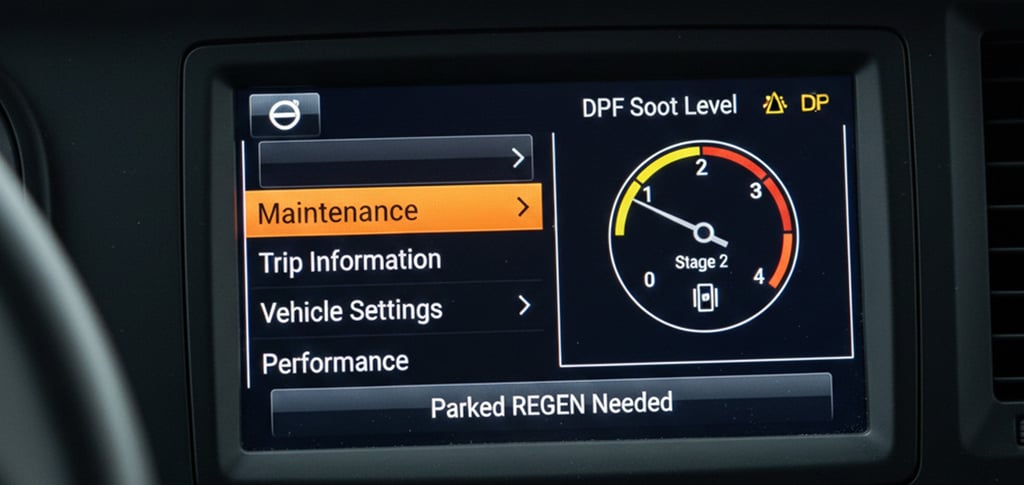
The Volvo FM displays soot loading through a gauge on the instrument cluster marked with positions A, 2, 3, and 4, each representing an escalating level of concern.
At position A, soot loading is low and the system manages regeneration passively during normal driving.
At position 2, the DPF warning lamp illuminates solid amber and the DID displays "Parked REGEN Needed" — the driver should perform a manual regen at the next safe opportunity.
At position 3, the warning lamp flashes amber and the truck must stop immediately for a parked regen to avoid engine derate.
At position 4, the DPF is critically plugged: parked regeneration is no longer possible, the engine enters severe derate (progressing from torque reduction to a 5 mph speed limit), and the vehicle requires professional workshop service.
Internally, Volvo uses a doubled percentage scale where 200% represents a fully face-plugged filter. The derate sequence follows a 120-minute warning, then a 30-minute warning with torque reduction, then the 5 mph crawl mode. On Euro 6 Volvo FM trucks, fault code P10FE00 signals critical soot accumulation. The key message for drivers is straightforward: never ignore an amber DPF lamp. Understanding the root causes, such as how a Volvo FM DPF becomes clogged after using cheap diesel, can help operators prevent these critical blockage scenarios before the window between "convenient regen" and "workshop recovery" closes.


What happens inside the engine during a 600°C burn cycle
During a parked regeneration, the ECM commands late post-injection of diesel fuel during the exhaust stroke. This unburnt fuel travels as vapour to the Diesel Oxidation Catalyst, where it ignites and raises the DPF substrate temperature to approximately 600–700°C (1,112–1,292°F). The tailpipe outlet temperature exceeds 525°C (977°F), which is why fire risk is the dominant safety concern during stationary regen. The process typically consumes roughly 2 litres of additional diesel over a duration of 20–45 minutes, though heavily loaded filters or cold ambient conditions can extend this toward 60 minutes. This fuel penalty adds up across a fleet, highlighting why boosting fleet fuel efficiency requires a strategy that minimizes these forced regeneration cycles.
The late post-injection mechanism that makes regeneration possible also creates the primary long-term risk: oil dilution. A portion of the late-injected fuel contacts cylinder walls as liquid, bypasses the piston rings, and washes into the sump. Research by Ito et al. (SAE 2019-01-2354) found that when post-injection timing shifts from 30° to 60° crank angle after top dead centre, the fuel oxidation rate drops from 83% to just 2.2%, with 40.9% of injected fuel lost to oil dilution. At 15% fuel-in-oil concentration, kinematic viscosity drops by up to 50%, degrading bearing protection and potentially creating a runaway feedback loop where diluted oil burns, produces more soot, triggers more regens, and causes further dilution. Drivers who routinely interrupt regeneration cycles or operate primarily in urban stop-start conditions face the highest oil dilution risk.
Passive, active, and parked regen compared
Passive regeneration occurs continuously during normal highway driving when exhaust temperatures sustain approximately 250–350°C at the catalysed DPF. The driver notices nothing — no warning lights, no RPM changes, no fuel penalty. Sustained driving at 70–100 km/h for 20–30 minutes under moderate-to-high engine load is sufficient. This is the ideal mode of DPF management and the reason long-haul trucks, which form the backbone of the UK haulage and logistics sector, rarely need manual intervention compared to urban delivery vehicles.
Active regeneration is triggered automatically by the ECM when the differential pressure sensor detects rising soot load and passive conditions have been insufficient. The ECM initiates late fuel injection to raise DPF temperature to ~600°C while the truck continues driving normally. The driver may notice a "High Exhaust Temperature" message and a slight increase in fuel consumption. Active regens last 20–40 minutes and can occur roughly once per day during mixed driving.
Manual/parked regeneration becomes necessary only when both passive and active regens have failed to control soot accumulation — typically after extended urban driving, excessive idling, or repeated regen interruptions. This is the most fuel-intensive and time-consuming method, and the one carrying the greatest fire and oil dilution risks, which is why promoting passive regen through appropriate driving patterns is the single most important DPF management strategy.
Why a manual regen fails and the fault codes behind it?
The most common reason a Volvo FM refuses to initiate manual regen is unmet safety interlock conditions — a depressed pedal, parking brake not fully engaged, or coolant temperature below threshold. After interlocks, active fault codes in the aftertreatment system are the next most frequent cause. The ECM will not permit regeneration while any derate code is active; the underlying fault must be repaired first, then a derate disable command must be run through the Volvo Premium Tech Tool before regen can proceed.
The differential pressure sensor (DPS) is the single most commonly failed DPF-related component on the Volvo FM. Fault codes SPN 3251 FMI 0 (pressure above normal range, >30 kPa), SPN 3251 FMI 5 (open circuit), and SPN 3251 FMI 2 (erratic/intermittent signal) frequently block regeneration. The sensor's sampling tubes clog with soot and its wiring degrades from exhaust heat. Temperature sensor failures are equally disruptive: codes SPN 3249 FMI 3/4 (DPF intake temperature) and SPN 3245 FMI 2/3 (DPF outlet temperature) prevent the ECM from verifying safe operating conditions. A broken wire that causes a cold reading will inhibit regen entirely. NOx sensor failures (U029D, U029E — missing signal) cascade into DEF dosing faults that ultimately block regeneration through codes SPN 4094 (insufficient DEF quality) and SPN 4095 (interrupted DEF dosing).
The AHI (Aftertreatment Hydrocarbon Injection) dosing module — commonly called the 7th injector system — is another frequent culprit. A blocked doser prevents exhaust gas from reaching target temperature, and all regen processes fail as a result. Technicians report that the dosing module itself fails more often than the injector nozzle, despite the injector typically being blamed first. Other documented causes include faulty EGR valves or clogged EGR coolers (which increase soot production and prevent suitable regen conditions), turbocharger boost leaks, face-plugged DOC inlets, low battery voltage (<20V on 24V systems), and outdated ECM/ACM software — Volvo Field Service Bulletin 284-061 documented a specific software issue causing regen abort at ~40% completion on 2013–2015 vehicles.
A minimum fuel level of one-quarter tank is recommended, but many Volvo FM models will actively inhibit or abort regeneration if fuel drops to the 10–15% mark (triggering the low fuel warning lamp). This safeguard prevents air ingestion into fuel lines during the high fuel consumption phase of regeneration — the engine is running at elevated RPM with late post-injection consuming roughly 2 litres over the cycle, and any air bubble drawn into the system at this stage can cause a stall or require manual priming. Never attempt regen with the fuel warning lamp illuminated.
Beyond simple DEF quantity faults, crystallised SCR injector nozzles and failed DEF pumps generate what technicians call "ghost DPF codes" — fault codes that appear DPF-related but actually originate from the SCR system. Because the differential pressure sensor measures backpressure across the entire exhaust aftertreatment string (DPF, DOC, SCR catalyst, and outlet), a blocked DEF injector or failed SCR pump affects the pressure signature and can falsely indicate DPF overloading. This diagnostic trap leads to wasted shop hours targeting the DPF when the actual fault lies upstream in the DEF dosing circuit. Codes SPN 4094 (insufficient DEF quality) and SPN 4095 (interrupted DEF dosing) should always be investigated before condemning the DPF.
While the nominal 24V system voltage is referenced, Volvo ECMs are highly sensitive to electrical noise and voltage ripple. A failing alternator producing AC ripple on the DC bus, or weak batteries unable to buffer voltage spikes, will cause the ECM to abort regeneration mid-cycle to preserve cranking reserve. This manifests as unexplained regen failures with no logged fault codes — the driver initiates the process, RPM rises normally for 5–10 minutes, then the engine suddenly drops back to idle with "REGEN Incomplete" displayed. Technicians report that battery testing under load (not just static voltage checks) and alternator ripple measurement with an oscilloscope are essential diagnostics when facing chronic regen abort failures. Minimum stable voltage during regen should be ≥23V DC with <0.5V AC ripple.
UK regulations that govern where and when you can regen
There is no explicit UK legal exemption for stationary DPF regeneration under anti-idling law. Regulation 98 of the Road Vehicles (Construction and Use) Regulations 1986 requires drivers of stationary vehicles to stop the engine "so far as may be necessary for the prevention of noise or of exhaust emissions." The statutory exemptions cover traffic-related stops, defect diagnosis and rectification, and situations where "machinery on a vehicle requires the engine to be running." A DPF regeneration could arguably fall under the defect rectification or machinery exemptions, but these remain untested legal arguments with no supporting case law. In practice, local authorities enforcing anti-idling laws under the Road Traffic (Vehicle Emissions) (Fixed Penalty) (England) Regulations 2002 must first ask the driver to switch off; only a refusal triggers a £20 fixed penalty notice. Some authorities apply higher fines up to £80 through Public Spaces Protection Orders.
Noise is the more immediate legal risk. The Environmental Protection Act 1990, Part III, defines statutory nuisance to include noise from vehicles in a street that is "prejudicial to health or a nuisance." A truck running at 1,100–1,400 RPM for 30–45 minutes in or near a residential area — particularly between 11 pm and 7 am — could easily meet this threshold. There is no fixed decibel limit; nuisance is assessed subjectively based on duration, intensity, time of day, and locality. Local authorities have a duty to investigate complaints and must serve an abatement notice if satisfied a nuisance exists. Failure to comply is a criminal offence.
The safest legal position is to perform manual regens at truck stops, motorway services, operating centres, or industrial estates during daytime hours. These locations are classified as commercial land, reducing noise nuisance risk and avoiding Regulation 98 enforcement on public roads. Beyond the immediate risk of fixed penalty notices, the downtime associated with parked regeneration directly impacts the bottom line. Learning how to improve fleet management profitability involves minimizing these non-productive idle times while navigating compliance. Residential areas carry the highest legal exposure, and performing regens within UK Clean Air Zones is permissible only if the vehicle meets Euro VI compliance. Non-compliant HGVs face daily charges of £50–£100 depending on the zone, with London's ULEZ charging £100 per day.
For annual testing and DVSA roadside checks, Euro VI trucks must meet a smoke opacity limit of 0.7 m⁻¹, and any DPF-equipped vehicle producing visible smoke is an automatic major fault failure. DVSA examiners specifically check for DPF presence, AdBlue levels, and evidence of tampering or bypass devices. Non-compliance can result in vehicle prohibition notices, fines up to £300, and referral to Traffic Commissioners affecting the operator's OCRS score.
Fire Safety and the 15-metre rule
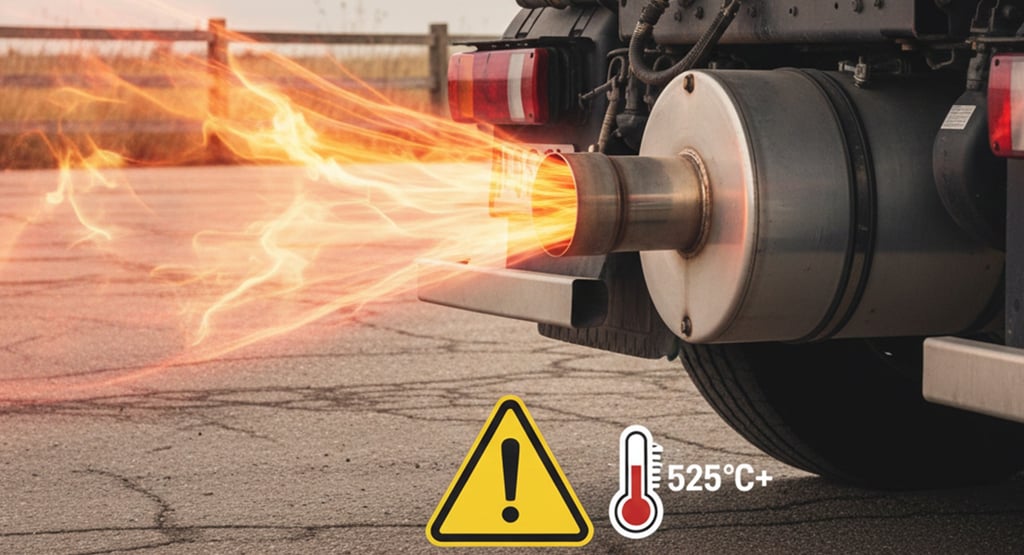
DPF regeneration is a genuine fire ignition source. The USDA Forest Service measured exhaust outlet temperatures exceeding 525°C during parked regen, while dry grass ignites at approximately 404°C with just light wind. Their official guidance mandates parking at least 50 feet (15 metres) from any flammable materials. Real-world incidents confirm the risk: a DPF failure on a Washington State truck in 2011 caused sparks that burned 3,600 acres and destroyed over 100 structures. In California, a 2016 Peterbilt burned to the frame in eight minutes during suspected regeneration. WorkSafeBC documented multiple fires in British Columbia where DPF heat ruptured nearby hydraulic lines.
Regeneration must never be performed indoors, in garages or workshops, near fuel stations, over dry grass or leaf litter, near buildings, in tunnels, at loading docks, or near other vehicles. The only acceptable surface is clean, dry concrete or paved ground in an open-air location. Carbon monoxide presents an additional lethal hazard in enclosed spaces — diesel exhaust during regen is odourless and colourless, and a 52-year-old truck driver died from CO poisoning with 67% carboxyhemoglobin saturation while sleeping in his cab near a running engine. The driver should remain with the vehicle throughout the entire process, never sleep in the cab during regen, and ideally carry a battery-powered CO detector in the cab.
Fuel quality and oil specifications that protect the DPF
All UK road diesel must meet BS EN 590 standards: maximum 10 ppm sulfur (Ultra Low Sulfur Diesel), minimum 51 cetane number, and maximum 7% FAME (biodiesel) by volume. The ultra-low sulfur content is essential for DPF longevity because sulfur produces sulfate ash that accumulates permanently in the filter and cannot be removed by regeneration. FAME biodiesel contains trace metallic elements from production that contribute additional non-combustible ash, so higher biodiesel blends accelerate DPF loading. The 51+ cetane number ensures clean combustion and reduced soot formation, directly lowering regen frequency.
For engine oil, Volvo specifies VDS-4 (minimum) or VDS-4.5 (recommended) — both are low-SAPS (Sulfated Ash, Phosphorus, Sulfur) formulations aligned with API CJ-4/CK-4 and ACEA E9 standards. The critical chemical limits are ≤1.0% sulfated ash, ≤0.12% phosphorus, and ≤0.4% sulfur by weight. Approximately 90% of the non-combustible ash that accumulates in a DPF originates from engine oil additives, making oil specification the single largest controllable factor in long-term DPF health. Standard viscosity grades are 15W-40 (most conditions) or 10W-30 (Volvo factory fill for newer models), with 5W-40 acceptable for cold climates. Using a non-approved, high-SAPS oil dramatically shortens DPF life and voids warranty coverage.
Driving habits and maintenance that extend DPF life to 640,000 km
The most effective DPF management requires no switches, menus, or time spent parked — it requires driving patterns that sustain passive regeneration. A loaded Volvo FM cruising at 70–100 km/h for 20–30 minutes generates exhaust temperatures of 250–350°C, sufficient for the catalysed DPF to continuously oxidise accumulated soot with no fuel penalty and no driver intervention. Vehicles operating primarily in urban or stop-start conditions, such as those focused on delivery vehicle fuel cost saving, should receive a sustained motorway run of at least 30 minutes at 80+ km/h at least once per week to ensure passive regeneration occurs. Extended idling is particularly damaging: it produces low exhaust temperatures that prevent any form of passive regen while simultaneously increasing oil consumption, which accelerates ash accumulation.
Volvo extended the DPF ash cleaning interval to 400,000 miles (~640,000 km) for long-haul and regional applications on D11/D13 engines, with the filter substrate itself potentially lasting the vehicle's full 600,000+ mile service life if properly maintained. Professional ash cleaning costs £400–£800 and involves compressed air purging followed by chemical rinse and a four-hour bake cycle. Vehicles operating under severe-duty conditions — high idle percentages, urban delivery, or frequent short trips — may need cleaning as early as 160,000–240,000 km.
From Symptom Management to Root-Cause Prevention: The FuelMarble Advantage
While the procedures above get your Volvo FM back on the road, they address the symptom — accumulated soot — rather than the underlying cause: incomplete combustion. Every manual regen, every interrupted cycle, and every premature DPF cleaning traces back to inefficient fuel oxidation in the combustion chamber. The unburnt hydrocarbons that escape the cylinder are the same particles clogging your filter and forcing these costly 45-minute regeneration cycles.
FuelMarble approaches this problem from a different angle: thermal stabilization. By optimizing coolant temperature consistency, the system creates more stable combustion conditions, which independent testing in Japan has shown can reduce unburnt hydrocarbons (HC) by up to 95% and carbon monoxide (CO) by up to 100%. Detailed mechanisms are explained in our guide on how FuelMarble technology works, which breaks down the science of fuel enhancement and thermal stabilization. Cleaner combustion at the source means fewer soot particles generated in the first place — reducing DPF loading, extending passive regeneration intervals, and potentially lowering the frequency of forced manual regens. The technology installs directly in the coolant reservoir as a simple drop-in solution, requiring no ECU remapping, fuel system modifications, or changes to emissions control hardware. For operators facing chronic regen cycles in urban delivery routes or dealing with repeated DPF warnings, addressing combustion stability through thermal management may offer a complementary maintenance strategy alongside proper driving habits and quality fuel.
Conclusion
Forcing a manual DPF regen on a Volvo FM is mechanically straightforward but operationally consequential. The 20–45 minute procedure demands strict attention to safety interlocks, fire separation distances, and UK noise and emissions regulations — particularly avoiding residential areas and night-time hours. The differential pressure sensor and AHI dosing module are the components most likely to prevent regen initiation, and any active derate code must be resolved before the ECM permits the process. The deeper insight for fleet operators is that every forced regen represents a failure of the passive system, and the cumulative costs — fuel burn, oil dilution, driver downtime, and accelerated ash loading — compound rapidly. Investing in driving patterns that sustain highway exhaust temperatures, using VDS-4.5 low-SAPS oil, maintaining EN 590 fuel quality, and never interrupting a regen cycle once started will do more for DPF longevity than any diagnostic tool or workshop procedure.
Disclaimer: This article is provided for educational purposes only and is based on publicly available information current as of February 2026. Always consult your Volvo FM operator's manual for your specific vehicle model, follow UK regulations for stationary regeneration locations and noise restrictions, and seek professional assistance from a Volvo-certified technician if fault codes persist or regeneration repeatedly fails. We are not liable for vehicle damage, property damage, personal injury, regulatory fines, warranty voidance, or any consequences resulting from procedures described in this article. FuelMarble performance claims are based on available test data and individual results may vary—consult your fleet maintenance provider before installing aftermarket devices. All images are AI-generated for illustrative purposes only; refer to your actual vehicle manual for accurate visual references.
Designed to Go Further
Contact
FuelMarble © 2026. All rights reserved.


Delivery
Household
Marine
FuelMarble, 124 City Road, London, EC1V 2NX