DPF Cleaning Cost UK 2026 — What Workshops Won't Tell You
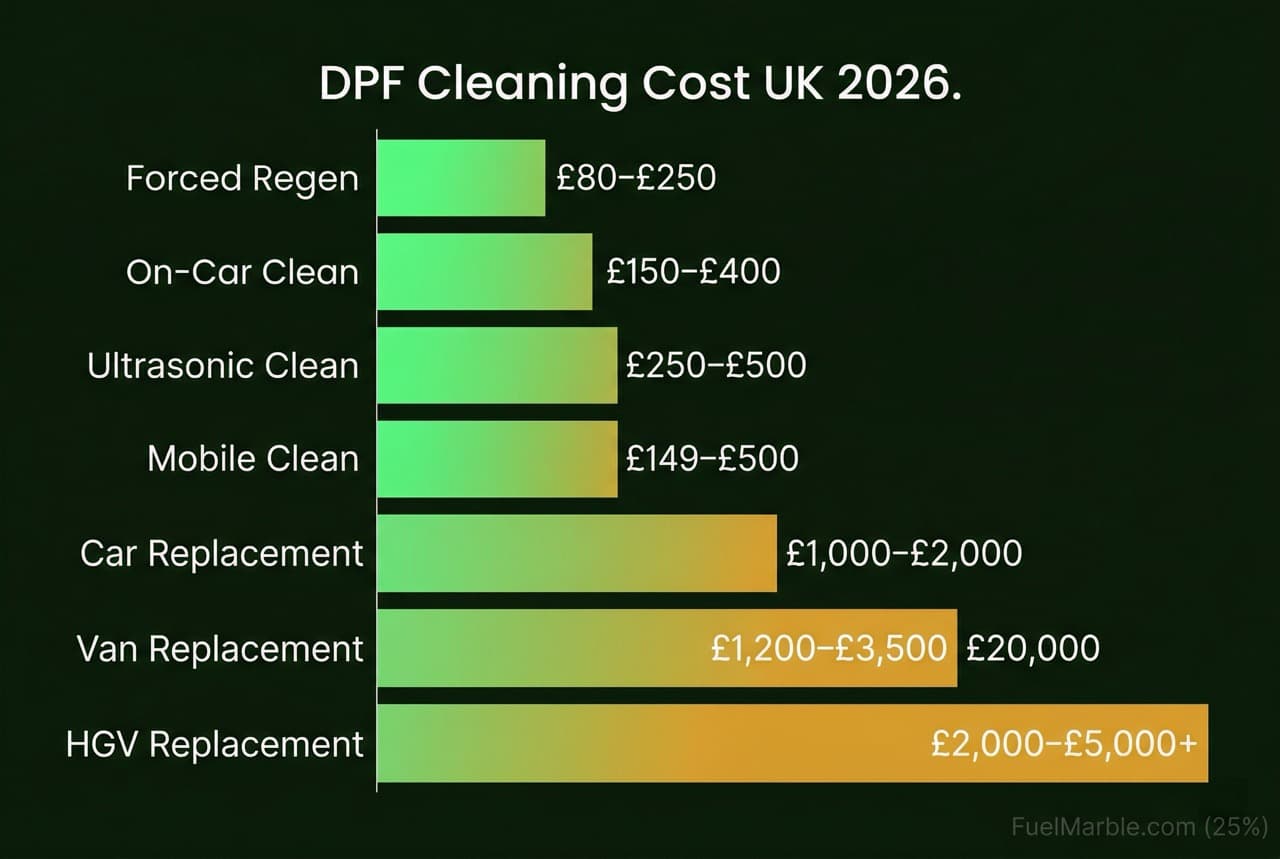
DPF cleaning in the UK costs £80–£250 for a forced regeneration, £150–£400 for a professional on-car clean, or £250–£500 for an off-car ultrasonic clean. HGV filters and full replacements run higher — up to £5,000+ on commercial vehicles. Here is the full breakdown.
DPF cleaning has become one of the fastest-growing diesel maintenance categories in the UK — and one of the most inconsistently priced. Our guide to heavy-duty truck emission systems covers the broader emission control landscape, but this article focuses on the specific question every van owner and fleet operator is asking: how much does DPF cleaning actually cost, what does each service tier involve, and is it worth it?
The price spread is enormous. A forced regen at a local garage might cost £80. An ultrasonic clean from a specialist runs £250–£500. A full DPF replacement on an HGV can exceed £5,000. The difference between these options is not just price — it is whether the service actually addresses your problem or simply delays it by a few weeks.
What Does DPF Cleaning Cost in the UK?
- Forced regeneration (garage): £80–£250 — burns soot only, leaves ash untouched
- Professional on-car cleaning: £150–£400 — includes diagnostics plus chemical or thermal treatment
- Off-car ultrasonic cleaning: £250–£500 + VAT — deepest clean available, restores 90–98% airflow
- Mobile DPF cleaning: £149–£500 — convenience premium, effectiveness varies by provider
- DPF replacement (car/van): £1,000–£3,500 fitted — aftermarket filters from £300, OEM from £600+
This applies when your DPF warning light has triggered and you need to decide which service tier to book — it does NOT apply if your vehicle has passed its MOT and you are simply looking for preventative maintenance (a £35–£85 routine clean may suffice).
Micro-example: A fleet operator running eight Ford Transits in Birmingham faced recurring DPF warnings after 40,000 miles of urban delivery work. Three vans were quoted £2,200 each for replacement. Ultrasonic cleaning at £350 per filter restored all three to 95%+ airflow — saving over £5,500 across the fleet.
| Service | Typical Cost | What It Does |
|---|---|---|
| Forced regen (garage) | £80–£250 | Burns soot at 600°C+; does not remove ash |
| On-car professional clean | £150–£400 | Diagnostics + chemical/thermal soot removal |
| Off-car ultrasonic clean | £250–£500 + VAT | Full soak and pressure rinse; removes soot AND ash |
| Mobile DPF cleaning | £149–£500 | On-site service; effectiveness varies by provider |
| DPF replacement — car | £1,000–£2,000 | New aftermarket or OEM filter fitted |
| DPF replacement — van | £1,200–£3,500 | Transit, Sprinter, Crafter class |
| DPF replacement — HGV | £2,000–£5,000+ | Quote-based; limited published pricing |
| Mercedes Sprinter 2.1 CDI (ultrasonic) | £280–£450 | Most common UK fleet/courier van; medium removal complexity |
All prices exclude VAT unless stated. London and southeast garages typically charge 20–40% more in labour rates than regional workshops.
DPF Downtime Cost Estimator
Quantify the hidden fuel and maintenance cost of forced DPF regeneration across your fleet
Est. Excess Fuel Cost per Vehicle / Month
Est. Annual Regen Fuel Cost — Whole Fleet
DPF Cleaning Frequency at Current Soot Load
Est. Annual DPF Maintenance Cost — Fleet
Estimates based on industry-average regen fuel consumption uplift (7.5%) and DPF service thresholds. Actual costs vary by vehicle specification and operator.
Reduce DPF Costs →Ultrasonic DPF Cleaning — The Most Effective Option
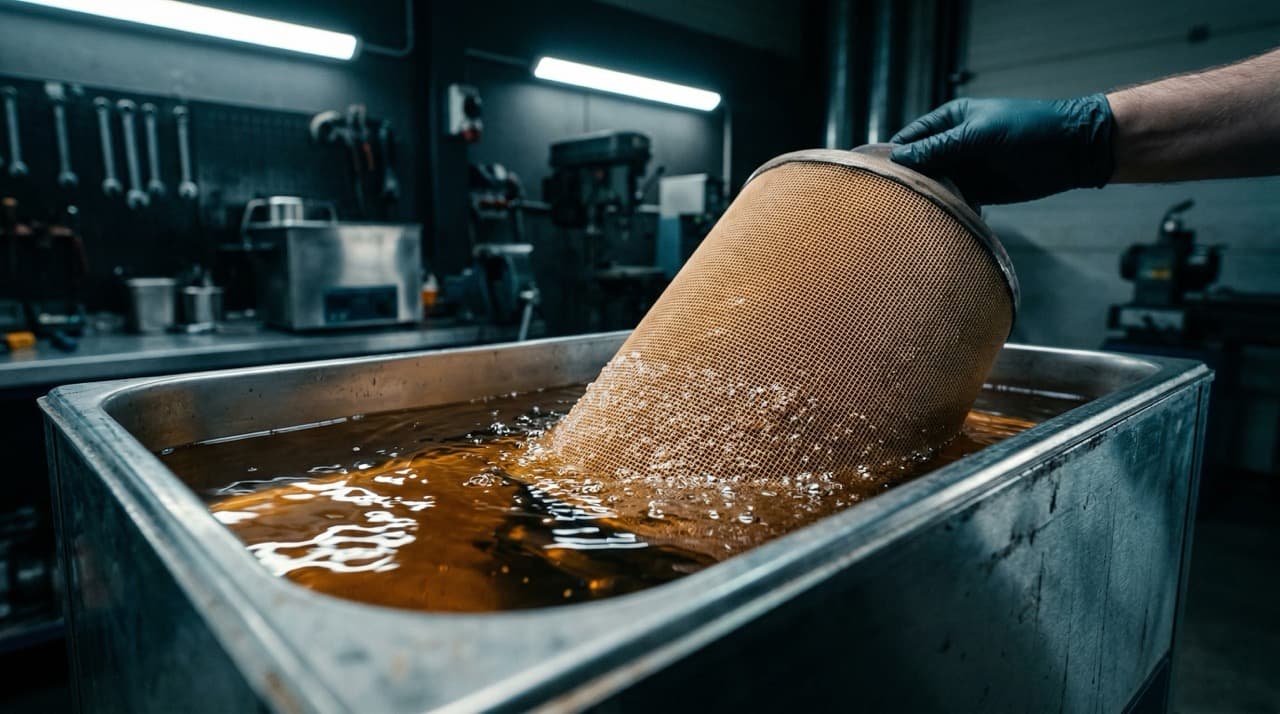
- Process: DPF removed → immersed in ultrasonic bath → high-frequency cavitation dislodges particles → pressure rinse → oven dry → flow test → refit and ECU reset
- Cost: £250–£500 + VAT for the clean; labour for removal and refit adds £100–£300 depending on vehicle access
- Turnaround: Same day to 48 hours; some specialists offer free collection and delivery within 35 miles
- Success rate: Leading UK providers report 96–98% restoration rates across tens of thousands of units
- Warranty: Typically 12 months from specialist providers, with "no clean, no fee" guarantees increasingly common
This applies when your DPF is heavily blocked (above 70% soot load), has failed a forced regen, or has high ash content from extended service — it does NOT apply if the ceramic substrate is cracked, melted, or contaminated with engine oil or coolant (replacement is the only option at that point).
Micro-example: A haulage company sent a Volvo FM DPF to a specialist after two failed forced regens. The ultrasonic clean cost £420 + VAT plus £180 labour — total £720. The quoted replacement was £3,800. The cleaned filter passed differential pressure testing at 97% of OEM specification and ran 35,000 miles before its next service.
How Do You Choose a Reliable DPF Cleaning Specialist in the UK?
- Flow test report: Insist on a pre- and post-clean differential pressure reading — this is the only objective proof the clean worked; a reputable specialist provides it as standard
- Warranty terms: 12 months or 25,000 km minimum; "no clean, no fee" guarantees are increasingly common among established UK providers and indicate confidence in the process
- Substrate inspection: The specialist should assess the ceramic substrate for cracks or melt damage before accepting the job — cleaning a fractured filter is money wasted on both sides
- Separation of diagnostics and cleaning: A bundled quote with no breakdown is a red flag; diagnostics, removal/refit labour, and the clean itself should each be itemised
- Commercial vehicle capability: Confirm the provider has industrial oven and pneumatic equipment rated for your vehicle class — a specialist whose largest previous job was a Transit is not equipped for an HGV DPF
This applies when you are selecting a specialist for the first time or evaluating a new provider for a fleet contract. It does NOT apply if you are using an OEM dealer service under manufacturer warranty — in that case the manufacturer's own standards govern the process.
Micro-example: A fleet manager in Bristol contracted a specialist advertising "DPF cleaning from £150." No flow test was provided, the warranty was 90 days, and the DPF re-blocked within six weeks. A second specialist — who provided pre/post pressure readings and a 12-month guarantee — resolved the same filter for £340. The difference was documentation, not price.
The ultrasonic process works because high-frequency sound waves — typically 25–40 kHz — create millions of microscopic cavitation bubbles in the cleaning solution. These bubbles implode against the filter walls with enough force to dislodge metallic ash deposits that thermal regeneration simply cannot touch. It is the only widely available method that effectively addresses both soot (combustible) and ash (non-combustible) contamination.
Ultrasonic vs chemical cleaning: Chemical cleaning uses solvent immersion rather than sonic cavitation and costs £80–£150 — cheaper, but typically achieves only 60–80% airflow restoration. The solvent dissolves soot but cannot dislodge the metallic ash compounds embedded in the substrate walls. Ultrasonic cleaning costs more but consistently achieves 90–98% restoration. For fleet vehicles that need the filter returned to near-OEM performance, ultrasonic is the only method worth specifying.
One critical caveat: roughly 35% of DPFs received by specialist ultrasonic providers have already been "cleaned" elsewhere without success. This usually means the first garage performed a forced regen and called it a clean — a distinction that costs fleet operators real money when the filter blocks again within weeks. The mechanics of why repeated regens fail to clear the filter — specifically how ash compounds outlast every heat cycle — explain why this category of wasted spend is so persistent across fleets.
Why Does HGV DPF Cleaning Cost More Than a Car's Filter?
- Filter volume: HGV DPF units are typically 15–40 litres in substrate volume; car units are 2–5 litres
- Removal complexity: Heavy truck DPFs are often bolted into confined chassis positions requiring two technicians and specialist tooling
- Ash load: At typical HGV mileages and fuel burn rates, ash accumulation is 3–5× faster than equivalent car usage
- Specialist equipment: Commercial DPF cleaning requires industrial thermal ovens and high-pressure pneumatic cleaning systems not used in standard workshops
This applies to Euro V and Euro VI HGVs operating under normal commercial load — it does NOT apply to light commercial vehicles under 3.5 tonnes, which are cleaned at car-equivalent rates regardless of the van's commercial function.
Micro-example: A Volvo FM 460 Euro VI with 400,000 km on the chassis required an industrial oven cycle of 8 hours at 600°C followed by pneumatic backflush to clear the 18-litre substrate — a process that takes 20 minutes on a typical passenger car DPF.
| Service | Cost Range | Notes |
|---|---|---|
| Forced regeneration (on-vehicle) | £80–£200 | Removes soot only, not ash |
| Off-vehicle professional cleaning | £500–£1,500 | Removes soot and ash; substrate must be intact |
| DPF replacement — aftermarket | £1,500–£3,000 | Compatibility varies; check Euro VI approvals |
| DPF replacement — OEM | £3,000–£8,000+ | Most common range for Volvo, DAF, Mercedes-Benz Euro VI |
| Associated sensors and fittings | £330–£800 | DPF temp sensor, differential pressure sensor, gaskets |
| Downtime cost per day (HGV) | £500–£1,000 | Based on average UK HGV daily revenue — verify against your fleet actuals |
ℹ Note: All HGV figures are estimates based on UK market data 2025–2026. Verify with current specialist and dealer quotes before committing.
On-Vehicle DPF Forced Regen — What Garages Actually Do
- Process: OBD diagnostic connection → soot and ash level check → ECU commands regen at 600–700°C → technician monitors temperatures and pressures for 30–90 minutes
- What it removes: Soot — carbon particles from incomplete combustion
- What it leaves behind: Ash — non-combustible metallic residue from engine oil additives that accumulates permanently
- Effectiveness ceiling: Typically ineffective above 70% soot load or when ash comprises more than 50% of filter content
This applies when your DPF light has recently appeared and the vehicle is below 60,000 miles on its current filter — it does NOT apply if the DPF has failed multiple regens, the warning has persisted for more than a week, or you hear metallic rattling from the exhaust indicating potential substrate damage.
⚠ Caution: a forced regen is not DPF cleaning
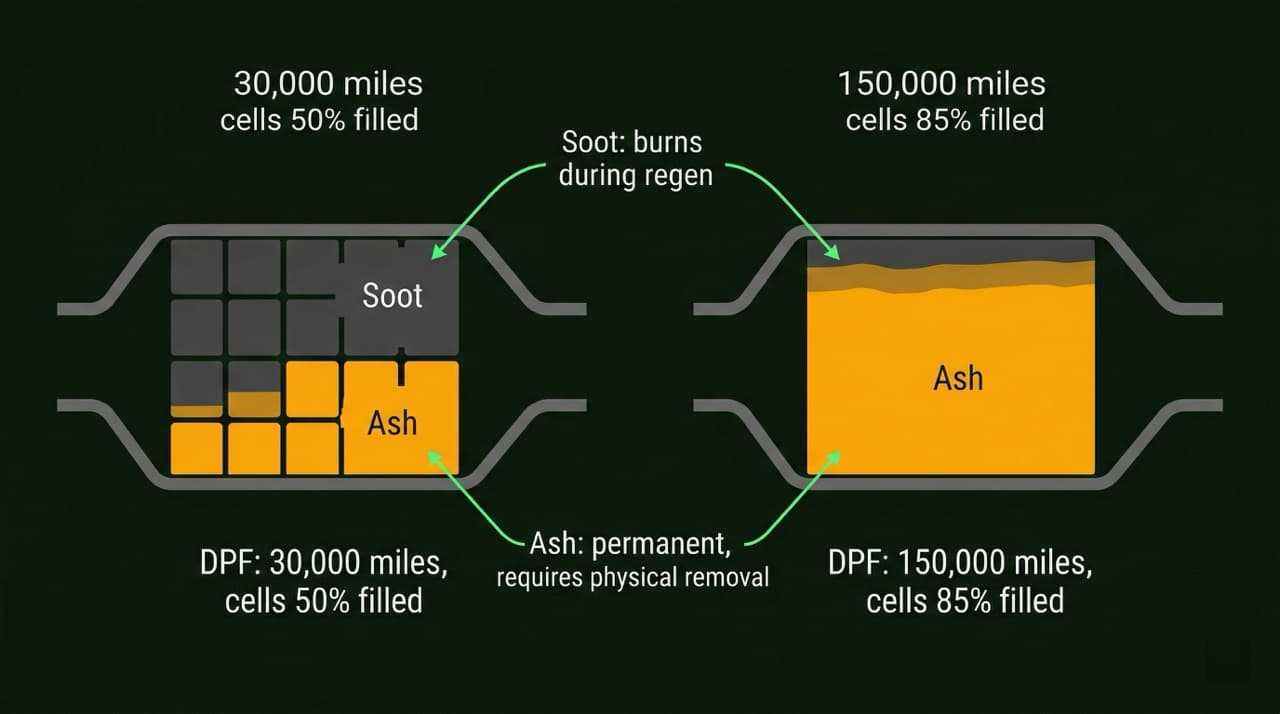
Forced regeneration burns soot at 600°C but leaves non-combustible ash permanently in the filter. By 33,000 miles, roughly half the material in your DPF is ash — which no regen cycle can remove. If a garage quotes you £100 for a "DPF clean," ask whether they mean a forced regen or an off-car ultrasonic clean. The difference matters.
Micro-example: A Vauxhall Vivaro owner paid £120 for a forced regen at a local garage. The DPF light cleared for eleven days, then returned. A second garage charged £95 for another forced regen — same result. The third visit, to a specialist, revealed 58% ash loading that no forced regen could ever address. Ultrasonic cleaning at £380 resolved it. Total wasted on forced regens: £215.
Volvo FM operators who need to understand how to attempt a manual DPF regen before reaching a specialist can follow the step-by-step procedure in detail — including the diagnostic thresholds that determine whether a regen will succeed or simply prolong the blockage.
Many garages advertise "DPF cleaning" when they perform nothing more than a forced regen. By 33,000 miles, approximately half the material trapped in your DPF is ash, not soot. By 150,000 miles, ash comprises over 80%. This is why a £100 forced regen delivers diminishing returns with every passing service interval — and why the honest answer from most garages should be "you need an ultrasonic clean" rather than "we'll run a regen."
How Long Does a Cleaned DPF Last?
- With root cause fixed (driving habits, oil specification, engine faults resolved): 50,000–100,000+ miles before the next clean
- Without root cause fixed: As little as two to six weeks before re-clogging
- Professional cleaning warranty: Typically 12 months or 25,000–40,000 km from reputable providers
- Total DPF substrate lifespan: 100,000–150,000 miles before degradation makes cleaning unviable
This applies when you have had a professional off-car clean and are deciding whether additional preventive action is needed — it does NOT apply if the DPF warning light returns within 30 days of cleaning (this indicates an unresolved engine fault, not a cleaning quality issue).
Micro-example: Two identical Mercedes Sprinters in the same courier fleet had DPFs cleaned on the same day at £380 each. Van A, used for 70% motorway work, ran 62,000 miles before its next clean. Van B, doing exclusively London deliveries, re-clogged in 14 weeks. Same clean, same filter, same cost — the driving cycle was the only variable.
The single biggest factor in DPF longevity after cleaning is driving pattern. DPFs need sustained exhaust temperatures above 350°C for passive regeneration, which requires roughly 30 minutes at motorway speed. Vehicles that never reach these conditions — urban delivery vans, short-hop HGVs, school-run cars — accumulate soot faster than the system can self-clean.
Other factors that accelerate re-clogging deserve attention. Wrong oil specification is a silent killer: non-low-SAPS oil produces approximately 60% more non-combustible ash per mile than the correct ACEA C-rated alternative. Faulty EGR valves create a vicious feedback loop — the stuck valve increases soot production, the DPF blocks faster, rising backpressure worsens EGR contamination, and the cycle accelerates. Leaking injectors dump unburned fuel into the exhaust, overwhelming filter capacity within months. Cheap diesel additives accelerating DPF loading operate through the same mechanism — certain aftermarket formulations introduce metallic ash compounds that no heat cycle can remove, quietly reducing the interval between cleans with every fill.
Why DPF Cleaning Is a Symptom, Not the Fix
- Root cause: Incomplete combustion produces excess soot → DPF captures it → filter capacity fills → warning triggers
- Cleaning resets capacity but does not alter the rate at which soot accumulates
- Repeat cleaning cycles at £250–£500 each exceed replacement cost within three to four cycles
- Addressing combustion efficiency upstream is the only approach that breaks the cycle
This applies when you have cleaned the same DPF more than once in 18 months and are questioning whether a better approach exists — it does NOT apply if the blockage was a one-off event caused by a specific, now-resolved engine fault such as a failed injector that has been replaced.
Micro-example: A regional haulage operator spent £1,840 on DPF cleaning across four Volvo FMs over twelve months. Each clean lasted three to five months before the cycle repeated. The root problem was never the filter — it was the volume of particulate reaching it on every combustion stroke. The same failure pattern — repeated cleans, each lasting only months — is documented in a real-world DPF clog case study tracing how fuel quality and additive use accelerated DPF loading on a commercial Volvo FM fleet.
Here is what most workshops will not volunteer: every DPF clean you pay for is evidence that the engine is producing more soot than it should. The filter is performing exactly as designed. The question that actually matters is why your engine generates enough particulate matter to overwhelm it between service intervals.
The upstream causes are well-documented — suboptimal combustion chamber thermal conditions, poor fuel atomisation, and low oxygen density in the charge air. These conditions produce excess soot. The Kurume Institute's combustion research identifies the thermal boundary layer around the combustion chamber as the primary variable controlling particulate output per cycle: when that boundary layer is suboptimal, incomplete combustion produces excess particulate matter on every stroke, regardless of what happens downstream at the DPF. Cleaning the filter does not change that rate.
For a fleet running urban distribution cycles — where exhaust temperatures rarely sustain passive regeneration — the arithmetic compounds quickly. The four Volvo FMs in the micro-example above cost £1,840 in cleaning over twelve months. Scaled to a fifty-vehicle fleet at the same cleaning frequency, that figure reaches £23,000 a year before a single filter reaches replacement cost. That is the recurring cost of treating a symptom.
FuelMarble L addresses combustion efficiency at source, working through the coolant system to optimise the thermal boundary layer so that more oxygen is available per stroke and combustion completes more fully.
The practical result: less soot produced per combustion event, less reaching the DPF, and the filter able to cut your fleet's DPF cleaning frequency with FuelMarble L. It installs in under 60 seconds into the coolant reservoir — non-chemical, solid state, no fuel contact. Typical fuel efficiency improvements of 7–15% are a secondary benefit; the primary relevance for fleet operators is the measurable reduction in particulate output that extends the interval between cleans.
DPF Removal — Is It Legal in the UK?
- Legal basis: Regulation 61a(3) — it is an offence to drive a vehicle modified to no longer meet its designed emission standards
- MOT: Mandatory DPF visual check since February 2014; stricter defect categories since May 2018; evidence of tampering is an automatic major-defect failure
- Fines: Up to £1,000 for cars, £2,500 for light goods vehicles
- Insurance: The Association of British Insurers has stated that driving a vehicle known to be illegal or unroadworthy constitutes potential misrepresentation — insurers can and do reject claims
This applies when you are considering or have been offered a DPF delete as a cost-saving measure — it does NOT apply if your vehicle pre-dates 2009 and was never factory-fitted with a DPF (these vehicles are not subject to DPF-specific MOT checks).
Micro-example: Two Sheffield mechanics were banned from MOT testing for two years after performing DPF removals and passing the vehicles as compliant. During a single 2016–2017 enforcement sweep, DVSA issued 761 warnings and disqualifications across the UK. The risk reaches beyond the vehicle owner directly to the workshop.
A DPF "delete" involves two stages: physical removal or gutting of the ceramic substrate, and an ECU remap to suppress regeneration commands and warning lights. MOT testers are now specifically instructed to reject filters showing evidence of being cut open and rewelded without documented evidence of legitimate professional cleaning.
The enforcement environment is tightening, not loosening. The UK now operates over twelve Clean Air Zones across major cities — Birmingham, Bristol, Bath, Sheffield, and all four major Scottish cities among them. DVSA has begun piloting remote emission sensors capable of flagging non-compliant vehicles on the road in real time. A deleted DPF is an increasingly detectable liability.
How to Extend Your DPF Lifespan
- Drive at motorway speed for 30+ minutes at least once per fortnight — this allows passive regeneration to complete at exhaust temperatures above 350°C
- Use manufacturer-specified low-SAPS oil (ACEA C1–C5 classification) — standard oil produces approximately 60% more non-combustible ash per mile
- Buy diesel from high-turnover, reputable stations — water and sulphur contamination in poor-quality fuel directly increases soot output
- Fix EGR valve and injector faults immediately — these are the two most common root causes of accelerated DPF clogging and create feedback loops that worsen exponentially
- Never interrupt an active regeneration — if engine idle speed rises and cooling fans run at standstill, keep driving for 10–20 minutes until the cycle completes
This applies when you are running a diesel vehicle with a DPF and want to minimise lifetime maintenance costs — it does NOT apply if your DPF is already showing active warning symptoms (address the immediate blockage first, then implement preventive measures).
Micro-example: A courier company operating twelve Sprinters reduced DPF cleaning events from six per year across its fleet to one by making three changes: switching to ACEA C3 oil at every service, routing each van through a 20-minute motorway section weekly, and replacing two EGR valves that diagnostics had flagged as marginal but not yet failed.
How to Choose a DPF Specialist — 5 Things to Check
Not all DPF specialists offer the same standard of work. Before booking:
- No-clean, no-fee guarantee — reputable providers will not charge if the filter cannot be restored to a specified airflow threshold
- Flow test certificate — the clean should be verified with a differential pressure test; ask for the before-and-after result in writing
- Vehicle-specific experience — confirm the provider has cleaned your specific vehicle make and model, particularly for HGVs and LCVs with unusual DPF mounting positions
- Post-clean ECU reset included — without a diagnostic reset, the DPF warning may remain even after a successful clean; confirm this is in scope
- DVSA compliance — for HGV operators, confirm the provider can supply documentation suitable for operator licence records
If you are seeing recurring DPF issues across multiple vehicles, the pattern almost always points to systemic causes rather than filter defects. Understanding the top 5 Volvo FM DPF clog symptoms early — before the filter reaches critical loading — is the difference between a £100 forced regen and a £3,500 replacement.
Quick Answers: DPF Cleaning Questions UK Drivers Ask Most
How Long Does DPF Cleaning Take?
Most specialists quote same-day to 48-hour turnaround for cars and vans, and 48–72 hours for HGVs. Mobile on-site cleaning typically takes two to four hours depending on vehicle access.
This applies when booking in a blocked DPF and planning for vehicle downtime. It does NOT apply to preventative maintenance cleans — those are faster because the filter is not critically loaded.
Micro-example: A courier company in Manchester booked four Sprinters in over a Monday. All four were returned by Wednesday morning after ultrasonic cleaning — the two-day window included removal, eight-hour oven and rinse cycles, flow testing, and refit.
How Much Does DPF Cleaning Cost for a Mercedes Sprinter or BMW?
This applies to the most common UK commercial van and premium diesel car models. It does NOT apply to older pre-2009 BMW models without factory-fitted DPFs.
Micro-example: A BMW 520d owner was quoted £1,450 for OEM DPF replacement at a main dealer. An independent specialist cleaned the same filter ultrasonically for £380, with a 12-month warranty and a post-clean flow test confirming 93% airflow recovery.
What Is the Difference Between Chemical DPF Cleaning and Ultrasonic Cleaning?
- Chemical on-car: £80–£200 — quickest option, targets soot only, no removal required
- Chemical off-car soak: £150–£300 — better penetration than on-car spray, still limited on ash
- Ultrasonic off-car: £250–£500 — removes both soot and ash, highest restoration rate, requires removal
- Combined chemical + ultrasonic: Offered by some specialists as a premium service; most thorough option for heavily contaminated filters
This applies when comparing quotes from different specialists who use different terminology. It does NOT apply to forced regeneration — that is a heat process, not a chemical or ultrasonic one, and should not be described as "cleaning" at all.
Micro-example: A fleet manager received three quotes for the same Sprinter DPF: £120 (on-car chemical spray), £290 (off-car chemical soak), and £390 (ultrasonic). The £120 option cleared the warning light for 19 days before it returned. The £390 ultrasonic clean resolved it for 14 months.
Where Can You Find a DPF Cleaning Specialist Near You?
Three established UK specialist networks worth checking: Commercial DPF Restore (commercialdpfrestore.uk), DPF Clean Team (dpfcleanteam.co.uk), and UK DPF Cleaning (ukdpfcleaning.co.uk). All three offer collection and delivery services if no local specialist exists in your area.
This applies when you need to find a vetted specialist rather than a general garage. It does NOT apply if your vehicle is under manufacturer warranty — in that case, use an authorised dealer to avoid warranty invalidation.
Conclusion
DPF cleaning costs in the UK span from £80 for a forced regen to over £5,000 for HGV replacement. Ultrasonic cleaning at £250–£500 remains the most cost-effective intervention for moderately to heavily blocked filters, restoring 90–98% of original airflow at a fraction of replacement cost. Forced regens have their place for light soot buildup below 60,000 miles, but they become progressively less effective as ash accumulates — and too many garages sell them as "cleaning" when they are not.
The decision framework is straightforward. If the DPF warning just appeared and the vehicle is under 60,000 miles: try a forced regen at £80–£250. If that fails or the filter is beyond 60,000 miles: go directly to ultrasonic cleaning. If the substrate is physically damaged: replace. And if you find yourself cleaning the same filter repeatedly, stop treating the filter and start treating the engine — because the soot is produced upstream, and that is where the lasting fix lives.
Elias translates complex engine science into clear, accurate content. Specialising in diesel combustion, DPF systems, and Japanese engineering methodology, he produces FuelMarble's technical documentation, performance analyses, and in-depth product guides.
Ready to Improve Your Fuel Efficiency?
FuelMarble delivers up to 15% fuel efficiency improvement. Simple drop-in install.