Reduce Marine Fuel Costs by 5–15%
FuelMarble minerals install in your vessel's expansion tank, no engine modifications, no plumbing changes. Verified 7.33% year-on-year fuel reduction on a 55,810 DWT bulk carrier in active commercial service.
Shop FuelMarble LIndependently Trialled by Japanese Government Bodies
FuelMarble's underlying technology has been independently trialled by Japan's Ministry of Land, Infrastructure, Transport and Tourism (MLIT) and the Japan New Fishing Vessel & Fishery Technology Research Association. The MLIT trial on a 12,000-tonne ferry recorded a 5.9% fuel reduction and ¥52.8 million (~$352,000 / ~£278,000) in annual savings, read the full Miyazaki Express ferry trial breakdown. The fishing association's 2-year trial recorded an average 5.1% reduction, rising to 11% at optimal engine RPM.
Source: Japan MLIT Maritime Bureau, Coastal Shipping Rationalisation and Convenience Improvement Demonstration Project Report, Heisei 22 (March 2010). Co-published with Nihon Kaiyou Kagaku Co., Ltd.
Source: Japan New Fishing Vessel & Fishery Technology Research Association trial report, Heisei 22–23 (2010–2011). Published in Suisan Shuho (水産週報) No.1826, 15 June 2011.
Sources
- Japan MLIT Maritime Bureau: Coastal Shipping Rationalisation and Convenience Improvement Demonstration Project Report (Heisei 22, March 2010). Co-published with Nihon Kaiyou Kagaku Co., Ltd.
- Japan New Fishing Vessel & Fishery Technology Research Association. Fuel Savings Countermeasure Demonstration Experiment Report, Yamaguchi Maru No.1 & No.2 (60t). Heisei 22–23 (2010–2011). Published in Suisan Shuho (水産週報) No.1826, 15 June 2011.
- Tamai Steamship Co., Ltd.: TRES FELICES operational consumption logs, November 2024 vs November 2025.
All Verified Marine Trials at a Glance
| Vessel | Type | Fuel Type | Reduction | Trial Body | Year |
|---|---|---|---|---|---|
| TRES FELICES | 55,810 DWT bulk carrier | C Heavy Oil (HFO) | 7.33% (wind-corrected); 8.31% (latest period) | Tamai Steamship Co. | 2024–2025 |
| Miyazaki Express | 12,000 GRT passenger ferry | C Heavy Oil (HFO) | 5.9% | Japan MLIT Maritime Bureau | 2010 |
| No.2 Yamaguchi Maru | 60t fishing vessel (treated) | Marine diesel | 5.1–11% | Japan Fishing Vessel Research Assoc. | 2008–2010 |
Fuel reduction figures are drawn from monitored commercial marine operations and government-commissioned trials. Results vary by vessel type, engine displacement, route profile, and operating load.
How Much FuelMarble Does Your Vessel Need?
Marine FuelMarble is supplied as bulk mineral, scaled to vessel size. The dosing rule is simple: 1 kg of FuelMarble for every 10 tonnes of vessel.
Dosing Rule
1 kg of FuelMarble · per 10 tonnes of vessel
FuelMarble required (kg) = vessel tonnage ÷ 10
| Vessel size | FuelMarble required |
|---|---|
| 10 tonnes | 1 kg |
| 20 tonnes | 2 kg |
| 50 tonnes | 5 kg |
| 100 tonnes | 10 kg |
| 500 tonnes | 50 kg |
| 1,000 tonnes | 100 kg |
Example figures based on the 1 kg : 10 tonne ratio. Exact dosing depends on cooling-circuit volume and engine configuration.
Ships Are Quoted Individually
Because every vessel differs in tonnage, engine type, and cooling-circuit volume, marine FuelMarble is priced per vessel rather than as an off-the-shelf unit. Tell us your vessel's tonnage and engine details and we will calculate the exact FuelMarble quantity and provide a tailored quote.
- ✓Dosing scaled to your vessel's tonnage (1 kg per 10 tonnes)
- ✓Installs into the freshwater expansion tank, no engine modifications
- ✓Suitable for marine diesel and heavy fuel oil (HFO) engines
- ✓Fleet pricing available for multiple vessels
Fewer Fuel Stops. Lower Voyage Costs.
In marine operations, fuel efficiency directly determines profitability and range. FuelMarble delivers measurable improvements on every engine hour.
Verified Voyage Fuel Savings
Fuel is the largest operating cost on any vessel. FuelMarble's 5–15% consumption reduction translates directly to measurable savings per voyage, verified on commercial bulk carriers in active service.
Works on HFO & Diesel-Powered Vessels
FuelMarble works with both marine diesel and heavy fuel oil engines, making it suitable for commercial bulk carriers, offshore vessels, and large leisure craft running on C Heavy Oil.
Reduced Exhaust Emissions
Improved combustion efficiency results in cleaner exhaust profiles. As international maritime emissions regulations tighten under IMO 2030 and beyond, FuelMarble helps vessels move towards compliance.
See emission reduction data →No Engine Modifications Required
FuelMarble installs into the engine's freshwater expansion tank, no modifications to the engine, fuel system, or exhaust. No impact on classification society requirements. Fully reversible.
Extended Engine Service Intervals
Cleaner, more stable combustion reduces internal engine wear and deposit buildup. This translates to longer intervals between scheduled maintenance, reducing haul-out frequency and servicing costs.
Passive: No Ongoing Action
Once installed, FuelMarble requires no maintenance, no servicing, and no consumables. The FuelMarble mineral pack works continuously as coolant circulates. Every engine hour delivers results.
Measured Fuel Reduction Across Vessel Types
Fuel consumption data drawn from monitored commercial marine operations, offshore fishing vessels and express passenger ships.
Active commercial fishing vessel · Monitored over full fishing season
Express passenger ferry · Measured across regular scheduled route
Fuel reduction figures are drawn from monitored commercial marine operations. Results vary by vessel type, engine displacement, route profile, and operating load. Contact our team for a vessel-specific assessment.
How FuelMarble Works Onboard
A passive, three-step process, from installation to verified fuel savings.
The mineral technology is protected by three Japanese patents (JP4402484, JP2000-191338, JP2005-256802).
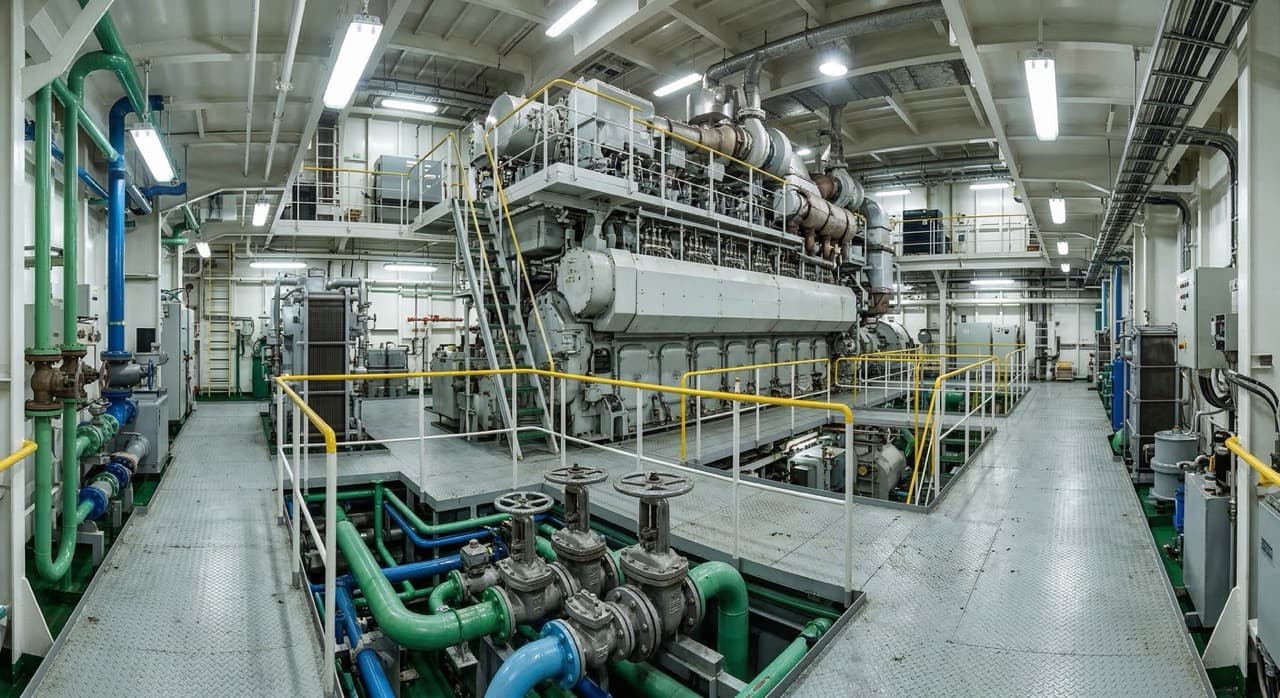
Install in Expansion Tank
Coolant Circulates Through Minerals
Engine Runs Cooler, Burns Less Fuel
Compatible With Any Freshwater-Cooled Vessel
FuelMarble works on any marine engine with a freshwater cooling circuit, from offshore fishing vessels to large bulk carriers running on heavy fuel oil.
Bulk Carriers & Cargo Ships
Commercial vessels on long international routes carry the highest fuel burden. A 5–15% consumption reduction on voyages between North America, Asia, and Europe delivers substantial annual savings, verified by the TRES FELICES case study.
Fishing Vessels & Trawlers
Fishing fleets operating hundreds of engine hours per season benefit significantly from 5–10% diesel reduction. Lower fuel costs per trip improve margins for independent operators and commercial fleets alike.
Passenger Ferries
Express passenger ships and roll-on/roll-off ferries running scheduled routes achieve consistent fuel savings across every sailing. Trial data shows approximately 5.9% fuel reduction on express passenger vessels.
Offshore & Support Vessels
Offshore support vessels, anchor-handling tugs, and platform supply vessels operating extended offshore schedules benefit from lower per-hour fuel consumption. Reducing operational costs over long deployments. Operating under dynamic positioning (DP) for sustained periods or running at constant RPM between shore bases and platforms, these vessels burn significant quantities of marine diesel daily. FuelMarble's passive coolant-circuit installation reduces per-hour consumption without changing operational protocols, improving economics across both short-interval platform supply runs and multi-week offshore campaigns.
FuelMarble L. Marine Sizing Guide
| Vessel Size | FuelMarble L Units Required |
|---|---|
| Small inshore vessels / up to 60 DWT | 1 unit |
| Medium fishing vessels, river freight / 60–500 DWT | 2 units |
| Commercial ferries, bulk carriers, offshore / 500+ DWT | 3 units (contact us for configuration) |
For large commercial vessels (TRES FELICES class), a custom multi-unit configuration was used. Contact our marine team to specify the correct installation for your vessel.
Verified on a 55,810-Tonne Bulk Carrier
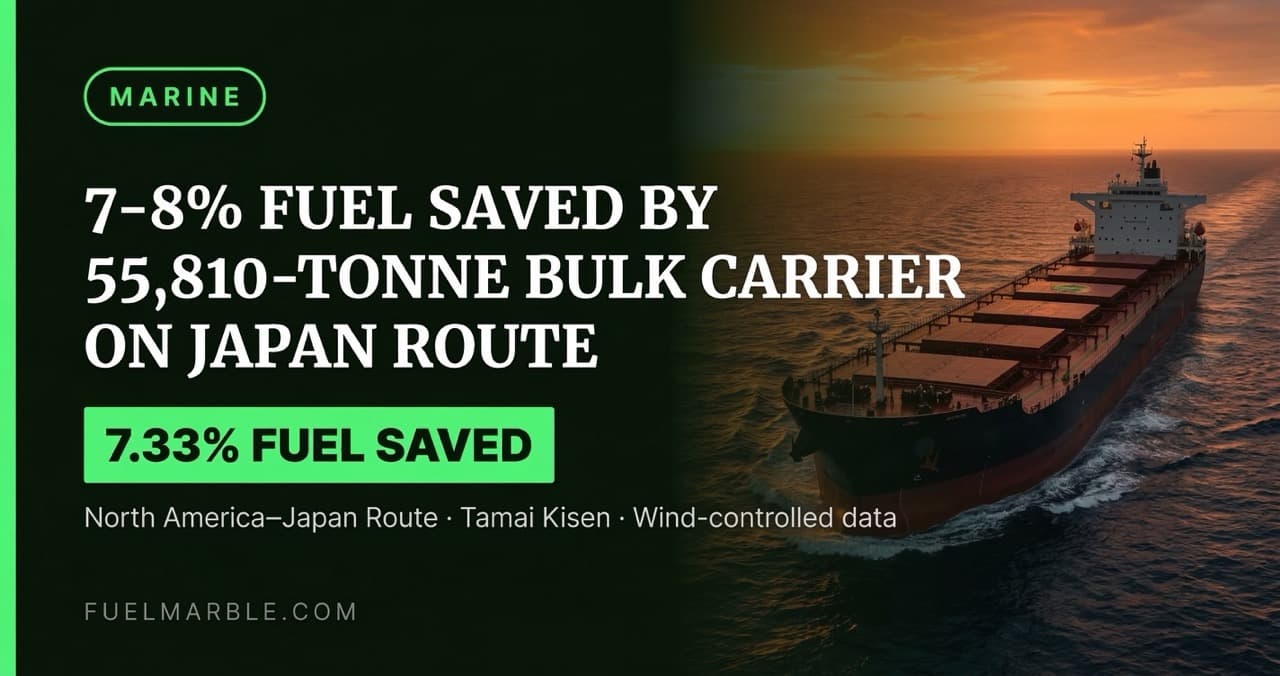
TRES FELICES. Tamai Steamship
Methodology note: Tamai Steamship used a wind-correction methodology to isolate the FuelMarble contribution from voyage-to-voyage weather variation. The 7.33% figure represents the wind-corrected year-on-year reduction (November 2024 vs November 2025, same-month baseline). The 8.31% figure represents the most recent monitored period.
IMO CII Compliance Context
Commercial vessel operators under CII pressure can document a measurable fuel consumption reduction. FuelMarble's independently verified 7–8.31% fuel efficiency improvement reduces your vessel's Carbon Intensity Indicator score, with a published test methodology that qualifies as evidence for CII improvement reporting. Explore fleet applications →
Commercial Vessel Applications
Reduces diesel consumption on extended voyages
Applicable for inland waterway diesel engines
Works with heavy fuel oil and marine diesel
TRES FELICES: 7.33% Year-on-Year Fuel Reduction
A documented case study from Tamai Steamship Co., Ltd. monitoring fuel consumption before and after FuelMarble installation on a 55,810 DWT bulk carrier.
TRES FELICES: Bulk Carrier
Tamai Steamship Co., Ltd. · Japan
FuelMarble mineral pack (20 kg) installed across 2 freshwater expansion tanks. No engine modifications. No system downtime.
Data sourced from Tamai Steamship Co., Ltd. operational logs comparing same-month year-on-year consumption. CO₂ credit value calculated at prevailing carbon market rates. Annual saving figures based on full-year projection from monitored periods.
USD and GBP equivalents are approximate, based on Q1 2026 exchange rates (1 USD ≈ ¥149, 1 GBP ≈ ¥189). Actual value varies with currency movements.
Marine Fuel Costs. Why Efficiency Matters
Bunker fuel (heavy fuel oil (HFO) and marine diesel oil (MDO)) accounts for 50–60% of total voyage operating costs on most commercial vessels. As of 2025, VLSFO (Very Low Sulphur Fuel Oil) is priced at approximately $500–600 per metric tonne at major bunkering ports including Rotterdam, Singapore, and Fujairah. For a 55,000 DWT bulk carrier consuming 25–30 tonnes per day, a single 14-day trans-Pacific passage can carry a fuel bill exceeding $200,000.
A 7% efficiency gain at these price levels reduces voyage costs by thousands of dollars per passage, with no schedule change, no crew impact, and no operational disruption. FuelMarble's verified 7.33% reduction on the TRES FELICES represents exactly this scenario: passive installation delivering measurable savings on every voyage from day one.
How Much Does It Cost to Fill a Large Vessel?
Bunker fuel costs vary significantly by vessel size, fuel type, and current market price. As a reference point:
A Capesize bulk carrier (180,000 DWT) carries roughly 5,000–7,000 tonnes of HFO in its fuel tanks. At current IFO 380 prices of approximately $450–$550 per tonne (as of mid-2026), a full bunker for a large bulk carrier costs $2.25M–$3.85M.
A cruise ship of similar size consumes roughly 150–250 tonnes of fuel per day at sea. A 7-day Mediterranean voyage at current Very Low Sulphur Fuel Oil (VLSFO) prices (~$600/tonne) costs approximately $630,000–$1,050,000 in fuel alone per voyage.
At FuelMarble's verified 7.33% fuel reduction (TRES FELICES bulk carrier, Tamai Steamship, 2024–2025), a vessel spending $2.5M per fill-up saves approximately $183,000 per voyage, before accounting for the compounding effect across a full year of operations.
Prepare for Tightening Maritime Emissions Rules
The International Maritime Organisation (IMO) continues to tighten emissions standards for commercial shipping. NOx and SOx reduction targets are becoming mandatory across more vessel categories and operating areas.
FuelMarble's improved combustion efficiency produces cleaner exhaust profiles, helping vessel operators move towards compliance, without engine replacement or costly exhaust treatment systems.
NOx Emission Reduction
FuelMarble's improved combustion process produces lower NOx output, relevant in the context of IMO Tier III NOx requirements for vessels operating in NOx Emission Control Areas (NECAs). Under MARPOL Annex VI, NOx emission limits apply to marine diesel engines above 130 kW installed on vessels constructed on or after 1 January 2000, with Tier III limits applying in designated Emission Control Areas including the North American and North Sea ECAs.
Port State Control
Vessel inspections under Port State Control increasingly scrutinise emission performance. FuelMarble improves the combustion profile of your engines without altering their fundamental operation.
No Classification Society Impact
As a passive coolant-circuit device, FuelMarble does not modify engine hardware or systems. It does not require approval from classification societies such as Lloyd's Register or DNV.
Reduce Your Vessel's Fuel Costs
Speak to our marine team for a vessel-specific assessment. We will advise on the right configuration for your engine type, coolant system, and operational profile.
Marine EnquiryMore FuelMarble Applications
Save up to 15% on fuel in personal cars, vans, and SUVs. Drop-in coolant installation.
22.14% fuel efficiency gain on city route buses. Verified by Yamanashi Kotsu, Japan 2024.
Save ~£8,000 per year on a 10-vehicle delivery fleet. DPF protection and zero downtime.