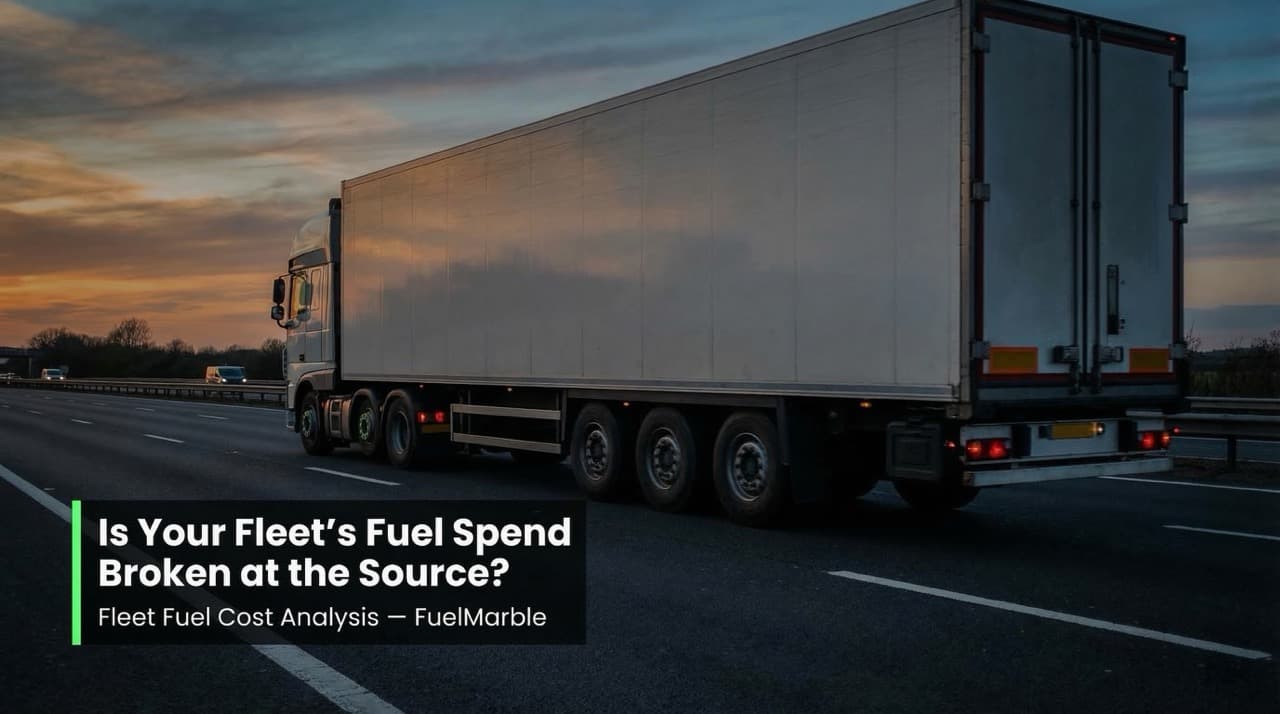
Fleet Fuel Efficiency: Typically 7–15% Better, Fitted Once
FuelMarble has been road-tested in Japan, China and Indonesia (APAC-origin results). No fuel additives, no engine modifications, no ongoing cost. Install in under 60 seconds per vehicle. Results vary by vehicle, engine and duty cycle. In one operator trial, stop-start city work showed a larger gain than steady highway running, and some vehicles show little or no change. We recommend judging it on several weeks of fill-to-fill fuel records. If you're not happy, you can return it within 30 days of delivery under our return policy.
In another market? US fleet operators → · Canadian fleets →
Illustrative example: 20-van delivery fleet
20 diesel LCVs · 150 miles/day · 10% saving at £1.49/L diesel
~£19,000/yr saved
On a one-time investment of £10,380 · Payback in ~4 months
Test Standards and Evidence
How Much Can Your Fleet Save?
Select your region, enter your fleet composition, daily distance, and fuel efficiency. The calculator works in your local units (miles or km, MPG or L/100 km) and currency, using a conservative 7–15% saving range.
Select your region. Units are set automatically
🇬🇧 United Kingdom, units in use: miles · mpg (UK/Imperial) · £
Distance in miles · Efficiency in UK/Imperial MPG · Fuel sold & priced in £/litre. Note: UK fuel consumption is rated in MPG, but petrol/diesel is purchased in litres at the pump. 1 UK (Imperial) gallon = 4.546 litres.
UK & Canadian gallon are identical, both use the Imperial gallon (4.546 L), which is ~20% larger than the US gallon (3.785 L). Canada transitioned to metric (litres & L/100km) for everyday use, but the legal definition of the Canadian gallon remains the Imperial standard.
1. Trip & Efficiency Patterns
Unit locked to your region, switch tabs above to change
Typical UK: cars 35–55 mpg · SUVs 28–40 mpg · delivery vans 25–38 mpg · HGVs 6–12 mpg
UK MPG uses Imperial gallons (4.546 L). Fuel is still bought in litres at the pump
Enter price per litre in £. Current range £1.73–£1.99 (petrol to diesel), week ending 2 Nov 2026. See live UK fuel prices →
Typical commercial fleet: 22–26 working days/month
2. Fleet Composition
Typical range 7–15%. Results vary by vehicle and duty cycle; some vehicles show little or no change. We recommend judging it on several weeks of fill-to-fill fuel records. If you're not happy, you can return it within 30 days of delivery under our return policy.
This is the reduction in fuel used, not the gain in km/L. They are different numbers: a vehicle going from 7.4 to 8.2 km/L gains 10.8% in distance per litre but buys 9.8% less fuel. If you have your own before/after figures, use 1 − (before ÷ after).
Estimates based on your inputs. Actual results depend on vehicle type, load, route, and driving conditions.
FuelMarble vs. Other Fleet Cost Levers
Fuel cards reduce your unit cost, compare the best fuel card options for UK fleets. Driver training reduces consumption per kilometre. Route optimisation reduces total mileage. If you have already done all three and your fleet fuel spend is still running above benchmark, the problem is inside the combustion chamber, and it cannot be reached by any of those three levers. If you are weighing electrification, first see how to reduce fleet fuel costs without electrifying your existing diesel vehicles. When prices jump mid-contract, work through the diesel price spike action plan for fleet managers; and if you already run a dosing programme, see the 3-year TCO of a fuel additive programme versus hardware before renewing it. For the deeper analysis, compare the 3-year total cost of ownership comparison, practical ways to cut HGV diesel consumption, and fleet emission compliance requirements.
| Lever | One-time cost | Annual saving | Ceiling |
|---|---|---|---|
| Fuel cards | None | 2–4p/litre discount | Hit in year 1 |
| Driver training | £200–£500/driver | 3–5% fuel reduction | Degrades over time |
| Route optimisation | £500–£2,000/yr | 5–8% on eligible routes | Route-dependent |
| FuelMarble L | £519/vehicle (once) | 7–15% per vehicle | None (fitted once) |
The Right Unit for Every Vehicle Class
FuelMarble is sized to match coolant volume. Mixed fleets can be fully equipped in a single order.
Not sure which size? Contact us with your vehicle list and we will confirm the exact configuration. Or use the ton-to-lbs converter to check a vehicle's GVWR band.
Rule of thumb: below 2 tons GVWR → FuelMarble S; 2–4 tons GVWR → 1× FuelMarble L. Heavier vehicles add a unit per band. Marine vessels are dosed separately (1 kg per 10 tonnes), see the marine sizing guide. Convert any weight with the ton-to-lbs converter.
Four Ways Fleets Cut Fuel Costs
Fuel cards reduce your unit cost. Driver training reduces your consumption per kilometre. Route optimisation reduces your total mileage. If you have already done all three and your fleet fuel spend is still running above benchmark, the problem is inside the combustion chamber, and it cannot be reached by any of those three levers.
Combustion inefficiency also drives DPF cleaning costs that follow when combustion efficiency falls, an expense that fuel cards and route optimisation cannot address.
FuelMarble addresses the combustion efficiency root cause, the one gap that behaviour and procurement changes cannot close.
| Method | Typical saving | Ongoing cost | Addresses combustion? | Setup |
|---|---|---|---|---|
| Fuel cards | 2–5% unit cost reduction | Annual fee + admin | No | Contract required |
| Driver training | 5–10% consumption reduction | Recurring training cost | No | Scheduling required |
| Route optimisation | 5–15% mileage reduction | Software subscription | No | Integration required |
| FuelMarble | 7–15% fuel efficiency gain | £0 after purchase | Yes (lab-tested) | Under 60 seconds per vehicle |
FuelMarble works alongside fuel cards, training, and route optimisation, combined deployment addresses every layer of fleet fuel cost.
Why Fleets Choose FuelMarble Over Fuel Additives
Fuel additives carry ongoing purchase cost, DPF contamination risk from fuel additives, and unverified claims. FuelMarble is a one-time hardware investment with zero recurring cost.
No recurring spend
One-off purchase per vehicle. No subscriptions or refills.
DPF-safe
Operates in the coolant circuit, never contacts fuel, exhaust, or DPF.
2-minute install, zero downtime
Drop into the coolant reservoir. A 20-van fleet can be fully equipped in under an hour.
Transferable between vehicles
Move FuelMarble from a retired vehicle to a new one. Your investment stays with your business.
Real-World Fuel Test Results: Vehicles & Vessels
Commercial bus trials, bulk carrier operator fuel logs, and passenger vehicle road tests across Japan, Indonesia, and China. Individual results vary; the typical road-test range is 7–15%.
Yamanashi Kotsu. Isuzu & Hino Diesel Buses
Operator fill-to-fill fuel logs in revenue service · September–October 2024
C932: City route bus (Hino diesel)
4.11 km/L → 5.02 km/L
C933: Highway coach (Isuzu diesel)
3.46 km/L → 4.01 km/L · Kofu → Shinjuku
TRES FELICES, 55,810-Tonne Bulk Carrier
Operator fuel logs
Passenger & light commercial vehicle results (individual results; typical road-test range: 7–15%)
Toyota Granvia
2700cc
Before
4.1 km/L
After
4.73 km/L
Land Rover
4000cc
Before
5.4 km/L
After
6.0 km/L
Toyota Hilux Surf
2700cc
Before
4.5 km/L
After
5.1 km/L
Toyota Corolla Fielder
1500cc
Before
13.6 km/L
After
15.0 km/L
How to Roll Out FuelMarble Across a Mixed Fleet
A 50-vehicle mixed fleet can be fully equipped within a single working day. Here is the standard four-step deployment process used by fleet managers across haulage, logistics, and public transport operations.
Assess and order by vehicle weight class
Begin by classifying your fleet into three weight bands using the sizing guide above. Vehicles at or below 3.5t, cars and light commercial vans including the Transit, Sprinter, and Vivaro, take one FuelMarble S or L unit. Medium trucks between 4–13t take two FuelMarble L units. HGVs and articulated lorries above 13t take three FuelMarble L units. A single order can cover your entire fleet. There are no service appointments to schedule, no workshop bookings, and no lead time beyond standard delivery.
Mixed Euro standard fleets (Euro 4, 5, and 6 vehicles operating together) are fully compatible. FuelMarble operates in the coolant circuit, not the exhaust or fuel system, so Euro emission standard has no bearing on unit selection or performance outcome.
Install across the fleet, no tools, no downtime
Installation requires no mechanics, no lift, and no modification to any vehicle component. Each unit drops directly into the coolant reservoir. For a depot of 20 vans, a single operative can complete the full fleet installation in under 30 minutes. For a larger HGV fleet of 50 vehicles, allow approximately 60–90 minutes working methodically through the yard.
Coolant moves between the reservoir and the rest of the cooling circuit as the engine warms up and cools down, so the effect builds gradually. Around 200 km is typical; some vehicles need longer. Judge the result on several weeks of fill-to-fill records, not one tank.
Monitor ROI over the first 90 days
The most reliable performance measurement method for a commercial fleet is fill-to-fill fuel logging, the same methodology used in the published test programme. Record odometer readings and fuel quantities at each fill event per vehicle. After 30 days you will have a comparable baseline against your pre-installation logs for the same period and route mix.
For operators running telematics, mpg data from your existing fleet management system will reflect the improvement automatically, no additional instrumentation is required. At 90 days you will have a statistically robust dataset to calculate per-vehicle ROI and project the full-fleet annual saving with confidence. The Yamanashi Kotsu bus operator documented this with fill-to-fill fuel logs in revenue service, producing before-and-after figures of +22.14% and +15.90% in operator fuel logs (typical road-test range: 7–15%).
Transfer units at vehicle turnover, your investment follows the fleet
When a vehicle is retired, sold, or replaced, FuelMarble is removed in seconds and reinstalled in its replacement. The unit requires no recalibration and carries no vehicle-specific pairing. In the new vehicle, the effect builds again over the first few hundred kilometres. This means your entire fleet investment migrates with your fleet rather than being written off at vehicle disposal.
For fleet managers operating lease vehicles, FuelMarble leaves no trace on removal, no modification, no residue, and no impact on end-of-lease condition assessments. The unit is physically indistinguishable from not having been fitted once removed, making it fully compatible with operating lease terms that restrict permanent modifications to vehicles.
Deployment summary, 20-van delivery fleet
Time to deploy
Under 30 minutes
Vehicles off-road
Zero
Mechanic required
None
Request a Fleet Quote
Fleet orders of 5 or more vehicles qualify for volume pricing. Share your fleet details and we will respond within one business day with a tailored quote and ROI breakdown.
Tailored ROI report
We will calculate your specific fleet's annual saving based on actual vehicle specs.
Volume pricing
Fleets of 5+ vehicles qualify for reduced per-unit pricing. The larger the fleet, the lower the payback period.
Response within 1 business day
WhatsApp: +44 7344 668989 · Contact form: fuelmarble.com/contact
Frequently Asked Questions
Ready to Cut Your Fleet Fuel Bill?
Calculate your ROI above, then place your order, or request a fleet quote for volume pricing.