How to Improve Fleet Management Company Profitability: Stopping the Invisible Profit Leak
Page Summary
Fuel is the largest controllable cost in a fleet P&L, but most fleet operators manage it as if it were fixed. A 10% improvement in fuel efficiency on a typical fleet doesn't just save fuel. It restructures the entire profit and loss account, delivering a 25–30% gain in net operating profit from a single change.
Most fleet profitability conversations focus on negotiating fuel contracts, cutting overhead, or managing driver overtime. These are real levers, but they are not where the largest untapped margin is hiding. The operational framework for reaching that margin begins with the complete guide to how UK fleet managers actually cut diesel costs, this article extends those fuel savings into the full P&L impact.
The largest untapped margin in most fleets is the gap between what the engine is designed to burn and what it actually burns. That gap is driven by thermal inefficiency, and it is invisible in a standard fleet P&L because fuel appears as a single line item rather than as a controlled variable.
This guide breaks down the full fleet P&L, quantifies the impact of a 10% fuel efficiency improvement, and provides a practical audit framework for identifying where your fleet's invisible profit leak is occurring.
The Invisible Profit Leak: Why Fuel Efficiency Is a Margin Problem, Not Just a Fuel Problem
Fuel is not a fixed cost. It behaves like one in most fleet accounting systems, appearing as a total line on the P&L without per-vehicle or per-route breakdown. But the underlying economics are entirely variable.
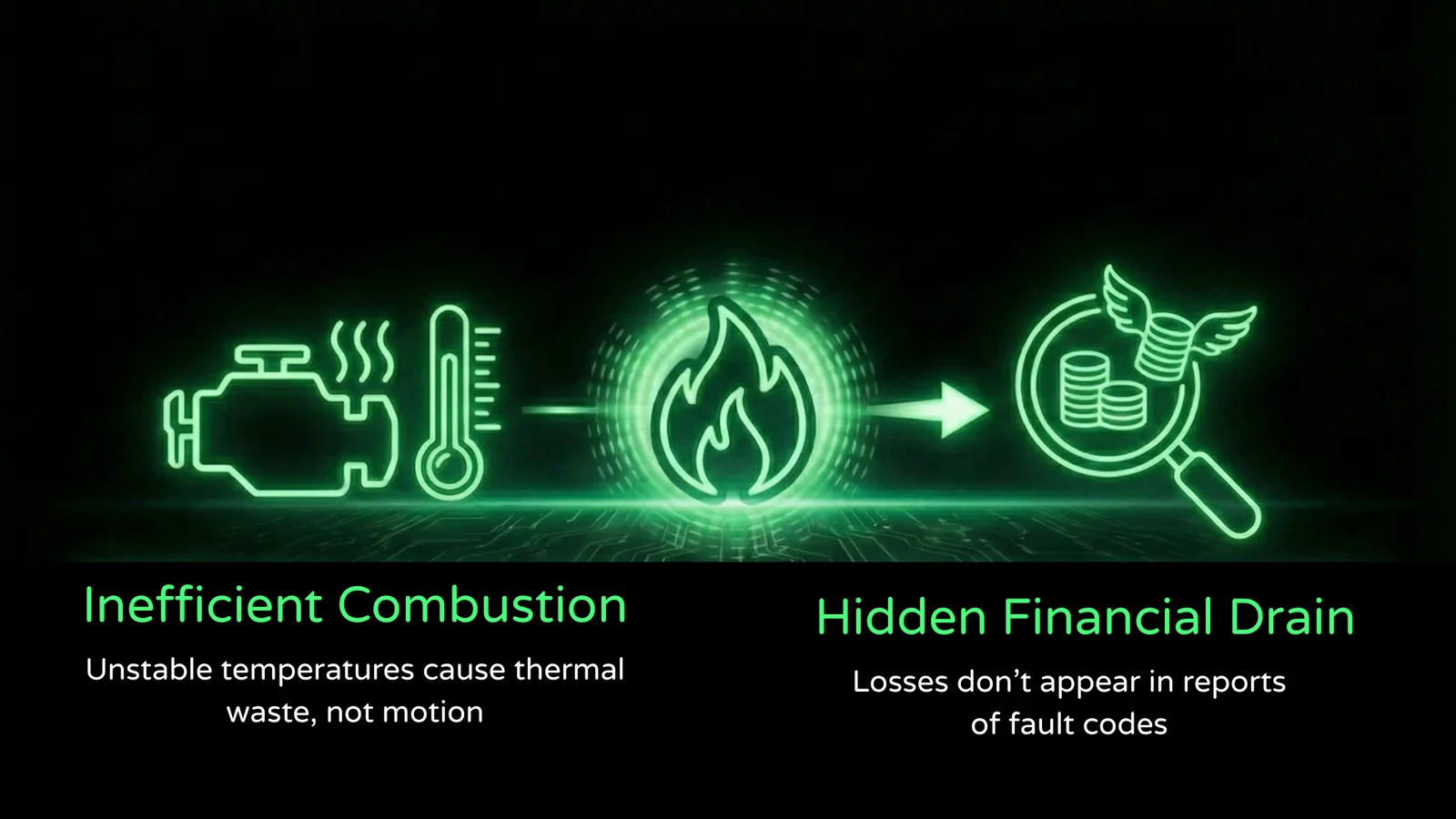
A petrol engine converts only 20–25% of fuel energy into forward motion. A diesel engine reaches 40–45% under ideal conditions. The remainder leaves as waste heat through the exhaust and through the engine block. For a 10-vehicle fleet covering 150,000 km per year each, the cumulative waste is substantial, and a material portion of it is recoverable through improving combustion conditions.
Fuel accounts for 20–40% of fleet costs. Most "healthy" P&Ls ignore the 10%+ lost to thermal waste.
Stop treating fuel as a fixed cost. Efficiency gains offer a faster ROI than cutting operational overhead.
A small gain in fuel efficiency creates a disproportionate 25–30% boost in net operating profit.
The challenge is measurement. Most fleet operators receive a monthly fuel invoice showing total spend across the fleet. Without per-vehicle data, there is no way to know whether a specific vehicle is consuming 8% more fuel than it should because of a sticking EGR valve, under-inflated tyres, or an injector fault. That excess disappears into the fleet average, invisible in the P&L, but entirely real in its cost.
The starting point for improving fleet profitability is making the invisible visible. That means tracking fuel consumption per vehicle, per week, against a benchmark. Once you can see the variation, you can identify the cause and take action.
The Full Fleet P&L: Where the Margin Actually Is
Before quantifying the opportunity, it helps to see exactly how a typical 10-vehicle UK haulage fleet P&L is structured.
| Category | Item | Amount |
|---|---|---|
| Revenue | Total Revenue | £420,000 |
| Direct Costs | Fuel | £148,000 |
| Drivers | £96,000 | |
| Maintenance & Tyres | £38,000 | |
| Agency & Overtime | £22,000 | |
| Gross Margin | After Direct Costs | £116,000 |
| Overheads | Insurance | £18,000 |
| Office & Admin | £14,000 | |
| Compliance & Consultancy | £9,000 | |
| Vehicle Hire (Cover) | £21,000 | |
| Net Profit | Final Operating Profit | £54,000 |
The numbers above represent a typical UK operation, not an outlier. A fleet generating £420,000 in annual revenue and running 12.9% net margin is not a failing business. It is a normal, functioning fleet.
But examine the structure closely:
- Fuel at £148,000 represents 35% of total revenue, and it is the largest single line item in the business
- Net profit at £54,000 is sitting on top of a cost base where one line item is three times larger than the profit itself
- A 10% reduction in the fuel line (£14,800) represents 27% of current net profit
No other single lever in this P&L delivers that ratio. Cutting insurance is hard, slow, and requires negotiating with multiple providers. Reducing driver costs requires operational restructuring. Cutting compliance spend creates regulatory risk.
Improving fuel efficiency by 10% through better combustion reduces the fuel line and adds directly to net profit. The overhead structure stays the same. The revenue stays the same. Only the fuel cost changes, and every pound saved falls straight to the bottom line.
Before & After: What a 10% Fuel Improvement Does to the P&L
The comparison below shows the same fleet P&L, before and after a 10% fuel efficiency improvement.
A 10% fuel efficiency gain on a £148,000 fuel bill saves £14,800/year, lifting net profit by +27%.
Figures illustrative, based on a typical UK fleet P&L with £148k annual fuel spend.

The mechanism behind the "Optimised" column is not a hypothetical. It reflects the documented outcome of improved combustion completeness: more of the fuel charge burns during the power stroke, producing more mechanical work per litre of fuel consumed.
FuelMarble achieves this through the cooling system rather than the fuel system. By placing its hydrophilic mineral in the coolant reservoir, it alters how the coolant interacts with the engine wall, specifically eliminating the vapour boundary layer that traps heat at cylinder surfaces. The result is an 8–12°C reduction in cylinder wall temperature (Kurume Institute of Technology data), which increases charge air density and allows more complete combustion.
The 10% efficiency figure used in the comparison above is deliberately conservative. Verified field testing across multiple vehicle types documents 7–15% efficiency gains. A fleet achieving the upper end of that range would see net profit rise to about £76,200, a 41% gain from a single operational change.
The Fuel Cost of Depot Idling: Data, Alternatives, and What It Costs Your Fleet
How Much Fuel Does Idling Actually Waste?
Idling is deceptive as a cost centre because it appears on the fuel invoice as part of the fleet total, invisible in the same way that per-vehicle fuel variation is invisible without per-vehicle tracking.
Published data from the U.S. Department of Energy's Alternative Fuels Data Center (covering medium-duty and heavy-duty truck idling research) provides the baseline figures most fleet operators have never seen applied to their own P&L:
| Vehicle Class | Idle Fuel Consumption | Annual Idle Cost (90 min/day, 250 days) |
|---|---|---|
| Medium-duty truck (3.5–7.5t) | 0.8–1.0 L/hr | £270–£338/vehicle |
| Heavy-duty truck (18t+) | 1.5–2.5 L/hr | £506–£844/vehicle |
| Refrigerated trailer (TRU running) | 1.8–3.2 L/hr additional | £608–£1,080/vehicle |
Fuel cost calculated at £0.75/litre. Idle time based on 90 minutes per operating day across 250 working days.
For a 10-vehicle medium-duty fleet, that is £2,700–£3,380 per year in fuel spend that produces zero loaded miles. It does not appear as a separate line on the P&L. It is absorbed into the total fuel cost and treated as fixed. It is not fixed.
Why Idling Is Worse Than Just Wasted Fuel
The fuel cost is the measurable part. The maintenance cost is harder to quantify but typically larger.
A diesel engine idling produces exhaust temperatures of 150–250°C, well below the 350–450°C threshold required for passive DPF regeneration. Every idling minute loads the DPF with cold soot without burning any of it off.
The consequence is a shortened passive regeneration cycle: the ECU triggers active regeneration (injecting additional fuel to raise exhaust temps to 550–650°C) more frequently, which:
- Burns extra fuel during the active regen event itself (approximately 0.3–0.5L per event)
- Increases thermal cycling stress on the DPF substrate
- Accelerates ash accumulation, bringing forward the service interval
A vehicle idling 90 minutes per day will typically trigger active regeneration 30–40% more frequently than an equivalent vehicle with managed idle time, translating to £200–£400 in additional annual DPF maintenance cost per vehicle before any hardware replacement is considered.
Idling Reduction Alternatives: What the DOE Research Covers
The DOE's idle reduction research programme identified three primary categories of alternative for commercial fleet operators:
1. Auxiliary Power Units (APUs) Diesel or battery-powered APUs supply cab heating, cooling, and electrical loads during driver rest periods without running the main engine. A diesel APU consumes approximately 0.25–0.4 L/hr, a 70–80% reduction in fuel consumption compared to main engine idling. Capital cost: £4,000–£8,000 per unit. Payback: 18–36 months for operators with significant overnight rest idling.
2. Cab Comfort Technologies (CoolCab Programme) The DOE CoolCab project, a collaboration between the DOE, truck manufacturers, and fleet operators, focused on reducing the thermal load that makes cab idling necessary in the first place. Improvements to cab insulation, reflective glazing, and thermal mass reduce the rate at which cab temperature rises or falls, decreasing the need for climate control during rest periods. A well-insulated cab can maintain a comfortable temperature for 4–6 hours after engine shutdown versus 45–90 minutes in a standard configuration.
3. Engine-Off Policies with Pre-Conditioning The simplest intervention, running the engine for a defined pre-conditioning period before shutdown to stabilise coolant and cab temperature, then enforcing engine-off. When combined with adequate cab insulation, this approach costs nothing beyond driver training and a policy document, and typically reduces main-engine idle time by 40–60% for depot operations.
Applying This to Your Fleet P&L
Using the 10-vehicle fleet example from earlier in this article (£148,000 annual fuel spend):
| Idle Reduction Measure | Estimated Annual Saving | Implementation Cost |
|---|---|---|
| Engine-off policy + driver training | £1,200–£1,800 | £0 |
| CoolCab insulation improvements | £800–£1,400 | £300–£600 per vehicle |
| APU installation (overnight operators) | £2,400–£3,200 | £4,000–£8,000 per vehicle |
| Reduced DPF active regen frequency | £1,800–£3,600 | £0 (consequence of above) |
The engine-off policy is the most accessible starting point, zero capital cost, immediate fuel saving, and measurable reduction in DPF active regeneration frequency.
It is also worth noting that idling reduction and combustion improvement are complementary, not competing. A vehicle that idles less loads its DPF with less cold soot. A vehicle with more complete combustion produces less soot per litre burned. Both reduce the DPF maintenance burden through different mechanisms, and the combination produces a larger total reduction than either achieves independently.
The ROI Proof: What the Numbers Actually Look Like
For fleet operators who prefer to see the calculation before committing to any change, the step-by-step proof below shows exactly what the return looks like.
5-year net saving: £68,810 on a £5,190 investment.
The 128-day payback period assumes the conservative 10% efficiency figure and a fleet of 10 vehicles. For fleets achieving the upper end of the 7–15% range, payback occurs in approximately 85 days.
For comparison: a fuel contract renegotiation that achieves a 2p/litre reduction on a fleet consuming 400,000 litres per year saves £8,000 annually. The same fleet installing FuelMarble saves £26,640–£32,560 annually at documented efficiency levels, three to four times the fuel contract saving, with no supplier relationship to manage and no contract renewal risk.
Four Fleet Audit Checks That Pay for Themselves
Before implementing any technology-based efficiency improvement, it is worth confirming that the operational fundamentals are in place. The four checks below identify the most common causes of invisible fuel waste in commercial fleets.
Fleet averages hide outliers. A vehicle consuming 8% more than its peers has a fault, and it is costing you money every day it goes undetected.
Non-Low-SAPS oil leaves permanent ash in your DPF. Check the oil specification sticker on every vehicle against the manufacturer's requirement, not just the API or ACEA rating.
If any vehicle is triggering active regeneration more than once every few hundred kilometres, investigate the root cause before the filter reaches critical loading.
Idling produces exhaust temperatures below 200°C, too low for passive DPF regeneration. Every idling minute loads the DPF without burning any of it off.
Each of these checks addresses a root cause of fuel inefficiency that will persist regardless of what else is done. A vehicle with a sticking EGR valve, non-Low-SAPS oil, or unmanaged idling will underperform any fuel efficiency improvement layered on top of it.
The order of operations matters:
- Fix the mechanical issues (EGR, injectors, oil specification)
- Manage the operational factors (idling, tyre pressure, route efficiency)
- Apply combustion improvement at the source (FuelMarble)
Attempting step 3 without addressing steps 1 and 2 will still show improvement, but not the full improvement available. The documented 7–15% efficiency gains assume a fleet operating in reasonable mechanical condition.
For fleets that want to understand how FuelMarble specifically reduces DPF maintenance burden as well as fuel costs, the heavy-duty truck maintenance guide covers the full aftertreatment chain and explains how reduced soot production at the combustion stage decreases active regeneration frequency and DPF service costs.
Conclusion: Fuel Efficiency Is the Fastest Route to Margin Improvement
The arithmetic of fleet profitability is unusual compared to most businesses. Because net margins are thin and fuel costs are large, small changes in fuel efficiency produce disproportionately large changes in net profit.
A 10% improvement in fuel efficiency is not an aspirational target. It is the conservative lower bound of documented field results. A fleet achieving this improvement on a £148,000 fuel bill gains £14,800 per year in additional net profit. That is a 27% increase in net operating profit from a single operational change.
The four-step framework for capturing this improvement:
- Make the invisible visible, track fuel consumption per vehicle, not per fleet
- Fix the mechanical root causes: EGR, injectors, oil specification, tyre pressure
- Manage the operational factors: idling, routing, driver behaviour
- Improve combustion at the source, reduce thermal boundary layer, increase charge air density, achieve more complete combustion
Each step builds on the last. The fleet that completes all four steps is not just more fuel-efficient. It is a structurally more profitable business with lower maintenance costs, longer DPF service intervals, and a P&L that is less exposed to fuel price volatility.
For vehicle-specific compatibility and sizing guidance, see the FuelMarble applications page. To see the third-party test data that underpins the efficiency figures used in this article, visit the verified results section.
Related reading:
- How Haulage Costs Are Rising, and What to Do About It
- How a Small Delivery Company Can Save Over £4,000 a Year with FuelMarble
- the fleet fuel efficiency guide for UK operators
- the complete guide to UK haulage and logistics
Calculate your fleet's potential fuel saving, or shop FuelMarble for your fleet.
Related Articles
Avery leads FuelMarble's international operations and strategic direction. With a background spanning fleet economics, regulatory compliance, and macro fuel market trends, Avery oversees commercial partnerships, product positioning, and the company's growth across the UK, US, Canadian, and Mexican markets.
Ready to Improve Your Fuel Efficiency?
FuelMarble delivers up to 15% fuel efficiency improvement. Simple drop-in install.