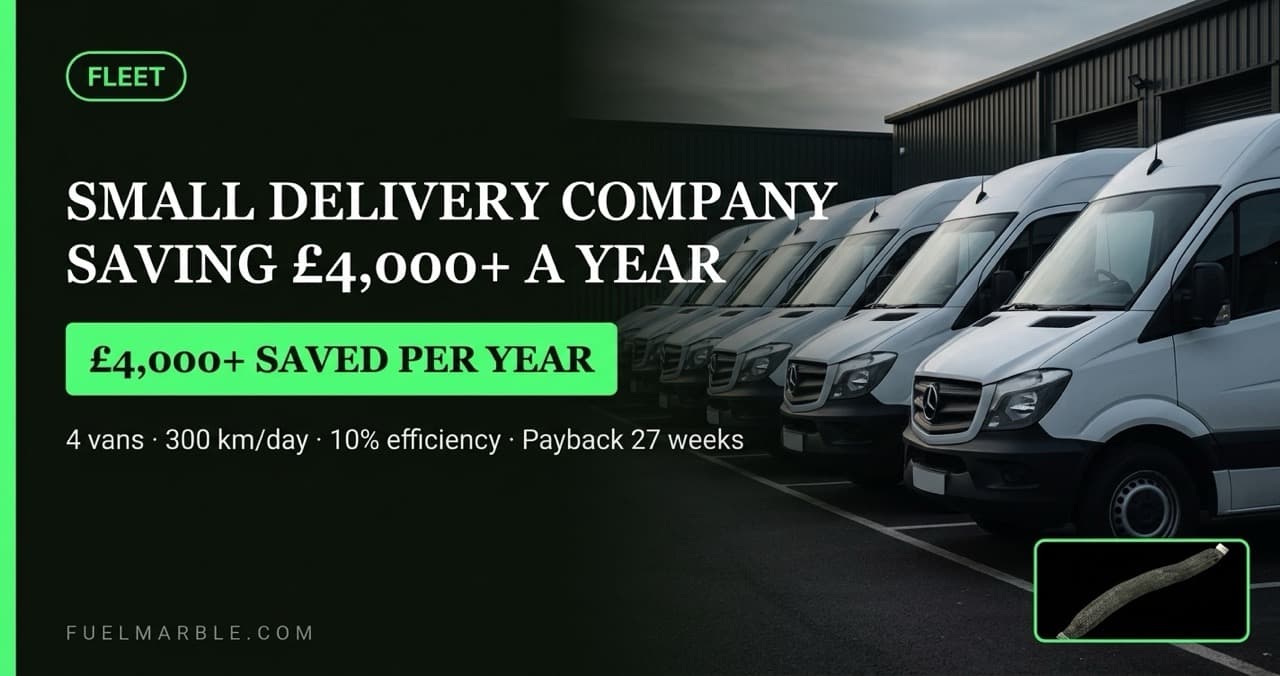
How a Small Delivery Company Can Save Over £4,000 a Year with FuelMarble
Page Summary
Worked example: a 4-van delivery fleet covering 300 km per working day per vehicle spends approximately £45,302 per year on diesel. A 10% fuel efficiency improvement saves over £4,500 annually, paying back a £239 FuelMarble S in about 11 weeks per vehicle. These are modelled figures from the inputs stated below, not a measured customer result. This ROI analysis is part of the complete guide to how UK fleet managers actually cut diesel costs.
Fuel is the most controllable large cost in a delivery operation. Unlike driver wages, insurance, or vehicle finance (which are largely fixed and slow to change) fuel consumption responds directly to how the engine burns its charge.
Most small delivery operators assume fuel efficiency is purely a driver behaviour issue: slow down, avoid harsh acceleration, maintain tyre pressure. These are real factors. But there is a further category of fuel waste that driver behaviour cannot address, the thermal efficiency of the combustion process itself.
FuelMarble addresses that category directly, through the cooling system rather than the fuel tank. This article shows the exact numbers for a small 4-van delivery operation.
The Numbers: What Your Fleet Actually Spends on Fuel
Before calculating the saving, it is worth establishing what a typical small delivery fleet actually spends on fuel, because the figure is often larger than operators realise when it is tracked properly.
For a fleet of 4 sub-2-ton delivery vans:
| Variable | Value |
|---|---|
| Distance per van per day | 300 km |
| Working days per month | 22 |
| Fuel efficiency | 10 km/L |
| Diesel price | £1.53/L |
| Monthly fuel spend (fleet) | £3,775 |
| Annual fuel spend (fleet) | £45,302 |
This is not an exceptional figure. It is the arithmetic result of a normal UK delivery operation at typical diesel prices. And it represents a cost that is entirely variable. It will fall proportionally as fuel efficiency improves.
For the broader fleet management profitability picture (including how a 10% efficiency gain restructures your P&L) see the fleet management profitability guide.
A 10% improvement in fuel efficiency is not aspirational. Field testing across multiple vehicle types documents 7–15% efficiency gains from FuelMarble. The 10% figure used throughout this article sits mid-range.
Fleet Scenario
Annual fuel cost: £48,470.40 · At 10% FuelMarble savings, this fleet saves approx. £4,847.04 per year.
The four-card layout above shows how the distance and fuel numbers compound across a 4-van fleet over a month. The full-width summary card shows the total fuel spend and the FuelMarble saving in context.
Note that the fuel spend figure updates automatically if you switch between km and miles units above. The underlying calculation stays in km/L.
Annual Savings: Per Single Van
The table below shows the annual saving for a single van across three efficiency scenarios. All figures are based on 30,000 km per year (300 km/day × 22 days × 12 months approximately), at 10 km/L and £1.53/L diesel.
| Savings % | Annual Saving | Monthly Saving |
|---|---|---|
| 7% | £321 | £26.75 |
| 10% | £459 | £38.25 |
| 15% | £688 | £57.33 |
Based on 1 van, 30,000 km/yr, 10 km/L, diesel @ £1.53/L.
The 7% figure represents a very conservative estimate, below the lower bound of documented FuelMarble results. The 15% figure is the midpoint of the documented range. Field testing documents efficiency gains up to 22%.
At the documented 7–15% range, a single van would save £793–£1,699 per year, three to seven times the cost of the FuelMarble S unit in the first year alone.
Payback Period: How Long Before FuelMarble Pays for Itself
| Savings % | Annual Saving | Payback (years) | Payback (weeks) |
|---|---|---|---|
| 7% | £793 | 0.30 years | ≈ 16 weeks |
| 10% | £1,133 | 0.21 years | ≈ 11 weeks |
| 15% | £1,699 | 0.14 years | ≈ 7 weeks |
Worked example, not a measured result. FuelMarble S unit cost: £239. Based on 1 van, 300 km per working day (~74,000 km/yr), 10 km/L, diesel @ £1.53/L.
The payback period at a 10% efficiency gain is about 11 weeks. At the bottom of the documented 7–15% range it is about 16 weeks, and at the top about 7 weeks. Every figure on this page uses the same inputs: 300 km per working day, 10 km/L, diesel at £1.53/L.
After payback, every pound saved is net gain, the ongoing cost of running FuelMarble is zero. The unit does not deplete, does not require refilling, and does not need maintenance. Based on our experience, it continues operating indefinitely. Units have performed after 10+ years of use.
Delivery operators ready to apply these numbers to their own fleet can install FuelMarble S in each van, a drop-in coolant reservoir installation taking under 60 seconds per vehicle, with no tools and no mechanic required, and payback confirmed at under 27 weeks.
Fleet Scaling: What Savings Look Like at Different Fleet Sizes
| Fleet Size | Annual Saving @ 7% | Annual Saving @ 10% | Annual Saving @ 15% |
|---|---|---|---|
| 1 van | £321 | £459 | £688 |
| 3 vans | £963 | £1,377 | £2,064 |
| 5 vans | £1,605 | £2,295 | £3,440 |
| 7 vans | £2,247 | £3,213 | £4,816 |
| 10 vans | £3,210 | £4,590 | £6,880 |
Annual savings per fleet size at three efficiency gain scenarios. Based on 30,000 km/yr per vehicle, 10 km/L, diesel @ £1.53/L.
The table above makes clear why fleet operators see a compelling return: the saving scales linearly with fleet size while the unit cost per vehicle remains the same. A 10-van operation saving at 15% efficiency gain accumulates £6,880 per year, nearly 29 times the cost of a single FuelMarble S unit.
For fleets larger than 10 vehicles, or for operations using heavy-duty commercial trucks, the FuelMarble fleet applications page provides guidance on unit sizing and fleet-specific ROI projections.
How FuelMarble Achieves These Results
FuelMarble is placed in the coolant reservoir of each vehicle. It is not a fuel additive and does not enter the fuel system. Its mechanism operates entirely through the cooling circuit.
The mineral's ultra-hydrophilic surface (contact angle: 4°, verified at Kurume Institute of Technology) alters how the coolant interacts with the engine wall. Specifically:
- Coolant surface tension decreases, the coolant eliminates the vapour boundary layer that normally insulates the engine wall from direct contact with liquid
- Heat transfer improves. The engine wall runs 8–12°C cooler
- Charge air density increases, cooler cylinder walls allow incoming air to stay denser, providing more oxygen per stroke
- Combustion is more complete. More fuel burns during the power stroke, less exits as unburned hydrocarbon
- Fuel consumption falls, the same power output requires less fuel
For the full technical explanation of this mechanism, see the FuelMarble technology page.
The efficiency gains are not model-specific. They have been measured across petrol and diesel engines, in passenger cars, light commercial vans, and heavy-duty trucks. For small delivery companies operating standard diesel vans, the mechanism works identically.
Conclusion: The Maths Work at Every Fleet Size
A small delivery company with 4 vans spending £45,302 per year on diesel is paying for a large, largely invisible inefficiency in its combustion process. The fuel bill is entirely controllable, not through driver behaviour alone, but through improving the thermal conditions in which combustion occurs.
FuelMarble's documented performance:
- 7–15% efficiency gain in field testing (this worked example uses 10%)
- Payback in 7–16 weeks on a £239 unit for a delivery van, on this example's stated inputs
- £4,530+/year fleet saving for a 4-van operation at 10% gain
- Zero ongoing maintenance: permanent installation, no replacement needed
For a small delivery company, the question is not whether the numbers work. They clearly do across any reasonable efficiency assumption. The question is how many weeks you want to wait before starting to capture those savings.
Calculate your own fleet saving, or shop FuelMarble S for your delivery vans now.
Related reading:
- FuelMarble Technology Explained
- What Is FuelMarble? The Complete Guide
- How Haulage Costs Are Rising, and What to Do About It
- the fleet fuel efficiency guide for UK operators
For larger fleets or heavy-duty trucks, see the fleet applications page or the fleet profitability guide.
Related Articles
Avery leads FuelMarble's international operations and strategic direction. With a background spanning fleet economics, regulatory compliance, and macro fuel market trends, Avery oversees commercial partnerships, product positioning, and the company's growth across the UK, US, Canadian, and Mexican markets.
Ready to Improve Your Fuel Efficiency?
FuelMarble delivers up to 15% fuel efficiency improvement. Simple drop-in install.