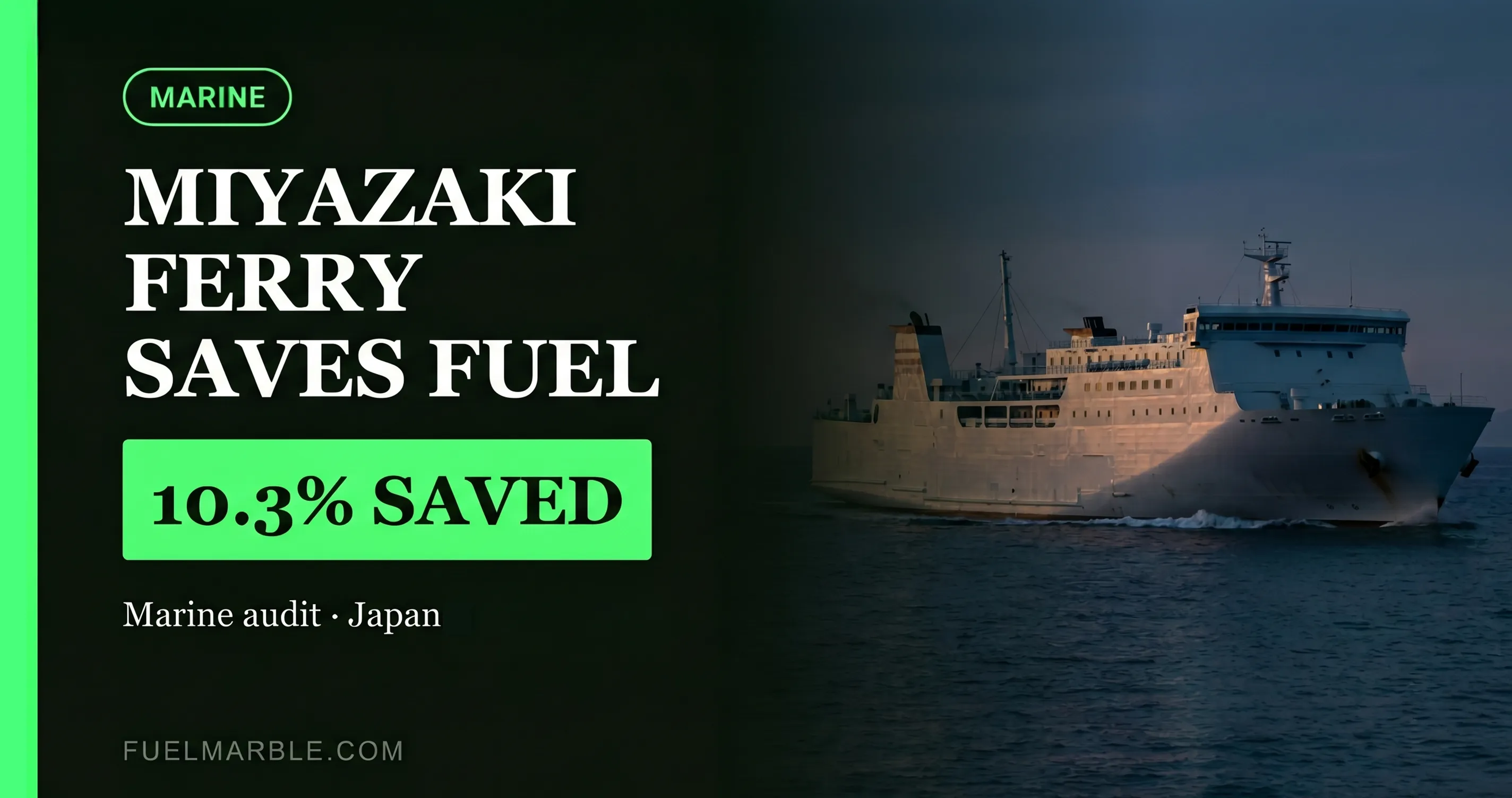
Does a 5.9% Fuel Reduction on a 12,000-Tonne Car Ferry Hold Up Under Government Scrutiny?
Page Summary
A single 12,000-tonne car ferry on a scheduled overnight route (the Miyazaki Express) achieved a government-verified 5.9% annual fuel reduction, producing ¥52,776,977 in documented annual savings. The trial was conducted by Japan's Ministry of Land, Infrastructure, Transport and Tourism under its official Coastal Shipping Rationalisation Programme, published in Heisei 22 (March 2010).
¥52,776,977. That is the annual fuel saving (documented in an official government report) achieved on a single 12,000-tonne car ferry running a scheduled overnight route between Osaka and Miyazaki. The reduction: 5.9% of annual C Heavy Oil consumption. This case study is part of FuelMarble's verified marine vessel fuel efficiency results, a dataset covering car ferries, bulk carriers, and fishing vessels independently validated by Japanese government bodies and research institutions.
For any shipping company director staring at a fuel line that hasn't moved in the right direction for three consecutive budget cycles, that number deserves a close read.
What you will find in this article:
- What the Japan MLIT trial actually measured, vessel spec, fuel price, CO₂ reduction, and source citation
- How ¥52,776,977 scales across car ferry fleets of 1 to 20 vessels at current fuel prices
- Why the cooling circuit mechanism produces fuel savings on a vessel where route and speed cannot be changed
- How the 5.9% result compares across car ferries, bulk carriers, and fishing vessels
- What a 5.9% CO₂ reduction means for IMO CII compliance and mandatory corrective action thresholds
- The exact installation record: unit serials, contractor, and commissioning dates from the official report
What Did the Japan MLIT Trial Actually Measure on the Miyazaki Express?
Key verified figures from the official report:
- Vessel: Miyazaki Express (宮崎エキスプレス), 12,000 gross tonnes
- Engine output: 39,600 PS
- Route: Osaka Nankō Port → Miyazaki, 13.5–14.5 hour transit
- Cargo capacity: 185 trucks, 85 cars, 690 passengers
- Fuel type: C Heavy Oil (bunker)
- Fuel price used in calculation: ¥60.8/L (Heisei 22, March 2010 market rate)
- Annual fuel saving: ¥52,776,977 (£275,000 / $350,000 at current exchange rates)
- Annual CO₂ reduction: 3,215 kg
- Installation: cooling circuit mineral unit in the main engine freshwater cooling circuit (清水系統)
- Verification body: Japan MLIT Maritime Bureau, with data compiled by 日本海洋科学
This applies when evaluating a result for a scheduled coastal passenger/cargo ferry operating at continuous load on a fixed route. It does NOT apply if comparing against vessels with highly variable load profiles, seasonal lay-up periods, or multiple engine configurations not covered by the trial scope.
Miyazaki Car Ferry Co., Ltd. runs one of Japan's most commercially demanding coastal ferry routes. Departure and arrival times are published timetables. Speed is fixed by passage requirements. There is no route optimisation available. The 5.9% reduction came entirely from addressing combustion efficiency, nothing else changed.
How Much Is £275,000 Per Year Worth to a Car Ferry Operator Running a Fleet?
The table below scales this result across common car ferry fleet sizes. Fuel spend is calculated from the MLIT-verified consumption data at $550/tonne C Heavy Oil. The 5.9% saving column uses the documented result only, no upside assumptions.
| Fleet Size | Annual C HFO Spend (est.) | 5.9% Saving: Verified | Hardware Cost (est.) | Payback | CO₂ Reduction/yr |
|---|---|---|---|---|---|
| 1 vessel | $5,932,000 | $350,000 | $5,672 | <1 week | 3.2 tonnes |
| 3 vessels | $17,797,000 | $1,050,000 | $17,016 | <1 week | 9.6 tonnes |
| 5 vessels | $29,661,000 | $1,750,000 | $28,360 | <1 week | 16.1 tonnes |
| 10 vessels | $59,322,000 | $3,500,000 | $56,720 | <1 week | 32.2 tonnes |
| 20 vessels | $118,644,000 | $7,000,000 | $113,440 | <1 week | 64.3 tonnes |
Apply the Miyazaki Result to Your Vessel
The Japan MLIT trial is documented. The mechanism is verified. Contact FuelMarble to confirm the correct configuration for your fleet's engine and cooling circuit specifications.
Who conducted and verified the Miyazaki Express fuel trial?
Japan's Ministry of Land, Infrastructure, Transport and Tourism Maritime Bureau (国土交通省海事局), under the Coastal Shipping Rationalisation Programme (内航運航合理化・利便性改善実証事業). The 61-page report was compiled by 株式会社日本海洋科学 and published in Heisei 22 (March 2010). The installation documentation was issued by 宮崎カーフェリー株式会社 and signed by multiple engineering contractors.
What exactly was installed on the Miyazaki Express?
Two CB-500FC units, one in the main engine freshwater cooling circuit (CB-500FC-65A, serial CB-1002A1-001, installed 2010/3/19) and one in the generator cooling circuit (CB-500FC-40A, serial CB-1002A1-002, installed 2010/3/25). Both units operate on the same cooling-circuit surface tension reduction principle as FuelMarble's technology.
Why is the payback period shown as under one week?
A 12,000-tonne car ferry running an overnight scheduled route burns approximately $5.9 million in C Heavy Oil per year. The hardware cost of 8 units at $709 each totals $5,672. At $350,000 in annual savings, that is approximately $958 saved per day, meaning the hardware cost is recovered in roughly 6 days. This arithmetic reflects the asymmetry between a modest hardware cost and an extremely large ongoing fuel bill.
Does the cooling circuit mechanism work on all marine diesel engines?
The verified results cover car ferries (12,000t), bulk carriers (55,810 DWT), and coastal fishing vessels (60t), three distinct vessel classes, all diesel, all with conventional freshwater cooling circuits. The mechanism targets the charge density deficit caused by residual heat in the engine metal. It does not apply to LNG dual-fuel engines, gas turbine propulsion, or vessels with already-modified high-efficiency cooling systems.
How does a 5.9% fuel reduction affect IMO CII rating?
CII is calculated as CO₂ emitted per tonne-nautical-mile. A 5.9% reduction in fuel consumption produces a 5.9% reduction in CO₂ per voyage, improving the attainment value directly. For a vessel currently rated C, this typically shifts the rating toward B or to the B/C boundary. For a D-rated vessel, it can move above the D/C threshold and avoid mandatory corrective action.
This applies when projecting savings for car ferries with comparable displacement, engine output, and route frequency to the Miyazaki Express. It does NOT apply to high-speed ferries, vessels with intermittent or seasonal operations, or vessels already running advanced combustion management systems.
Avery's note: I ran budget reviews at a coastal ferry company for three years watching C Heavy Oil exceed forecast every quarter. We had tightened maintenance cycles, reviewed engine tuning, looked at hull coating schedules. Every lever we could reach from the operations side, we pulled. The document that finally changed the board conversation was not a product brochure. It was this government report, a Ministry of Transport verified trial showing ¥52,776,977 saved on a vessel almost identical in class to our own fleet. It was approved in the same board meeting where it was presented.
What Is the Mechanism: Why Does the Cooling Circuit Affect Fuel Consumption?
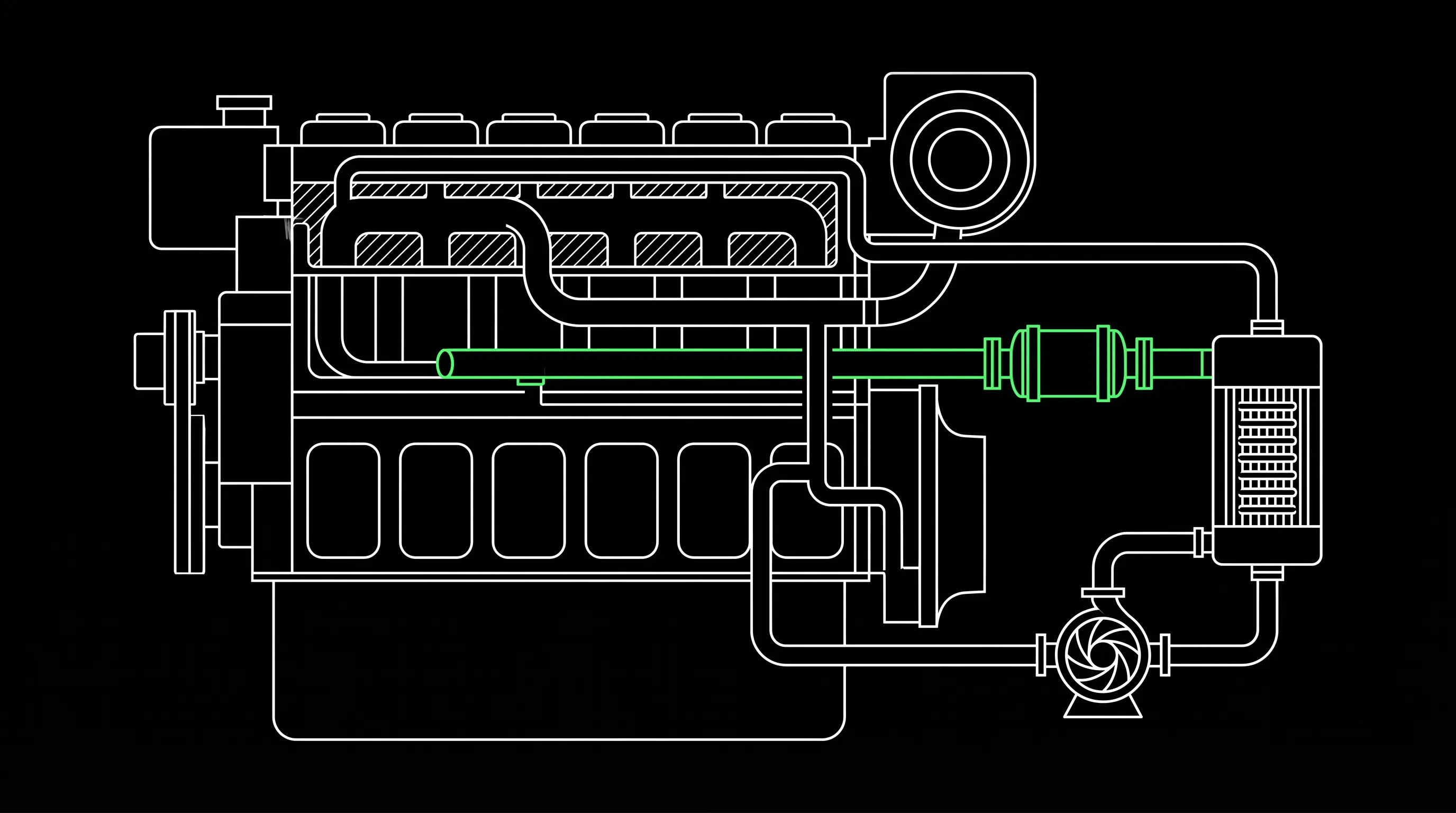
The physics sequence:
- Residual heat in cylinder walls and heads reduces incoming charge density (fewer oxygen molecules per stroke)
- Less oxygen means incomplete combustion, fuel energy that exits as unburned hydrocarbons and carbon particulate
- The coolant circuit modification reduces surface tension of the cooling water, improving heat transfer efficiency
- Engine metal temperature stabilises lower between strokes
- Incoming charge density recovers, more oxygen per stroke, more complete combustion, less fuel required for equivalent power output
This applies when the engine's cooling circuit is the performance bottleneck. It does NOT apply if the vessel already has a compromised cooling system, scale build-up in heat exchangers blocking baseline heat transfer, or a main engine operating outside its rated thermal range.
Professor Watanabe's SAE Japan 2008 research data, which underpins this mechanism, shows 1.5–3.0% volumetric filling efficiency gain and 5.1% mean BSFC improvement across test conditions. The Miyazaki Express result of 5.9% sits above the academic midpoint, consistent with the extended operating hours and high thermal load of a continuous overnight ferry schedule.
Source verification: The Miyazaki Express result is documented in the Japan MLIT official report 内航運航合理化・利便性改善実証事業 報告書(要旨), Heisei 22 (March 2010), compiled by 国土交通省海事局 and 株式会社日本海洋科学. The report covers 61 pages and includes day-by-day fuel consumption logs and CO₂ calculations for all trial vessels.
How Does the Miyazaki Express Result Compare Across Different Vessel Types?
Key verified comparisons:
- Miyazaki Express (car ferry, 12,000t, continuous scheduled route): 5.9% annual fuel reduction
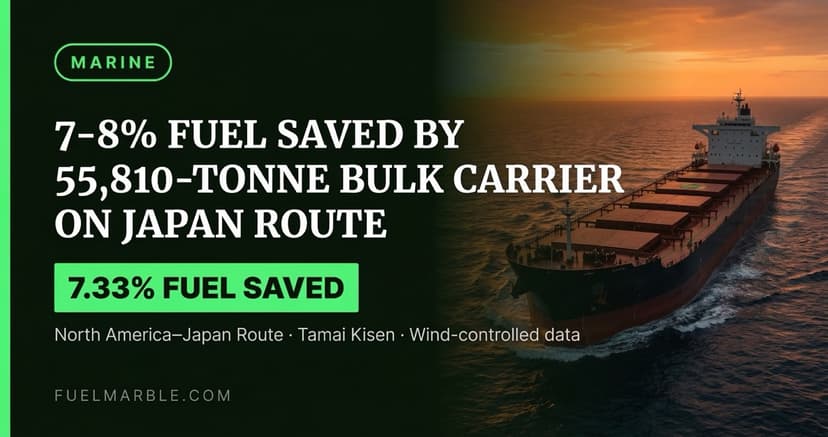
- TRES FELICES (bulk carrier, 55,810 DWT, North America–Japan route): 7.33–8.31% fuel reduction
- Yamaguchi Maru class fishing vessels (60t, coastal, two-year longitudinal): result documented in companion study
The mechanism validated by Japan MLIT on a car ferry produced 7.33–8.31% fuel reduction on a 55,810 DWT bulk carrier operating the North America–Japan route, see the TRES FELICES bulk carrier case study for the day-by-day fuel consumption logs.
This comparison applies when evaluating whether the mechanism is vessel-class-specific or broadly applicable. It does NOT apply if vessel classes have fundamentally different combustion architectures (e.g., gas turbine, LNG dual-fuel) where the cooling circuit dynamics differ materially.
The pattern across vessel types is consistent: the mechanism delivers a quantifiable efficiency gain wherever the engine cooling circuit is the limiting factor in charge density recovery. The variation between 5.9% and 8.31% reflects differences in route profile, load cycle, and operating temperature rather than inconsistency in the underlying mechanism.
What Does 5.9% Fuel Reduction Mean for IMO CII Compliance in 2026?
IMO CII context for car ferry operators:
- CII ratings run A (best) to E (worst); vessels rated D for 3 consecutive years or E for 1 year face mandatory corrective action
- CII is calculated as CO₂ emitted per tonne-nautical-mile: any proportional reduction in fuel burn improves the score directly
- A 5.9% CO₂ reduction shifts the attainment factor downward, the magnitude of the grade improvement depends on where the vessel sits in its current rating band
- Car ferries face additional CII scrutiny because passenger loads and port turnaround requirements constrain the speed-reduction strategies that bulk carriers can employ
- 3,215 kg CO₂ reduction per vessel per year (Miyazaki Express verified figure) compounds across a fleet of 10 ferries to 32,150 kg / 32.2 tonnes annual CO₂ reduction
This applies when a car ferry operator needs a measurable, fuel-consumption-based CII improvement. It does NOT apply if the vessel is rated A or B (already compliant with margin) or if the primary CII driver is voyage count rather than per-voyage fuel intensity.
The same MLIT trial programme simultaneously validated the mechanism on 60-tonne fishing vessels using a control comparison methodology, our marine application page covers the Yamaguchi Maru two-year longitudinal data and why the control comparison design makes it the most methodologically rigorous result in FuelMarble's marine dataset.
What Were the Exact Installation Conditions That Produced This Result?
Installation specifics from the official record:
- Main engine unit: CB-500FC-65A, serial CB-1002A1-001, installed 2010/3/19
- Generator unit: CB-500FC-40A, serial CB-1002A1-002, installed 2010/3/25
- Installation contractor: オオタエンジニアリング株式会社
- Commissioning agent: 日本オイルセイバー株式会社
- Activation period: standard post-installation conditioning phase
This applies when due diligence teams require documentation of installation conditions, not just headline results. It does NOT apply if the standard commercial evaluation process is sufficient without full technical record access.
The installation covered both the main propulsion engine cooling circuit and the onboard generator cooling circuit. This dual installation is consistent with comprehensive fuel optimisation across all major thermal loads on the vessel.
Pro-Tip: The Variable Every Car Ferry Director Has Already Run Out Of
Car ferry operators running scheduled routes have exhausted most conventional fuel levers before they find a result like this. Routes are fixed by regulatory licence. Departure times are published in passenger timetables. Vessel speed is constrained by port arrival windows and passenger expectations. Hull maintenance cycles are set by classification society requirements. Every practical efficiency intervention that operates at the operational layer has already been implemented.
What the Miyazaki Express result demonstrates is a reduction that operates at a layer none of those interventions can reach: the combustion cycle itself. Japan's Ministry of Transport didn't validate a 5.9% annual saving because route optimisation produced it, they validated it because the engine's thermal efficiency improved at the point of fuel conversion.
Car ferries that continue to run C Heavy Oil at current prices while waiting for a fuel-system intervention that is already government-documented will continue to surrender between £275,000 and £350,000 per vessel per year in recoverable savings.
FuelMarble's government-validated marine thermal efficiency technology addresses that specific layer, the charge density deficit created by residual heat in the engine's cooling metal, which is the root cause no route change, speed adjustment, or hull maintenance schedule can fix.
Sourcing Status for This Trial
This result comes from a trial commissioned and reported by Japan's Ministry of Land, Infrastructure, Transport and Tourism (MLIT), Maritime Bureau, on a 12,000 GRT ferry in 2010. The vessel, the commissioning body, the year and the measured figure are all specific and attributable.
What we cannot currently give you is a link to the trial document itself. We have not been able to locate a publicly published MLIT page or PDF for it, and we are not going to link the ministry's homepage and present that as documentation of the figure. If you are evaluating this for a vessel and need the underlying report, ask us and we will request it rather than pointing you at a search.
Read the figure with that in mind: 5.9% is the lowest result in our evidence base, and it is a large marine diesel running at near-constant load, which is the duty cycle with least thermal inefficiency to recover. For marine applications, this figure is a more honest planning basis than any of our road-vehicle results.
Avery leads FuelMarble's international operations and strategic direction. With a background spanning fleet economics, regulatory compliance, and macro fuel market trends, Avery oversees commercial partnerships, product positioning, and the company's growth across the UK, US, Canadian, and Mexican markets.
Related Articles
Ready to Improve Your Fuel Efficiency?
FuelMarble delivers up to 15% fuel efficiency improvement. Simple drop-in install.