How Can a Diesel Fleet Reduce Its Emission Output and Operating Costs Without Replacing Every Vehicle?
How Can a Diesel Fleet Reduce Its Emission Output and Operating Costs Without Replacing Every Vehicle?

Diesel fleet operators facing emission pressure have three levers: pay zone charges, replace vehicles, or reduce actual emission output per vehicle. The third option costs the least and delivers returns in weeks — but it requires understanding exactly what it can and cannot fix. This article is part of the complete guide to how UK fleet managers actually cut diesel costs, focusing specifically on emission compliance. Every practical step in this guide works through the same mechanism — improving combustion completeness — which is why the verified emission reduction results from independent testing are the evidence base for everything that follows.
Full fleet electrification is the obvious answer on paper — but why fleets are retreating from the EV transition explains why most operators cannot execute it on the timelines regulators are assuming. So if new vehicles are not viable right now, what does a practical action plan look like?
What Emission Standards Does Your Diesel Fleet Actually Face Right Now?
Diesel fleet operators are now operating under four simultaneous compliance pressures — and most are misreading which one carries the highest immediate financial risk.
The four active compliance frameworks are:
- Clean Air Zones (UK) and ULEZ (London): Compliance is based on a vehicle's registered Euro emission standard — not a tailpipe test result. Diesel cars and vans under 3.5 tonnes must be Euro 6 to avoid the £12.50/day ULEZ charge. HGVs over 3.5 tonnes in the London Low Emission Zone must meet Euro VI or face £100/day (failing Euro VI for NOx/PM) or £300/day (failing Euro IV entirely). The enforcement system is ANPR camera plus DVLA database lookup — no physical emissions test is involved.
- Euro VII (EU and UK): Proposed to cut NOx limits by 56% versus Euro VI for new type approvals from 2027 onward for HGVs. Existing fleets are not directly affected by type-approval rules, but operators in regulated zones will face growing exclusion pressure as zone thresholds tighten.
- IMO 2030 / CII Regulations: For maritime operators, the Carbon Intensity Indicator (CII) rating system came into force in 2023. Vessels rated D or E in three consecutive years face mandatory improvement plans.
- Scope 3 Reporting (CSRD and UK SDR): From 2025–2026, large companies must disclose Scope 3 emissions including logistics and freight. Fleet operators supplying CSRD-covered clients face contractual sustainability obligations — which are measured by actual fuel consumption and CO₂ output, not Euro standard classification.
This applies when your fleet operates diesel vehicles in the UK, EU, or on international maritime routes — it does NOT apply if your entire fleet has already been converted to BEV or hydrogen, or if you operate exclusively outside any designated emission zone.
Regulatory Fact — UK CAZ & ULEZ
Zone compliance is an administrative database check — not an emissions test
TfL and local Clean Air Zone authorities determine compliance by looking up a vehicle's registered Euro emission standard on the DVLA database when its numberplate is read by ANPR camera. They do not measure what comes out of the exhaust. A vehicle's Euro standard is fixed at manufacture and type-approval — it cannot be changed by any aftermarket device.
The only recognised retrofit pathway (CVRAS — full SCR/DPF exhaust overhauls costing £6,000–£17,000) was closed to new accreditations in September 2024.
Aftermarket combustion improvement devices like FuelMarble affect fuel economy, CO₂ output, MOT emissions results, and Scope 3 carbon reporting — not a vehicle's DVLA-registered Euro standard or zone compliance status.
In my experience working through board-level compliance reviews with directors running mixed urban-and-regional fleets, the Scope 3 obligation is the one that catches operators off guard. A fleet manager described it precisely: the team had focused entirely on daily ULEZ charge exposure, then a major client sent a supplier sustainability questionnaire that nearly cost them the contract. Clean Air Zone charges are visible because they hit the accounts daily. Scope 3 is invisible until a customer makes it visible.
For a clear breakdown of what the UK diesel ban actually covers and when, is the UK diesel lorry ban real separates fact from headline.
What Does Replacing Your Fleet Actually Cost Versus What Zone Charges Actually Cost?
For most operators, fleet replacement is not viable on the timelines regulators are assuming — and the numbers make this concrete.
The real cost comparison:
- EV HGV purchase cost: £250,000–£400,000 per vehicle (2024 UK market). A 20-vehicle fleet: £5–£8 million capex before infrastructure.
- EV charging infrastructure: £15,000–£80,000 per depot charging point for HGV-rated units. Multi-vehicle fleets need multiple points.
- Availability: Electric HGVs capable of sustained long-haul routes remain limited in supply, with 12–24 month delivery lead times.
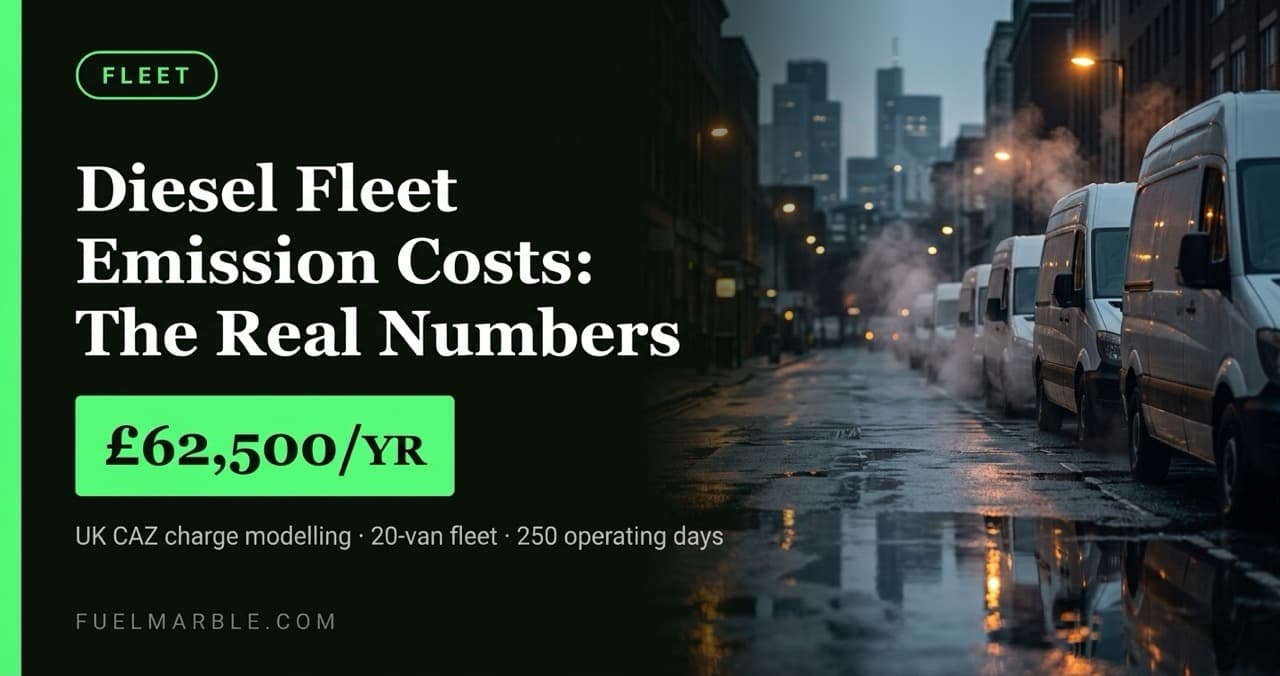
- London ULEZ charge (non-compliant van, under 3.5t): £12.50/day. A 20-van fleet making daily ULEZ entries: £12.50 × 20 × 250 days = £62,500/year in charges alone — before any non-payment penalties.
- London LEZ charge (non-compliant HGV, over 3.5t, failing Euro VI NOx/PM): £100/day. A 5-HGV fleet making daily LEZ entries: £100 × 5 × 250 days = £125,000/year.
This applies when your fleet vehicles regularly enter a designated Clean Air Zone or the London ULEZ/LEZ and do not meet the required Euro standard — it does NOT apply if your vehicles are already Euro 6/VI compliant, or if your routes do not enter any designated zone.
Here is where the numbers became a board decision. I was involved in a review for a courier operation running 20 vans on daily urban deliveries in a newly expanded CAZ. The options on the table: pay the daily charge (£62,500/year ongoing), replace with EVs (£800,000+ capex with an 18-month delivery queue and no depot infrastructure), or improve combustion efficiency with FuelMarble to reduce fuel costs and CO₂ output for Scope 3 reporting. The third option cost £10,380 one-time. It did not change the vehicles' ULEZ compliance status — but it cut fuel spend and reduced the CO₂ output that the fleet's biggest client was measuring under Scope 3. For operators whose compliance problem is contractual rather than regulatory, that is a meaningful distinction.
What Are the Four Actions That Reduce Diesel Fleet Emissions Without New Vehicles?
Four actions reduce actual emission output on existing diesel vehicles. Ranked here by cost-per-tonne of CO₂ equivalent reduced.
Ranked from highest to lowest impact-per-pound:
- Combustion improvement (thermal): Addressing cylinder wall temperature to improve combustion completeness. Targets the source of CO, HC, and PM output — not the downstream filter. Verified results: up to 93% CO reduction, 98% NOx reduction, 10.34% CO₂ reduction in independent testing. Does not affect DVLA-registered Euro standard or ULEZ/LEZ compliance status. Value is in fuel cost, MOT results, and Scope 3 carbon reporting.
- DPF and SCR maintenance: A clogged DPF forces partial regeneration cycles, releasing concentrated PM bursts. A functioning SCR system reduces NOx. Keeping these systems clean and operational is the minimum floor — nothing else works properly without it.
- Driver behaviour training: Hard acceleration from cold increases incomplete combustion by 30–40% in the first five minutes of operation. Smooth warm-up protocols and steady-state cruising reduce NOx and PM output measurably on any vehicle.
- Fuel quality management: Contaminated or low-cetane diesel reduces combustion efficiency. Fleet operators using on-site storage tanks without regular testing consistently show higher HC and CO outputs across the fleet.
This applies when vehicles are mechanically sound and the DPF/SCR system is not already past its service threshold — it does NOT apply if the aftertreatment system is flagged for replacement on diagnostic scan, in which case maintenance action is required first.
The full Euro VI aftertreatment chain — DPF, SCR, EGR, DOC — and how each component interacts with combustion efficiency is covered in the complete heavy-duty truck emission systems guide.
How Much Actual Emission Reduction Is Achievable on an Existing Vehicle, and How Fast?
Verified independent testing shows reductions far beyond what most fleet managers expect to be possible without engine modification — but the value of these reductions is in operating costs and carbon reporting, not zone compliance reclassification.
Verified results from independent testing across three countries:
- CO (carbon monoxide): Reduced by up to 93% in standardised exhaust testing
- HC (hydrocarbons): Reduced to near-zero measurable output in multiple test cycles
- NOx (nitrogen oxides): Reduced by up to 98% in tested load ranges
- CO₂: Reduced by 10.34% in the Indonesia driving trial (Honda Freed MPV, 2012, 1500cc, 106,045km odometer — a high-mileage real-world vehicle)
- Fuel efficiency gain: 21.75% in the same Indonesia trial
Emission Output: Before vs After FuelMarble Installation
Source: Independent testing — Kurume Institute of Technology (Japan) · Jakarta driving trial (Indonesia, 2023)
% of pre-installation baseline (lower = better)
The mechanism behind these results is a cylinder wall temperature reduction of 8–12°C, confirmed in laboratory testing by Professor Watanabe at Kurume Institute of Technology. This temperature reduction improves coolant contact area with the water jacket wall, increasing heat extraction efficiency per combustion cycle. The result is more complete combustion: more CO₂ and H₂O per cycle, less CO, HC, and PM soot.
This applies when the vehicle's cooling system is intact and the coolant circuit is functioning normally — it does NOT apply to air-cooled engines or vehicles with active cooling system faults.
For a fleet running 20 Euro V vans on daily ULEZ routes, these results do not change zone compliance status — the vehicles remain Euro V on the DVLA register and still accrue ULEZ charges. What changes is: fuel spend per kilometre, CO₂ output per kilometre for Scope 3 reporting, and the actual pollutant concentrations in MOT emissions checks. For operators whose biggest pressure is a client sustainability audit rather than a government zone charge, this is the correct framing.
The Operating Cost Comparison: What Does the Real Financial Exposure Look Like at Your Fleet Size?
The table below converts emission-related operating costs into a financial decision matrix. It separates zone charge exposure (which FuelMarble does not affect) from the fuel and Scope 3 cost savings (which FuelMarble does affect) so the decision calculus is clear.
Fleet Operating Cost Matrix: Zone Charges vs Fuel & Carbon Costs
Two separate cost types. Zone charges are fixed by Euro standard — FuelMarble has no effect. Fuel and Scope 3 carbon costs are driven by combustion efficiency — FuelMarble directly reduces these.
| Fleet Size | Vehicle Type | Zone / Charge | Annual Charge | How to Fix |
|---|---|---|---|---|
| 5 Vans | Diesel, pre-Euro 6, ≤3.5t | ULEZ £12.50/day | £15,625/yr | Vehicle upgrade or CVRAS retrofit only |
| 10 Vans | Diesel, pre-Euro 6, ≤3.5t | ULEZ £12.50/day | £31,250/yr | Vehicle upgrade or CVRAS retrofit only |
| 20 Vans | Diesel, pre-Euro 6, ≤3.5t | ULEZ £12.50/day | £62,500/yr | Vehicle upgrade or CVRAS retrofit only |
| 5 HGVs | Diesel, pre-Euro VI, >3.5t | LEZ £100/day | £125,000/yr | Vehicle upgrade or CVRAS retrofit only |
| Fleet Size | Est. Annual Fuel Spend | FuelMarble Fuel Saving (7–15%) | CO₂ for Scope 3 | FuelMarble Cost | Payback |
|---|---|---|---|---|---|
| 5 Vans | ~£37,500 | £2,625–£5,625/yr | ~3.3–7.1 tCO₂e/yr | £2,595 | 5–9 months |
| 10 Vans | ~£75,000 | £5,250–£11,250/yr | ~6.6–14.3 tCO₂e/yr | £5,190 | 5–9 months |
| 20 Vans | ~£150,000 | £10,500–£22,500/yr | ~13.2–28.6 tCO₂e/yr | £10,380 | 5–9 months |
| 5 HGVs | ~£187,500 | £13,125–£28,125/yr | ~33–71 tCO₂e/yr | Contact for pricing | ~5–7 months |
* Fuel spend estimates based on ~15,000 litres/year/van at ~£1.50/litre (HMRC / RHA 2024). HGV: ~50,000 litres/year/vehicle. Saving range reflects the independently verified 7–15% fleet improvement range. CO₂: BEIS 2024 diesel factor 2.544 kgCO₂e/litre. FuelMarble pricing for FuelMarble L (van/LCV). Contact FuelMarble for HGV-rated product pricing.
See Verified Test Data →The Root Cause Your Fleet Is Missing
The four actions above are all worth doing. If you implement them — combustion improvement, DPF maintenance, driver training, fuel management — you will reduce your fleet's actual emission output and fuel costs measurably.
But here is what the pattern data shows. Fleets that treat emission output as a maintenance problem — clean the DPF, retrain the drivers, retest — find themselves back at the same emission levels within 12–18 months. The DPF loads at the same rate because the underlying soot production rate has not changed.
The root cause is combustion completeness at the thermal level. Each combustion cycle in an unmodified diesel engine produces a predictable quantity of incomplete combustion byproducts — CO, HC, and particulate soot — because the cylinder wall temperature creates a partial quench zone where the flame front cannot fully burn the charge.
That is the mechanism a coolant-based combustion improvement device with verified 93% CO and 98% NOx reduction targets at the source. By reducing cylinder wall temperature by 8–12°C through coolant modification — no engine contact, no fuel system modification — it increases combustion completeness on every engine cycle. The result is a permanent reduction in what your engine produces per litre of fuel burned: lower fuel cost, lower CO₂ output for carbon reporting, and cleaner exhaust at the point of measurement.
Avery leads FuelMarble's international operations and strategic direction. With a background spanning fleet economics, regulatory compliance, and macro fuel market trends, Avery oversees commercial partnerships, product positioning, and the company's growth across the UK, US, Canadian, and Mexican markets.
Related Articles
Ready to Improve Your Fuel Efficiency?
FuelMarble delivers up to 15% fuel efficiency improvement. Simple drop-in install.