
Cut HGV Fuel Consumption by 10–15%: 6-Step Checklist
HGV Consumption Reduction: 6-Step Diagnostic Checklist
Work through these steps in order — fastest saving, lowest cost first. Steps 1–5 recover 6–14% through maintenance and behaviour. Step 6 addresses the charge density deficit the others cannot reach.
Baseline Your Consumption vs Industry Benchmark
Pull 90 days of telematics fuel data by vehicle type. Compare against class benchmarks: 44-tonne artic = 32–38 L/100km motorway; 18-tonne rigid = 22–28 L/100km. Flag any vehicle >8% above class benchmark for immediate investigation.
DPF Health Check — Soot Load, Regen Frequency, Restriction Pressure
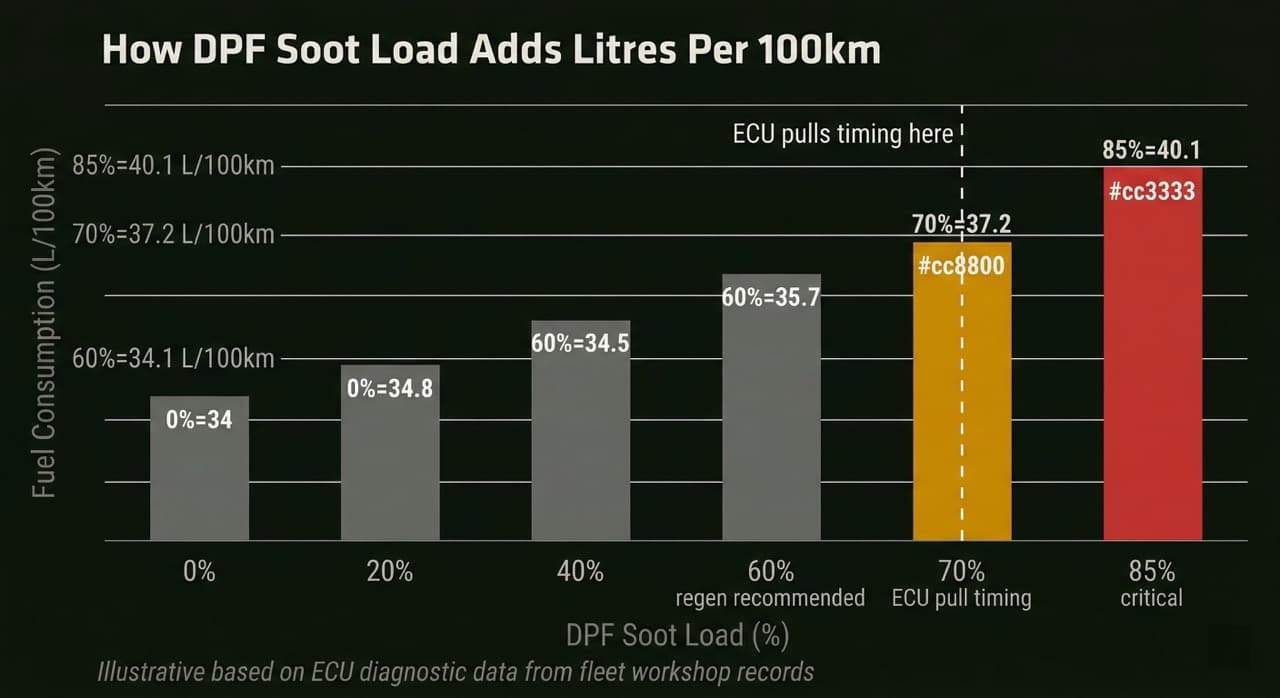
Scan DPF soot load %. Above 70%: schedule forced regeneration immediately — the ECU has likely already pulled timing back, adding 3–6 L/100km. Check active regen frequency (below 300km between cycles = incomplete burn temperature). Verify differential pressure sensor accuracy.
Injector & Fuel System Condition — Nozzle Wear, Return Temperature, Rail Pressure
Check injector return fuel temperature — above 55°C indicates internal nozzle seat leakage. Request spray pattern test at 150,000km+. Verify common-rail pressure drop is below 8% from pump outlet to injector inlet. Inspect fuel filter service history for contamination events.
Aerodynamics & Rolling Resistance — Deflectors, Skirts, Tyre Pressure & Spec
Inspect roof deflector alignment (gap >100mm above trailer roofline = measurable fuel cost at motorway speeds). Check all side skirts for damage. Audit tyre pressures monthly — each drive tyre underinflated by 10 PSI adds ~0.3% rolling resistance. Verify low-rolling-resistance tyre spec at last replacement.
Driver Behaviour — Gear Shift Points, Cruise Control Usage, Daily Idle Time
Pull gear shift events from telematics — upshifts consistently above 1,600 RPM add 4–7% fuel per journey. Measure cruise control usage rate on motorway segments (target: 70–85%). Audit idle time per vehicle per day: 45 minutes daily idle = 280–390 extra litres per vehicle per year.
Beyond maintenance — the charge density gap
Combustion Charge Optimisation — Coolant Surface Tension & Charge Density
Residual heat in the cylinder walls and head between combustion events warms the incoming air charge, reducing its density and oxygen content per stroke. Mineral activation of the coolant reduces surface tension, improving water jacket wall contact and charge cooling efficiency between cycles — increasing volumetric filling efficiency by 1.5–3.0% and reducing BSFC by a mean of 5.1% in academic engine testing.
Steps 1–5 fix what maintenance can fix. Step 6 fixes the charge density gap that perfect maintenance still leaves open. FuelMarble mineral activation targets the residual heat in the metal structure between combustion events — improving air charge density, combustion completeness, and fuel consumption across all load ranges.
See How FuelMarble Works →Page Summary

A 44-tonne artic running 11% above its fleet average consumption can be brought back into benchmark — and past it — by working through six specific system checks in the right sequence. This checklist is part of the heavy duty truck emission system maintenance guide — the full reference for every Euro VI aftertreatment component and what each one costs in fuel terms when it fails. The structural reasons why haulage costs keep rising sit upstream of this guide; this article focuses on the six controllable causes of excess consumption and the exact actions that address each one, ranked by ROI.
Step-Results Overview: What Each Fix Delivers Before You Start
Before running the full diagnostic, use this table to triage which steps to prioritise based on your fleet type, current mileage, and budget.
| Step | What it addresses | Saving range | Implementation cost | Payback period | Best applies to |
|---|---|---|---|---|---|
| 1 | Benchmark baseline | Identifies target vehicles | £0 | Immediate | All HGV fleets |
| 2 | DPF soot load & regen | 2–5% | £0–£400 regen service | 2–6 weeks | Euro V / Euro VI artics and rigids above 300,000 km |
| 3 | Injector nozzle wear | 1.5–4% | £300–£1,200 per injector | 4–12 weeks | Any HGV above 150,000 km since last injector service |
| 4 | Aerodynamics & tyres | 1–5% | £0–£800 | Immediate–2 weeks | Motorway-dominant fleets (>60% A-road / motorway routing) |
| 5 | Driver behaviour | 3–8% | £0 (telematics coaching) | 4–8 weeks | Fleets with >10% consumption gap between driver quartiles |
| 6 | Combustion charge efficiency | 7–15% additional | Single installation | 2–6 weeks post-activation | All water-cooled diesel HGVs regardless of maintenance condition |
Combined potential (Steps 1–6): 10–20% total consumption reduction on a vehicle with multiple concurrent faults.
Step 1: Does Your Fleet Know Its Actual Consumption Benchmark — Or Is It Comparing Against Itself?
Ranked actions for Step 1:
- Pull your telematics fuel data for the last 90 days by vehicle type — not fleet-wide averages, which mask high-consumption outliers
- Compare against vehicle-class benchmarks: a 44-tonne artic should run 32–38 litres per 100km on motorway-dominated routes; a rigid 18-tonne HGV 22–28 litres per 100km
- Flag any vehicle running more than 8% above its vehicle-class benchmark — that threshold indicates at least one mechanical or system fault, not driver behaviour
- Record baseline litres-per-day and litres-per-100km side by side — fleet managers track daily burn rates; the per-100km figure anchors the diagnostic steps that follow
This applies when you have at least 30 days of telematics fuel data segmented by vehicle — it does NOT apply if you are comparing a mixed fleet of articulated and rigid vehicles against a single average figure, which will mask every outlier in both directions.
Before you can measure improvement you need to know where you stand — UK HGV fuel consumption benchmarks 2026 gives you the industry averages to compare against by vehicle type and route profile.
Micro-example: A 10-vehicle fleet running a mix of Scania R450 artics and DAF CF 18-tonne rigids was tracking combined average consumption at 36 L/100km. Separating by vehicle type revealed the DAF rigids were running at 31 L/100km (within benchmark) while the Scania artics were at 41 L/100km — 8% above class benchmark. The fleet average had concealed a problem that was actually three Scania units running at fault-level consumption.
Expected saving from this step alone: 0% direct — but it identifies which vehicles to prioritise and prevents wasted spend on trucks already running at benchmark.
Step 2: Is Your DPF Restricting Airflow Enough to Force the ECU Into a Conservative Fuel Map?
Ranked actions for Step 2:
- Pull DPF soot load percentage from your diagnostic tool — above 60% warrants monitoring; above 70% warrants immediate active regeneration; above 85% means the ECU fuel map has almost certainly been compromised
- Check active regeneration frequency: Euro VI articulated vehicles should complete regen cycles every 400–600km; below 300km indicates the DPF is not reaching full burn temperature during normal operation
- Measure exhaust restriction pressure — above 25 kPa on a loaded vehicle at motorway speed is a confirmed restriction event
- Check the DPF differential pressure sensor — a faulty sensor can report false-low soot loads while the physical filter is severely clogged
Vehicle-specific diagnostic notes:
- Scania R-series (DC13/DC16): DPF soot load accessible via Scania Diagnos & Programmer 3 (SDP3). Regeneration threshold typically set at 75% — monitor from 60%.
- Volvo FM (D13/D11): VCADS Pro shows soot load as a percentage. Active regen inhibit conditions (speed below 50 km/h, PTO active) cause soot to accumulate faster on urban routes.
- DAF XF (MX-11/MX-13): DAF VCI diagnostic interface. Known issue: DAF XF Euro VI models can show false-low soot readings if the differential pressure sensor is coated with oil vapour from EGR deposits — clean sensor before trusting readings.
- MAN TGX (D26/D38): MAN-cats II diagnostic. Regen inhibit lamp (yellow exhaust symbol) appears at 80% soot — by that point the ECU has already been running a conservative map for several days.
This applies when the vehicle completes regular long-haul routes above 60 mph, allowing passive regeneration — it does NOT apply if the vehicle operates predominantly in urban stop-start conditions, where active forced regeneration cycles are the correct management protocol regardless of soot load percentage.
DPF health is the single most impactful maintenance factor on HGV consumption — the complete heavy-duty truck emission system guide covers the full Euro VI aftertreatment chain and what each component's failure costs in fuel terms. On Euro 6 commercial vehicles, these 5 DPF clogging symptoms are the earliest warning signs that your DPF is adding to your fuel bill before the fault codes arrive.
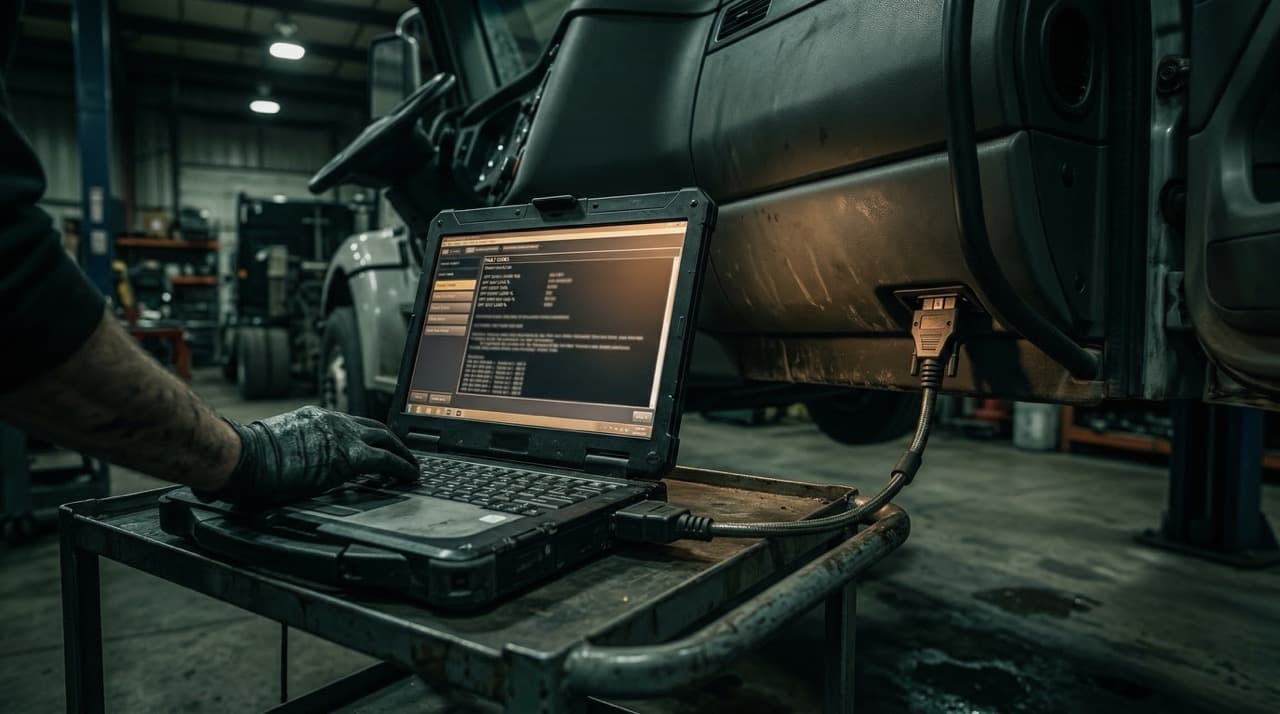
In my experience: The 44-tonne artic I pulled into the workshop — a Scania R450 at 412,000 km, flagged by telematics at 11% above fleet average — showed a DPF soot load of 74% on the SDP3 diagnostic scan. The driver had no warning lights, no perceptible power loss. The DPF alone was forcing the ECU into a fuel map adding approximately 4.2 L/100km. We ran a forced regeneration cycle, dropped the soot load to 12%, and the vehicle's consumption dropped 3.8% in the same week. Same route, same driver, same load. That's 3.2 L/100km recovered from a single DPF service.
Expected saving from Step 2: 2–5% consumption reduction on vehicles running above 65% soot load. Zero saving on vehicles with a clean DPF — which is exactly why Step 1 benchmarking identifies which trucks to prioritise.
Step 3: Are Your Injectors Atomising Fuel Efficiently, or Are They Depositing Unburned Carbon Into the Combustion Chamber?
Ranked actions for Step 3:
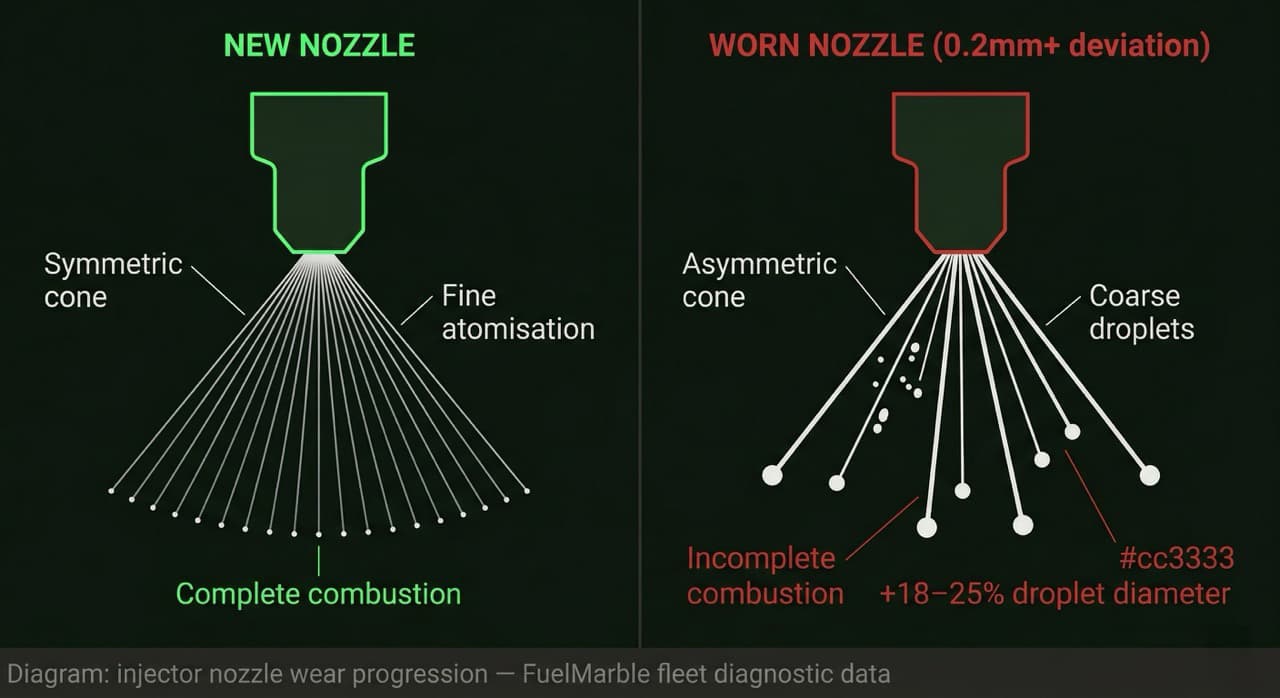
- Check injector return fuel temperature — return fuel above 55°C at the injector rail indicates excessive internal leakage from worn nozzle seats, wasting pressurised fuel that never reaches the combustion chamber
- Request a spray pattern test if the vehicle is in for scheduled maintenance — a worn nozzle produces a visible asymmetric cone that no calibration can correct; replacement is the only fix
- Check common-rail fuel pressure at idle and at full load — pressure drop above 8% between the pump outlet and the injector inlet indicates either pump wear or a leaking high-pressure line
- Inspect fuel filter service history — contaminated fuel accelerates nozzle wear by a factor of 3–4x; a vehicle that has run contaminated diesel for even one full service interval will show nozzle wear 60,000km ahead of schedule
Vehicle-specific diagnostic notes:
- Scania R450 (XPI injection): Scania XPI injectors are known for return fuel temperature sensitivity — above 55°C at the return rail on any injector warrants immediate spray pattern test. Replacement interval: 200,000–250,000 km in clean fuel conditions.
- Volvo FM D13: Volvo D13 Delphi injectors show early nozzle wear in fleets running B20 biodiesel blends — check return temperature at 120,000 km rather than waiting for 150,000 km on biodiesel vehicles.
- DAF XF MX-13: DAF common-rail injectors on the MX-13 are particularly susceptible to nozzle coking from low-speed urban operation. A vehicle doing predominantly urban distribution with occasional motorway runs should be on a 100,000 km spray pattern inspection cycle.
- MAN TGX D26: MAN D26 injectors — standard Bosch CR system. Return temperature above 60°C is the MAN-specific threshold (slightly higher than the general 55°C due to injector body design).
This applies when the vehicle has covered more than 150,000km since last injector service — it does NOT apply to vehicles under 100,000km from new with a clean fuel contamination history.
Micro-example: A Volvo FM D13 at 310,000 km came in with a 6% overconsumption flag and a return fuel temperature of 62°C on two of six injectors. Spray pattern test confirmed asymmetric cone on both — 0.18mm and 0.22mm bore deviation respectively. Replacing both injectors reduced consumption by 2.8 L/100km. Combined with the DPF service already completed, total recovery at that point was 6.0 L/100km.
Expected saving from Step 3: 1.5–4% consumption reduction on vehicles with confirmed nozzle wear. The saving compounds with the DPF recovery from Step 2 — clean atomisation reduces carbon soot output, extending DPF service intervals simultaneously.
Back on that Scania R450: alongside the clogged DPF, the diagnostic found two injectors with return fuel temperatures of 61°C and 58°C respectively — both above the 55°C threshold. Nozzle inspection confirmed bore wear of 0.18mm and 0.22mm deviation from spec. Replacing both injectors, in combination with the DPF regeneration, brought cumulative fuel savings to 7.6% over the next three weeks.
Step 4: Is Aerodynamic Drag and Rolling Resistance Adding Litres Per Day That Cost Nothing to Fix?
Ranked actions for Step 4:
- Inspect roof deflector alignment — the deflector should sit flush or slightly above the trailer roofline; a gap of more than 100mm is measurable on fuel consumption
- Check side skirts for damage or misalignment — missing or bent side skirts on a trailer add 1.5–2.5 litres per 100km at motorway speeds
- Audit tyre pressure across the fleet monthly, not at service intervals — a single drive axle tyre underinflated by 10 PSI adds approximately 0.3% rolling resistance, which across six drive tyres compounds to 1.8% additional fuel load
- Verify tyre specification — low-rolling-resistance tyre compounds can reduce fuel consumption by 2–3% versus standard compounds on the same axle configuration
Vehicle-specific notes:
- Scania R/S-series with Scania Highline cab: The Scania cab-integrated deflector system relies on the trailer matching Scania's deflector height calibration. When a Scania Highline tractor is paired with a non-Scania trailer, re-measure deflector gap on every new trailer combination.
- Volvo FM with MirrorCam: The MirrorCam housing creates a small but measurable aerodynamic penalty versus optical mirrors at speeds above 85 km/h — a known Volvo factor. Budget 0.3–0.5 L/100km for this on affected vehicles.
- DAF XF Space Cab: DAF XF Space Cab is aerodynamically optimised from the factory, but the cab-roof deflector can be knocked out of alignment by pressure washing from the wrong angle. Inspect quarterly on high-wash-frequency operations.
- MAN TGX XLX/GX: The MAN TGX GX cab roof line is among the highest in the Euro VI generation — ensure the trailer roof is within 150mm of the cab roof maximum. Any trailer more than 200mm below the cab roofline creates turbulent separation adding 2+ L/100km.
This applies when the vehicle operates predominantly on motorway or A-road routes at sustained speeds above 70 km/h — it does NOT apply if the vehicle is primarily urban distribution, where aerodynamic drag is a negligible fuel factor.
Micro-example: A DAF XF 480 Super Space Cab at 280,000 km in a temperature-controlled distribution fleet was running 2.1 L/100km above its class average on a motorway-dominant route. Physical inspection found two missing side skirt panels on the trailer (damaged in a yard incident, not yet reported) and a roof deflector gap of 180mm. Correcting both reduced consumption by 1.9 L/100km — recoverable in an afternoon with no parts cost on the cab itself.
Expected saving from Step 4: 1–3% from aerodynamic corrections; 1–2% from tyre pressure management — achievable in a single afternoon with no parts cost.
Step 5: Is Driver Behaviour Adding 5–8% to Your Fuel Bill Through Gear Shift Points, Idle Time, and Speed Management?
Ranked actions for Step 5:
- Pull gear shift event data from telematics — drivers shifting below 1,200 RPM on upshifts are operating in the fuel-efficient zone; drivers consistently shifting above 1,600 RPM are burning 4–7% more fuel per journey with no payload or speed advantage
- Measure cruise control usage rate on routes where cruise control is appropriate — top-quartile drivers achieve 70–85% cruise control usage on eligible road segments; bottom-quartile drivers achieve below 40%
- Audit daily idle time per vehicle — a diesel HGV consumes approximately 2.5–3.5 litres per hour at idle; a driver idling for 45 minutes per day across a 250-day working year burns 280–390 extra litres annually per vehicle, with zero payload delivery
- Use 30-day coaching periods with weekly data feedback — peer comparison against anonymised fleet averages produces 3–5% consumption improvements within 6 weeks without punitive management approaches
Vehicle-specific notes:
- Scania R450 with Scania Opticruise: Opticruise-equipped vehicles show gear shift compliance in the Scania Fleet Management Portal — filter by "manual override events" to identify drivers consistently overriding automated gear selection, the primary fuel waste signal on automated gearbox vehicles.
- Volvo FM with I-Shift: Volvo Dynafleet shows gear efficiency score per driver per trip. Score below 75 on I-Shift vehicles correlates with 4–6% excess consumption versus the same vehicle with a score above 90.
- DAF XF with AS-Tronic: DAF Paccar Connect telemetry shows "out of optimum" gear events. More than 15 out-of-optimum events per 100km indicates a coaching intervention is needed.
- MAN TGX with MAN TipMatic: MAN RIO platform shows fuel efficiency ranking per driver. The gap between MAN's "eco" driving mode and "performance" driving mode on TipMatic is approximately 6–9% consumption on identical routes.
This applies when telematics data shows consistent behavioural variance between drivers — it does NOT apply as a first intervention if mechanical faults (Steps 2–3) have not yet been investigated, because attributing a fuel variance to driver behaviour when the real cause is a clogged DPF will produce no measurable result and damage trust with drivers.
Micro-example: A MAN TGX 26.460 fleet of eight vehicles on an identical daily distribution route showed a 9.3% consumption gap between the top and bottom driver. The bottom driver's RIO data showed 62 out-of-optimum gear events per 100km versus 11 for the top driver, and 52 minutes of daily idle versus 8 minutes. A 30-day coaching programme using anonymised peer ranking reduced that driver's consumption by 7.1% — equivalent to 4.2 L/100km recovered, with no mechanical intervention.
Expected saving from Step 5: 3–8% on fleets with high driver behaviour variance; 1–3% on fleets that already have active telematics coaching programmes.
Step 6: After Fixing Everything Else, Why Is Your Fleet Still Leaving 7–15% on the Table?
Steps 1–5 will recover 6–14% of wasted diesel for most HGV fleets — but there is a separate efficiency gap that maintenance cannot address. It has nothing to do with pulling heat out of the combustion gases during the power stroke. It operates before ignition.
Here is the physics: diesel engines convert thermal energy into mechanical work by expanding hot combustion gases against the piston. That process works best when the incoming air charge is dense. More oxygen per stroke means more complete combustion. More complete combustion means more mechanical work extracted from the same quantity of fuel.
The problem is residual heat. Between combustion events, the cylinder walls, cylinder head, piston crown, and connecting rod retain heat from the previous cycle. That residual heat warms the incoming air charge before ignition, reducing its density. Less dense air means less oxygen per stroke. Less oxygen means less complete combustion — and the ECU compensates by injecting slightly more fuel to maintain power output. This is the charge density deficit.
This is the same principle as an intercooler on a turbocharged engine — lower the charge temperature before ignition, increase charge density, support more complete combustion. The intercooler operates on the air path. This intervention operates on the metal structure the air path passes through.
What the research shows:
Academic testing published by Professor Watanabe at the Society of Automotive Engineers (Japan, 2008) — testing mineral activation of the cooling system in a direct-injection diesel engine — found the following results compared to standard coolant:
- Brake-specific fuel consumption (BSFC) improved by 1.3–11.6% across all tested load ranges (mean: 5.1%)
- Volumetric (charge filling) efficiency increased by 1.5–3.0% across all load ranges — more air per stroke
- Lubricating oil temperature reduced by 4–12K — the metal structure between cycles was running cooler
- Exhaust gas temperature reduced by 4–23K at high load — more energy was converted to work, less was thrown away as exhaust heat
- CO emissions reduced by 7–54% — more complete combustion at all tested load points
The pressure-crank-angle diagram from the same research shows the direct consequence: with mineral activation, maximum cylinder pressure is higher — not lower — and the effective combustion cycle is longer. This is the measurable fingerprint of improved charge density driving more complete combustion.
The mechanism:
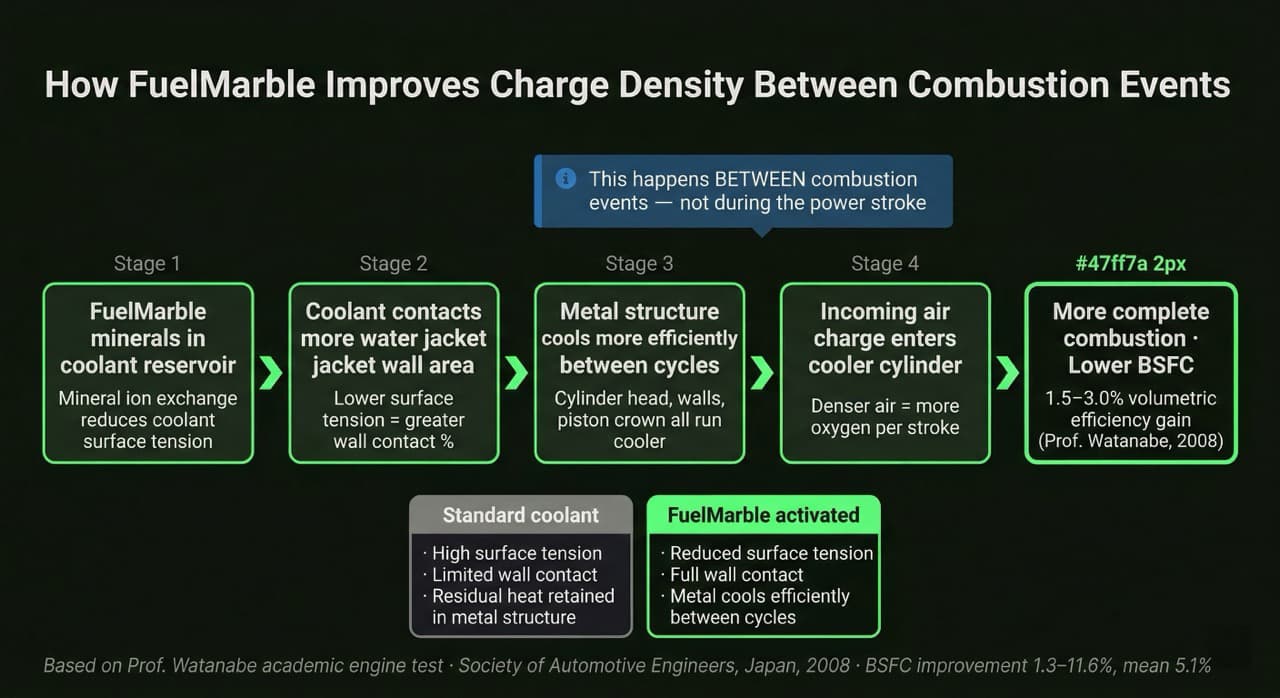
Reducing coolant surface tension — through the mineral ion exchange properties of FuelMarble — increases the contact area between the coolant and the water jacket walls. Coolant that contacts more of the wall surface removes residual heat from the metal structure more efficiently between combustion events. The incoming air charge enters a slightly cooler cylinder. It is denser. It contains more oxygen per stroke. Combustion is more complete. BSFC falls. Exhaust temperature falls. Soot output falls — extending DPF service intervals as a secondary benefit.
This applies to any water-cooled diesel HGV with standard coolant — it does NOT apply to air-cooled engines or vehicles already running coolant additives with verified ion-exchange mineral activation properties.
Completing the war story: After fixing the DPF, the two injectors, and a sticking thermostat on that Scania R450 at 412,000 km — a combined 7.6% recovery — I installed FuelMarble in the freshwater reservoir tank. Over the following six weeks, consumption dropped a further 6.6% beyond the 7.6% already recovered through the mechanical fixes. Total reduction from baseline: 14.2%. The driver's telematics score hadn't changed. The route hadn't changed. The residual gap was charge density — the metal structure was running hotter between cycles than it should have been, and the incoming air charge was paying for it on every stroke.
⚡ Why Steps 1–5 Aren't the Whole Answer
Working through Steps 1–5 is the right sequence. Fixing a clogged DPF, worn injectors, misaligned aerodynamics, and inconsistent driver behaviour will recover 6–14% of wasted diesel — and you should do every single one of them before spending anything else.
But there is a separate efficiency gap that maintenance cannot close: the charge density deficit created by residual heat in the cylinder walls, head, and piston crown between combustion events. Even a perfectly maintained Euro VI HGV — calibrated injectors, clean DPF, optimal tyre pressure, trained driver — is losing oxygen-carrying capacity on every stroke because the incoming air charge is being warmed by metal structures carrying heat from the previous combustion cycle.
Academic engine testing by Professor Watanabe (Society of Automotive Engineers, Japan) found that mineral activation of the coolant — reducing its surface tension to improve water jacket wall contact — increased volumetric filling efficiency by 1.5–3.0% across all load ranges, reducing brake-specific fuel consumption by a mean of 5.1%. Exhaust temperatures dropped by up to 23K at high load, confirming that more energy was being converted to work rather than leaving as waste heat.
That charge density gap is what FuelMarble's mineral activation technology addresses at the source. By placing mineral balls in the coolant reservoir, it modifies the surface tension of the coolant through ion exchange, improving wall contact efficiency in the water jacket, reducing the residual heat the incoming air charge encounters, and recovering the 7–15% that five steps of conventional maintenance still leaves on the table.
Elias translates complex engine science into clear, accurate content. Specialising in diesel combustion, DPF systems, and Japanese engineering methodology, he produces FuelMarble's technical documentation, performance analyses, and in-depth product guides.
Related Articles



Ready to Improve Your Fuel Efficiency?
FuelMarble delivers up to 15% fuel efficiency improvement. Simple drop-in install.