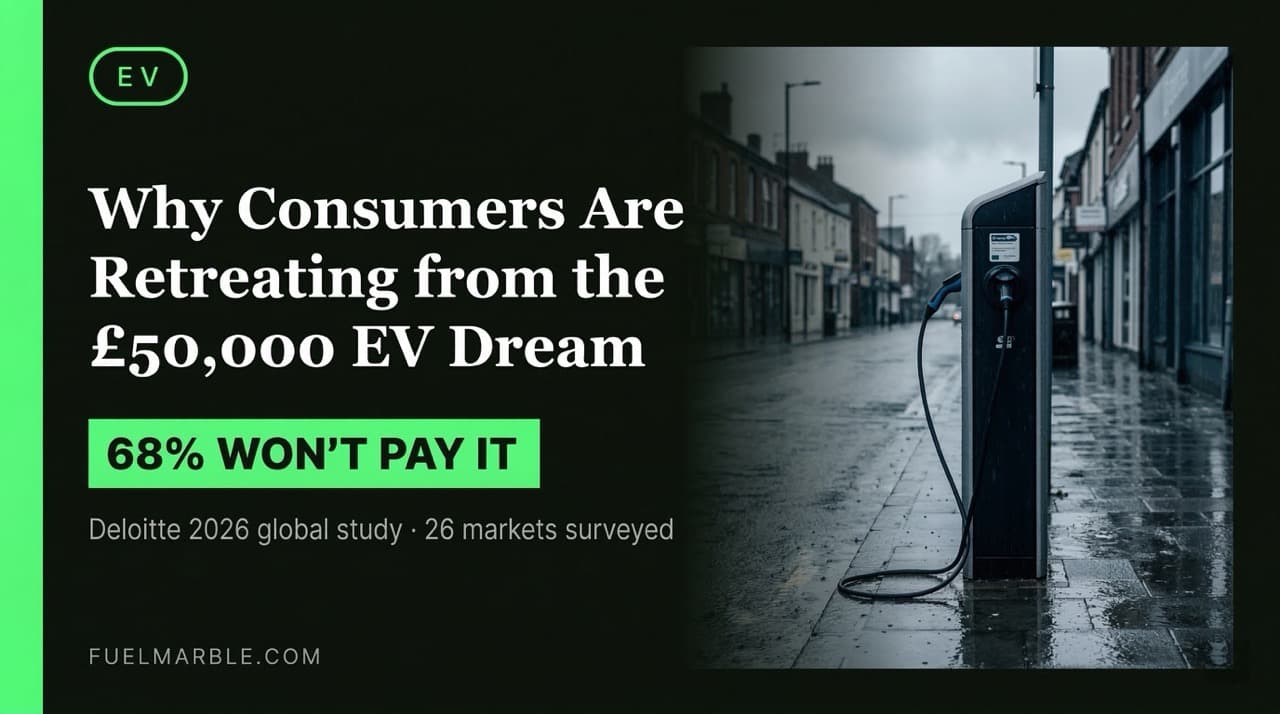
Why Consumers Are Retreating from the £50,000 EV Dream
Page Summary
This article examines why consumer enthusiasm for electric vehicles is cooling in 2026 (backed by Deloitte's global automotive study) and what the shift toward hybrid and optimised ICE technology means for vehicle owners today. This analysis connects to the complete guide to cutting UK fleet diesel costs, because the ICE optimisation decisions fleet operators make now compound in value over the transition period. It also covers the hidden financial risks of EV ownership that rarely appear in manufacturer marketing.
Contents
- What the 2026 Deloitte data actually shows
- Why fast charging fails real-world demands
- The hidden cost of EV battery degradation
- Resale value: EV vs optimised ICE
- What consumers actually want
- A smarter path: optimise what you drive now
What the 2026 Deloitte Data Actually Shows
The 2026 Deloitte Global Automotive Consumer Study surveyed tens of thousands of vehicle owners across major markets. The findings cut against years of optimistic EV adoption forecasts.
These are not fringe opinions, they represent a majority position among car buyers. The four headline findings tell a consistent story: EV adoption is being blocked by cost, infrastructure, and practical concerns that manufacturers and policy advocates have systematically underestimated.
The 68% who refuse to pay the EV price premium are not anti-technology. They are responding rationally to a value proposition that does not yet add up for most drivers' real-world situations.
Why Fast Charging Fails Real-World Demands
The EV charging argument often presents rapid chargers as a near-equivalent to petrol stations. The mathematics of daily life tells a different story.
A typical petrol or diesel refuel takes under five minutes. Even a 150 kW rapid charger, which requires compatible hardware and incurs premium pricing. Takes 30–45 minutes to charge a large battery from low to 80%. For drivers on tight schedules, making multiple stops, or travelling with children, this is not a minor inconvenience. It is a structural barrier.
The infrastructure problem compounds the time problem. Public rapid charging coverage remains patchy outside major urban corridors. For rural drivers, commercial vehicle operators, and households without off-street parking for home charging, the public network is simply not a viable primary charging solution in 2026.
This is why 48% of consumers in the Deloitte study reject the public charging infrastructure as adequate for their needs, not because they dislike technology, but because the technology does not yet match how they live and work.
The Hidden Cost of EV Battery Degradation
EV total cost of ownership calculations typically focus on fuel savings and lower servicing costs. They rarely foreground the single largest financial risk: battery pack degradation and replacement cost.
Lithium-ion battery packs degrade over time and with charge cycles. A battery at 70–75% state of health significantly reduces the vehicle's real-world range. A problem that becomes acute in cold weather, at motorway speeds, or with heavy use of heating and air conditioning.
When degradation crosses the threshold where the vehicle becomes impractical for its original purpose, the choice is either to sell at a heavily depreciated price or absorb a battery replacement bill of £12,000 to £20,000 or more.
For a vehicle originally purchased at £40,000–55,000, this hidden liability fundamentally changes the total cost calculation. It also explains why used EV values are under sustained pressure in 2026. Buyers are pricing in the battery replacement risk.
Resale Value: EV vs Optimised ICE
| Metric | Standard EV | Optimised ICE / Hybrid |
|---|---|---|
| Retention % | 35% – 40% | 58% – 65% |
| Depreciation driver | Battery health (SoH) | Mechanical durability |
| Major repair risk | £12k – £20k (pack) | £2k – £4k (overhaul) |
| Market demand | Declining (used) | High (reliability) |
The resale value gap is not a temporary market anomaly, it reflects structural realities. Battery state of health is opaque to most buyers. Charging infrastructure is still expanding. And the pace of new EV model releases means any given used EV competes against significantly improved newer versions at declining new prices.
By contrast, well-maintained petrol and diesel vehicles with documented service history and optimised fuel efficiency hold their value through proven mechanical durability. A vehicle that demonstrably costs less to fuel and produces lower emissions than its unoptimised equivalent commands a premium in the used market.
For fleet operators weighing ICE optimisation against the transition timeline, the is the UK diesel lorry ban real? article sets out the confirmed policy position and what it means in practice for existing fleets.
What Consumers Actually Want
Strip away the noise and the Deloitte data reveals a clear consumer priority: lower daily fuel costs, without sacrificing vehicle practicality.
This is not an argument against electrification in principle. It is a statement that the current state of EV technology, infrastructure, and economics does not deliver what most drivers need right now. For commercial operators specifically, the regulatory reality around the UK diesel lorry ban is also far more gradual than headlines suggest, giving fleets considerably more time than they realise. Forty-two percent specifically prefer hybrid or optimised ICE technology because it threads the needle: improved efficiency without charging dependency.
The consumer preference is essentially: give me the fuel savings promised by electrification, without the infrastructure constraints, hidden battery costs, and resale uncertainty that EVs currently carry.
A Smarter Path: Optimise What You Drive Now
The insight that 42% of consumers prefer optimised ICE technology points directly to what FuelMarble delivers.
FuelMarble is a permanent mineral-based device that improves combustion efficiency by 7–15% on existing petrol, diesel, LPG, and CNG engines. It does not require a new vehicle, a charging point, or any change to how you drive. It installs once and works continuously for the life of the vehicle.
The results are verified, not theoretical:
- 10.34% CO₂ reduction in the Jakarta traffic test
- 18% fuel efficiency improvement in the 2007 Honda Accord retrofit
- Measurable reduction in CO, NOx, and particulate emissions
For a driver spending £2,000+ per year on fuel, a 15% saving returns the cost of FuelMarble S (£239) in under two months. No charging infrastructure. No battery degradation risk. No resale value uncertainty.
Use the FuelMarble fuel savings calculator to see your specific payback timeline.
FuelMarble S: for cars and vans: £239, free UK delivery
FuelMarble L: for SUVs, fleets, and commercial vehicles: £519, free UK delivery
The most immediate action for ICE vehicle owners is reducing per-mile fuel consumption now. FuelMarble S for passenger cars delivers 7–20% fuel efficiency improvement through a drop-in coolant reservoir installation. Reducing running costs and emissions on vehicles that will continue operating through the EV transition.
For fleet operators managing multiple vehicles, our guide to the fleet fuel efficiency guide for UK operators covers the full toolkit for reducing running costs without capital replacement. And for those still tempted to solve it by buying newer trucks, the real cost of chasing efficiency through fleet replacement weighs the brand-by-brand economy gap against the capital outlay.
Related reading:
Related Articles
The practical alternative to EV transition. Reduce diesel costs now →
Elias translates complex engine science into clear, accurate content. Specialising in diesel combustion, DPF systems, and Japanese engineering methodology, he produces FuelMarble's technical documentation, performance analyses, and in-depth product guides.
Ready to Improve Your Fuel Efficiency?
FuelMarble delivers up to 15% fuel efficiency improvement. Simple drop-in install.