Fleet Telematics Fuel Savings: Real Numbers for UK HGV Operators
One in four UK HGV operators is still not using telematics. With diesel costs eating 22–24% of total fleet running costs and pump prices continuing to fluctuate. You can check today's rates on FuelMarble's live fuel price tracker, that silence from the dashboard is costing real money every single day. If you're looking to take control of what your fleet actually burns, this sits within a broader framework covered in our complete guide to fleet fuel efficiency for UK operators. This article gets into the specific numbers on telematics: what it saves, how it works, and what UK operators are actually seeing on the road.
What Fleet Telematics Actually Does to Your Fuel Bill
Fleet telematics cuts fuel spend by attacking three distinct cost sources simultaneously: driver behaviour, idle time, and route inefficiency. A typical HGV covering 100,000 miles per year at 10 mpg consumes approximately 45,460 litres of diesel. For a small-to-medium fleet of 12–15 vehicles, that is a combined annual fuel spend approaching £1.3 million at current pump prices. A verified 10% reduction from telematics returns £100,000–£126,000 annually, from a technology that costs four figures per year to run.
The mechanism is straightforward: telematics systems collect real-time data on vehicle location, speed, engine state, and driver inputs. That data is processed into actionable reports, driver scorecards, idle time logs, fuel consumption variance per route. That fleet managers can act on immediately. The fuel bill doesn't fall because of the hardware itself. It falls because the data changes behaviour.
What separates effective telematics programmes from expensive GPS tracking is what you do with the numbers.
Driver Behaviour: The Biggest Lever Most Operators Underuse
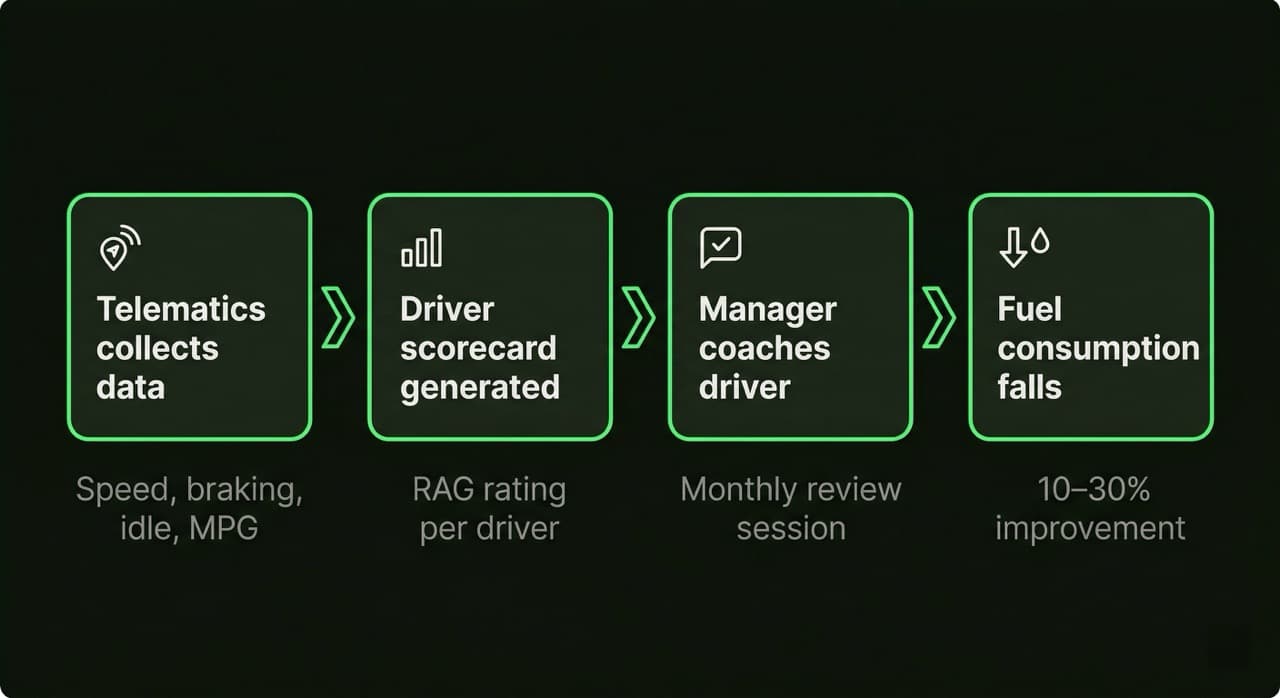
Telematics captures the specific inputs that inflate consumption: speeding above 60 mph, harsh braking, rapid acceleration, and unnecessary idling. At motorway speeds, every 5 mph above 60 mph costs approximately 0.7 mpg per truck. On a 44-tonne combination covering 100,000 miles per year, that difference compounds into thousands of pounds per driver per year.
The practical application is driver scorecard systems. Telematics platforms compile speeding events, harsh braking incidents, and fuel consumption data into RAG-rated (Red, Amber, Green) reports per driver. Fleets that implement structured coaching based on these reports see speeding reduced by over 60% and harsh braking down by 70% within months of deployment. The key is using scorecard data for coaching, not punishment, operators who use it for recognition and training see far faster behaviour change than those who use it purely as a disciplinary tool.
Wren Kitchens saw an average fuel improvement of 1.5 mpg across their 100-truck fleet, spanning from 7.5-tonne rigids to 44-tonne tractor and trailer combinations, within a year of full Fleetboard telematics deployment.
Idle Time: The Silent Fuel Drain Hidden in Plain Sight
Idle time is the fuel cost most operators cannot see without telematics, and therefore cannot manage. UK HGV fleets typically record between 30 and 60 minutes of unnecessary idling per vehicle per day, caused by traffic queuing, loading and unloading wait times, PTO (Power Take-Off) equipment, and brief rest stops.
That number is easy to dismiss on a per-vehicle basis. Scaled across a fleet and an operating year, it is not.
Telematics makes this visible and actionable. Once fleet managers can see idle time per vehicle and per driver, the interventions are often simple: revised depot procedures, pre-planned departure sequencing, or scheduled maintenance that eliminates queuing. A UK fleet of 130 vehicles achieved a 10% reduction in operational miles within months of telematics rollout. Their insurer also reduced premiums by £135 per vehicle per year and contributed £5,000 toward the cost of the telematics system, a side benefit most operators do not factor into their ROI calculation.
Route Optimisation: Compounding the Savings With Every Journey
Route optimisation is the third fuel lever in the telematics toolkit, and it works differently from behaviour and idle reduction. Rather than changing what drivers do, it changes how many miles they drive and how efficiently those miles are sequenced.
For multi-drop HGV operations, the gains come from reducing backtracking, avoiding congestion windows that inflate idle time, and sequencing deliveries to minimise total distance. For trunking operations, the gains come from load optimisation and departure timing that keeps average speeds in the fuel-efficient 50–60 mph band.
Lynch Plant Hire & Haulage publicly reported six-figure savings exceeding £100,000 alongside a 30% reduction in fleet-related incidents within a single year, after implementing a fully integrated telematics and driver performance solution through Connexas Group.
Telematics + Hardware: Why Data Alone Has a Ceiling
Telematics gives you visibility. It tells you exactly how much fuel each vehicle is burning, which drivers are costing you more per mile, and where your routes are inefficient. It is the most important diagnostic tool a fleet manager has.
But telematics data has a ceiling. Once you have optimised driver behaviour, tightened routes, and minimised idle time, you have extracted what behavioural and operational changes can deliver. The data at that point is telling you how efficiently your fleet is running, not improving the combustion efficiency of the engine itself.
Telematics handles the operational layer. FuelMarble addresses the engine layer.
FuelMarble is a combustion enhancement device fitted to the coolant system of diesel HGVs and fleet vehicles. It improves burn efficiency and reduces DPF loading on every cycle. Operators running FuelMarble alongside a telematics programme report compound savings: telematics handles routing, behaviour, and idle time. FuelMarble addresses what happens inside the combustion chamber.
See FuelMarble Fleet Programme →DVSA Compliance: The Telematics Benefit Operators Overlook
Fuel savings are the headline benefit of telematics, but DVSA compliance is the operational benefit that fleet managers running tight margins cannot afford to ignore. Telematics systems automate record-keeping for driver hours, tachograph data integration, vehicle inspection logs, and maintenance scheduling.
Operators enrolled in DVSA's Earned Recognition scheme, which rewards demonstrated compliance standards with reduced roadside interventions, increasingly use telematics data as the primary evidence base for their applications. Beyond that, major logistics contracts and TfL-connected operations frequently specify telematics as a contractual requirement.
The compliance story is also a cost story. For any fleet operator reviewing telematics investment, the fuel savings calculation is compelling on its own. When you add the compliance value, the insurance premium reductions, and the maintenance cost reduction, the question shifts from whether telematics pays back to how quickly.
For UK operators benchmarking their current fuel consumption before or after a telematics rollout, our analysis of HGV fleet fuel consumption benchmarks for UK operators gives you the reference data to measure your gains against.
The Bottom Line for UK HGV Fleet Operators
Fleet telematics delivers a documented 10–15% reduction in fuel spend for UK HGV operators, through driver behaviour improvement, idle time elimination, and route optimisation. For a fleet of 12–15 HGVs, that is a six-figure annual saving from a four-figure annual subscription cost. Lynch Plant Hire proved it. O'Neill's Transport measured it. Wren Kitchens tracked it across 100 trucks.
The 25% of HGV operators not yet running telematics are, in most cases, smaller operators for whom the upfront activation friction has delayed what is almost universally a positive financial decision once made. The data is consistent across case studies: payback comes within months, and the operational visibility telematics provides compounds in value as you use it.
If your fleet is not yet instrumented, the starting point is a telematics subscription from any of the established UK providers. If your fleet is already running telematics and you want to push fuel savings beyond what behaviour and routing can deliver, FuelMarble's fleet programme is the next layer worth evaluating.
The data will tell you what is possible. The hardware can take you further than the data alone.
Avery leads FuelMarble's international operations and strategic direction. With a background spanning fleet economics, regulatory compliance, and macro fuel market trends, Avery oversees commercial partnerships, product positioning, and the company's growth across the UK, US, Canadian, and Mexican markets.
Ready to Improve Your Fuel Efficiency?
FuelMarble delivers up to 15% fuel efficiency improvement. Simple drop-in install.