UK HGV Fuel Consumption Benchmarks 2026: MPG, Cost Per Mile & Efficiency Data
Page Summary
This benchmark data is one component of the complete guide to how UK fleet managers actually cut diesel costs. Where you can see how each efficiency lever stacks against these numbers.
This guide compiles the most current UK-specific fuel consumption benchmarks, cost data, and efficiency metrics from the RHA, DfT, FORS, Energy Saving Trust, and industry telematics providers. It gives fleet managers and procurement directors hard numbers to benchmark against, and a calculator to quantify exactly where their fleet sits.
Fuel has dropped from 24% of total HGV operating costs in 2023 to 22.4% in 2024 according to the RHA, thanks to falling diesel prices. But with margins across UK haulage now averaging just 1.58% pre-tax profit, even small efficiency gains translate directly to the bottom line. For deeper context on how rising non-fuel costs compound this pressure, see the full UK haulage operating cost breakdown.
What Is the Accepted MPG Benchmark for a UK 44-Tonne HGV?
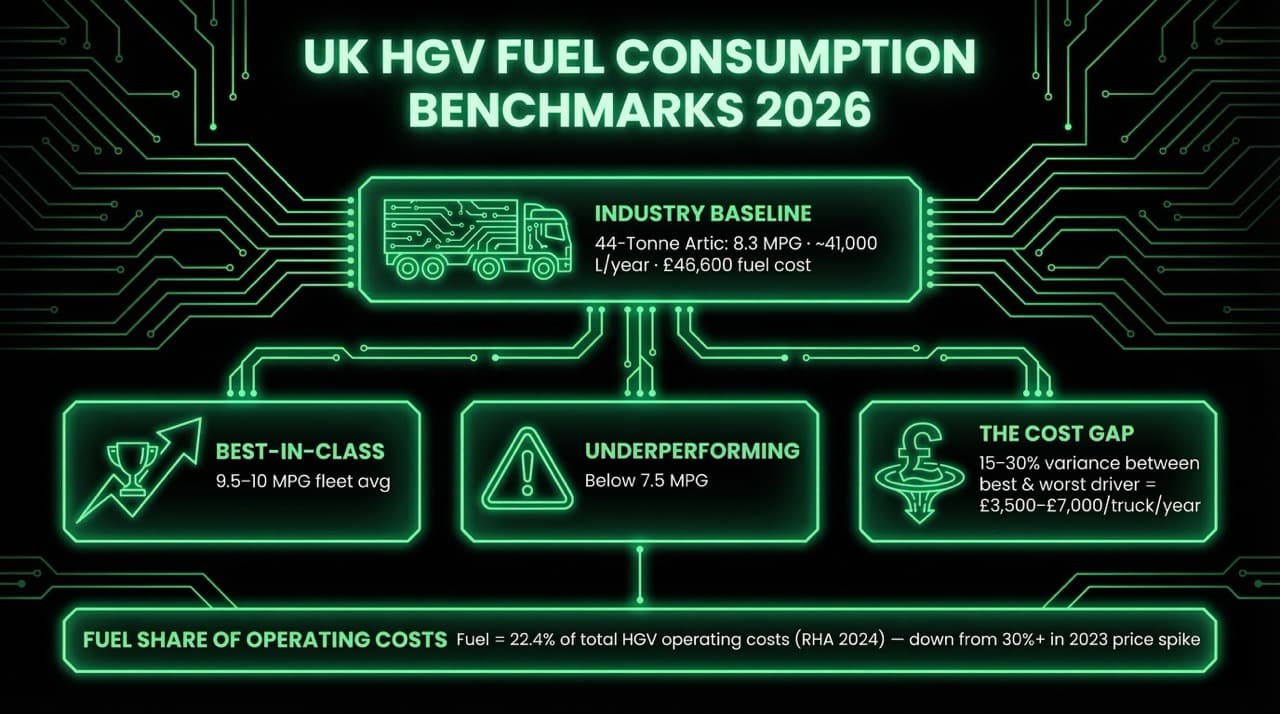
For 44-tonne articulated HGVs, the typical fleet average sits at 8.0–9.0 MPG (31–35 litres per 100km). Well-managed fleets with modern Euro VI vehicles, predictive cruise control, and trained drivers achieve 9.0–9.5 MPG (30–31 L/100km). The current best-in-class benchmark was set in November 2025, when a Volvo FH Aero recorded 11.25 MPG (25.1 L/100km) on Commercial Motor's standardised 477-mile test route, a 14.6% improvement over the previous 2022 record of 9.82 MPG. Urban stop-start operation drags consumption down to 5–6 MPG (47–56 L/100km).
For 18-tonne rigid HGVs, the typical range is 10–12 MPG (24–28 L/100km) in mixed distribution work. Motorway running at lighter loads pushes this to 12–14 MPG, while heavy urban work drops it to 9–10 MPG. Best-in-class modern Euro VI 18-tonners on favourable routes achieve 13–15 MPG (19–22 L/100km).
For 7.5-tonne rigid HGVs, the industry baseline is approximately 12 MPG (23.5 L/100km), with a typical operating range of 10–15 MPG. Well-maintained modern vehicles achieve 15–18 MPG (16–19 L/100km). The DfT recorded an 8.7% jump in MPG for the 3.5–7.5-tonne class between 2015 and 2016, attributed to Euro VI fleet penetration.
| Vehicle class | Typical fleet MPG | Best-in-class MPG | Typical L/100km | Best L/100km |
|---|---|---|---|---|
| 44t articulated | 8.0–9.0 | 9.5–10.0 (fleet avg) | 31–35 | 28–30 |
| 18t rigid | 10–12 | 13–15 | 24–28 | 19–22 |
| 7.5t rigid | 12–15 | 15–18 | 19–24 | 16–19 |
What UK Fleets Actually Pay for Diesel
The RHA blended price peaked at around 120p in February 2024 and fell to 103.58p by August before climbing back to 108p by November. Retail pump prices fluctuated between 139p and 158.7p through 2024, falling to a near four-year low of 138.4p in May 2025 before settling around 143–147p into early 2026.
UK fuel duty remains frozen at 52.95p per litre, the temporary 5p cut from the standard 57.95p, extended through March 2026. Red diesel has been prohibited for road vehicles since April 2022, closing off that historic cost advantage for hauliers.
Using the RHA's 44-tonne model, 75,000 miles at 8.3 MPG consuming approximately 41,080 litres annually. Fuel costs work out to roughly £46,600 per truck per year at the ex-VAT blended rate, or closer to £58,000 at pump prices including VAT. Logistics UK's advocacy for a 6p/litre fuel duty cut would save approximately £2,424 per 44-tonne truck annually, implying a consistent consumption estimate of around 40,400 litres per vehicle. For a 50-truck fleet, that annual fuel bill sits at approximately £2.3 million before VAT recovery.
The Real Cost Per Mile and Fuel's Share of Total HGV Operating Costs
The RHA's 2024 Haulage Cost Movement report puts total operating costs for a 44-tonne articulated vehicle at £208,397 per year over 75,000 miles, equivalent to £2.78 per mile. Driver employment costs represent the single largest expense category at 29.5% of total costs, with fuel second at 22.4%.
Total operating costs rose 3.5% in 2024 including fuel, but 5.95% excluding fuel. Falling diesel prices masked significant inflation in driver wages, insurance, and vehicle acquisition costs. The margin improvement from lower pump prices is structural only if operators use it to invest in efficiency, otherwise, the next price spike erases it entirely.
The wider cost picture: vehicle depreciation accounts for 13.9%, repairs and maintenance 7.0%, overheads 18.5%, and insurance 2.8%. For a comprehensive breakdown of how these lines interact and compound over time, the the fleet fuel efficiency guide for UK operators details the P&L mechanics across 10- and 50-vehicle fleets.
Where the 10–30% Efficiency Gap Hides, and What Quantifies It
No single UK government study quantifies the exact percentage of fleets underperforming benchmarks, but converging data from multiple authoritative sources gives a consistent picture. One UK fleet operator running DAFs, Scanias, and a Mercedes reported 15–20% variation between drivers, with the least efficient driver consuming nearly 30% more fuel than the best on identical routes.
FORS calculates that improving fleet MPG by just 5% saves over £2,200 per HGV per year: scaling to £22,000+ annually for a 10-vehicle fleet. The Energy Saving Trust's programme, covering nearly 50,000 UK drivers, achieved an average 14% fuel reduction on training day, though long-term sustained savings settle at 3–6% without ongoing reinforcement, and up to 15% with consistent application.
Telematics delivers measurable returns: UK fleets adopting telematics systems commonly report 10–20% efficiency improvements within the first year, with route optimisation alone contributing 5–10%. Tyre management adds further gains. FORS data shows that for every 10% drop in tyre pressure, fuel consumption rises 2%, while low-rolling-resistance tyres can cut fuel bills by up to 13%. Speed management is perhaps the simplest lever: dropping from 56 MPH to 50 MPH produces a 20% fuel consumption reduction according to FORS data.
For the full list of proven interventions and their verified ROI, see the fleet fuel efficiency guide for UK operators. For the profitability mechanics beyond fuel, the fleet management profitability framework covers the full P&L impact.
Pro Tip: The Micro-Context These Metrics Miss: All of the above interventions (driver training, telematics, tyre management, speed policies) address behaviour. None of them address the engine's thermal efficiency: the ratio of fuel energy that actually becomes mechanical work versus heat lost to the coolant, exhaust, and ambient radiation. That gap is structural, not behavioural. And for high-mileage fleets with carbon accumulation on cylinder walls, it widens silently as the vehicle ages. Fixing that gap is the frontier that driver training cannot reach. See what happens inside a diesel engine below.
FleetPoint reports that 70% of fleet managers identify rising fuel expenses as one of their most significant operational challenges, yet most of the interventions they apply cost relatively little to implement. The barrier is not cost; it is awareness that the benchmark gap is measurable and addressable at the combustion level.
What Actually Happens to the Diesel Inside the Engine, and Where the Efficiency Frontier Is
The ICCT/West Virginia University's 2014 energy audit of a reference heavy-duty diesel engine over standardised test cycles provides the definitive breakdown: 39.1% becomes useful brake power, while 35.5% exits as exhaust heat, 10.6% transfers to coolant, 6.0% is rejected through charge air cooling, and 3.4% radiates as ambient heat.
Incomplete combustion specifically accounts for a relatively small slice at full load. Modern diesel engines achieve 95–99% combustion efficiency, meaning only 1–2% of fuel energy is lost to incomplete combustion at full load. At part load (where many trucks spend significant operating time) this rises to approximately 2–3%. The real efficiency frontier lies not in burning fuel more completely, but in recovering the enormous heat energy currently lost through the exhaust and coolant system.
Weichai Power set a world record of 53.09% brake thermal efficiency in April 2024, while Cummins' SuperTruck 2 programme targets 55% with waste heat recovery, demonstrating that meaningful gains remain possible through thermal engineering innovation. For high-mileage commercial vehicles, however, the accessible frontier is the gradual efficiency loss from carbon accumulation on cylinder walls and combustion chamber surfaces, which increases thermal resistance and progressively reduces combustion completeness. Understanding this mechanism is central to the science of heavy-duty truck maintenance and emission systems.
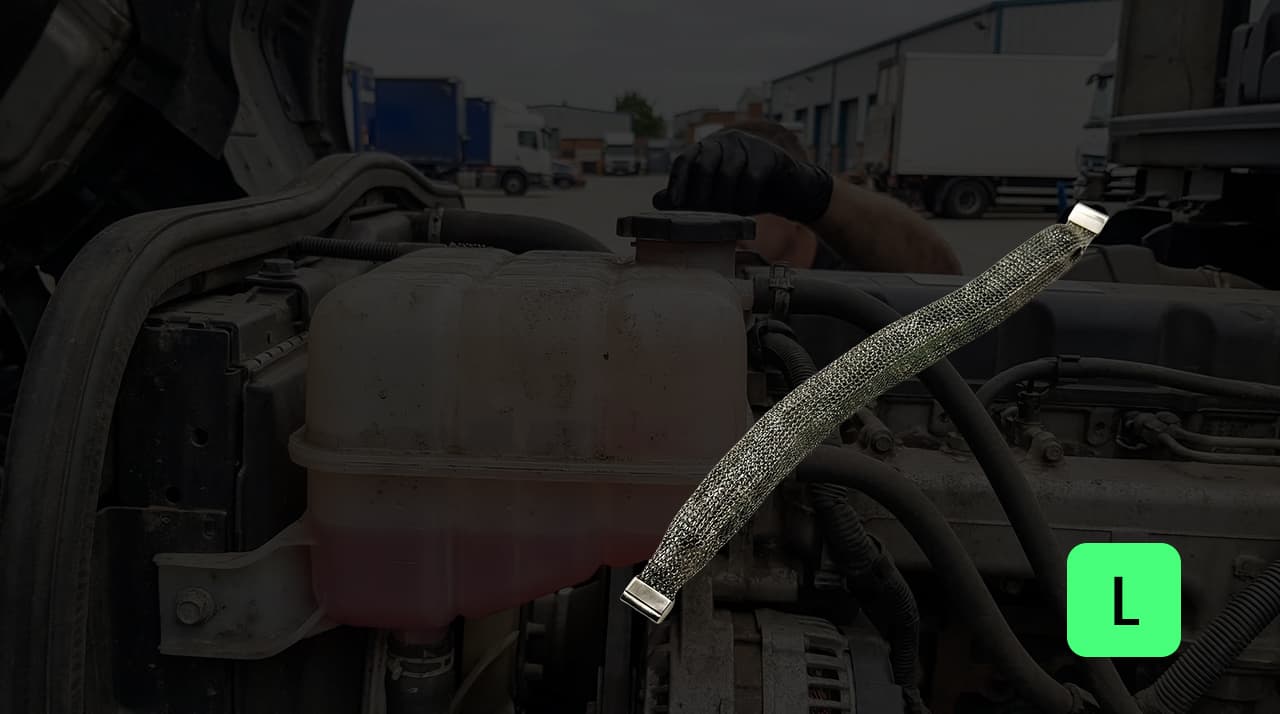
FuelMarble addresses this specifically. By placing FuelMarble minerals in the coolant reservoir, FuelMarble stabilises the thermal boundary layer at the cylinder wall, the interface where carbon accumulation causes heat to transfer inefficiently rather than producing combustion pressure. The result is a more complete combustion cycle per stroke, recovered across hundreds of thousands of engine events daily. Verified test results, available in the full efficiency test data, show 7–15% fuel efficiency improvement on high-mileage commercial vehicles.
At £46,600 annual fuel cost per 44-tonne truck, a 15% improvement saves approximately £7,000 per vehicle per year. FuelMarble L (£519) achieves payback in weeks, not months. For fleets also managing DPF maintenance costs, the improvement in combustion completeness reduces soot production per kilometre, directly reducing the frequency of active DPF regeneration events and the accumulated ash load that leads to premature filter replacement. See how cheap diesel additives compound this DPF damage for the full chemistry.
Fleet Benchmark Calculator: See Where Your Fleet Sits
Enter your fleet data below. The calculator uses RHA 2024 benchmarks to show your exact annual fuel cost versus the industry baseline, and the cost of the gap across your whole fleet.
HGV Fleet Fuel Benchmark Calculator
Enter your fleet data to see exactly how your fuel cost compares to the RHA industry benchmark, per vehicle and across your whole fleet.
For fleets sitting more than 10% above benchmark, a combustion-level efficiency device deployed across the fleet typically produces measurable MPG improvement within 150–200 km (about 95–125 miles) per vehicle. Heavier units can take longer, for example around 300 km (185 miles), which varies with the coolant system, with no driver retraining and no route changes required.
Conclusion
The UK HGV fuel efficiency landscape in 2024–2026 is defined by a paradox: the technology exists to achieve dramatically better fuel economy, but national fleet averages improve glacially because fleet turnover takes 5–10 years and operational discipline varies enormously. The RHA's 8.3 MPG baseline for a 44-tonne artic remains the industry-standard cost planning figure, but best-in-class fleets already exceed 9.5 MPG in sustained operation.
Because that turnover is so slow, most of the achievable gain has to come from the trucks already on the road, and even for operators who do replace, how much fuel economy actually varies between truck brands shows the modern brand-to-brand gap is modest against the within-fleet variance below.
For fleet managers, the most actionable insight is the 15–30% variance between best and worst performers. At roughly £46,600 in annual fuel cost per truck, even closing half of that gap through driver training, telematics, tyre management, speed policies, and combustion-level intervention can save £3,500–£7,000 per vehicle per year, dwarfing the cost of any single implementation.
With UK haulage pre-tax margins at just 1.58% and nearly half of companies formed since 2019 already closed or insolvent, fuel efficiency is not a nice-to-have but a survival imperative. For the full picture of where fuel fits in the the complete guide to UK haulage and logistics, and for the complete UK haulage and logistics cost guide, use those resources alongside this benchmark data to build your fleet's 2026 cost plan.
FuelMarble L is available at £519 per unit: designed for commercial vehicles and HGVs. Use the fleet fuel savings calculator to model the full ROI for your specific fleet profile.
For US and Canadian Fleet Operators
The benchmarks above use UK units (L/100km, HGV classifications). Here are the equivalent US benchmarks and ROI calculation for American operators running Class 7 and Class 8 trucks.
US Class 8 fuel consumption benchmarks (2026): Long-haul Class 8 trucks (Kenworth T680, Peterbilt 579, Freightliner Cascadia) average 6.0–6.5 MPG on interstate routes. Regional distribution averages 4.5–5.5 MPG. Urban last-mile Class 8 operations can drop to 3.5–4.5 MPG. FuelMarble's 7–15% improvement translates to 0.3–1.0 MPG improvement depending on baseline and duty cycle, at 120,000 miles/year, that is 2,000–10,000 gallons saved per truck annually.
US diesel context (2026): Average US diesel price is approximately $3.47/gallon (EIA forecast). Class 8 trucks average 4.5–6.5 MPG depending on route, load, and spec.
US ROI example: 10 Class 8 trucks:
- Annual mileage per truck: 120,000 miles
- Fuel consumption at 6.0 MPG average: 20,000 gallons/truck/year
- Fuel spend per truck at $3.47/gal: $69,400/year
- Fleet fuel spend (10 trucks): $694,000/year
- FuelMarble saving at 7% (conservative): $48,580/year
- FuelMarble L cost (10 units at $709 each): $7,090
- Payback period: 7.9 weeks
Warranty note for US buyers: FuelMarble installs into the coolant reservoir only. It does not modify the engine, fuel system, or any OEM component. Under the Magnuson-Moss Warranty Act, a manufacturer cannot void your warranty for using an aftermarket product that does not cause the defect. FuelMarble does not touch your fuel system.
US vehicle compatibility: FuelMarble L covers Class 4–8 trucks. FuelMarble S covers Class 1–3 pickup trucks and cargo vans. Both are compatible with Cummins, Duramax, and Powerstroke diesel engines.
Canadian operators: All figures above apply in Canada. Canadian diesel averages CAD $1.45–$1.65/litre depending on province (approximately USD $3.80–$4.30/US gallon equivalent). ROI timeline is similar to the US example above.
How to Improve HGV Fuel Consumption Below These Benchmarks
In my experience reviewing fleet cost reports, the question that follows every benchmarking exercise is always the same: "fine, but what do we actually do about it?" Here it is, five methods ordered by impact magnitude, with the numbers your procurement team needs.
A 44-tonne fleet running at 7.5 MPG against the 8.3 MPG RHA baseline is losing approximately £6,200 per vehicle per year at current ex-VAT diesel prices. For a 25-truck operation, that is £155,000 of recoverable annual cost sitting in the gap between where you are and where the industry benchmark sits. These five levers close it. For the driver-and-maintenance playbook in depth, see how to reduce HGV diesel consumption.
- Combustion completeness (hardware). FuelMarble's mineral technology sits in the coolant reservoir and reduces coolant surface tension. This improves heat transfer across the cylinder wall, increases intake charge density, and raises combustion completeness on every engine cycle, with no engine modification required. Verified results: Tamai Steamship Co. (Tres Felices bulk carrier) confirmed 7.33–8.31% fuel reduction in wind-condition-controlled independent trials. Yamanashi Kotsu bus fleet returned 22.14% improvement on city routes. Professor Watanabe's SAE Japan 2008 peer-reviewed research documented a 1.5–3.0% volumetric filling efficiency gain and 5.1% mean brake-specific fuel consumption improvement. This method operates at the engine level, it recovers energy that would otherwise be lost as soot, heat, and unburned hydrocarbons on every combustion cycle.
- Driver behaviour. The Energy Saving Trust's programme across nearly 50,000 UK drivers achieved an average 14% fuel reduction on training day. Sustained long-term savings settle at 3–6% without ongoing reinforcement, up to 15% with consistent application. Within-fleet MPG variance between your best and worst driver on identical vehicles on identical routes can reach 15–30%, the single largest controllable variable in your fuel budget.
- Speed discipline. FORS data is unambiguous: dropping from 56 mph to 50 mph reduces fuel consumption by up to 20%. At the 8.3 MPG baseline for a 75,000-mile operator, that is a recoverable 1.66 MPG, equivalent to £8,900 per truck per year at 113p/litre ex-VAT. Speed limiters already enforce 56 mph on most UK HGVs; the gain comes from coaching drivers to run at 50–52 mph on motorway sections where schedules permit.
- Tyre pressure management. FORS data: every 10% drop in tyre pressure increases fuel consumption by 2%. For a 20-vehicle fleet where half the assets are consistently under-inflated by 15%, the annual cost in excess fuel runs to £1,800–£2,400 fleet-wide before accounting for accelerated tyre wear. Weekly pressure checks are the highest-ROI maintenance task per hour of workshop time.
- Route and load optimisation. Telematics-led route optimisation delivers 5–10% fuel savings in the first year across most UK fleet deployments. Empty return miles are the most expensive miles you run. Every partial load on an outbound run and empty trailer on the return is a direct charge against fuel efficiency, load consolidation and backload matching are the fastest route to structural improvement without touching the engine.
This applies when your fleet's current MPG is measurably below the RHA baseline for your vehicle class. It does NOT apply if you are already running at or above benchmark AND have verified this against live telematics data rather than manufacturer estimates or driver self-reporting.
Case in point: Yamanashi Kotsu, a Japanese city bus operator running routes equivalent in stop-start intensity to UK urban HGV distribution, applied FuelMarble across their fleet. City routes returned a verified 22.14% fuel efficiency improvement. Highway coach routes returned 15.90%. For a 10-vehicle UK urban distribution fleet currently running at 8.0 MPG against an 11.0 MPG benchmark for 18-tonne vehicles, recovering just 30% of the benchmark gap through combustion optimisation alone saves approximately £12,000 per year fleet-wide, at zero change to routes, drivers, or maintenance schedule.
Closing that gap through driver training, tyre pressure, and route optimisation is the right move. Those methods are proven, and any fleet director who implements all five consistently will see a material difference in their fuel line within a quarter.
But every one of those five methods reduces how much fuel your engines demand. None of them recovers the fuel energy that was demanded, injected, and then wasted, because combustion was incomplete. Every diesel engine loses a percentage of each injection cycle to partial combustion: unburned hydrocarbons, carbon particulates, and heat escaping through the exhaust rather than driving the piston. That percentage is not large on a single cycle. Across a fleet of 25 vehicles running 75,000 miles a year, it compounds into tens of thousands of litres of diesel that were purchased, burned, and contributed nothing to forward motion.
That is what FuelMarble's coolant-side combustion optimisation targets at the source, by improving heat transfer across the cylinder wall through surface tension reduction in the coolant, it increases intake charge density and raises combustion completeness on every engine cycle, across every vehicle in the fleet, without engine modification, without driver retraining, and without changing a single route.
Related Articles
Avery leads FuelMarble's international operations and strategic direction. With a background spanning fleet economics, regulatory compliance, and macro fuel market trends, Avery oversees commercial partnerships, product positioning, and the company's growth across the UK, US, Canadian, and Mexican markets.
Ready to Improve Your Fuel Efficiency?
FuelMarble delivers up to 15% fuel efficiency improvement. Simple drop-in install.