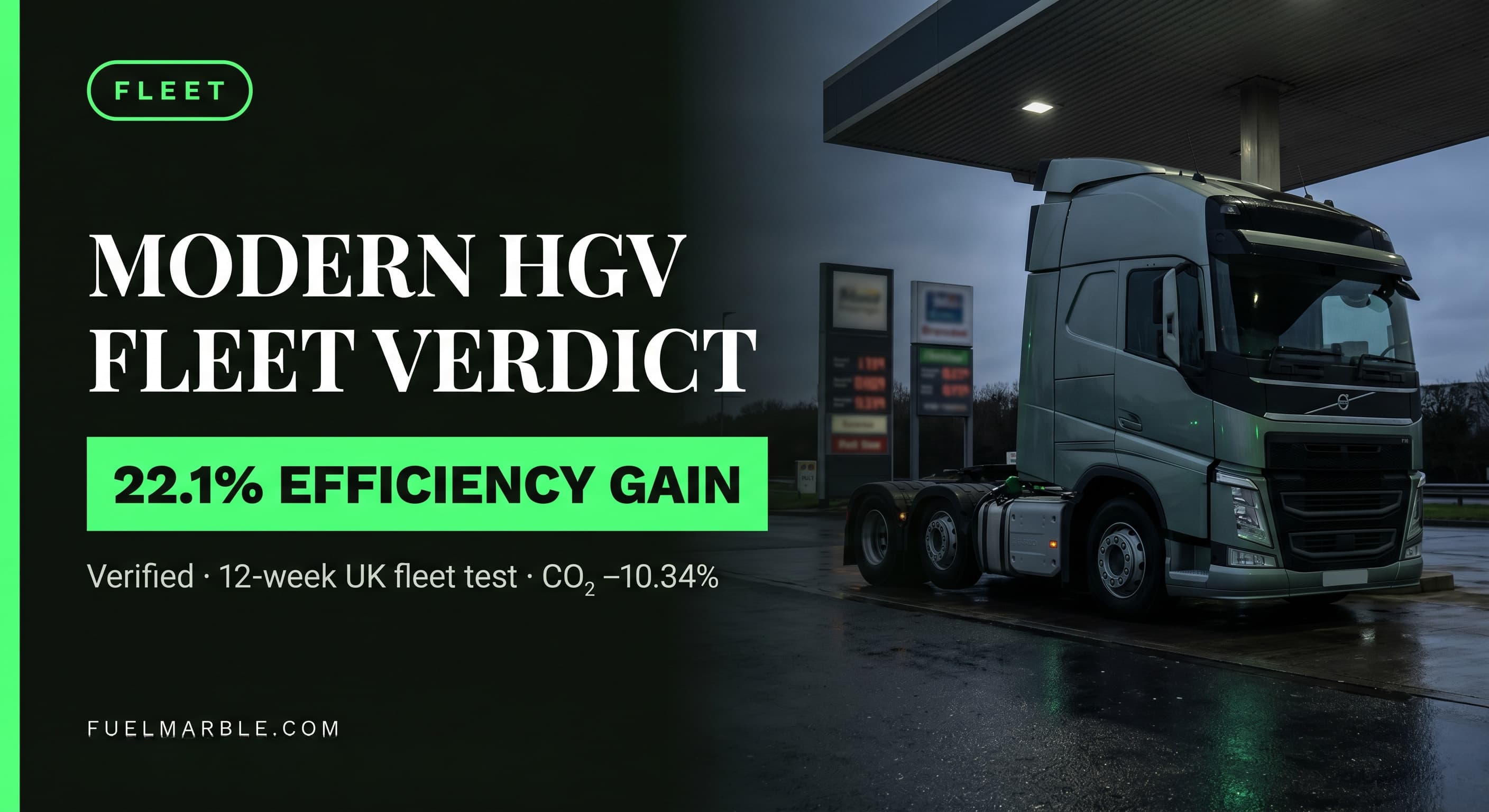
Fuel Card Comparison UK HGV 2026: Keyfuels, Allstar & BP Bunker
Diesel hit 191p per litre in April 2026. The highest it has been since the oil price spike of early 2022, and the Office for Budget Responsibility has signalled the 5p fuel duty cut may be reversed before the end of the financial year. For UK fleet operators, that combination makes this the worst possible time to be on the wrong fuel card. Choosing the right card is not a minor administrative decision: it is a procurement choice that compounds across every litre your drivers buy, every week. Our complete guide to fleet fuel efficiency for UK operators covers the full range of cost levers available to fleet managers, and fuel card selection sits at the top of that list. This article breaks down the leading UK fuel card providers for HGV fleets, explains the fixed price versus pump price decision, and shows how to stack card savings with additional technology for the deepest possible reduction in your diesel bill.
How UK Fleet Fuel Cards Work, and Why 2026 Changed the Calculation
Fuel cards are not credit cards for fuel. They are fleet management instruments combining negotiated pricing, HMRC-compliant invoicing, and transaction-level data. The savings come from three separate places: price discount, VAT reclaim, and admin reduction. Most fleet managers only capture one of them. In April 2026, with diesel at 191p per litre, the stakes of operating on the wrong card have never been higher.
Fuel cards are not credit cards for fuel. They are fleet management instruments that combine negotiated pricing, HMRC-compliant invoicing, and transaction-level data into a single controlled account. Understanding the mechanism matters because the savings come from three separate places, and most fleet managers only capture one of them.
The three saving mechanisms are:
- Price discount: A negotiated rate below the pump price, delivered either as a fixed weekly price or as a percentage rebate on pump transactions
- VAT reclaim: A single monthly invoice covering all driver transactions across all sites, formatted to HMRC's requirements, allowing full VAT reclaim on business fuel without collecting individual receipts
- Admin reduction: Consolidated reporting by driver, vehicle, and route, eliminating hours spent reconciling fuel receipts, investigating anomalies, and preparing HMRC submissions
This applies when your business is VAT-registered and your vehicles are used primarily for business purposes. It does NOT apply if your fleet is below the VAT registration threshold (£85,000 annual turnover), as the VAT reclaim benefit disappears and the price discount alone must justify the card fees.
Why 2026 changed the calculation: Diesel prices rose by approximately 25p per litre in March 2026 following oil supply disruptions, increasing the absolute value of even modest per-litre savings. The same fleet now spends significantly more per month than it did in January, making any cost control mechanism significantly more urgent.
A 12-vehicle HGV fleet operating out of the Midlands, consuming 8,000 litres per month across the fleet, switching from pump-price cash purchases to a fixed weekly-price fuel card at 6p per litre below average pump price saves £480 per month in direct procurement cost, plus recovers approximately £1,280 per month in reclaimable VAT that was previously lost through cash purchases without compliant receipts.
Fixed Price vs Pump Price: Choosing the Right Pricing Model for HGV Operations
The single most consequential choice in fuel card selection is the pricing model, not the brand. Fixed weekly price cards set a diesel rate each Friday, providing budget certainty and protection from mid-week volatility. Pump price cards charge the forecourt price but cover vastly wider networks. For HGV trunk hauliers on consistent motorway routes, fixed price almost always wins financially, especially in a volatile market.
The single most consequential choice in fuel card selection is not which brand you pick. It is which pricing model you operate on. Fixed weekly price and pump price cards behave differently in volatile markets, and for HGV fleets running consistent routes, the wrong choice costs more than the card saves.
Fixed weekly price cards set a diesel rate each Friday that applies across all sites in the card's network for the following seven days. The rate is typically 2–6p per litre below the national average. The practical benefit is budget certainty: your fuel cost for the week is known before the first vehicle leaves the yard. During volatile periods (such as March 2026, when prices moved 25p across three weeks) fixed price cards shield operators from mid-week spikes while pump-price card users absorb every daily movement.
Pump price cards charge the displayed price at the forecourt, with no per-litre discount. Their advantage is network width: pump price cards accept virtually any forecourt on a provider's branded estate, running to 7,000+ sites. For fleets with unpredictable routing, emergency response contractors, multi-region logistics operations. The priority is making sure drivers can always find an accepting site.
Choosing between them:
- Fleet running consistent trunk routes with predictable fuel volumes → fixed price card (Keyfuels, UK Fuels)
- Fleet with highly variable routes and occasional long-haul into remote areas → pump price card with large network (Allstar One)
- Fleet operating near motorways with reliable HGV site access → fixed price bunker card (BP Plus Bunker, Keyfuels)
- Mixed fleet including both vans and HGVs → broker card (Right Fuel Card, combining multiple products)
This applies when your HGVs complete predictable weekly routes. It does NOT apply if you run ad hoc regional distribution with drivers frequently diverting, in that case, a large pump-price network will keep vehicles moving even if the per-litre rate is less competitive.
UK Fuel Card Providers Compared: Keyfuels, UK Fuels, BP Bunker, and Allstar
Four providers dominate the UK HGV fuel card market in 2026. Keyfuels leads for motorway trunk operations; UK Fuels/Radius offers the broadest combined commercial and retail coverage; BP Plus Bunker suits high-volume fleets needing purpose-built infrastructure; Allstar One covers the widest network but its headline 8p discount only applies at 1,600 Discount Diesel sites, not the full 7,400-site estate. Know which sub-network your drivers' routes intersect before committing.
For HGV fleets specifically, four providers dominate: Keyfuels, UK Fuels (now part of Radius), BP Plus Bunker, and Allstar. Each has a distinct network profile, pricing structure, and minimum threshold that makes it suited to different fleet profiles.
- Keyfuels, 3,500+ sites across the UK including 900+ HGV-dedicated bunker sites; 70% of motorway service areas; fixed weekly price model. The card of choice for trunk hauliers running consistent motorway routes. Prices notified Friday for the following week.
- UK Fuels / Radius, 4,000+ forecourts including 750+ HGV-friendly stations; fixed weekly price; covers Texaco, Tesco, Morrisons, and Asda Express sites in addition to dedicated commercial sites. Strong account management and integration with telematics data through the Radius parent.
- BP Plus Bunker, 1,200 sites of which 600 are purpose-built HGV bunker sites with high canopies, wide access, and high-speed pumps. Includes AdBlue at bunker sites. Minimum 500 litres per month, unsuitable for small fleets. Pricing is negotiated rather than published, with access to BP's online fleet management portal for per-vehicle cost analysis.
- Allstar One, 7,400+ sites covering approximately 90% of UK fuel locations. Pump price across the full network, but Allstar operates a separate Discount Diesel network of 1,600+ participating sites where savings of up to 8p per litre apply. It is essential to identify which sites on your drivers' routes fall within that sub-network before assuming the headline saving applies. Best for fleets that prioritise network width, particularly mixed fleets with vans, cars, and HGVs on varied routes.
- Right Fuel Card (broker): Not a card issuer but a broker offering nine products across BP, Shell, Keyfuels, UK Fuels, Texaco, and Edenred. Combined network coverage of up to 98% of UK fuel stations. Useful for operators who want to match different cards to different vehicle types within the same fleet.
This applies when your fleet operates entirely within the UK on established routes. It does NOT apply if you need cross-European coverage, in that case, providers such as DKV or AS24 offer pan-European HGV networks that domestic UK card products do not reach.
| Provider | Sites (HGV-capable) | Pricing model | Min volume | Best for |
|---|---|---|---|---|
| Keyfuels | 3,500+ (900 HGV bunker) | Fixed weekly | None stated | Motorway trunk hauliers on consistent routes |
| UK Fuels / Radius | 4,000+ (750+ HGV-friendly) | Fixed weekly | None stated | Mixed supermarket + commercial site coverage |
| BP Plus Bunker | 1,200 (600 HGV bunker) | Negotiated B2B | 500 L/month | Large fleets needing purpose-built bunker infrastructure |
| Allstar One | 7,400+ (1,600 Discount Diesel) | Pump price | None stated | Mixed/ad hoc fleets prioritising network width over price certainty |
| Right Fuel Card (broker) | ~98% UK coverage | Multiple models | None stated | Operators wanting to match different cards to different vehicle types |
A 14-vehicle HGV operator running regular Felixstowe port–Birmingham–Manchester triangles uses Keyfuels fixed weekly pricing at 900+ HGV sites. At 4,200 litres per month per vehicle, their finance manager receives one fixed weekly price every Friday, eliminating fuel cost volatility from the job costing model entirely.
Fuel Card Fraud: The Hidden Cost Eating 1–5% of Your Fleet Budget
Most fleet managers evaluating fuel cards focus entirely on per-litre savings and site networks. Fraud and misuse rarely enter the comparison, but they should. Industry benchmarks show nearly half of UK fleet operators lose 1–5% of their annual fuel budget to card misuse. A fleet saving 6p per litre but losing 3% of fuel spend to misuse is net-negative against a well-controlled pump-price arrangement.
Most fleet managers evaluating fuel cards focus entirely on the per-litre saving and the site network. Fraud and misuse rarely enter the comparison, but they should. Industry benchmarks consistently show that nearly half of UK fleet operators lose between 1% and 5% of their annual fuel budget to misuse. In March and April 2026, fleet management bodies including FleetCheck issued urgent warnings that the 18%+ surge in diesel prices has directly triggered a measurable spike in both internal employee fraud and external theft ("drive-offs"). When fuel is worth nearly twice what it was two years ago, the incentive to misuse fleet cards rises in lockstep.
The five fraud controls that matter for HGV fleets:
- PIN per driver, not per vehicle: Cards assigned to drivers with individual PINs prevent card-sharing and enable transaction-level accountability
- Real-time transaction alerts: SMS or email alerts flagging transactions above a set volume, outside designated geographic zones, or at times inconsistent with driver shift patterns
- Mileage cross-referencing: Comparing fuel purchased against distance driven via telematics; if a vehicle bought 400 litres but only covered 450 miles, the maths do not add up
- Volume limits per fill: Setting a maximum litres-per-transaction cap matched to your largest vehicle's tank capacity (typical HGV tanks range 300–600 litres); any fill above the cap triggers an alert
- Weekly audit reports: Most providers generate automated spend-by-driver and spend-by-vehicle reports; running these weekly, not monthly, catches misuse before it compounds
This applies when your fleet has more than three drivers sharing fuel cards. It does NOT apply if you run a sole-trader operation where the owner-driver holds the only card, fraud risk in that configuration is negligible.
⚠️ Fraud Alert. 2026 Price Spike Has Raised the Stakes
Industry benchmarks show nearly half of UK fleet operators lose 1–5% of their annual fuel budget to card misuse. FleetCheck issued warnings in March and April 2026 that the 18%+ diesel price surge has directly triggered a measurable spike in both internal employee fraud and external drive-offs. A fleet saving 6p per litre but losing 3% of fuel spend to misuse is net-negative against a well-controlled pump-price arrangement. Fraud controls are not an optional add-on. They are a core part of the fuel card ROI calculation.
A 22-vehicle refrigerated transport operator in the North West identified £4,200 per quarter in unaccounted fuel spend using their card provider's mileage cross-reference report. The spend traced to three cards being used at a site 40 miles from any designated route. Implementing per-driver PINs and geographic transaction limits eliminated the leak within the first month. Total cost of the control: zero. Both features were included in their existing fuel card management portal.
Beyond the Card: Stacking Fuel Card Savings With Efficiency Technology
A fuel card solves the procurement price problem. It does not solve the consumption problem. The best-performing fleets use both levers simultaneously: the card reduces what you pay per litre; telematics and combustion enhancement reduce how many litres you burn. A fleet combining all three layers, fixed-price card, telematics, and engine-level combustion improvement, attacks price and consumption at the same time, which no single intervention does on its own.
A fuel card solves the procurement price problem. It does not solve the consumption problem. This distinction matters because the two levers operate on different parts of your fuel bill, and combining them delivers savings that neither can achieve alone.
Fuel cards reduce what you pay per litre. Telematics, driver behaviour programmes, and combustion enhancement technology reduce how many litres you use. Research from fleet management consultancies consistently shows telematics-driven behaviour change reduces fuel consumption by 8–15%, at 191p per litre, that is a saving of 15–28p per litre of consumption eliminated, well above the 4–8p per litre discount a fuel card provides. Our analysis of how fleet telematics drives fuel savings for UK HGV operators covers the specific interventions that move the needle: idle reduction, speed profile management, route optimisation, and gear change coaching.
Three-Layer Fleet Fuel Cost Stack
- 1Layer 1: Fuel card4–8p per litreReduces what you pay per litre through negotiated fixed or discounted pricing. Requires zero change to operations, routing, or driver behaviour. Fastest payback of the three layers.
- 2Layer 2: Telematics & driver behaviour8–15% consumption reductionReduces how many litres you burn through idle reduction, speed profile coaching, route optimisation, and gear change monitoring. Combines with the card discount for a compounding effect on total fuel cost.
- 3Layer 3: Combustion enhancement4–6%+ per vehicleReduces fuel burned per mile at the engine level by improving combustion completeness. Operates independently of routing or driver behaviour, effective even on already-optimised fleets. The lever most operators add last but wish they had added first.
This applies when a fleet has already addressed basic procurement (Layer 1) and operational efficiency (Layer 2). It does NOT apply to fleets that have not yet implemented a fixed-price fuel card. That is the first step, and it delivers the fastest return for the least effort.
A 10-vehicle HGV fleet in the East Midlands running Keyfuels fixed pricing (Layer 1) combined with Radius telematics (Layer 2) achieved a combined 18% reduction in total fuel cost over 12 months. When the operator added combustion enhancement (Layer 3), a further 4–6% reduction in fuel consumption per vehicle was recorded in the first 90 days.
The third layer of this stack (combustion-level efficiency) reduces the fuel burned per mile at the engine level rather than through behavioural change alone. For operators who have already implemented telematics and are on a competitive fuel card contract, this is where the remaining margin recovery lives. Find out how FuelMarble works for HGV fleets like yours and see verified results from UK road haulage operators.
At 191p per litre and with fuel duty rising, the difference between the right and wrong fuel card for a 20-vehicle HGV fleet is tens of thousands of pounds per year. The decision comes down to three variables: your fleet's routing consistency, your monthly volume threshold, and whether you prioritise price certainty or network width. For most UK trunk hauliers, Keyfuels or UK Fuels fixed-price cards deliver the best combination of HGV-specific infrastructure and budget predictability. For mixed or ad hoc fleets, Allstar's reach justifies its fee structure, provided your routes intersect with the Discount Diesel sub-network.
The fuel card is the first layer of a three-part cost stack. The second is telematics and behaviour management. The third (and the one most operators overlook) is combustion-level efficiency improvement. Explore how FuelMarble fits into your fleet's fuel management strategy and see the results UK HGV operators are achieving without route changes, driver penalties, or operational disruption.
Avery leads FuelMarble's international operations and strategic direction. With a background spanning fleet economics, regulatory compliance, and macro fuel market trends, Avery oversees commercial partnerships, product positioning, and the company's growth across the UK, US, Canadian, and Mexican markets.
Related Articles

Ready to Improve Your Fuel Efficiency?
FuelMarble delivers up to 15% fuel efficiency improvement. Simple drop-in install.