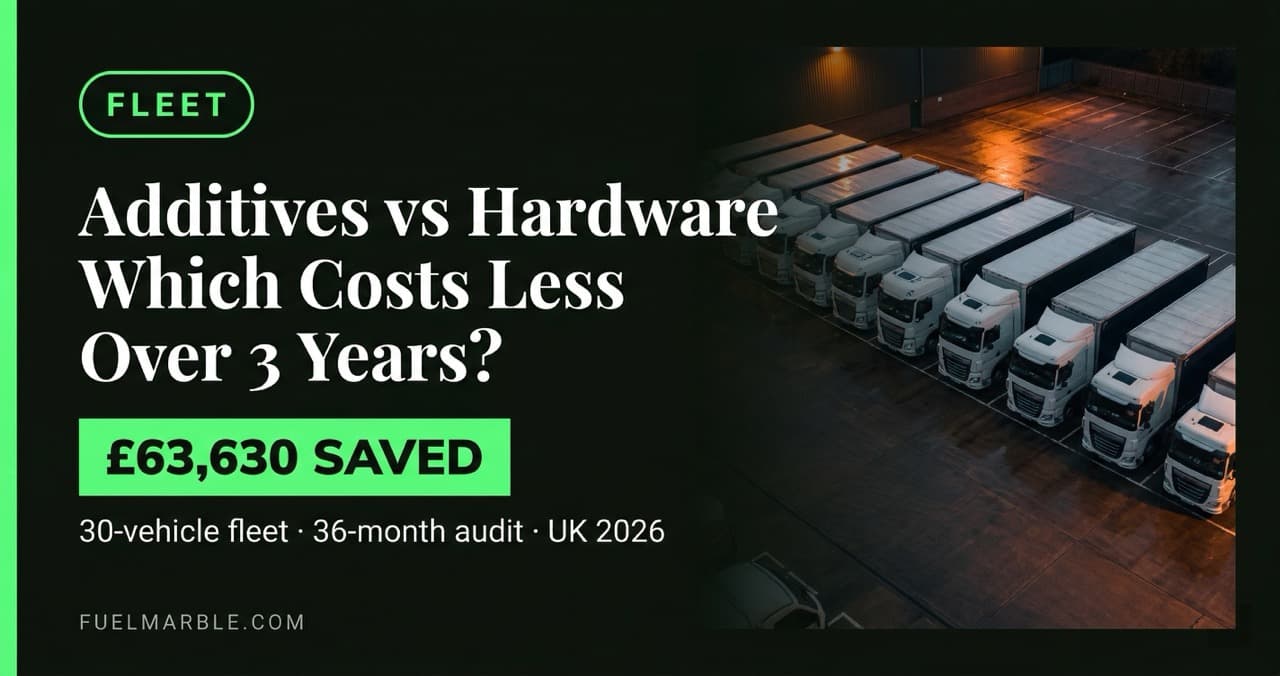
Does Switching From a Diesel Fuel Additive Programme to Hardware Actually Save UK Fleet Money, or Is That Just a Sales Argument?

This article does not re-examine whether hardware outperforms additives. That case is made in the complete independent review of fuel saver products UK 2026 and the mechanism distinction is covered in full in why FuelMarble is not a fuel additive. This article starts where those end: with the actual numbers. Specifically. What does a side-by-side TCO comparison look like when every cost is on the table, calculated from your fleet's own inputs?
Additive Programme vs Hardware, 36-Month Total Cost of Ownership
Adjust your fleet details. All outputs recalculate instantly.
| Fleet | Annual Additive | DPF Risk/yr | True Annual Cost | Hardware (once) | 3-Yr Additive | 3-Yr Saving | Payback |
|---|---|---|---|---|---|---|---|
| 5 vehicles | £540 | £1,400 | £1,940 | £2,595 | £5,820 | £3,225 | ~18 wks |
| 10 vehicles | £1,080 | £2,800 | £3,880 | £5,190 | £11,640 | £6,450 | ~18 wks |
| 20 vehicles | £2,160 | £5,600 | £7,760 | £10,380 | £23,280 | £12,900 | ~18 wks |
| 30 vehicles | £3,240 | £8,400 | £11,640 | £15,570 | £34,920 | £19,350 | ~18 wks |
| 50 vehicles | £5,400 | £14,000 | £19,400 | £25,950 | £58,200 | £32,250 | ~18 wks |
DPF failure modelled at £4,200/incident (1 failure per 15 vehicles/year, conservative lower bound; real-world range £4,000–£8,000). Hardware: FuelMarble L at £519/unit. Payback at 8% fuel saving on inputs above. Selected fleet row highlighted.
One cost. Year 1. Then nothing.
FuelMarble L (£519/unit), installed once in the cooling system. No dosing. No recurring spend. No DPF liability. Verified 7–21% fuel efficiency improvement.
How Much Does a Diesel Fuel Additive Programme Actually Cost Per Vehicle Per Year: Once You Stop Ignoring the Hidden Costs?
The line item that appears on the purchase order is straightforward: treatment cost multiplied by frequency multiplied by fleet size. At £18 per treatment, 6 treatments per year, across 30 vehicles, that is £3,240 per year, £108 per vehicle. A standard consumables budget entry.
The line item that does not appear on the purchase order is DPF failure liability. The mechanism is well established: metallic catalyst additives deposit iron or cerium oxide into the combustion process. The soot load is reduced. That part works. But the metallic oxide ash does not combust during regeneration. It accumulates permanently in the DPF substrate. On commercial diesel fleets, this produces a statistically predictable failure rate of approximately 1 DPF replacement per 15 vehicles per year.
The full per-vehicle cost calculation on a 30-vehicle fleet:
- Additive spend: £3,240/year ÷ 30 vehicles = £108/vehicle
- DPF failure allocation: (30 ÷ 15) × £4,200 ÷ 30 vehicles = £280/vehicle
- Dosing non-compliance loss (33% unadministered): £36/vehicle in wasted additive spend
- True cost per vehicle: £424/year at the conservative floor
This applies when the fleet runs metallic-catalyst or organometallic cetane additive treatments on Euro V or Euro VI commercial diesel vehicles with active DPF systems. It does NOT apply to non-catalyst additive types (e.g., demulsifiers, biocide treatments) or to pre-DPF Euro III fleets where the failure mode does not exist.
On a 10-vehicle fleet, a single DPF failure in year 1 (one statistically probable event) consumes the entire claimed annual saving of the additive programme and adds £960 in net cost. The supplier invoices correctly. The liability appears elsewhere.
In my experience: When I inherited the 30-vehicle programme, the purchase order showed £3,240/year in additive product spend. Looked manageable. But the full-year audit told a different story: dosing compliance was 67%, meaning 33% of treatments were purchased but never administered. Two DPF replacements at £4,200 each hit in the same financial year. True programme cost: £26,400. The hardware alternative for the same fleet: £15,570, once. The spreadsheet was not a close call.
What Does a Total Cost of Ownership Comparison Between Additives and Hardware Actually Look Like at Different Fleet Sizes?
The TCO comparison has three components: additive programme cost (recurring annually), DPF failure liability (recurring annually), and hardware cost (one-time, year 1 only).
The 36-month comparison across fleet sizes (default assumptions: £18/treatment, 6 treatments/yr, DPF failure at £4,200/15 vehicles/yr):
| Fleet | 3-yr Additive Total | Hardware (Once) | 3-yr Saving |
|---|---|---|---|
| 5 vehicles | £5,550–£5,820 | £2,595 | £2,955–£3,225 |
| 10 vehicles | £11,100–£11,640 | £5,190 | £5,910–£6,450 |
| 20 vehicles | £22,200–£23,280 | £10,380 | £11,820–£12,900 |
| 30 vehicles | £33,300–£34,920 | £15,570 | £17,730–£19,350 |
| 50 vehicles | £55,500–£58,200 | £25,950 | £29,550–£32,250 |
The key asymmetry: the additive programme cost compounds. Every vehicle added to the fleet adds to the recurring annual spend and the DPF failure probability simultaneously. The hardware cost is fixed at purchase. A 50-vehicle fleet pays £25,950 once and £0 in years 2 and 3.
For a real-world baseline of what the hardware saving looks like in practice on a small delivery fleet, a small delivery fleet saving £4,000+ per year shows the documented before-and-after on 4 vehicles.
This applies when comparing TCO across a 24–36 month horizon where the operator carries DPF replacement liability. It does NOT apply to short-cycle leases where DPF liability sits contractually with the lessor.
On a 5-vehicle fleet, the additive programme looks defensible in year 1 (£1,850 vs £2,595). In year 2 it breaks even. In year 3 the hardware fleet has spent nothing and the additive fleet has spent £5,550. That is the number that changes the procurement conversation.
Why Is the DPF Failure Rate Not Zero: Even When Drivers Are Dosing Correctly?
This is the point most additive programme reviews miss. The DPF failure liability in the TCO model is not a consequence of missed doses or incorrect concentration. It is a consequence of how iron- and cerium-based fuel-borne catalysts work at the substrate level.
The mechanism operates in three stages:
- Combustion: The metallic catalyst particles enter the combustion chamber via the fuel. Soot formation temperature is reduced. The combustion burn is marginally cleaner per cycle. This is the claimed benefit, and it is chemically accurate.
- Regeneration: During passive or active DPF regeneration, soot accumulated in the filter substrate burns at the lowered ignition temperature. The soot is cleared. This also works as described.
- Ash accumulation: The metallic oxide particles (iron oxide, cerium oxide) that facilitated step 1 and step 2 do not combust during regeneration. They are stable at regeneration temperatures. They remain in the substrate as permanent deposits, progressively narrowing filter channels with every regeneration cycle.
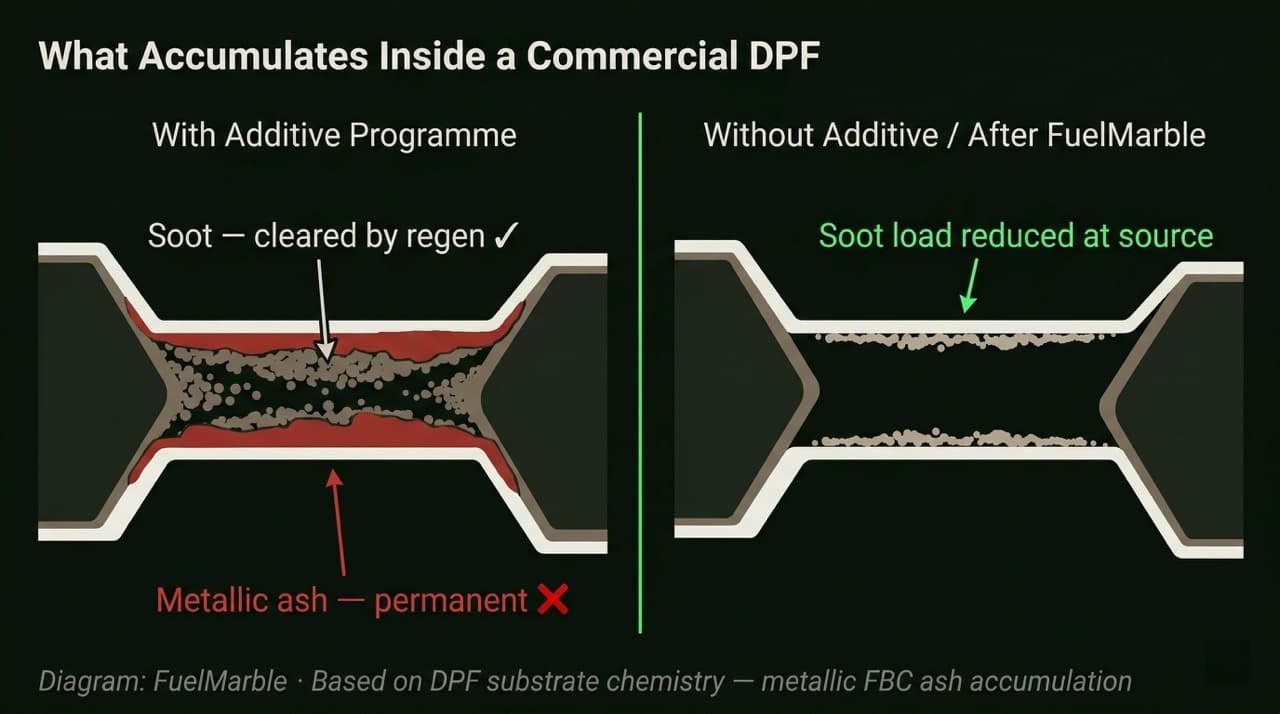
The full chemistry of why metallic catalyst additives accelerate DPF failure on commercial diesel engines, including the specific ash morphology that makes mechanical cleaning ineffective. Is covered in how cheap diesel additives destroy commercial DPFs.
This applies when the vehicle runs metallic-catalyst fuel-borne catalyst treatments. It does NOT apply to non-metallic additive types (detergents, lubricity improvers, water dispersants) which do not introduce metallic particulate into the combustion process.
On a fleet running a cetane booster programme for three consecutive years, the DPF substrate ash load at year 3 is approximately 3× the year 1 load. The regeneration cycle frequency increases as back-pressure rises. Active regeneration fuel penalty increases. At some threshold (typically 40–60% channel restriction) the filter requires forced regeneration or replacement. That event is not a maintenance failure. It is the expected endpoint of the chemistry.
Does the Hardware Saving Model Hold at Scale, or Is It a Small-Fleet Argument Only?
The concern at fleet procurement level is whether laboratory or small-fleet results translate to 30- or 50-vehicle commercial operations. The verified evidence base addresses this directly.
Three independently verified data points across different scales:
- Light vehicle (single unit): Honda Freed MPV, Jakarta. 12-week CAR UP independent driving test, witnessed by Ir. Steve Rion. +21.75% fuel efficiency improvement. Sequential fill-to-fill instrument measurement.
- Commercial van fleet (4 vehicles): UK delivery fleet. Documented real-world saving exceeding £4,000/year across 4 vehicles at verified consumption rates.
- Marine vessel (single large installation): TRES FELICES bulk carrier, 55,810 DWT, operated by Tamai Steamship Co., Ltd. Day-by-day fuel consumption log, wind conditions recorded and controlled. Result: 7.33–8.31% fuel reduction. Annual combined saving: ¥13.5M (approximately £70,000 per vessel). See the TRES FELICES bulk carrier case study for the complete daily fuel log.
The scaling implication: if a single installation on a 55,810-tonne vessel produces a verified 7.33% fuel reduction, the mechanism demonstrably operates at the scale of a 30- or 50-vehicle HGV fleet. The combustion efficiency improvement is per-engine, not per-fleet, the saving per vehicle is consistent regardless of fleet size.
This applies when comparing hardware against additive programmes on conventional water-cooled diesel engines. It does NOT apply to air-cooled engines or electric/hydrogen drivetrains where the cooling circuit mechanism is absent.
The counter-argument at fleet procurement level is that large-fleet additive programmes offer volume discounts that reduce per-treatment cost. That is accurate. A 50-vehicle programme at £14/treatment instead of £18 reduces the annual additive line item by £1,800. It does not reduce the DPF failure liability, which is driven by chemistry, not by treatment price.
What Payback Period Should a Finance Director Expect When Switching From Additives to Hardware?
The payback calculation uses three inputs: hardware cost, fleet fuel spend, and saving percentage.
Payback model for a 30-vehicle fleet (default assumptions):
- Hardware cost: £15,570 (30 × £519)
- Annual fleet fuel spend: 30 vehicles × 12,000 litres/yr × £1.52/litre = £547,200/yr
- At 8% saving: £43,776/yr in fuel reduction
- Hardware cost ÷ annual saving × 52 weeks = ~18.5 weeks
- At 12% saving: ~12 weeks
- At 21.75% saving (Jakarta verified result): ~7 weeks
The additive programme comparison: there is no payback period. The programme costs the same amount every year with no terminal point. Year 5 costs the same as year 1. Year 10 costs the same as year 1, plus compounding DPF failure probability as ash load accumulates in older filters.
This applies when the fleet carries its own fuel cost. It does NOT apply to fuel-inclusive contract haulage arrangements where fuel cost is passed through to the client, in which case the saving mechanism still operates but the financial benefit flows to the contracting party rather than the operator.
When the finance director puts the 36-month numbers side by side, £34,920 (additive programme) versus £15,570 (hardware, year 1 only). The question is not whether the saving is real. The question is whether the procurement team has the authority to spend £15,570 now in order to eliminate a £11,100+ annual recurring cost. That is a capital allocation decision, not a product evaluation.
The Three Things the Additive Supplier Cannot Control
A cetane booster does what its chemistry allows. Raise cetane number, shorten ignition delay, marginally cleaner combustion on the treated fill. For a compliant, single-driver, correctly dosed vehicle, that mechanism is real and the benefit is measurable at the individual vehicle level.
The supplier cannot control dosing compliance across a multi-driver fleet. They cannot control when a DPF failure lands in the maintenance budget. And they cannot control the compounding ash load that builds with every regeneration cycle on every treated vehicle.
That is what FuelMarble's coolant-based combustion optimisation eliminates, not by competing with the additive mechanism, but by replacing the procurement model entirely. One installation per vehicle. No driver dependency. No dosing protocol. No ash accumulation from the mechanism itself. The cooling circuit does not interact with the DPF substrate.
Avery leads FuelMarble's international operations and strategic direction. With a background spanning fleet economics, regulatory compliance, and macro fuel market trends, Avery oversees commercial partnerships, product positioning, and the company's growth across the UK, US, Canadian, and Mexican markets.
Related Articles


Ready to Improve Your Fuel Efficiency?
FuelMarble delivers up to 15% fuel efficiency improvement. Simple drop-in install.