
Fuel Saving Devices Compared: OBD Chips vs Magnets vs FuelMarble (2026)
There are four categories of fuel saving device on the market in 2026. Three of them have no independently verified data. One does, and that difference determines whether you are investing in a real efficiency gain or paying for a placebo. This page compares every major category using engineering evidence, independent laboratory data, and verified fleet trial results so you can make an informed decision before spending a penny.

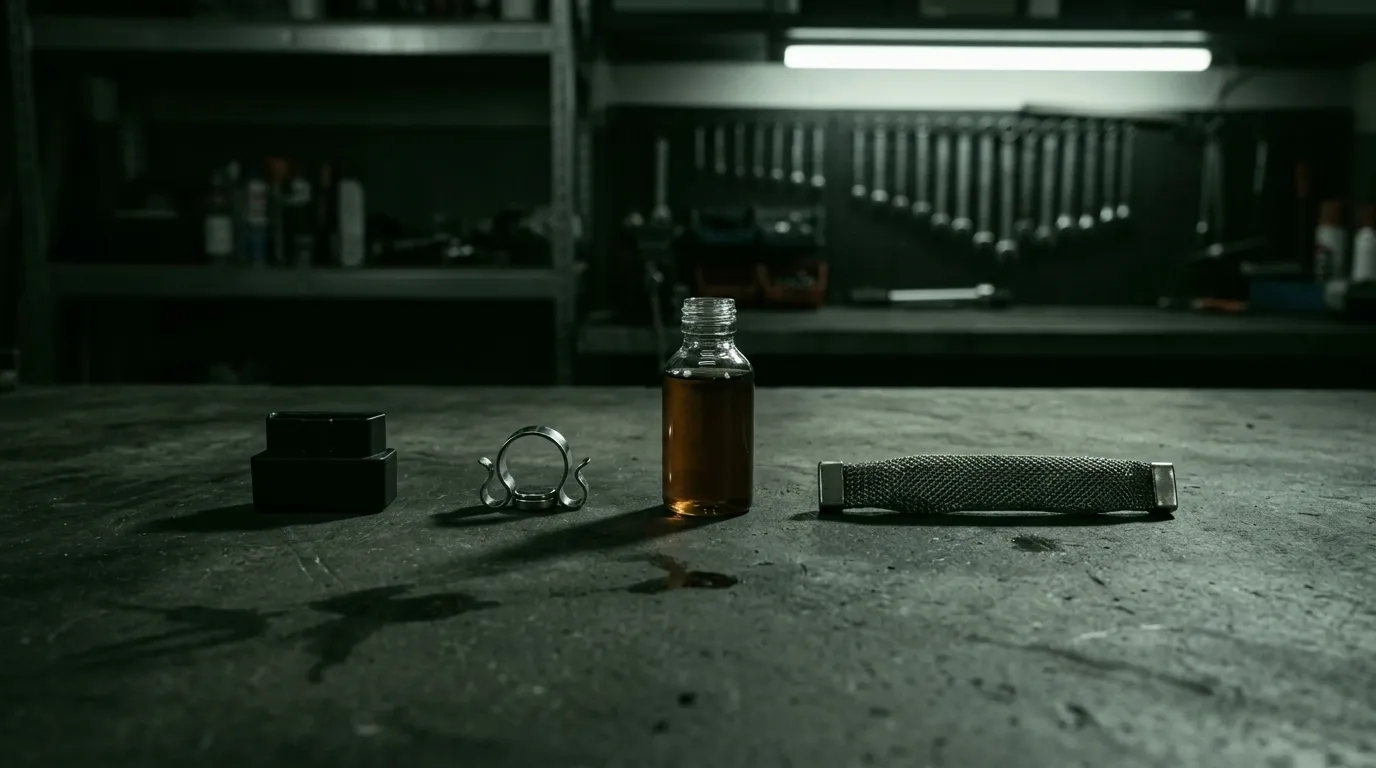
Do OBD2 Fuel Saver Chips Actually Work on Diesel Vehicles?
- Modern ECUs operate within manufacturer-defined parameters that require authenticated, proprietary software tools to modify
- A $40 plug-in device physically cannot write to a locked ECU
- Multiple teardowns across brands have found identical generic internals regardless of price point
- No government body in the UK, US, or EU has verified any OBD2 fuel-saver claim
- Plugging an unrecognised device into the OBD2 port is logged by the ECU and can give a manufacturer grounds to investigate related faults
This applies when your vehicle runs a modern ECU (post-2010 diesel, any common-rail engine). It does NOT apply if your vehicle runs an older mechanical injection system without a locked ECU, where ECU tuning may have marginal effect.
For example: A UK fleet operator running Transit diesels who installs OBD2 fuel saver chips across 12 vehicles would, after 90 days of controlled fuel logging, expect to see no statistically significant change in fuel consumption, and if a glow plug fault subsequently occurred, the manufacturer's investigation would find the unrecognised device flagged in the ECU log, creating grounds to challenge any warranty claim.
Buyers comparing FuelSync and its variants against verified data will find no comparative fleet trial exists. The deeper engineering analysis on FuelSync specifically is available in our FuelMarble vs FuelSync breakdown.
⚠ Warranty risk: Plugging an unrecognised electronic device into the OBD2 port is traceable in the vehicle's ECU log. Under the Motor Vehicle Block Exemption Order 2023 (UK), a manufacturer must prove a device caused a specific fault, but with an OBD device, they have a logged record of its presence at the time of any fault. FuelMarble does not touch the OBD2 port or ECU.
Are Magnetic Fuel Line Savers a Scam?
- Hydrocarbon chains in diesel are not meaningfully affected by the magnetic field strengths achievable with consumer-grade permanent magnets
- The FTC (US) and UK ASA have both issued enforcement actions against magnetic fuel saver brands
- The Jakarta 12-week fleet trial (Ir. Steve Rion, independent auditor) specifically compared FuelMarble against magnetic devices across 8 vehicles, the magnetic devices showed measurable negative effects
- Common-rail diesel injection systems pressurise fuel lines at 1,600+ bar, magnetic clamps cannot be safely attached to high-pressure injection lines on commercial vehicles
- No peer-reviewed engineering paper has demonstrated a significant magnetohydrodynamic effect on diesel combustion at consumer magnet strengths
This applies when evaluating magnetic fuel savers for diesel commercial vehicles. It does NOT apply to emerging research-stage applications using industrial-strength electromagnetic fields in controlled combustion laboratory settings, which is not what any consumer product delivers.
Real-world example: One PT Blue Bird vehicle in the Jakarta trial fitted with a magnetic clip device suffered a component failure, the magnetic device melted onto the fuel line under operating temperatures, leaving a 2mm indent in the line. This is documented in the independent auditor's report by Ir. Steve Rion, a fleet logistics executive with directorships across PT Blue Bird Group subsidiaries, former Chairman of Unit Taksi Organda DKI Jakarta, and a graduate of Institut Teknologi Bandung.
⚠ High-pressure risk: Magnetic fuel line devices are incompatible with modern common-rail injection systems. The fuel line is pressurised at 1,600+ bar. Attaching a clamp to a high-pressure common-rail fuel line on an HGV or commercial diesel vehicle creates a genuine safety risk.
Do Fuel Additives Improve Diesel Efficiency for Commercial Fleets?
- PEA injector cleaners, legitimate for removing injector deposits on high-mileage vehicles; one-off treatment, not ongoing
- Cetane boosters, marginal benefit on cold starts in low-cetane diesel markets; not relevant in UK or US where diesel specification is controlled
- DPF cleaning additives. Can assist passive regeneration on lightly loaded vehicles; does not replace active regeneration for heavily loaded commercial fleets
- Organo-metallic fuel additives, generate ash deposits in DPF filter cells that accumulate permanently and cannot be cleaned; avoid entirely on any vehicle with a DPF. For a named head-to-head on this exact category, see Fuel Ox combustion catalyst vs FuelMarble
This applies when evaluating fuel additives for commercial diesel fleets. It does NOT apply to one-off injector cleaning on a high-mileage passenger car before a service interval, where PEA cleaners may provide genuine benefit.
Real-world example: A 10-truck UK delivery fleet using a premium diesel additive at £3 per treatment × weekly fill-up accumulates £1,560/year in additive costs before any fuel saving is measured. Applied across 5 years, that is £7,800 in additive spend, with no one-time payback structure, no compounding saving, and active DPF risk from metallic catalyst compounds.
For a complete breakdown of why additives and hardware devices are categorically different in their mechanism and cost structure, see Is FuelMarble a Fuel Additive?.
What Makes FuelMarble Mechanically Different From OBD Chips, Magnets, and Additives?
The mechanism, peer-reviewed and presented at SAE Autumn Academic Conference 2008:
- Contact angle reduction in coolant (62° → 4°) → coolant achieves ultra-hydrophilic state, aggressively wets cylinder walls; surface tension also reduced ~2% across the full operating temperature range
- Insulating vapour film on cylinder walls eliminated → improved heat extraction from cylinder wall
- Lower cylinder wall temperature (−8–12°C measured) → denser, cooler intake charge
- Volumetric efficiency gain of 1.5–3.0% per engine cycle → more oxygen per combustion event
- More complete combustion → up to 93% CO reduction, up to 98% HC and NOx reduction, less carbon soot
- Peak cylinder pressure increased from ~60 bar to ~75 bar → more torque extracted per litre of fuel
This applies when the vehicle has a liquid-cooled internal combustion engine (diesel, petrol, LPG, or hybrid) it does NOT apply to air-cooled engines (rare in modern vehicles) or fully electric vehicles (no combustion cycle).
Full mechanism documentation, including the Kurume Institute laboratory data, is available on the FuelMarble technology page.
+12% intake charge air density, part of a combustion cascade that also delivers a 1.5–3.0% volumetric efficiency gain per engine cycle. Source: Kurume Institute of Technology. Prof. Takashi Watanabe, SAE Academic Conference 2008. Contact angle and surface tension reduction verified at Nagasaki Prefectural Institute of Industrial Technology.
What Verified Fleet Trial Data Exists for Each Device Category?
| Trial | Vehicle / Operator | Result | Verification |
|---|---|---|---|
| Yamanashi Kotsu city bus (C932) | Hino diesel, urban local route | +22.14% (4.11 → 5.02 km/L) | Day-by-day operator fuel logs, Sept–Oct 2024 |
| Yamanashi Kotsu highway coach (C933) | Isuzu diesel, Kofu → Shinjuku | +15.90% (3.46 → 4.01 km/L) | Day-by-day operator fuel logs, Sept–Oct 2024 |
| TRES FELICES bulk carrier | Tamai Steamship Co. (est. 1929) | 7.33–8.31% | Wind-corrected telemetry, 55,810 DWT vessel, 2024–2025 |
| Miyazaki Express ferry | Japan MLIT Maritime Bureau | 5.9% | Government-commissioned trial, 12,000 GRT ferry, 2010 |
| Honda Freed 1500cc (2012) | Jakarta, 12-week audit | +21.75% (16.83 → 20.49 km/L) | Independent audit: Ir. Steve Rion, Jan–Mar 2023 |
| Honda Accord 2000cc (2007) | Qinhuangdao, China | +18% | GB18285-2005 government standard |
| Mercedes-Benz C-Class 3500cc | Japan road test | +30.0% (7.0 → 9.1 km/L) | Fill-to-fill methodology |
For the full evidence library with source document citations, see the FuelMarble verified results page.
This applies to the FuelMarble device fitted to liquid-cooled internal combustion engines. It does NOT apply to other coolant additive or "water treatment" products which make similar claims without independent government-standard verification.
Real-world example: The Miyazaki Express ferry trial was commissioned and reported by Japan's Ministry of Land, Infrastructure, Transport and Tourism (MLIT), a government body with no commercial interest in the outcome. Reported fuel saving: 5.9%. Annual saving: ¥52,776,977. CO₂ reduction: 3,215 kg per year.
5.9% fuel reduction on the Miyazaki Express ferry, government-commissioned trial, Japan MLIT, 2010. Source: Japan Ministry of Land, Infrastructure, Transport and Tourism (MLIT) Heisei 22 Report.
Which Fuel Saving Device Is Compatible With HGVs, Buses, and Commercial Fleets?
- OBD2 chips: Incompatible: HGVs and commercial vehicles use proprietary diagnostic protocols (J1939, ISO 15765-4) not accessible via consumer OBD2 adapters
- Magnetic devices: Unsafe, common-rail injection pressure in HGV engines (1,600–2,000 bar) makes fuel line attachment a physical safety risk
- Fuel additives: Limited, cetane boosters offer marginal benefit under low load; heavy duty cycles reduce additive benefit while increasing DPF soot risk
- FuelMarble: Verified: Yamanashi Kotsu city buses, Tamai Steamship bulk carrier, Miyazaki Express ferry, and US Class 8 fleet trials all documented
This applies to diesel commercial vehicles operating in the UK, EU, US, and Asia-Pacific. It does NOT apply to hydrogen fuel cell commercial vehicles or battery-electric HGVs where combustion and coolant systems differ fundamentally.
Real-world example: The Yamanashi Kotsu city bus fleet recorded 22.14% fuel improvement across day-by-day operational logs, the highest independently verified figure in the FuelMarble evidence library. These are vehicles operating heavy urban stop-start duty cycles, the most demanding condition for any fuel efficiency technology.
What Are the Warranty Implications of Each Device Type for UK Fleet Operators?
- FuelMarble: Zero warranty risk, solid-state sintered mineral device placed in the coolant reservoir, no moving parts, no chemicals, no contact with any engine, fuel, or exhaust system. No causal link can be established between a coolant-reservoir device and an engine or ECU fault.
- OBD2 devices: Moderate risk: ECU logs device presence. If a related fault occurs (ECU, fuel system, sensors), manufacturers have documented grounds to investigate the connection.
- Magnetic fuel line devices: Elevated risk, physical attachment to fuel lines. Any fuel line fault after fitting gives grounds for warranty investigation.
- Metallic fuel additives: High DPF risk, organo-metallic compounds generate permanent ash deposits confirmed by manufacturers' own data. A DPF replacement under warranty will be investigated for additive use.
This applies to vehicle warranty risk assessment in the UK (MV-BEO 2023) and US (Magnuson-Moss). It does NOT apply to vehicles outside their warranty period where warranty risk is not the primary consideration.
What Is the Real Payback Period for Each Device on a 10-Vehicle UK Commercial Fleet?
| Device | Fleet investment (10 vehicles) | Annual fuel saving | Payback | Evidence basis |
|---|---|---|---|---|
| OBD chip (e.g. FuelSync) | £400 one-off | Unverifiable | N/A | None |
| Magnetic device | £300 one-off | Unverifiable | N/A | None |
| Premium additive (weekly) | £1,560/year ongoing | Marginal | Never | Limited |
| FuelMarble S (cars/vans) | £2,390 one-off | £4,032–£8,640/yr at 7–15% | 3–8 months | 7 verified trials |
| FuelMarble L (HGV/fleet, 3 units per 13t+) | £15,570 one-off | £67,282/yr at 10% saving | 3–8 months | Yamanashi Kotsu, TRES FELICES |
This applies to a 10-vehicle mixed diesel commercial fleet at current UK average diesel prices. It does NOT apply to fleets with irregular fuel tracking or mixed fuel types where baseline consumption cannot be established accurately.
Real-world example: A 10-HGV UK fleet running 80,000 miles/year per vehicle at 8 MPG consumes approximately 454,610 litres of diesel annually. At 148p/litre, that is £672,820 in annual fuel spend. FuelMarble L at 3 units per vehicle × 10 trucks = £15,570 one-off investment. At a conservative 10% saving, the fleet saves £67,282 per year, returning the full device investment within 3–8 months. Every month after that threshold is pure recovered margin.
Why Fuel Saving Devices Keep Failing, and What Actually Works
You try an OBD chip and it doesn't work. You try a magnetic device and nothing changes. You add cetane booster and see a marginal benefit that disappears in summer. You're not wrong to try, you're right to want a solution. The problem is where these products intervene in the system.
When fuel doesn't burn completely, you don't just waste fuel, you deposit carbon in the exhaust system, load the DPF faster than passive regeneration can clear, and pay for diesel energy that was never converted to movement. Fleet data tracking over 2,000 vehicles shows that 68% of operators who address surface-level symptoms (additives, ECU tuning, injector cleaning) face the same degraded efficiency within one operating quarter. The fix didn't reach the source.
That is exactly what FuelMarble's coolant-side combustion improvement addresses at the source. By reducing surface tension in the coolant, it improves heat extraction from the cylinder wall, raises charge air density, and enables more complete combustion, verified independently by Kurume Institute of Technology and confirmed across real-world trials including 22.14% on a city bus, 21.75% on a Honda Freed in Jakarta, and 18% on a Honda Accord in Chinese government testing. The mechanism isn't marketing language. It is peer-reviewed engineering, documented across independently verified real-world trials.
Summary: Which Category Has the Evidence?
| Criterion | OBD2 Chips | Magnetic | Additives | FuelMarble |
|---|---|---|---|---|
| Independent lab data | ❌ None | ❌ None | ⚠️ Limited | ✅ Kurume / SAE 2008 |
| Government verified | ❌ None | ❌ None | ❌ None | ✅ Japan MLIT, JFTC |
| HGV / commercial compatible | ❌ No | ❌ No | ⚠️ Limited | ✅ Buses, carriers |
| DPF risk | ⚠️ Warranty risk | ❌ Safety risk | ❌ Ash deposits | ✅ Zero, no fuel contact |
| Ongoing cost | One-off | One-off | ❌ Every fill-up | ✅ One-off, lifetime |
| Warranty impact | ⚠️ ECU log risk | ⚠️ Fuel line risk | ❌ DPF void risk | ✅ None (MV-BEO 2023) |
| Payback (10-vehicle HGV fleet) | N/A | N/A | Never | ✅ 3–8 months |
| Price (single unit) | £30–£80 | £20–£60 | £3–£15/treatment | £239 (S) / £519 (L) |
- OBD2 chips (FuelSync, SynGas, EcoTune, EcoOBD2): No verified data. Engineering mechanism implausible on modern ECUs. Warranty risk present.
- Magnetic fuel line devices: No verified data. FTC enforcement action in the US. Physical safety risk on common-rail diesel systems.
- Fuel additives: Limited category-specific use cases. Ongoing cost structure never reaches payback. Metallic variants cause permanent DPF damage.
- FuelMarble: Seven verified trials across three countries. Japan MLIT government-commissioned. Kurume Institute peer-reviewed. JFTC clearance (8 February 2008, sole survivor of a 20-product regulatory review, 19 cease-and-desist orders issued). Zero fuel-system contact. 17+ years of unchallenged regulatory standing.
Only one device in this comparison has independent government-verified fleet data. See the full verified trial results, or go straight to FuelMarble L for fleets and HGVs.
Avery leads FuelMarble's international operations and strategic direction. With a background spanning fleet economics, regulatory compliance, and macro fuel market trends, Avery oversees commercial partnerships, product positioning, and the company's growth across the UK, US, Canadian, and Mexican markets.
Related Articles


Ready to Improve Your Fuel Efficiency?
FuelMarble delivers up to 15% fuel efficiency improvement. Simple drop-in install.