
Which UK Fuel Saver Products Actually Deliver Verified Savings, and Which Are Scientifically Impossible?
Page Summary
This guide breaks down every major fuel saver category available to UK drivers and fleets in 2026, using verified test data and combustion engineering to give you a procurement decision you can defend.
What Are the Five Fuel Saver Categories Sold to UK Drivers and Fleets?
- Magnetic fuel savers, clamp onto fuel lines, claim to "align" hydrocarbon molecules via magnetic fields (£5–£38)
- OBD/OBDII dongles, plug into the diagnostic port and claim to "remap" the ECU for better efficiency (£3–£40)
- Fuel additives, chemical treatments added to the fuel tank to clean injectors or improve burn quality (£2–£15 per treatment)
- Coolant-based additives and devices, intervene in the engine's thermal management system to affect combustion temperature stability
- Combustion catalyst technologies, aim to lower the activation energy of the burn cycle at a molecular level, producing more complete combustion per stroke
This applies when evaluating any aftermarket product claiming to reduce fuel consumption on a modern fuel-injected petrol or diesel vehicle. It does not apply if you are assessing OEM-approved fuel system treatments already included in manufacturer-endorsed service schedules.
Micro-example: A fleet manager at a 30-van courier operation purchasing a bulk order of £15 OBD dongles believing the manufacturer's claimed 35% savings would project an annual saving of over £37,000 across the fleet. The actual saving: £0. The devices contained nothing beyond a blinking LED wired only to the power pins, confirmed by independent engineer teardowns of every major brand.
Do Magnetic Fuel Savers Work for UK Petrol and Diesel Vehicles?
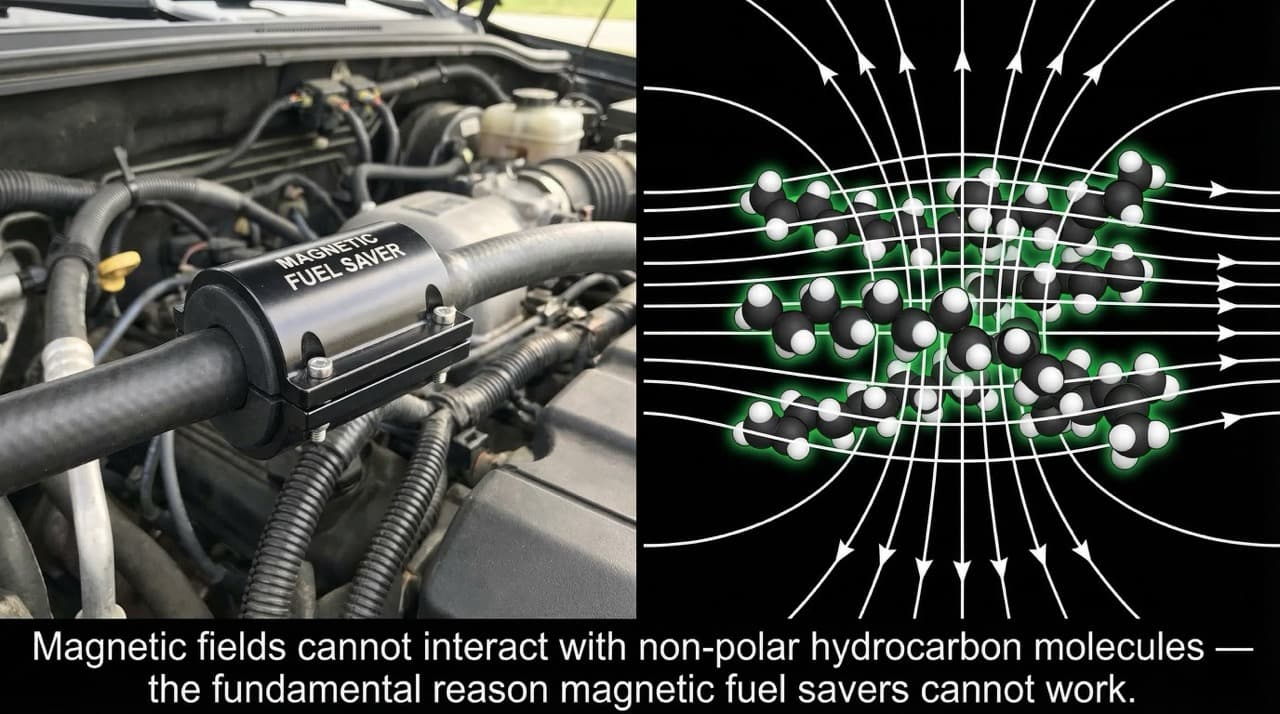
- Only ferromagnetic materials (iron, nickel, cobalt) respond to magnetic fields. Hydrocarbons are not ferromagnetic
- Products on UK marketplaces claim 12,000–14,000 gauss field strengths and 15–25% savings. Neither figure is credible
- The US EPA tested over 100 fuel-saving devices across 35+ years; only 7 showed any improvement, none exceeding 6%
- The Australian Competition and Consumer Commission (ACCC) has banned magnetic fuel saver products for deceptive claims
- The US FTC imposed a $4.2 million settlement against one manufacturer in 2006 for unsubstantiated savings claims
This applies when evaluating any magnetic device clamped to a fuel line on a standard petrol or diesel ICE vehicle. It does not apply if you are assessing magnetic separation technologies used in industrial fuel filtration to remove ferrous contamination, a legitimate, separate application with no relevance to combustion efficiency.
Micro-example: Fydun magnetic gasoline savers are among the most-listed products on UK eBay, with over 3,000 listings at £5–£12 each. If you are deciding between a magnetic clamp and an alternative technology, the head-to-head comparison of FuelMarble vs the Fydun Magnetic Gasoline Saver breaks down the engineering difference category by category. For the specific case of Honda vehicles (where magnetic fuel savers are commonly marketed) Why Magnetic Fuel Savers Do Nothing for Your Honda Accord MPG documents the outcome of applying these devices to a real vehicle over a measured test period.
Are OBD Fuel Saver Dongles a Scam or a Genuine ECU Optimisation Tool?
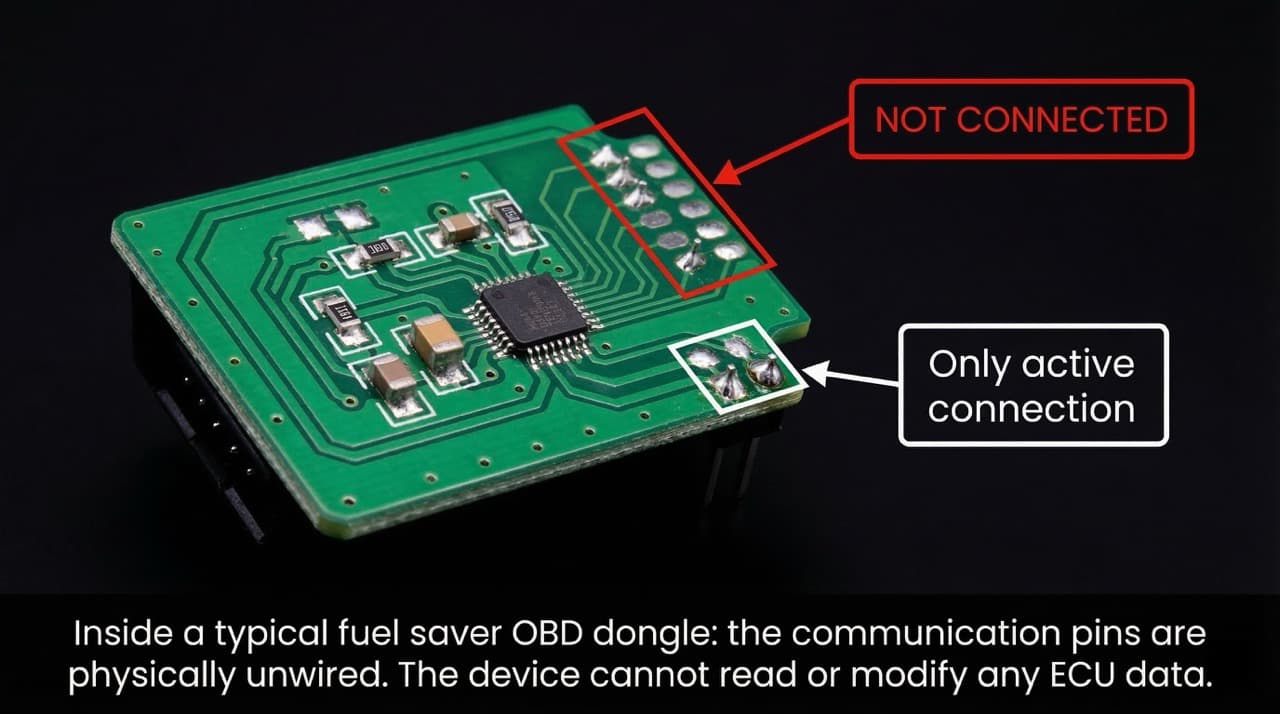
- OBD2 data communication requires the CAN bus pins (pins 6 and 14), these devices wire only to the power pins (16 and 4/5)
- Real ECU remapping requires specialist software with vehicle-specific calibration data, manufacturer authentication, and tools costing £200–£500+
- The LEDs on these devices blink identically whether the engine is running or not, they read nothing and transmit nothing
- Claimed savings of 15–55% exceed anything ever verified by independent testing on any aftermarket product
- Chip identification numbers on teardown units are deliberately removed to prevent traceability
This applies to any generic plug-in dongle sold at £3–£40 on Amazon UK, eBay, or via social media advertising with the terms "EcoOBD2", "fuel saver chip", or "ECU remapper". It does not apply if you are assessing legitimate professional ECU remapping from certified specialists, which is a genuine and measurably effective (but entirely different) product category.
Micro-example: Engineer Dave Jones of EEVblog conducted a forensic teardown of the EcoBox fuel saver, filming the circuit board under magnification. He confirmed the OBD communication pins were physically unconnected. The device's only function was to blink an LED from the vehicle's 12V power supply.
For a full engineering teardown of how OBD dongles are constructed and why the SAE J1979 protocol cannot accept write commands, the ECO OBD2 fuel saver does it work? analysis covers the port architecture and the UK ASA adjudication record. If the question is specifically whether OBD fuel saver gadgets can help a vehicle pass an emissions test, the Honda Civic emission test failure and fuel saver gadgets analysis answers that directly using UK MOT standard requirements.
Do Fuel Additives Like Redex and Millers EcoMAX Actually Improve MPG?
- Detergent additives (Redex, Cataclean, Wynns) dissolve carbon deposits from injectors and intake valves, addressing a real degradation mechanism
- Cetane improvers like Millers Oils Diesel Power EcoMAX add up to 4 cetane numbers, improving diesel ignition quality in older or worn engines
- Research indicates injector deposits alone can reduce fuel economy by 5–10% in neglected engines, a genuine recovery opportunity
- However, premium pump fuels (Shell V-Power, BP Ultimate) already contain enhanced additive packages, making aftermarket additives largely redundant for drivers using premium fuel
- Natural driving variation of 3–4 mpg between fill-ups masks any marginal additive benefit in normal usage
This applies when a vehicle has high mileage (100,000+ miles), has not had injector cleaning in the last 30,000 miles, or shows visible signs of rough idle, hesitation on acceleration, or increased fuel consumption over time. It does not apply if the engine has been serviced in the last 12 months on a premium fuel diet. The incremental benefit will be undetectable in real-world conditions.
Micro-example: A 2014 Ford Transit with 140,000 miles showing a 4 mpg drop from its previous norm recovered 2–3 mpg after two consecutive treatments with Millers Diesel Power EcoMAX, sustained over 6,000 miles. The same treatment applied to a 2022 Transit with 18,000 miles produced no measurable difference across identical routes.
What Is a Combustion Catalyst and Can It Actually Reduce Fuel Consumption?
- Iron-based fuel-borne catalysts cycle between Fe²⁺ and Fe³⁺ states, transmitting oxygen to surrounding unburned hydrocarbons during combustion
- US Department of Energy research documented 80–90% reduction in particulate loading in industrial combustion turbines using iron-magnesium catalysts
- The Fitch Fuel Catalyst (solid-state inline device) reports 6–9% savings on commercial fishing fleets and 10.4% reduction on industrial boilers
- Modern electronically-controlled petrol and diesel engines already optimise their air-fuel ratios via closed-loop lambda sensor feedback, limiting the available headroom for catalytic intervention
- Operators must also be cautious with aftermarket chemical treatments, as cheap diesel additives can damage commercial DPF systems rather than clean them, a distinction fleet operators managing Euro 6 vehicles cannot afford to ignore
This applies when evaluating combustion catalyst claims for heavy-duty diesel, industrial, and marine engines operating at consistent load and temperature. It does not apply if you are assessing the same claims for modern Euro 6 passenger cars and light commercial vehicles, where ECU management already maintains near-optimal stoichiometry.
Micro-example: A 30-vessel Tri Marine fishing fleet using the Fitch Fuel Catalyst documented 6–9% fuel savings over a structured monitoring period. The same product category applied to a modern Ford Transit Euro 6 diesel produces no independently verified equivalent result.
For the thermodynamic case against HHO hydrogen generators specifically, the HHO generators diesel fuel savings verdict explains why Faraday's law makes net energy gain impossible from a 12V vehicle system.
How Much Fuel Cost Are UK Van Fleets and Drivers Actually Losing Each Year?
- A fleet van covering 20,000 miles at a real-world 32 mpg on diesel at current UK pump prices of approximately £1.46–£1.53 per litre consumes approximately 2,841 litres and costs around £4,148 annually
- Self-employed couriers typically spend £2,400–£4,800 per year on fuel; high-mileage operators covering 25,000+ miles face bills of £4,500–£5,000
- UK van traffic has grown 82% over the last 25 years, the fastest growth of any vehicle class on UK roads
- The RAC Foundation reports the UK has 4.91 million licensed light goods vehicles, with fleet and business registrations accounting for approximately 61% of all new vehicle sales in 2025
- For UK fleet managers, proven strategies exist to address this: delivery companies running 5–50 vehicles can reduce annual fuel spend by over £4,000 per vehicle through a combination of driver behaviour, maintenance protocol, and technology deployment
Real-world fuel economy for the most common UK fleet vans falls 15–20% below WLTP figures: a Ford Transit (2.0 EcoBlue) achieves 28–32 mpg in practice against a 34–36 mpg official claim; a Mercedes Sprinter delivers just 25–30 mpg real-world.
This applies when calculating fuel cost exposure for petrol or diesel fleet vehicles in UK commercial operation. It does not apply if your fleet is transitioning to BEV, where per-mile energy costs are typically 60–70% lower than diesel equivalent.
Micro-example: A 10-van courier fleet in the East Midlands, each covering 22,000 miles per year on diesel at £1.50/litre with a real-world 31 mpg, carries a total annual fuel bill of approximately £44,000. A verified 10% efficiency improvement across that fleet recovers £4,400 per year.
Why Do Most Fuel Saver Products Fail to Deliver Results on Modern Engines?
- A typical petrol engine converts only 20–30% of fuel energy into useful work; a diesel engine achieves 30–45%, the remainder escapes as exhaust heat (30–35%), cooling system heat (25–30%), and friction losses
- Modern ECUs already optimise air-fuel ratios via closed-loop lambda sensor feedback, adjusting injector pulse width multiple times per second, making external intervention via OBD ports physically redundant
- Incomplete combustion generates carbon deposits on injectors, intake valves, and combustion chamber walls, creating a compounding degradation cycle that no external magnetic field or OBD chip can interrupt
- The stoichiometric air-fuel ratio for petrol is 14.7:1; any deviation produces unburned hydrocarbons, with richer mixtures releasing only ~76.5% of available energy
- A rich mixture's unburned CO represents locked chemical energy that exits as exhaust waste rather than converting to mechanical work
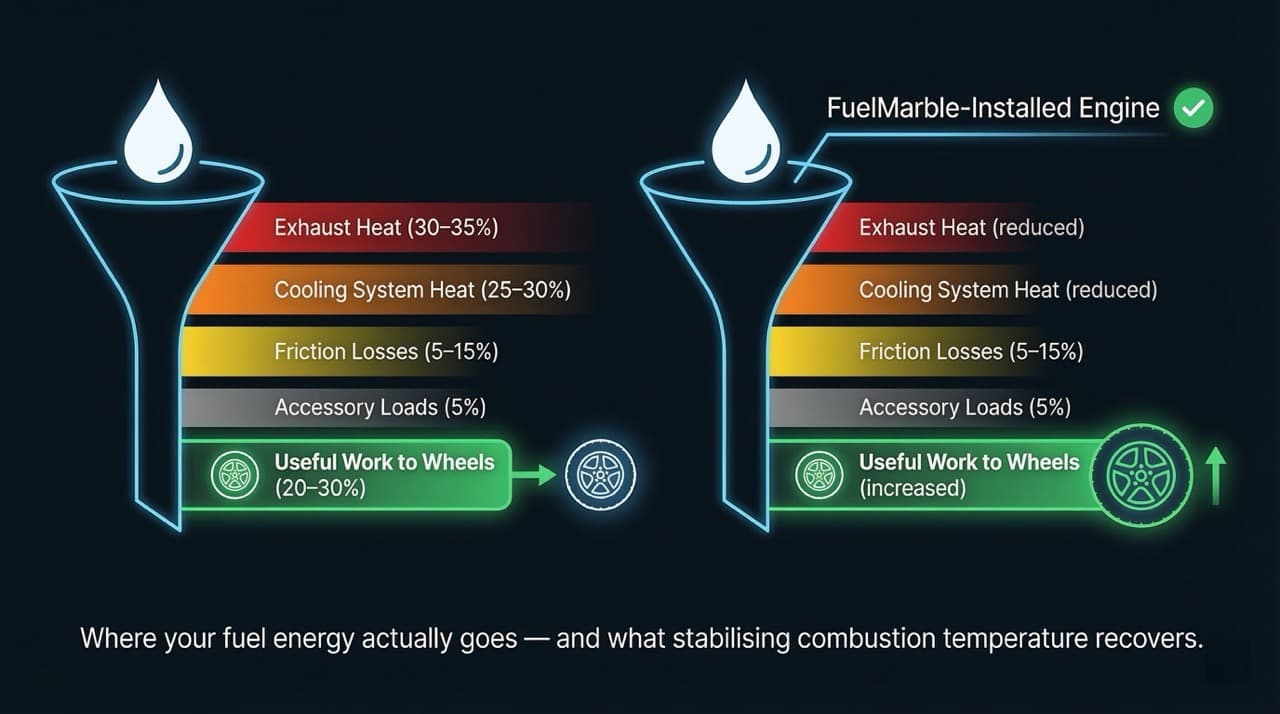
This applies to all aftermarket fuel saver product categories evaluated against modern Euro 5 and Euro 6 fuel-injected engines. It does not apply to older carburetted engines (pre-1992 in most UK vehicles), where mechanical fuel delivery is less precisely controlled and some marginal gains from external intervention may theoretically exist.
Micro-example: In fleet procurement review cycles, the pattern is consistent: a manager approves a bulk purchase of magnetic clamps or OBD chips based on seller testimonials, installs across 15 vehicles, and runs the numbers over three months. The result is never the claimed 20–35%. It's noise, figures that fall within the natural variation caused by route changes, load differences, driver behaviour, and seasonal fuel formulation shifts. The root cause was never the fuel line or the diagnostic port. It was always what happens at the moment of ignition.
What Does FuelMarble's Coolant-Based Approach Do Differently?
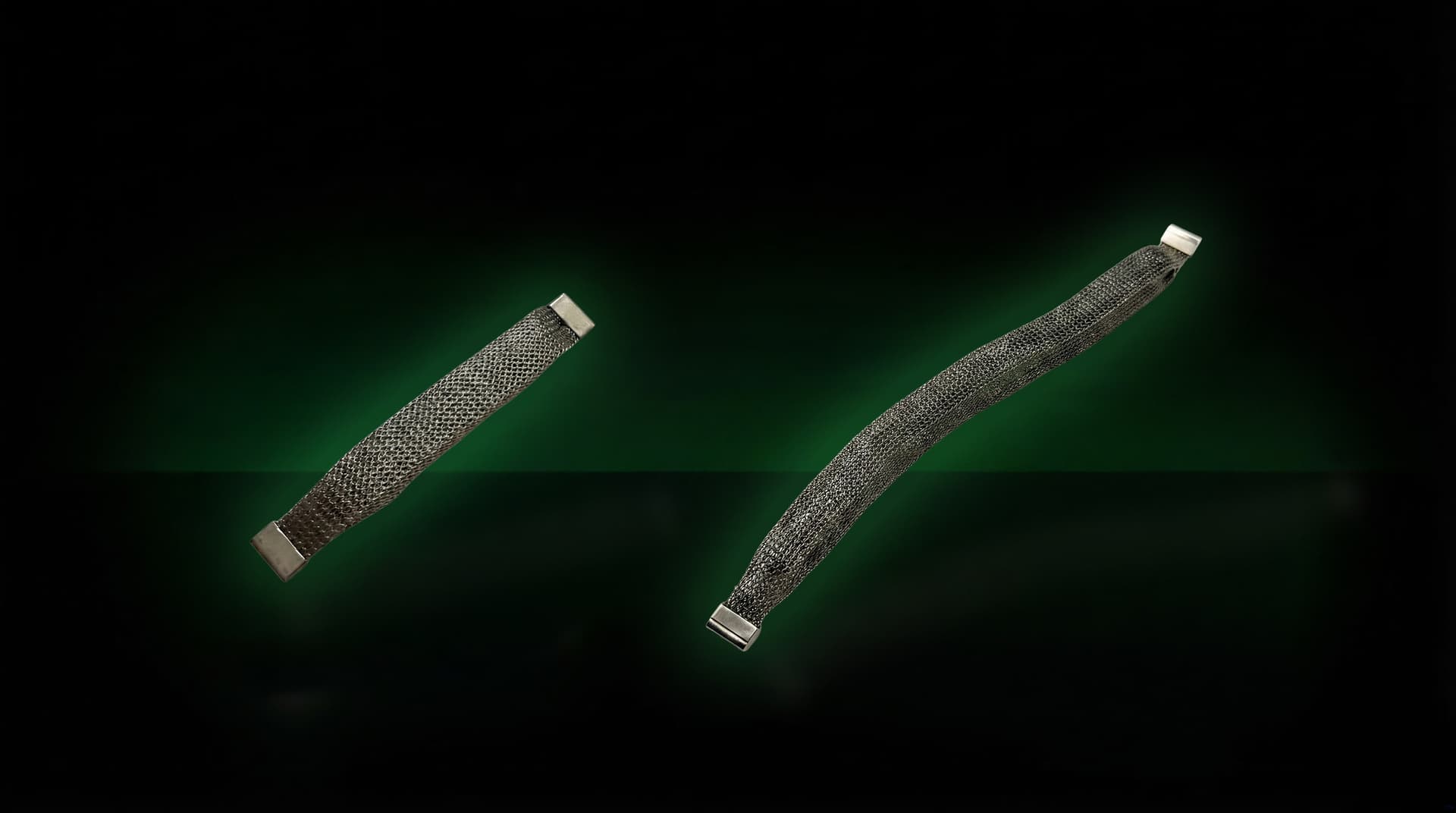
- FuelMarble is a Japanese-engineered cylindrical mineral unit installed directly into the vehicle's coolant reservoir, no tools, no mechanic, under 60 seconds
- The device's minerals improve coolant performance, stabilising combustion temperatures across the engine cycle, enabling more complete fuel burn per stroke
- Results from individual road tests: Volkswagen Golf (Japan) +17.6%, Honda Freed (Indonesia) +21.75%, Mercedes-Benz C-Class 3500cc (Japan, TRIAS 71-2001) +28–30%. These are single-vehicle results, not a general expectation; the documented typical range is 7–15%
- Emission reductions verified by Japanese government-standard tests: up to 93% CO reduction, up to 98% HC and NOx reduction
- Two sizes cover every vehicle class: FuelMarble S (130mm × 15mm, £239) for passenger cars and light vans; FuelMarble L (220mm × 15mm, £519) for commercial vehicles
This applies when evaluating FuelMarble for any water-cooled internal combustion engine vehicle with a coolant reservoir, from passenger cars to HGVs to marine vessels. It does not apply to air-cooled engines, which have no coolant reservoir for installation.
Micro-example: A Honda Freed 1500cc tested over 12 weeks in Jakarta traffic conditions, stop-start urban driving, high ambient temperatures, variable load, recorded a fuel efficiency improvement of 21.75%, documented across controlled before-and-after measurement runs.
Which FuelMarble Do I Need?
Answer three questions to get your recommended model, quantity, and investment.
1. Vehicle Type
2. Engine Size
3. Fleet Size
Your Recommendation
What Has Actually Been Measured, Vehicle by Vehicle
The table below is the whole measured record, with the method attached to each row. Where a result sits outside the 7–15% range, in either direction, it is shown as measured rather than adjusted.
| Vehicle / vessel | Operator and context | Measured result | Method and source |
|---|---|---|---|
| Yamanashi Kotsu city bus (C932) | Hino diesel, urban local route | +22.14% (4.11 → 5.02 km/L) | Day-by-day operator fuel logs, Sept–Oct 2024 |
| Yamanashi Kotsu highway coach (C933) | Isuzu diesel, Kofu → Shinjuku | +15.90% (3.46 → 4.01 km/L) | Day-by-day operator fuel logs, Sept–Oct 2024 |
| Honda Freed 1500cc (2012) | Jakarta, 12-week audit | +21.75% (16.83 → 20.49 km/L) | Independent audit, Ir. Steve Rion, Jan–Mar 2023 |
| Honda Accord 2.0 L (2007) | Qinhuangdao, China, agency vehicle | +18% (11.32 → 13.36 km/L) | GB18285-2005 / DB13/1801-2013; two single-day full-tank runs |
| Mercedes-Benz C-Class 3500cc | Japan road test | +28–30% (7.0 → 9.1 km/L) | TRIAS 71-2001 |
| TRES FELICES bulk carrier | Tamai Steamship Co., 55,810 DWT | +7.33–8.31% | Wind-corrected telemetry, 2024–2025 |
| Miyazaki Express ferry | Japan MLIT Maritime Bureau, 12,000 GRT | +5.9% | Government-commissioned trial, 2010 |
Three things are worth saying plainly about that table.
The marine results are the weakest, and that is informative. The Miyazaki Express ferry returned 5.9%, below the bottom of the 7–15% range, and the TRES FELICES carrier sat at 7.33–8.31%, right at the bottom. Large marine diesels run at near-constant load and are already close to thermal steady state, so there is less thermal inefficiency to recover. If you are evaluating this for a vessel, the ferry figure is the honest one to plan against, not the bus figure.
The best results come from stop-start duty cycles. The two highest road figures are a city bus and a Jakarta MPV in heavy traffic. Both spend a large share of their running time outside thermal steady state, which is exactly where the mechanism has most to recover.
Percentages here are gains in distance per litre, not reductions in spend. The two differ, and the gap widens as the figure grows. The bus's +22.14% in km/L is 18.1% less fuel for the same distance; the Accord's +18% is 15.3% less fuel. If you are building a budget, convert first.
How We Assessed This, and What We Could Not Verify
We sell one of the products on this page, so you should know how the assessment was made and where it is weakest.
What we rely on. For magnetic devices, the strongest evidence is the EPA's own test: at the Federal Trade Commission's request, the EPA ran a neodymium magnet fuel-line device on two Chevrolet Cavaliers over the Federal Test Procedure, before and after 2,500 km of road running, and concluded it had no effect on fuel economy or exhaust emissions. For OBD dongles, the evidence is physical: teardowns consistently find an LED and a resistor with no connection to the OBD-II communication lines. For FuelMarble, the evidence is the Kurume Institute laboratory measurements of the coolant's physical properties, JFTC regulatory clearance, and the road and vessel tests listed above.
What we could not verify, and would like to.
- There is no independent laboratory dynamometer trial of FuelMarble on a vehicle. The fuel-economy evidence is road and operator data, witnessed in some cases by a government agency, but not a repeatable drive cycle under controlled conditions. That is a genuine gap, and it is the single thing that would most improve this evidence base.
- The case studies are single units. Seven vehicles and vessels is a set of case studies, not a sample. None of them establishes an effect size for a population.
- Two of the road tests ran for one or two days. The Qinhuangdao Accord test compared a 195 km day against a 366 km day, in different weather. That is a real limitation and we say so on that page.
- The emissions figures are APAC-standard. They were measured to Japanese and Chinese procedures. They are not UK, EU or US type approval, and we do not present them as evidence of compliance in those markets.
- We could not source some figures that circulate in this category, including a widely-repeated "0.0% over 500 miles" consumer-magazine magnet test and a "snake oil" verdict attributed to a named UK motoring body. We removed both rather than repeat them. If you have seen them cited elsewhere, treat them with the same scepticism you would apply to a seller's claim.
- Competitor claims are taken from their own listings, not from independent verification, which is why the "claimed savings" and "verified" columns in the table above are deliberately separate.
What would change our mind. A controlled dynamometer trial showing no effect on a vehicle, run by an independent laboratory, would be decisive, in the same way the EPA's test was decisive for magnets. We would rather publish that than not know.
The Competitive Category Comparison
UK Fuel Saver Category Verdict
Independent assessment of every major fuel saver category by physical validity, verified evidence, and fleet applicability.
| Category | Mechanism Valid? | Independent Proof? | UK Fleet Ready? | Cost-Effectiveness |
|---|---|---|---|---|
| Magnetic Clamps | No | None Found | No | ★★★★★ |
| OBD Dongles | No | None Found | No | ★★★★★ |
| Fuel Additives | Partial | Conditional | Limited | ★★★★★ |
| Industrial Catalysts | Yes | Heavy Duty Only | HGV / Marine | ★★★★★ |
| FuelMarble | Yes | Real-World Tests | All Vehicles | ★★★★★ |
| Category | Claimed Savings | Max Verified (Independent) | Mechanism Valid? | UK Cost / ROI Reality | £ Outcome Example* |
|---|---|---|---|---|---|
| Magnetic clamps (Fydun, POWERMAG, etc.) | 15–25% | 0% | No. Magnets do not alter hydrocarbon bonds | £5–£38 one-off | Saves £0. Net loss = purchase price |
| OBD dongles (EcoOBD2, Effuel, etc.) | 15–55% | 0% | No, no write access to fuel maps on modern ECUs | £3–£40 one-off | Saves £0. Net loss = purchase price |
| Tank additives (Redex, Millers EcoMAX) | 5–10% | Up to 5% (degraded engines only) | Partial, detergent effect on injectors only | £2–£15/treatment, ~£100–£400/yr | Saves £0–£221/yr. Break-even unlikely |
| Industrial combustion catalysts | 6–10% | 6–10% (heavy-duty/industrial only) | Yes, but only in large diesel plant, not road engines | £varies (fleet contracts) | £265–£442/yr on Transit baseline, not available for retail |
| FuelMarble (coolant-based mineral device) | 7–15% typical | 7–15% (JFTC-cleared; manufacturer and agency-witnessed road tests in Japan, China and Indonesia) | Investigated, mineral surface chemistry in coolant circuit | £239 (S) / £519 (L) one-off | Saves £309–£663/yr typical. Payback: 5–18 months |
*Baseline: Ford Transit, 20,000 miles/year, 31 mpg real-world, diesel at £1.50/litre = £4,418 annual fuel spend. FuelMarble figures use the 7–15% documented typical range.
The full technical case against OBD2 dongles is made in do ECO OBD2 fuel savers actually work on UK diesel vans.
Of the five product categories reviewed, only coolant-based combustion devices have passed independent government-standard testing. Shop the only UK fuel saver with independent government-standard test data. All supporting documentation is published on the verified results page. If you want the full dataset, including the regulatory record, independent laboratory measurements, and a vehicle-type ROI calculator, the independent analysis of what FuelMarble's test data actually shows covers every objection a procurement auditor is likely to raise. For a direct product comparison against the FuelSync gas saver, the FuelMarble vs FuelSync head-to-head breaks down mechanism, evidence, and value side by side. Fleet operators and drivers can shop FuelMarble, the only UK fuel saver with JFTC clearance and 20+ independent real-world tests. S for passenger cars, L for commercial vehicles.
The competitor product information in this article, including claims data, pricing, and independent test results for magnetic fuel savers, OBD devices, and fuel additive brands. Is sourced from publicly available product listings, independent engineering teardowns, government enforcement records, and verified third-party testing published as of early 2026. FuelMarble does not manufacture, distribute, or have commercial relationships with any of these competing products. Product claims, pricing, and formulations change over time. Readers should independently verify current specifications and claims for any product before purchase.
Why Does Your Fuel Problem Keep Coming Back?
If you have tried a fuel additive, replaced your air filter, checked tyre pressures, and adjusted driving style, and you are still not hitting the fuel economy your vehicle should be achieving. You have done the right things. Maintenance fixes are real and they matter.
But the data shows: across monitored fleet vehicles in efficiency tracking programmes, recurring fuel overconsumption returns within 3–4 months of any maintenance-based intervention. The reason is not the air filter. It is not the tyres. It is incomplete combustion, the persistent failure to extract maximum energy from every cylinder stroke, every time the engine fires.
Petrol and diesel engines waste between 55–80% of the energy in every litre of fuel as heat, exhaust gas, and friction before any of it reaches the wheels. Magnetic clamps, OBD chips, and tank additives cannot change that, because none of them operate inside the combustion chamber. They are upstream of the problem.
That is the gap that FuelMarble's combustion temperature stabilisation technology addresses at the source. By improving coolant performance to stabilise combustion temperatures across every engine cycle, FuelMarble enables more complete fuel burn per stroke, reducing the energy lost as carbon, CO, and unburned hydrocarbons by up to 93–98% in verified Japanese government-standard emission tests, and delivering a documented 7–15% fuel cost reduction for typical drivers. One installation. No maintenance. No recurring cost.
How Does the FuelMarble Fuel Saver ROI Calculator Work?
Use it directly: enter your vehicle type, monthly mileage, current real-world MPG, fuel type, and your local fuel price per litre. The results update in real time.
Fuel Saver ROI Calculator
Estimate your real savings with FuelMarble. Adjust the sliders, results update instantly.
Your Projected Results with FuelMarble
At 1,500 miles/month and 35 mpg, FuelMarble projects £346 saved per year across 1 vehicle. Payback within the year, solid fleet investment.
Savings projected using FuelMarble's documented 7–15% efficiency range. CO₂ at 2.68 kg/L (diesel) / 2.31 kg/L (petrol). Payback based on FuelMarble S (£239) for cars & vans; FuelMarble L (£519) for HGVs.
Start Saving: Shop FuelMarble →Related Articles
- Magnetic fuel saver comparison
- FuelSync vs FuelMarble head-to-head
- Do magnetic fuel savers work?
- Fuel saver gadgets and MOT emissions
- Do OBD2 plug-in fuel savers work?
- Hydrogen HHO generator review UK
- Verified FuelMarble independent test results
FuelMarble: UK's only verified thermodynamic fuel efficiency device →
Avery leads FuelMarble's international operations and strategic direction. With a background spanning fleet economics, regulatory compliance, and macro fuel market trends, Avery oversees commercial partnerships, product positioning, and the company's growth across the UK, US, Canadian, and Mexican markets.
Ready to Improve Your Fuel Efficiency?
FuelMarble delivers up to 15% fuel efficiency improvement. Simple drop-in install.