Fuel Saving Tips 2026: The Complete UK Guide
Page Summary
The average UK driver spends over £1,400 per year on fuel. Driver behaviour alone accounts for up to 30% of that variation. This guide covers what actually moves the needle, and what wastes your money.
This is not a tips listicle. Every recommendation in this article has a documented mechanism, physics, chemistry, or independently measured data. We cover the driving habits that cost or save the most, what vehicle maintenance actually affects fuel consumption, which technologies have real evidence, and which gadgets consistently return zero in controlled testing. Fleet operators managing multiple vehicles will find the fuller operational framework in the complete guide to how UK fleet managers actually cut diesel costs.
What you will find in this guide:
- The physics of where your fuel actually goes (and why 75% is wasted before you move an inch)
- The driving habits with the highest measurable impact
- The maintenance tasks that silently drain fuel when neglected
- A clear, evidence-based verdict on every fuel-saving technology category
- An interactive maintenance checklist and savings calculator
The Physics of Fuel: Why Your Engine Doesn't Work the Way You Think
Before any tip makes sense, the underlying physics needs to be understood. Most drivers assume their engine converts most of their fuel into forward motion. It does not.
Where Your Fuel Actually Goes
Typical petrol engine energy distribution per 100% of fuel burned
Source: SAE International / US Dept. of Energy. Diesel engines reach up to 45% useful motion under ideal conditions. Every fuel-saving technique in this guide targets the red and orange bars above.
A typical petrol engine converts only 20–25% of fuel energy into motion. The rest leaves as exhaust heat, engine block heat, and mechanical friction. Diesel engines perform better (up to 45% under ideal conditions) but the same principle applies. Three quarters of what you pay for at the pump is not moving your vehicle.

This matters because every fuel-saving technique targets one of those loss categories. Smooth driving reduces parasitic load and aerodynamic drag. Correct tyre pressure reduces rolling resistance. A clean fuel system maximises combustion efficiency. Eco-routing reduces total distance and idle time. None of them are magic, they all operate on the same thermodynamic reality.
Two drivers on identical routes in identical vehicles were measured returning a 22% difference in fuel consumption every single week. Same vehicle, same fuel, same road. The difference was entirely behavioural.
Driving Habits: The Biggest Lever You Already Control
Fuel Saving Impact by Category
Estimated % reduction achievable by an average UK driver
Smooth Driving and Anticipation
Smooth driving is the highest-impact fuel-saving change available to any driver, and it costs nothing. The physics are unforgiving: doubling your speed from 30 to 60 mph does not double aerodynamic drag, it quadruples it. Every unnecessary acceleration event burns fuel to build kinetic energy that is then destroyed by braking.
The technique: Read the road 10–15 seconds ahead. Identify traffic lights, junctions, and slowing vehicles early. Allow the vehicle to decelerate in-gear. The ECU cuts fuel entirely during engine braking on modern fuel-injected vehicles. Only brake when necessary.
The measured difference between aggressive and smooth driving style on the same route is consistently 20–30% in peer-reviewed driving behaviour studies. No other single change comes close.
Gear Discipline
Running at lower engine speeds in a higher gear reduces fuel consumption directly. The optimal shift points for most vehicles:
- Petrol engines: change up around 2,500 RPM
- Diesel engines: change up around 2,000 RPM
- Never let the engine labour below 1,200 RPM, drop a gear before that point
Modern vehicles with gear shift indicators make this straightforward. If your vehicle has one, use it consistently.

Understanding Your Engine's Efficiency Map (And How to Stay In It)
Most fuel-saving advice focuses on what you do behind the wheel, and rightly so. But there is a layer beneath driving behaviour that determines how efficiently your engine converts fuel into forward motion, regardless of how smoothly you drive. That layer is combustion temperature.
Engineers map this using something called a Brake Specific Fuel Consumption (BSFC) map, a contour diagram that plots fuel efficiency across every combination of engine speed (RPM) and torque output. Think of it like a topographic map of your engine: there is a valley at the centre where the engine burns fuel most efficiently, and the terrain rises steeply toward the edges.
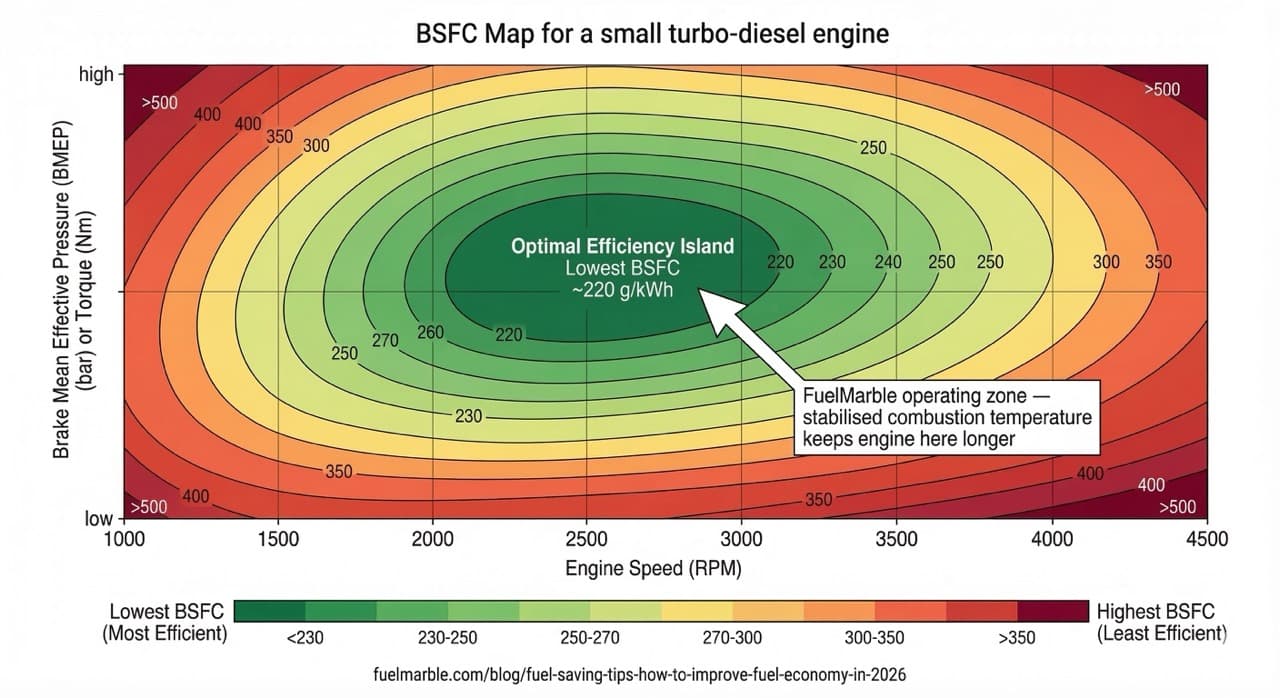
For a typical turbo-diesel, that efficiency island sits at mid-to-high torque and relatively low RPM, roughly 1,200–2,000 rpm under meaningful load. This is why driving in the highest appropriate gear at a steady speed saves fuel: you are keeping the engine inside its most efficient operating zone.
The temperature problem most drivers never see
Here is what the gear-change advice does not address: even when you are in the right gear at the right speed, combustion efficiency depends heavily on coolant temperature stability. When the coolant system runs with any variation in thermal performance, boundary layers on cylinder walls, inconsistent heat transfer, minor temperature fluctuations across the combustion cycle, the engine drifts away from its optimal BSFC zone with each stroke.
This is the engineering problem that FuelMarble's mineral technology is designed to solve. By improving the hydrophilic properties of the coolant fluid, FuelMarble reduces the thermal boundary layer on cylinder walls, stabilising combustion temperatures cycle-by-cycle. The practical result is that the engine spends more of its operating time inside the efficiency island shown on the BSFC map, burning less fuel per kilometre without any change to driving behaviour or engine hardware.
Independent road tests across Japan, Indonesia, and China have confirmed fuel efficiency improvements of 7–15% using this mechanism, improvements that driving technique alone cannot replicate, because they address the thermal layer beneath it.
What Is Hypermiling, and Is It Safe on UK Roads?
Hypermiling is a collection of advanced fuel-saving driving techniques developed to maximise distance per unit of fuel. Some are safe, practical, and measurably effective. Others are dangerous and illegal.
Safe hypermiling techniques:
- Pulse and glide, accelerate smoothly to a target speed, then allow the vehicle to decelerate in-gear before the next gentle acceleration phase
- Engine braking on descents, keep in gear on downhill sections, allowing the ECU to cut fuel entirely
- Anticipatory deceleration, identify red lights and queuing traffic at maximum distance and begin coasting immediately
Techniques to avoid:
- Drafting (tailgating lorries), dangerous, illegal under Highway Code Rule 126, and the fuel saving rarely justifies the collision risk
- Coasting in neutral, wastes fuel on modern vehicles (see Myths section) and reduces vehicle control
- Engine-off coasting, illegal on public roads, disables power steering and braking assistance
Applied correctly, hypermiling techniques can extend fuel economy by 10–20% beyond normal smooth driving, but the marginal gains require consistent, disciplined application to materialise.
Vehicle Maintenance: The Silent Drain on Every Tank
A poorly maintained vehicle burns more fuel than a well-serviced equivalent, and the losses are silent: no warning light, no obvious symptom, just a fuel meter that moves faster on every journey. The individual effects are smaller than most articles claim, which is exactly why they go unnoticed. The figures below are the published ones, not the marketed ones.
Fuel Efficiency Maintenance Checklist
- WeeklyCheck tyre pressure (all four + spare)Cold, at manufacturer's upper recommended PSI. Not the sidewall maximum.
- Every 12k milesInspect and replace air filter if blockedA clogged air filter richens the fuel mixture. Easy DIY check, hold it to the light.
- MonthlyCheck engine oil level and conditionOld, degraded oil increases internal friction. Use manufacturer-specified viscosity grade.
- NowRemove unnecessary weight from boot and cabinEvery 50 kg of extra weight costs approximately 1–2% in fuel economy on average trips.
- When not neededRemove roof rack or roof box if not in useAn empty roof rack increases aerodynamic drag by up to 10% at motorway speeds.
- If MPG dropsCheck for fault codes (OBD-II scan)A misfiring cylinder or faulty O2 sensor can silently add 20–40% to consumption.
- Every 3–4 tanksAdd a chemistry-backed fuel system cleanerAddresses injector and combustion deposits that maintenance alone cannot fix.
Tyre Pressure and Rolling Resistance
Tyre pressure is the most under-appreciated maintenance variable in fuel consumption, and also one of the most overstated. The US Department of Energy's published figure is that keeping tyres inflated to the proper pressure improves fuel economy by 0.6% on average, and up to 3% in some cases. That is worth having for a 60-second check, but it is not the 10–25% that fuel-saving listicles tend to imply, and anyone promising more than about 3% from tyre pressure alone is overselling it.

The correct method: Check tyre pressure cold (before driving more than 2 miles), at the manufacturer's recommended pressure, not the sidewall maximum. The recommended pressure is in the door jamb or owner's manual. For vans and loaded vehicles, use the fully-laden pressure specification.
For a fleet van covering 40,000 miles per year, correcting tyre pressure represents a meaningful annual fuel saving from a 60-second weekly check. If consumption has crept up with no obvious cause, tyre pressure and deposit build-up are the usual suspects. Both worsen silently, which is why consumption creeps up even when nothing feels wrong.
Motor Oil Grade
Using the grade of motor oil the manufacturer specifies, rather than whatever is cheapest on the shelf, is worth 1–2% according to the US Department of Energy. A heavier oil than specified makes the engine work harder against its own internal friction, particularly from cold. The grade is printed in the owner's manual and usually on the oil filler cap.
Air Filters, Spark Plugs and Cold Weather
These three are covered in detail in why your car is using more fuel than usual, which is the diagnostic companion to this guide. The short version of each, because all three are widely got wrong:
- Air filters. On a modern fuel-injected engine, replacing a clogged air filter does not improve fuel economy. The engine management system compensates for the restricted airflow. Change it on schedule for engine protection and acceleration, not for a fuel saving.
- Spark plugs. Worn plugs waste fuel, and the direction is reliable even though the commonly quoted percentages are not sourceable. Replace at the service interval.
- Cold weather. The penalty is driven by journey length more than by temperature, and the US Department of Energy's measured figures are more modest than most articles claim.
Engine Cleanliness
Over time, every combustion engine accumulates internal deposits, on injectors, inlet valves, combustion chamber surfaces, and exhaust components. These deposits disrupt fuel atomisation, alter combustion geometry, and reduce the efficiency of every burn cycle. A vehicle returning 42 mpg new may be achieving 36 mpg at 80,000 miles from deposit accumulation alone, without any mechanical fault.
This is the maintenance variable most often ignored because there is no warning light and no obvious symptom until fuel costs are compared directly.
Chemistry-backed fuel system cleaners, products with verified deposit-control chemistry rather than testimonial-based marketing, address this specifically. Learn more in our guide to how FuelMarble works and verified fuel efficiency results.
Myths Debunked: The Ideas That Are Quietly Costing You Money
Fuel-Saving Technology. Independent Verdict
| Technology / Product Type | Evidence Base | Typical Saving | Verdict |
|---|---|---|---|
| Eco-Routing (Google Maps / Waze) | US Dept. of Energy study | Up to 9% urban | Works |
| Start/Stop System (manufacturer-fitted) | SAE International / OEM data | 3–8% urban driving | Works |
| Chemistry-backed fuel system cleaners | Controlled laboratory & field tests | 3–7% on affected engines | Works |
| Correct tyre pressure maintenance | Michelin / Bridgestone fleet data | 1–3% per 10 PSI deficit | Works |
| Cruise control (flat motorways only) | Manufacturer testing | 2–4% vs. inattentive driver | Conditional |
| Premium fuel in standard engines | Manufacturer and consumer testing | <0.5% (within error margin) | Conditional |
| Magnetic "fuel saver" clips | EPA test at FTC request | No effect on fuel economy | Does Not Work |
| Vortex generator inserts | Multiple independent tests | 0% (controlled tests) | Does Not Work |
| Ionisation devices | Peer-reviewed engineering studies | 0% (controlled tests) | Does Not Work |
Does coasting in neutral save fuel on modern vehicles?
No. This is the most persistent fuel-saving myth and it does the opposite of what drivers expect.
With modern electronic fuel injection, the ECU cuts fuel delivery entirely during in-gear engine braking. When you select neutral, the ECU must inject fuel to keep the engine running at idle. Coasting in neutral burns more fuel than coasting in gear on any modern fuel-injected vehicle.
Highway Code Rule 122 additionally identifies coasting in neutral as dangerous. It reduces engine braking capability and vehicle control.
Does cruise control always save fuel?
Conditionally. On flat motorways, cruise control eliminates the micro-accelerations of inattentive human driving and typically returns 2–4% better economy than an average driver. On hilly terrain, it is often worse. Cruise control's algorithm maintains target speed regardless of gradient, accelerating into climbs and maintaining speed on descents unnecessarily. A skilled driver who reads hills, lifts off before peaks, and uses downhill momentum will consistently beat cruise control by 5–8% on undulating routes.
Do fuel-saving gadgets work?
No. When the EPA tested a magnetic fuel-line device at the Federal Trade Commission's request, running two vehicles over the Federal Test Procedure before and after 2,500 km of road use, it found no effect on fuel economy or exhaust emissions. Vortex inserts and ionisation devices have fared no better in published testing.

The mechanical argument exposes why: if a magnetic field around a fuel line could meaningfully alter the combustion properties of refined hydrocarbon fuel, engine manufacturers would have integrated this into every engine built since the 1950s. They have not, because the physics does not support it.
One category that does have verified results is coolant-based combustion devices, see what the UK fuel saver products comparison concludes.
What Fuel-Saving Technology Has Genuine, Measurable Evidence?
Start/Stop Systems
Modern manufacturer-fitted start/stop systems are not the unreliable nuisance of early implementations. Starters in current systems are rated for ten times the cycle life of conventional starters. The fuel saving in urban driving (3–8%) is manufacturer-documented and independently verified. Do not disable the system habitually in city driving.
Eco-Routing
US Department of Energy research shows eco-routing, choosing routes that minimise fuel consumption rather than time. Reduces consumption by an average of 9% in urban environments. Google Maps and Waze both offer eco-routing as a free option. Enable it. The time cost on most journeys is minimal; the fuel saving is consistent.
Want to find the most efficient routes for your specific journeys? Use our Route Planner to identify fuel-optimal paths.
Verified Fuel System Technology
Legitimate fuel system products have specific, documented chemical action, verifiable deposit-control chemistry, peer-reviewed viscosity effects, or independently measured combustion data. The distinction from gadgets is mechanism: a product claiming to improve combustion must document how, at the molecular level, it does so.
FuelMarble's independent test results, including verified 7–15% fuel efficiency improvements on real vehicles. Are available in our Verified Results section. Our emission reduction data includes third-party laboratory measurements, not self-reported figures.
Calculate Your Potential Savings
Calculate Your Savings
Typical cars average 35–50 mpg UK (≈ 15–22 km/L).
Typical range: 7–15%. Actual results vary by vehicle and driving style.
Conclusion: Building a Long-Term Fuel-Saving System
Fuel saving is not a single action. It is a compounding system. A 3% gain from correct tyre pressure, combined with a 5% gain from smoother driving, a 4% reduction in idle time, and a 3% improvement from a clean fuel system does not add up to 15%. Applied consistently, these gains compound across every tank, every month, every year.
The framework:
- Fix the free variables first, tyre pressure, unnecessary weight, roof rack removal. These cost nothing and pay immediately.
- Change the driving, smooth acceleration, anticipatory deceleration, correct gear discipline. The highest-impact variable in fuel consumption is always the driver.
- Address the invisible variables, internal deposits, coolant efficiency, fuel system cleanliness. These are the variables that worsen invisibly over time and that no amount of driving technique can compensate for.
- Use the fuel calculator, measure your actual consumption regularly. What gets measured gets managed.
Every 1% reduction in fuel consumption is a direct 1% reduction in CO₂ output. The environmental case and the financial case are identical.
For fleet operators managing multiple vehicles, the same principles apply at scale, and every percentage point compounds across every vehicle simultaneously. Explore how FuelMarble applies to delivery vehicles, fleet applications, and emission reduction requirements.
Related reading:
Ready to see measured results on your vehicle? View verified fuel efficiency data or shop FuelMarble.
Related Articles
Avery leads FuelMarble's international operations and strategic direction. With a background spanning fleet economics, regulatory compliance, and macro fuel market trends, Avery oversees commercial partnerships, product positioning, and the company's growth across the UK, US, Canadian, and Mexican markets.
Ready to Improve Your Fuel Efficiency?
FuelMarble delivers up to 15% fuel efficiency improvement. Simple drop-in install.