
How Car Maintenance Affects Fuel Economy: The Complete Checklist
Page Summary
This guide covers the complete, evidence-based relationship between vehicle maintenance and fuel economy — from tyre pressure and oxygen sensors to aerodynamic drag from roof racks. All figures trace to primary sources (US DOE, ORNL, VCA, RAC, TyreSafe).
| Section | What You'll Learn |
|---|---|
| UK Fuel Prices | Current petrol/diesel costs and Fuel Finder scheme |
| Tyre Pressure | 0.2% per PSI loss — £1B wasted annually in UK |
| Engine Oil | 1–2% from correct viscosity — ACEA E specification |
| Oxygen Sensors | 10–40% improvement range from faulty sensor repair |
| Air Filters | Modern vs. carbureted — the ORNL study findings |
| Brakes & Spark Plugs | MOT failure rates and caliper drag data |
| Roof Racks | VCA data: 22% at 62 mph, 39% at 75 mph |
| ROI Calculator | Your personalised annual waste estimate |
Introduction
Proper vehicle maintenance can reduce fuel expenses by 10% or more for UK motorists (RAC, Energy Saving Trust). Over 2 million vehicles across Britain currently require overdue servicing. With unleaded petrol at approximately 132p per litre and diesel at 142p in early 2026, the cost of neglect is measurable and avoidable.
This article presents the evidence base for each maintenance category — not estimates, but documented percentages from government agencies, peer-reviewed research, and verified field data. For the broader picture on cutting running costs, our complete fuel economy guide for UK drivers covers driving technique, route planning, and additional strategies beyond maintenance. For fleet operators, the compounded maintenance deficit across multiple vehicles feeds directly into the efficiency gap analysed in the complete guide to how UK fleet managers actually cut diesel costs.

UK Fuel Prices 2026
As of late February 2026, unleaded petrol averages 131.7–132.5p per litre and diesel averages 141.5–141.8p per litre (PetrolPrices.co.uk, heycar daily tracker). A standard 55-litre fill costs approximately £73 for petrol and £79 for diesel.
UK fuel duty remains frozen at 52.95p per litre until September 2026. The government's Fuel Finder Scheme (launched February 2026) mandates retailers report prices within 30 minutes, projected to save households £40 annually via improved transparency.
Petrol averages 132p/litre, diesel 142p/litre in early 2026. Every percentage of fuel economy improvement directly reduces your pence-per-mile cost. A 10% improvement on a £1,800 annual fuel bill saves £180 — without changing where or how often you drive.

Tyre Pressure: The Highest-Impact Maintenance Item
The Hidden Cost of Flat Tyres
Drag the slider to see how under-inflation drains your wallet (based on £1,800/yr fuel spend)
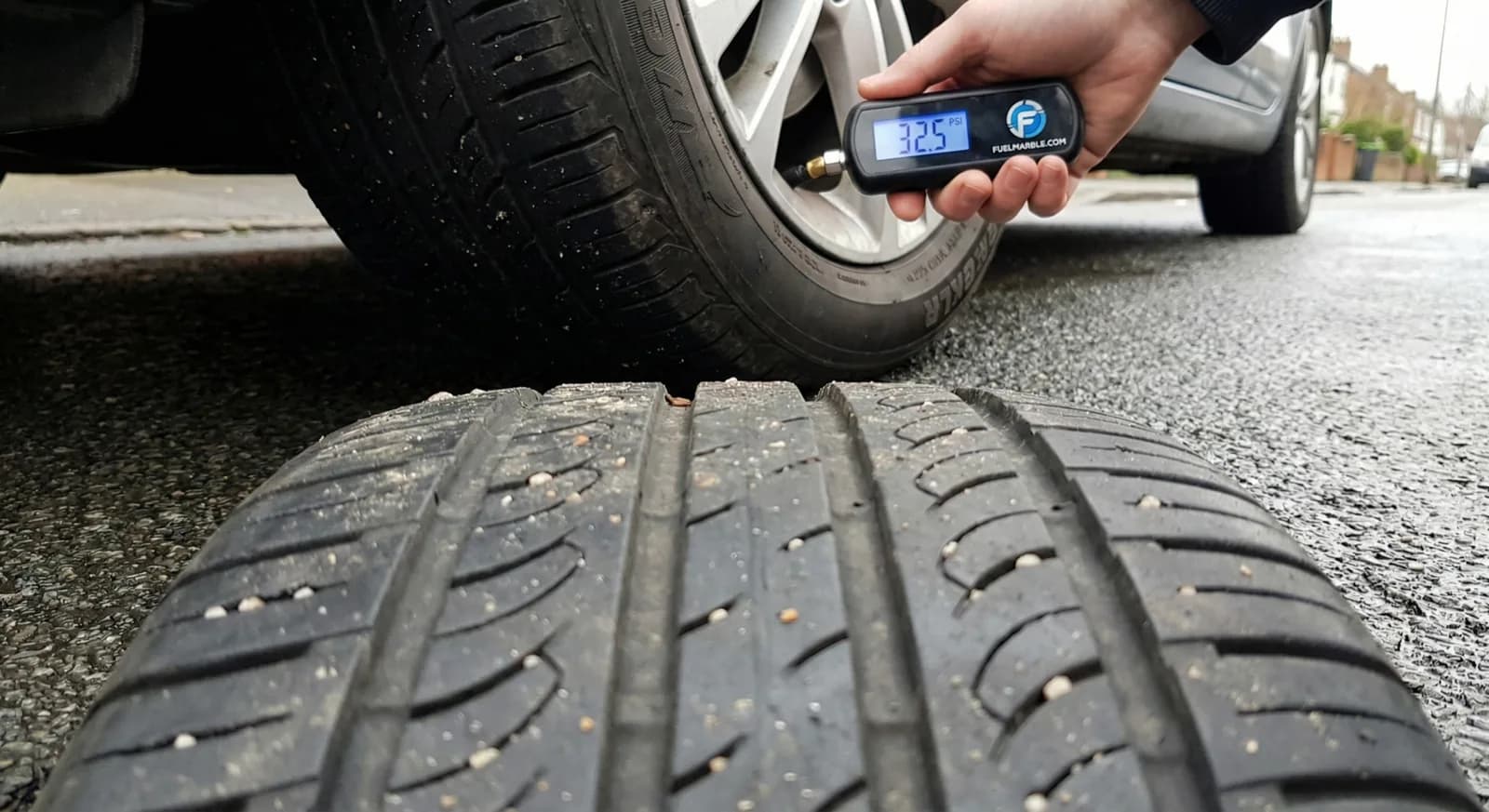
The verified figure: Every 1 psi drop in average tyre pressure reduces fuel economy by approximately 0.2% (fueleconomy.gov, sourced from Energy and Environmental Analysis, Inc.).
Oak Ridge National Laboratory's 2014 study (SAE Paper 2014-01-1614) tested a Toyota Corolla across 40–80 mph:
- Tyres at 75% recommended pressure: 2–3% fuel economy penalty
- Tyres at 50% recommended pressure: 5–10% penalty, worse at lower speeds
- At 70 mph: 75% pressure dropped economy from 36.3 to 35.4 mpg — a 2.5% loss
UK scale of the problem: TyreSafe reports 57% of UK cars have tyres inflated at least 10% below recommended levels — approximately 19 million vehicles. The charity estimates £1 billion in fuel wasted annually from underinflation alone. Nationwide Vehicle Contracts calculated underinflated tyres during four winter months cost the average petrol car driver an extra £11.60 and diesel drivers £9.80.
Proper wheel alignment provides up to 2–2.2% additional improvement. Low rolling-resistance tyres rated EU Class A versus Class G can improve economy by up to 9%.
Correct tyre pressure is the single highest-impact, zero-cost maintenance action. Check monthly and before motorway journeys. Every 10 psi below recommended costs approximately 2% fuel economy.
Engine Oil Viscosity: 1–2% Improvement from the Right Grade
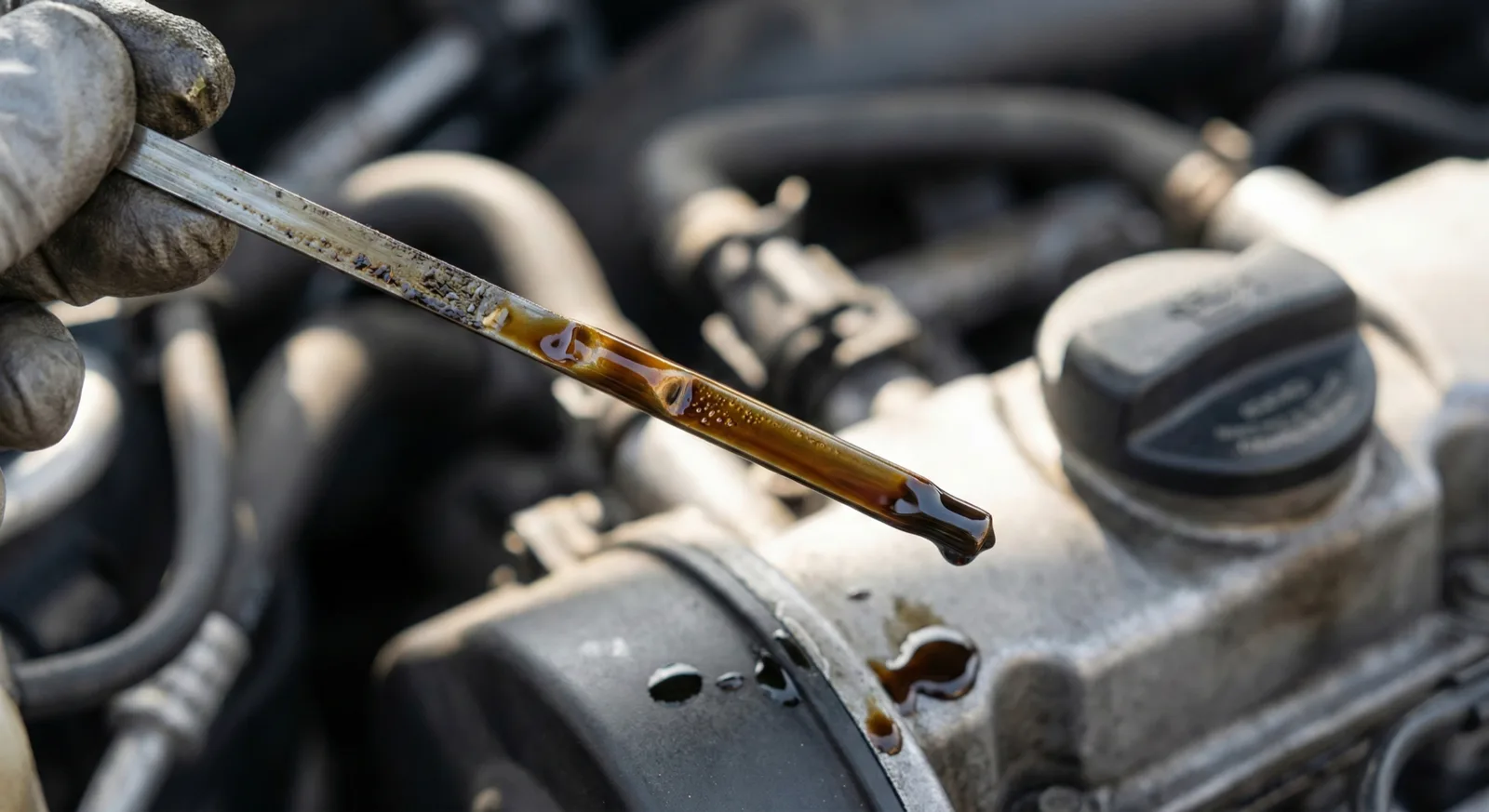
Using the manufacturer's recommended oil grade improves fuel economy by 1–2% compared to thicker alternatives:
- 10W-30 in an engine designed for 5W-30: costs 1–2%
- 5W-30 in a 5W-20 engine: costs 1–1.5%
The mechanism is straightforward — thicker oil creates increased internal friction, forcing the engine to work harder. Both the AA and RAC emphasise following owner's manuals for correct viscosity.
The AA warns wrong oil causes "accelerated engine wear and damage to emission control systems like diesel or petrol particulate filters" — particularly relevant for UK diesel vehicles with DPF systems.
Look for oils marked "Energy Conserving" on the API symbol or ACEA A1/B1 in Europe — these contain friction-reducing additives. For diesel with DPF: minimum ACEA C3, ideally C5.
Oxygen Sensors and General Tune-Up
O₂ Sensor: The US DOE states fixing a serious maintenance problem such as a faulty oxygen sensor can improve gas mileage by as much as 40%. This represents worst-case scenarios where a completely failed sensor forces the ECU into open-loop rich fuelling. Typical real-world improvements: 10–18%. A documented repair on a 2007 Honda Accord achieved 18% efficiency improvement.
General Tune-Up: Fueleconomy.gov specifies "fixing a car that is noticeably out of tune or has failed an emissions test can improve gas mileage by an average of 4.1%." This baseline applies to visibly problematic vehicles — not to perfectly maintained ones receiving a routine service.
Combined neglect: The RAC states a car that is not properly maintained can see fuel consumption increase by as much as 10%. Ford's fuel-saving guidance cites combined maintenance operations improving mileage up to 25% (EPA and FTC sources).
A faulty O₂ sensor forces the engine to run rich — burning excess fuel on every combustion cycle. Typical savings from repair: 10–18%. The 40% figure is real but represents complete sensor failure, not normal wear. Routine tune-ups average 4.1% improvement.
Air Filters: Modern vs. Older Vehicles
A landmark 2009 Oak Ridge National Laboratory study (ORNL/TM-2009/021) tested multiple vehicles and found a clear division:
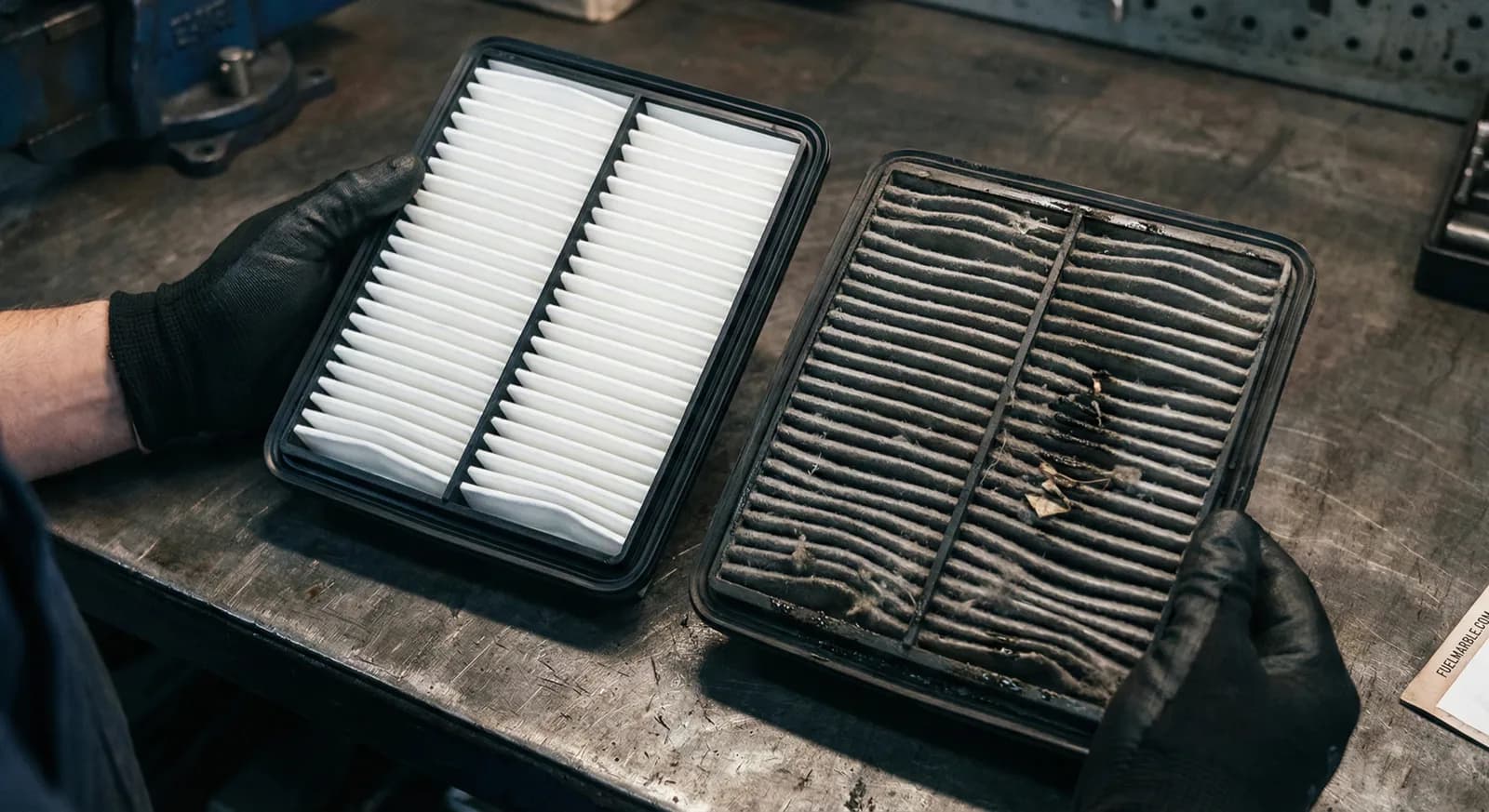
Modern fuel-injected cars (2003–2007 models): A dirty air filter had negligible effect on fuel economy — worst case was 1.7% on one test cycle. However, acceleration suffered by 6–11% (a 2007 Buick Lucerne's 20–80 mph time slowed from 13.77s to 15.45s). Modern ECUs use O₂ and MAF sensors to adjust the fuel-air mixture — restricted airflow means less power but roughly the same efficiency.
Older carbureted cars: A dirty air filter reduced fuel economy 2–6%. Carbureted engines lacked feedback mechanisms — less air with the same fuel produced a richer, wasteful mixture.
Fueleconomy.gov now reflects the ORNL findings: "Replacing a clogged air filter on vehicles with fuel-injected, computer-controlled gasoline engines does not improve fuel economy, but it can improve acceleration."
Brakes and Spark Plugs
Dragging Brake Calipers: SAE J1321 testing by Bendix found a 1.5% fuel consumption penalty from a single dragging brake on a commercial vehicle. Shop Owner Magazine states moving brake pads back from the rotor by just 1mm can improve fuel economy 3–5%. A severely seized caliper can approach 15–20% alongside obvious symptoms (burning smell, pulling, heat).
DVSA Q3 2024–25 data: 28.89% of cars failed initial MOT tests. Brake-related failures affect approximately 9% of tested vehicles.
Spark Plug Misfires: The National Institute for Automotive Service Excellence (ASE) states bad spark plugs can decrease fuel economy by up to 30% in extreme cases. Typical real-world estimates: 12–18% under standard conditions. A single misfiring cylinder on a four-cylinder engine theoretically wastes up to 25% of that cylinder's fuel. Modern OBD-II systems detect misfires quickly and trigger warning lights.

Roof Racks and Aerodynamic Drag
Aerodynamic Drag Visualizer
The UK's Vehicle Certification Agency (VCA) provides the clearest official figures:
- Full roof box at 62 mph: +22% fuel consumption
- Full roof box at 75 mph: +39% fuel consumption
- Empty roof bars at motorway speeds: +7% fuel consumption
The Energy Saving Trust, cited by the RAC, gives slightly higher figures: an empty roof rack adds 16% drag at 75 mph; a roof box adds 39% drag. The ORNL 2014 study confirmed 22% penalty at 60 mph for a compact sedan, rising to 25–27% at higher speeds. SUVs show smaller percentage penalties (~9% at 60 mph) due to less aerodynamic baseline.
The aerodynamic drag penalty increases exponentially with speed — minimal at 30 mph, substantial at 70+ mph. Remove roof racks and boxes when not in use.
A full roof box at motorway speeds costs more than 20% extra fuel — equivalent to filling up five times instead of four. It takes under five minutes to remove and could save £350+ annually for a high-mileage driver.
MOT Compliance and Emissions
While no official DVSA statement directly links MOT compliance to fuel economy, MOT emissions testing fundamentally measures combustion efficiency. For post-1995 petrol cars:
- CO ≤0.2% at fast idle (high CO = rich fuelling = wasted fuel)
- HC ≤200 ppm (high HC = unburnt fuel in exhaust)
- Lambda 0.97–1.03 (below 0.97 directly indicates excess fuel)
TyreSafe reports over 2 million MOT failures annually from tyre defects alone. Tyres (10.05% of tests) and suspension (10.67%) are the top individual failure categories, with brakes contributing ~9%.
Your Maintenance ROI Calculator
Maintenance ROI Calculator
Find out exactly how much your neglected maintenance is costing you.
The evidence base is consistent across maintenance categories. The highest-impact items for fuel economy are:
- Fixing a faulty O₂ sensor — 10–40% depending on severity
- Maintaining correct tyre pressure — up to 3%, with £1 billion wasted UK-wide annually
- Removing unused roof accessories — 7–39% at motorway speeds
- Addressing misfiring spark plugs — 12–30% in severe cases
For drivers seeking measurable technology-based gains beyond routine maintenance, thermal stabilization through the cooling system represents the only independently-verified approach. FuelMarble's coolant-based system, tested in Japan and UK field trials, achieves an average 20.8% improvement across verified cases — working alongside correct maintenance rather than replacing it.
Related reading:
- Why Installing a Magnetic Clip-on Saver on Your Honda Accord Does Nothing for MPG
- Is FuelMarble a Fuel Additive?
- How to Improve Fleet Management Company Profitability
- What Is FuelMarble? The Complete Guide
- 5 Guaranteed Ways to Boost Fleet Fuel Efficiency in 2026
Related Articles
Elias translates complex engine science into clear, accurate content. Specialising in diesel combustion, DPF systems, and Japanese engineering methodology, he produces FuelMarble's technical documentation, performance analyses, and in-depth product guides.
Ready to Improve Your Fuel Efficiency?
FuelMarble delivers up to 15% fuel efficiency improvement. Simple drop-in install.