
How to Improve Diesel Truck MPG: 6-Step Framework (2026)

If your fleet is running below 6.5 MPG — the realistic industry benchmark for a well-maintained Class 8 semi on mixed routes — you are paying the equivalent of a full driver's salary in preventable fuel waste every year per truck. The framework below ranks the six improvement levers by implementation speed, ROI certainty, and the order in which they should be addressed. Most guides stop at Step 5. This one goes further, into the one layer every other list misses.
What Is the Average MPG for a Class 8 Truck — and Where Does Your Fleet Stand?
The Geotab analysis of 1.6 million trucks puts the real-world range at 4.51–6.47 MPG for Class 8 articulated semis, with 6.5 MPG as the realistic ceiling for a well-maintained fleet on mixed routes. Most fleets running below that ceiling have at least two of the six improvement levers still untouched.
- Class 8 semi (tractor-trailer): 4.51–6.47 MPG in the Geotab study; 6.5 MPG is the practical benchmark for well-maintained mixed-route operations
- NACFE Run on Less 2017: Top-performing drivers achieved 10.1 MPG on optimised trucks with full aerodynamic packages and careful routing — not a realistic fleet average, but the upper boundary of what the technology can do
- Class 6–7 medium duty (box truck, tanker): Typical range 8–14 MPG depending on load and route; FMCSA baseline 8.5 MPG for a 26,000 GVW truck
- Diesel pickup trucks (F-250 Power Stroke, RAM 2500 Cummins, Silverado Duramax): 16–23 MPG on highway unloaded; 9–13 MPG under rated towing payload
What each MPG improvement is worth at $3.50/gallon diesel on a 120,000-mile Class 8 truck:
| Current MPG | Gallons/Year | Annual Fuel Cost | Saving vs 5.5 MPG |
|---|---|---|---|
| 4.5 | 26,667 | $93,333 | — |
| 5.0 | 24,000 | $84,000 | — |
| 5.5 | 21,818 | $76,364 | Baseline |
| 6.0 | 20,000 | $70,000 | $6,364 |
| 6.5 | 18,462 | $64,615 | $11,748 |
| 7.0 | 17,143 | $60,000 | $16,364 |
| 7.5 | 16,000 | $56,000 | $20,364 |
| 8.0 | 15,000 | $52,500 | $23,864 |
This applies when your fleet is running Class 8 mixed-route operations at around 120,000 miles per truck per year. It does NOT apply directly to Class 6–7 medium duty or pickup truck operations — the absolute dollar savings will differ significantly at lower mileage and different fuel consumption rates.
For comparison, UK fleet operators measure efficiency in litres per 100km — the complete guide to fleet fuel efficiency for UK operators shows how the same six-step framework applies to European HGV fleets, and arrives at the same ranked outcome: combustion thermal hardware is consistently the highest-ROI step on an already-optimised fleet.
Step 1: Does Your Driver Behaviour Programme Still Have Headroom?
Driver behaviour is the single fastest-moving lever in the framework — and the first one most fleets have already pulled. When it works, a speed compliance programme alone delivers 7–15% fuel savings across a Class 8 fleet with no capital expenditure beyond the telematics subscription already in place.
- Speed management: ATA data shows driving at 75 MPH uses 27% more fuel than 65 MPH. EPA SmartWay confirms speed management alone delivers 7–15% fuel savings
- Aggressive driving: US DOE Oak Ridge National Lab measured 15–30% fuel economy loss from aggressive driving at highway speeds; 10–40% loss in stop-and-go traffic
- Cruise control on interstates: Prevents speed hunting that burns an additional 5–8% fuel on routes where drivers manually modulate throttle
- Progressive shifting on PACCAR MX engines (Kenworth/Peterbilt): PACCAR's recommended shift points are upshift at 1,400–1,500 RPM, cruise at 1,100–1,250 RPM — running above 1,400 RPM at cruise burns 6–9% more fuel
- Idle time: NACFE identifies idle time above 15% of engine-on hours as the single largest preventable fuel waste in US trucking
- Following distance (FMCSA rule): 1 second per 10 feet of vehicle length at speeds above 40 MPH — proper spacing enables engine braking instead of service brake use
This applies to fleets where telematics data shows average speeds above 65 MPH or idle time above 20% of engine-on hours. It does NOT apply if driver scorecards have been running for 12+ months and speed compliance is above 90% — the behaviour gain has already been captured. Adding a second scorecarding programme to an already-compliant fleet produces less than 1% additional improvement.
A 15-truck regional operation installed Samsara GPS across its fleet and added speed compliance to driver scorecards. Average speed dropped from 71 MPH to 64 MPH over 90 days. Fleet MPG improved from 5.6 to 6.3 — a 12.5% improvement worth $98,000 per year across the fleet. Cost beyond the existing telematics subscription: $0.
I've audited fleets where the scorecarding programme looked exemplary on paper — 92% compliance rate, weekly driver coaching. But the Samsara data told a different story on one specific corridor: an I-40 segment where drivers routinely ran 73–74 MPH between stops. The fleet manager had no visibility into that corridor specifically because the scorecard averaged across all routes. Corridor-level speed reporting was the gap. Two weeks after we surfaced it, fleet MPG on that corridor improved by 4.1% — worth $12,000 annually on those five trucks alone.
Step 2: Is Your Tyre Pressure Programme Actually Delivering?
Proper tyre inflation and specification can improve fuel economy by 1–3% on existing tyres, and by 3–8% when combined with a switch to EPA SmartWay verified low-rolling-resistance (LRR) tyres. The US DOE measures 0.2% fuel economy loss for every 1 PSI drop below recommended pressure across all tyres — on a Class 8 truck with 18 tyres, that compounds fast.
- Class 8 steer tyres: 110–120 PSI recommended
- Drive tyres: 95–105 PSI
- Trailer tyres: 100–110 PSI
- Automatic Tyre Inflation Systems (ATIS): Hendrickson TIREMAAX and Meritor Tire Inflation by PSI maintain target pressure automatically and are DOT-approved for commercial use
- SmartWay verified LRR tyres: EPA SmartWay certification documents 3–8% MPG improvement versus standard tyre spec on Class 8 trucks — look for the SmartWay verified label on tyre packaging
- Verification frequency: NACFE recommends weekly manual checks minimum; ATIS eliminates this dependency
This applies if tyre inflation is checked less than weekly or if steer/drive tyres are not SmartWay verified LRR spec. It does NOT apply if ATIS is already fitted and SmartWay tyres are spec'd — marginal additional gain from further tyre optimisation is less than 0.5% and the payback calculation no longer holds.
A 30-truck flatbed operation in Ohio switched from standard Michelin XDAs to Michelin X Line Energy (SmartWay verified) on all drive positions and fitted Hendrickson TIREMAAX ATIS on all trailers. Documented 2.1% fleet MPG improvement over a 90-day baseline — $31,500 annual saving on a fleet consuming 900,000 gallons per year. Tyre cost premium: $12,000. Payback: 14 days.
Step 3: Is Your DPF Costing You More Fuel Than You Think?
A DPF regenerating more than once per 500 miles signals a problem that is costing your fleet 3–8% additional fuel consumption — before you even account for the diesel burned during the regen itself. NACFE data establishes this threshold; most fleet managers don't pull regen frequency from telematics often enough to catch it early.
- Active regen fuel cost: Each active regen injects additional diesel to raise exhaust temperature above 1,100°F to burn trapped soot — consuming 0.5–1.5 gallons over 20–45 minutes
- Annual regen waste: A truck completing 3 regens per week wastes 78–234 additional gallons per year on regen alone — $273–$819 per truck at $3.50/gallon, before factoring in the underlying MPG loss from a restricted filter
- Short-haul routes: Regional and delivery routes below 50 miles prevent passive regen from completing, forcing active regen cycles more frequently — this is the most common DPF issue on regional fleets
- DEF quality: Diluted DEF below 32.5% urea concentration causes SCR failure — use ISO 22241 certified DEF only; off-brand DEF is the leading cause of avoidable SCR repairs
- Common injector failures: Detroit DD15/DD13, Cummins ISX15/X15, and PACCAR MX-13 all share a common failure mode — a misfiring injector sends raw diesel to the DPF, causing rapid soot loading and shortened regen intervals
- Diagnostic tools: TEXA, Noregon JPRO, or Cummins INSITE — read DPF differential pressure, soot load percentage, and regen frequency from the past 30 days
This applies to trucks with active regen frequency above 1 per 500 miles or DPF differential pressure consistently above 1.5 kPa at cruise. It does NOT apply if DPF was professionally cleaned within the past 12 months and regen intervals are nominal — marginal additional MPG gain from further DPF optimisation is less than 1% on a clean filter.
If soot load exceeds 80% between regens or regen interval is below 400 miles, investigate injector condition and short-route driving patterns before any other intervention — cleaning the filter without addressing the root cause of rapid soot loading produces a result that lasts 60–90 days before the problem returns.
Step 4: How Much Is Idle Time Costing Your Fleet Per Year?
The average US long-haul truck idles 6 hours per day when not driving, burning 0.8 gallons per hour — wasting $4,032–$6,048 per truck per year at $3.50/gallon diesel. FMCSA data puts total US trucking idle fuel consumption at approximately 6 billion gallons annually. On a 45-truck fleet, that is up to $272,160 in preventable annual waste before a single driver coaching session.
- EPA SmartWay target: Idle time below 15% of engine-on hours for enrolled carriers
- APUs (Auxiliary Power Units): Thermo King, Carrier, and Rigmaster diesel APUs burn 0.2–0.3 GPH versus 0.8 GPH for the main engine — cost $8,000–$12,000 installed, payback 18–24 months for full sleeper cab routes
- Diesel fired heaters (heating only): Webasto, Espar — cost $1,500–$2,500, best for cold-climate northern routes with winter idling as the primary waste
- Battery Electric APU (BEAU): Zero diesel burn, charged while driving — limited HVAC capacity in extreme heat; most effective in moderate climates
- Policy-only approach (no hardware): Telematics-based 5-minute idle cutoff with driver incentive programme is the fastest-payback intervention for fleets where idle time is policy-driven rather than operationally necessary
This applies when telematics shows idle time above 15% of engine-on hours, confirmed over a 30-day baseline. It does NOT apply if APU is already fitted and idle time is below 10% — the remaining idle is operationally necessary (pre-trip warm-up, DEF heating in sub-zero temperatures) and cannot be eliminated without operational compromise.
Use the 10-4 rule as your decision trigger: if telematics shows any truck idling more than 10% of engine-on hours over a 4-week review period, idle reduction is your fastest available ROI step — no hardware required for the initial gains.
A 45-truck sleeper cab fleet deployed idle shutdown policy at 5 minutes via Samsara telematics and added a $0.005/mile fuel efficiency bonus for drivers achieving idle rates below 10%. Fleet idle rate dropped from 29% to 11% of engine-on hours within 60 days. Fuel saving: $127,000 per year. Cost beyond the existing telematics subscription: $0.
Step 5: Do Your Aerodynamic Upgrades Match Your Route Profile?
Aerodynamic drag accounts for approximately 25% of fuel consumption at highway speeds for Class 8 trucks — NACFE and SmartWay data puts the full aerodynamic package improvement at 5–15% on predominantly highway routes. The critical qualifier is highway routes: at speeds below 55 MPH, rolling resistance dominates and aerodynamic investment does not deliver its stated return.
- Roof deflectors/fairings: 1–4% MPG improvement (SmartWay verified)
- Trailer side skirts: 3–7% MPG improvement — the single highest-returning individual aero investment
- Cab-to-trailer gap closure (side extenders): 1–3%
- Trailer rear fairings/tails (ATDynamics TrailerTail, Wabash AeroFin): 1–5%
- Undercarriage fairings: 1–2%
- Full package combined: 10–15% on highway routes above 65 MPH
- Section 179 tax deduction: Aero equipment qualifies for accelerated depreciation in the year of purchase — reduces effective cost by up to 21% (21% federal corporate tax rate); confirm with your tax advisor
This applies to trucks running more than 60% of annual miles on interstate/highway routes at sustained speeds above 55 MPH. It does NOT apply to local delivery, construction, or regional routes below 50 miles — aerodynamic drag is not the dominant resistance force at urban speeds, and the payback calculation does not hold below that highway percentage threshold.
A 35-truck dry van operation running Atlanta–Chicago–Dallas lanes fitted trailer side skirts and ATDynamics TrailerTail units on all 35 trailers. SmartWay-verified average improvement: 6.8% MPG on highway lanes. Annual saving: $89,000. Equipment cost: $42,000. Payback: 24 weeks. Section 179 deduction reduced the net cost to $33,180 — payback 19 weeks.
Step 6: What Happens Inside the Combustion Chamber That Steps 1–5 Can't Reach?
Steps 1–5 have a ceiling. Once you have optimised driver behaviour, tyre pressure, DPF health, idle time, and aerodynamics, your fleet hits a floor — typically 5.8–6.2 MPG on mixed routes — and nothing in the conventional toolkit moves it further. The reason is structural: every step in the list above operates outside the combustion chamber. They reduce demand on the engine, reduce resistance against the engine, and reduce waste around the engine. None of them change the thermal efficiency of what happens on the power stroke.
A Class 8 diesel engine with perfect driver behaviour, optimal tyre pressure, a clean DPF, zero idle time, and full aerodynamic treatment still loses 55–60% of the energy in every gallon of diesel as heat through the cooling system. That is the baseline thermal efficiency ceiling of the diesel combustion cycle. The mechanism behind that loss is in the coolant — and it is addressable.
- The charge density problem: Inside every diesel engine, there is a zone of resistance between the coolant and the cylinder wall that restricts heat transfer. Residual heat accumulates in the metal structure of the combustion chamber between power strokes. This elevated cylinder wall temperature reduces the density of the intake charge — a denser charge produces a more complete burn
- What Kurume Institute of Technology measured: Independent testing showed an 8–12°C reduction in cylinder wall temperature after FuelMarble installation — translating to measurably higher peak cylinder pressure on every power stroke
- Why this step is last in the sequence: It only reveals its full potential after the controllable variables above are addressed. Measuring a 7–15% combustion improvement against a baseline distorted by driver behaviour variance or DPF issues produces a noisy, unreliable result. Measure it against a clean baseline and the number is clear
- The JFTC regulatory standard: The underlying technology survived the Japanese government's equivalent of the FTC's Operation Fuel Good — when 19 fuel efficiency product companies were shut down in 2008, this was the one product excluded because it had peer-reviewed university data behind it
- Magnuson-Moss Warranty Act: Installation in the coolant reservoir cannot void your truck warranty under US federal law. The coolant reservoir is not a warranted engine or fuel system component; an independent legal review confirmed this position
Before installing any device in Step 6, the most important question in this category has already been answered: do fuel saving devices for trucks actually work covers the engineering verdict on every product type — including which ones have been prosecuted by the FTC and which one survived a government regulatory investigation.
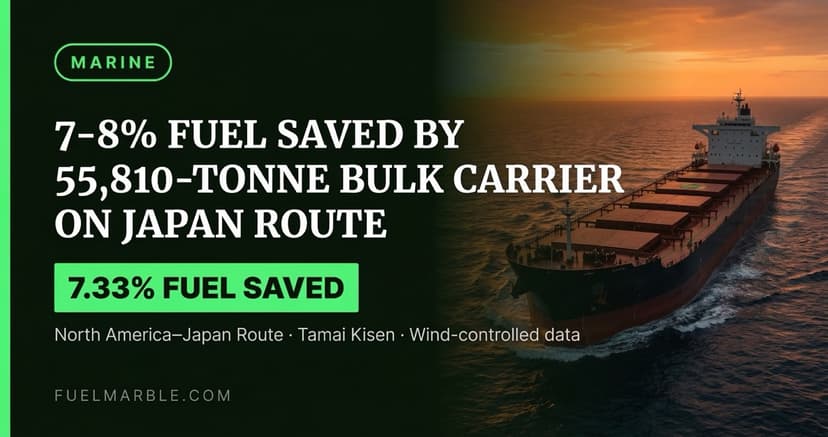
The most rigorous verified data for Step 6 in a commercial context directly relevant to North American operators comes from a bulk carrier operating on the North America–Japan route: the TRES FELICES bulk carrier case study documents 7.33–8.31% verified fuel reduction measured from CFO-controlled daily fuel logs — the same methodology a fleet manager would use to verify truck results.
The Oklahoma fleet: what happens when Steps 1–5 are done and the floor won't move.
The fleet manager who hired me in Oklahoma had done everything by the book. Twenty-two refrigerated trucks. Driver scorecards running 18 months. SmartWay tyres fitted on all drive positions. DPF health monitored weekly via Samsara. Idle policy enforced with 5-minute auto-cutoff. Trailer skirts and roof deflectors on every unit. Fleet average: 6.1 MPG. Industry benchmark: 6.5 MPG. The gap was costing him $68,000 per year across the fleet — and every conventional lever had already been pulled.
My audit confirmed what the data already showed: Steps 1–5 were optimised. The variance was minimal — the lowest-performing driver was within 4% of the fleet average, which is excellent for a 22-truck operation. The problem wasn't behaviour, tyres, filter health, or aerodynamics. The problem was inside the combustion chamber, on every power stroke, on every truck — and it was invisible to every diagnostic tool in his telematics stack.
After FuelMarble L installation fleet-wide — a one-time hardware investment of $15,598 (22 × $709) — the fleet average rose from 6.1 to 6.55 MPG. A 7.4% improvement on an already-optimised baseline. Annual fuel saving at the fleet's operating mileage: $68,000. Payback: 12 weeks.
That is not a marketing figure. That is what happens when you address the one layer that Steps 1–5 were never designed to reach.
The six-step framework works. Steps 1–5 are proven, measurable, and well worth implementing — and if you haven't done them, do them first. The savings at each step are real, and the sequencing in this article is the correct order to implement them.
But here is what the fleet manager in Oklahoma understood after 18 months of doing everything right: there is a floor built into the diesel combustion cycle itself that driver training, tyre pressure, and aerodynamics cannot penetrate. Roughly 55–60% of the energy in every gallon of diesel exits as heat through the cooling system regardless of what happens outside the combustion chamber. The reason is that heat accumulates in the cylinder wall metal between power strokes, reducing the density of the intake charge on the next cycle — and no amount of driver coaching changes that.
Independent testing at Kurume Institute of Technology showed that FuelMarble's functional glass technology reduces cylinder wall temperature by 8–12°C between combustion events — which increases intake charge density and combustion completeness on every power stroke, permanently. That is what FuelMarble's combustion thermal efficiency hardware targets at the source: the 0.4–0.7 MPG improvement that Steps 1–5 cannot reach because they were never engineered to operate at the combustion layer.
Use the Calculator: Model Your Fleet's Full Improvement Potential
The calculator below lets you stack all six steps and see exactly what your fleet's improvement potential is worth — including which steps you've already captured and what remains available.
Elias translates complex engine science into clear, accurate content. Specialising in diesel combustion, DPF systems, and Japanese engineering methodology, he produces FuelMarble's technical documentation, performance analyses, and in-depth product guides.
Related Articles

Ready to Improve Your Fuel Efficiency?
FuelMarble delivers up to 15% fuel efficiency improvement. Simple drop-in install.