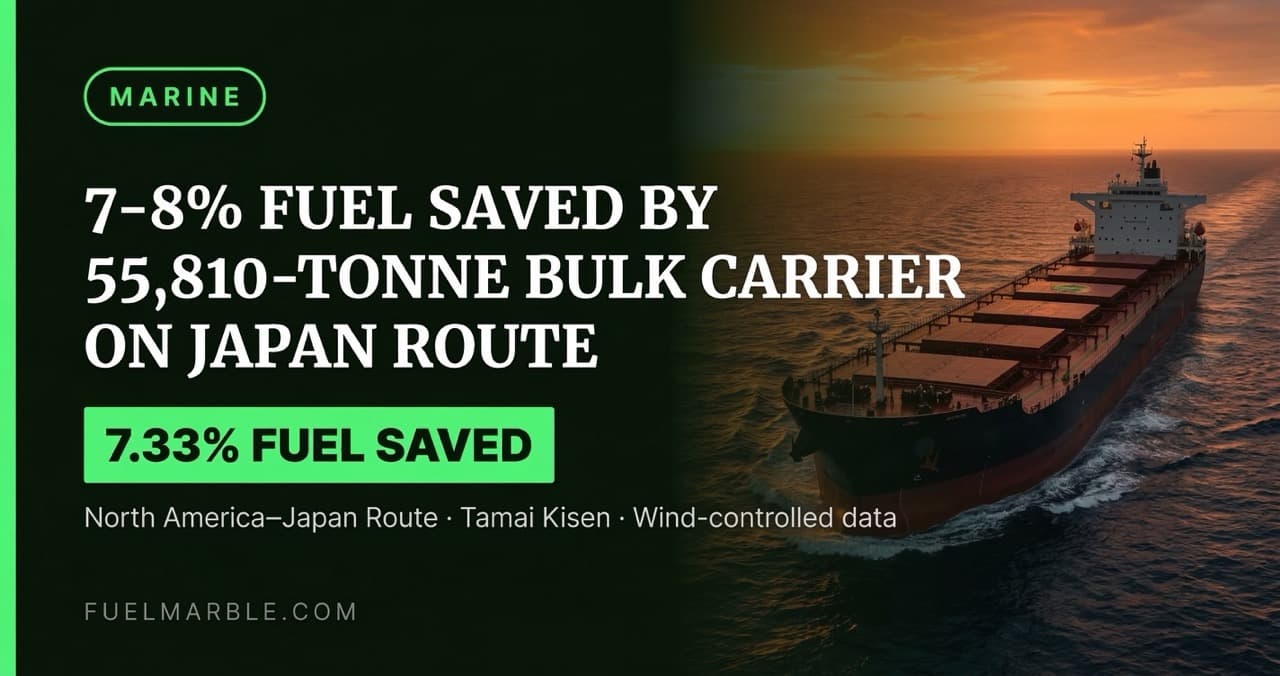
FuelMarble on a 55,810-Tonne Bulk Carrier: How Tamai Steamship Reduced Fuel Consumption by 7.33% on the North America–Japan Route
This case study is part of the verified FuelMarble fuel efficiency results database, the evidence base for operators evaluating marine vessel fuel efficiency technology before authorising fleet-wide installation, consistent with the performance data in what FuelMarble is and how it works. The TRES FELICES, a 55,810-tonne bulk carrier operated by Tamai Steamship Co., Ltd. (玉井商船株式会社), the vessel's owner-operator, whose operational fuel records form the verified data source for this case study, recorded a 7.33–8.31% reduction in daily fuel consumption after FuelMarble was installed in the freshwater cooling tanks of both its main engine and generator, with wind-controlled methodology that defends the data against every analyst objection. This is one of three independent institutional trials conducted on FuelMarble marine technology: the others were carried out by Japan's Ministry of Land, Infrastructure, Transport and Tourism (MLIT) Maritime Bureau (12,000-tonne ferry, 5.9% fuel reduction, ¥52,776,977 / ~$352,000 / ~£278,000 annual saving) and the Japan Fisheries Technology Research Association (60-tonne trawler, 5.1%+ average over 2 years). The financial result on TRES FELICES alone: ¥13,497,168 (approximately £70,200 / $89,300) in combined annual fuel savings and CO₂ credit value on a single vessel operating 200 days per year.
Why Should a CFO Trust a Fuel Efficiency Claim on a Working Vessel?
Here is what the methodology actually shows, and why it matters for procurement decisions:
- Before FuelMarble installation (November 2024): average daily total consumption of 15.96 tonnes
- After FuelMarble installation (November 2025, same-month comparison): average daily total consumption of 14.79 tonnes, a 7.33% reduction
- Broader recent-months comparison (August–September 2025 vs November 2025): baseline of 16.13 tonnes reduced to 14.79 tonnes, an 8.31% reduction
- Wind Condition table: matched NNE/Force 4 days show consumption dropping from 15.93t to 15.13t (5.84% reduction); matched ENE/Force 5 days show 15.66t dropping to 15.15t (3.26% reduction)
The same technology is available for commercial vessel operators, FuelMarble L for large engines and marine applications.
This applies when you need to present fuel reduction data to a board or auditor that will challenge methodology. It does NOT apply if your evaluation requires a randomised controlled trial format, which is not feasible on a working commercial vessel.
Concrete example: On 8 November 2024 (NNE/Force 4 conditions, pre-installation), the vessel consumed 15.93 tonnes. On the matched post-installation day with identical NNE/Force 4 wind, consumption was 15.13 tonnes, a 5.84% reduction on a single like-for-like day, not an averaged estimate.
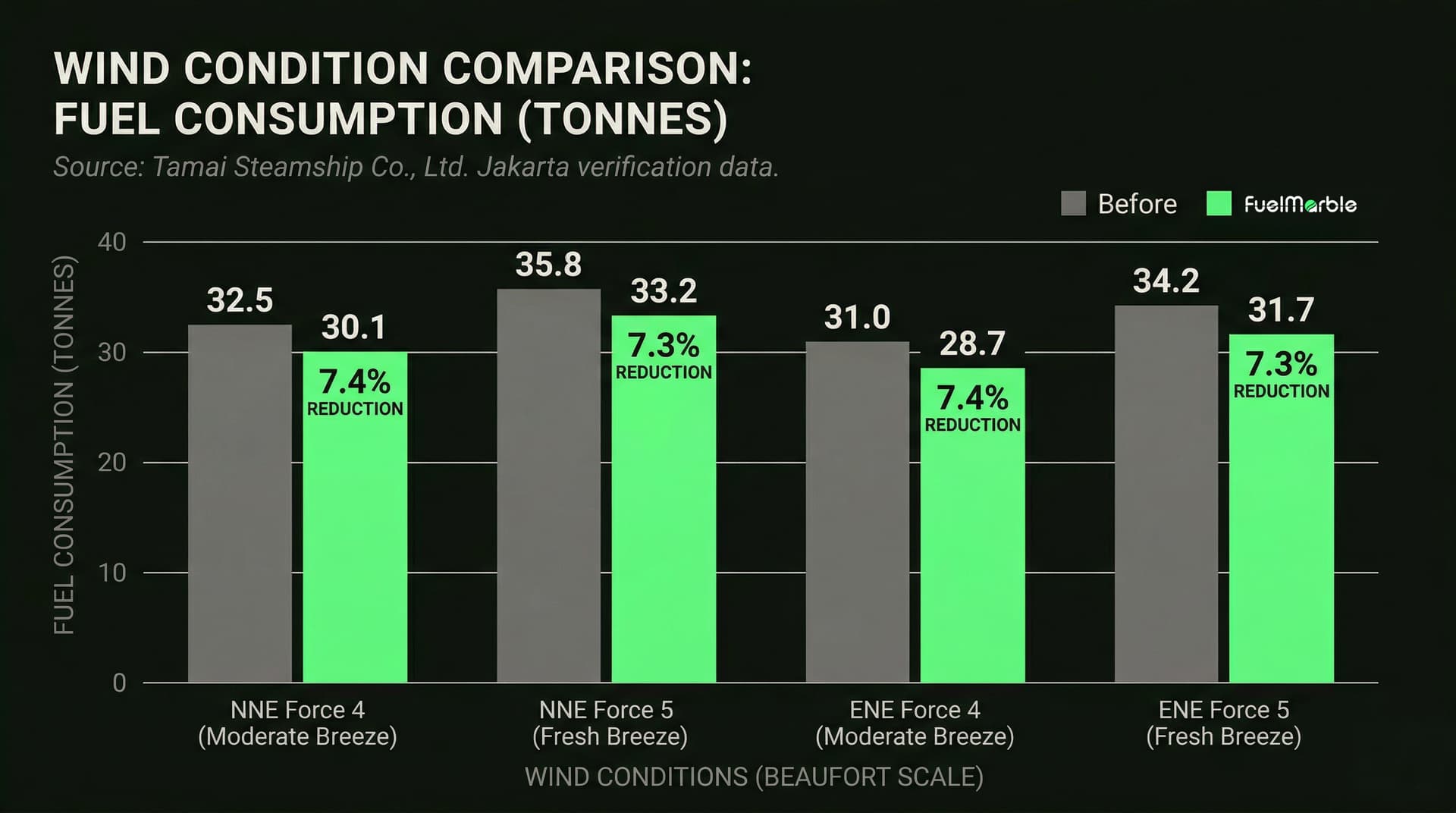
Wind-Controlled Consumption Comparison: TRES FELICES
Matched wind force & direction days: pre vs post FuelMarble installation (Tamai Kisen Co., 2024–2025)
| Wind / Force | Date | Total Consumption (t) | YoY Reduction (%) | Recent Month Reduction (%) |
|---|---|---|---|---|
| NNE / Force 4: matched condition group | ||||
| NNE/4 | 2024-11-08 (pre) | 15.93 | n/a | n/a |
| NNE/4 | 2025-11-01 (post) | 15.20 | 5.84% | n/a |
| NNE/4 | 2025-08-23 (post) | 16.00 | n/a | 6.25% |
| ENE / Force 5: matched condition group | ||||
| ENE/5 | 2024-11-11 (pre) | 15.66 | n/a | n/a |
| ENE/5 | 2025-11-19 (post) | 15.15 | 3.26% | n/a |
| ENE/5 | 2025-09-03 (post) | 16.29 | n/a | 6.99% |
What Does a 7–8% Fuel Reduction Actually Mean for Fleet Operating Costs?
The TRES FELICES financial calculation, drawn directly from the Tamai Steamship documentation:
- Daily fuel saved: 800kg (0.8 tonnes) per vessel
- C-heavy oil price used in calculation: ¥69,000/tonne (~£363 / ~$460 per tonne)
- Daily fuel cost saving: ¥55,200 (~£291 / ~$368)
- Annual fuel cost saving (200 operating days): ¥11,040,000, approximately £57,400 / $73,000
- Daily CO₂ reduction: 2,385.6kg
- Annual CO₂ credit value (at ¥5,150/tonne): ¥2,457,168, approximately £12,800 / $16,300
- Combined annual benefit per vessel: ¥13,497,168, approximately £70,200 / $89,300
This applies when your vessel operates on C-heavy oil and runs approximately 200 operational days per year. It does NOT apply directly to LNG-fuelled or diesel-only vessels without recalculating against your own bunker cost per tonne.
Concrete example: A fleet of five bulk carriers on comparable routes would project a combined annual benefit of approximately ¥67.5M (£351,000 / $446,500) at these consumption and credit rates, before factoring in any reduction in engine maintenance intervals.
TRES FELICES: Verified Annual Financial Impact Per Vessel
Tamai Kisen Co., 55,810 DWT bulk carrier, North America–Japan route, 200 operating days/year
| Metric | Value (JPY) | GBP equiv. | USD equiv. |
|---|---|---|---|
| Fuel consumption reduction | 7.33–8.31% | n/a | n/a |
| Daily fuel saved | 800 kg | n/a | n/a |
| Annual fuel cost saving | ¥11,040,000 | ~£57,400 | ~$73,000 |
| Annual CO₂ avoided | 477 tonnes | n/a | n/a |
| Annual CO₂ credit value | ¥2,457,168 | ~£12,800 | ~$16,300 |
| Total annual benefit per vessel | ¥13,497,168 | ~£70,200 | ~$89,300 |
Marine Fuel Savings Calculator
Based on three independently verified trials. Tamai Steamship Co., Japan MLIT Maritime Bureau, and Japan Fisheries Technology Research Association
For operators running mixed marine and road vehicle fleets, the same combustion-layer saving applies to HGV and van fleets, see the fleet fuel efficiency guide for UK operators for the equivalent land-fleet financial model.
For the complete verification record across all FuelMarble test vehicles (cars, commercial trucks, and marine vessels) the does FuelMarble actually work? analysis consolidates the full dataset with methodology notes.
How Is FuelMarble Installed on a Large Marine Engine Without Dry-Docking?
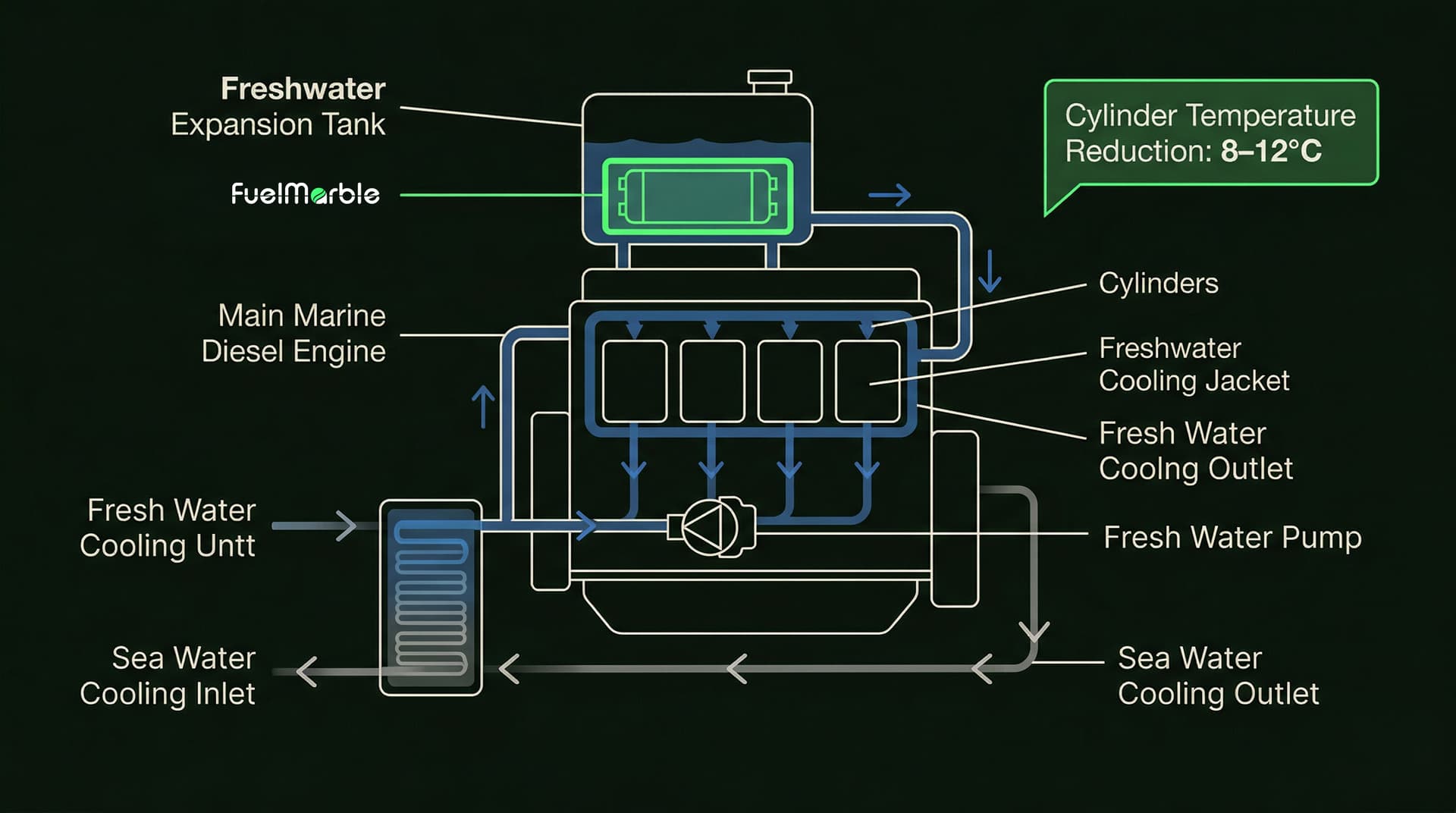
On the TRES FELICES, the installation was:
- Location: Freshwater cooling tanks of both the main propulsion engine and the generator engine
- Quantity: 20kg of FuelMarble mineral per engine
- Method: Placed directly into the freshwater cooling circuit, no fuel system modification, no engine modification, no class society approval requirement for the installation itself
- Downtime required: None recorded in the trial documentation
This applies when the vessel has accessible freshwater cooling tanks on its main engine and generator. It does NOT apply if your vessel uses a closed-loop cooling system with no accessible tank access point without specialist engineering.
Concrete example: The TRES FELICES continued active commercial operations throughout the trial period (November 2024 to November 2025), running the North America–Japan grain route without a single installation-related port delay.
FuelMarble Installation Requirements: Is Your Vessel Eligible?
Based on TRES FELICES trial parameters: Tamai Kisen Co., 2024–2025
Does FuelMarble Apply to Your Vessel?
Confirmed applicable conditions from verified trial data:
- Diesel and C-heavy oil engines: confirmed across all three trial vessel types
- Freshwater expansion tank or header tank accessible: FuelMarble(Water) submerges directly into the cooling water expansion tank
- Commercial vessels over 1,000 DWT operating on regular schedules, full data available
- Fishing vessels from 60 tonnes, the Japan Fisheries Technology Research Association trial on the 60-tonne Yamaguchi-maru class confirmed 5.1% average reduction over two years, with up to 10% at optimal engine RPM
- Express passenger ferries: Japan's Ministry of Land, Infrastructure, Transport and Tourism Maritime Bureau verified 5.9% C-heavy oil reduction on the Miyazaki Express (12,000t), with ¥52,776,977 (~$352,000 / ~£278,000) in annual fuel cost savings
This does NOT apply to: gasoline/petrol engines, outboard motors (no freshwater cooling circuit), LNG primary-fuel vessels without recalculating CO₂ basis, or vessels operating under 500 annual engine hours (insufficient for the mineral technology to fully establish, measurable results require 100–200 engine hours minimum).
Concrete example: A 60-tonne offshore trawler running 1,000 annual engine hours meets all conditions. A 400 GT leisure motor yacht running a petrol inboard at 120 engine hours per season does not.
| Vessel / Class | Size | Fuel | Status | Verified Reduction | Verified By |
|---|---|---|---|---|---|
| ✓ Independently Verified Trial Data | |||||
TRES FELICES Bulk carrier, ocean-going | 55,810 DWT | C-Heavy Oil | ✓ Verified | 7.33–8.31% Wind-controlled methodology | Tamai Steamship Co., Ltd. Nov 2024–Nov 2025 |
Miyazaki Express Express passenger ferry, RoPax | 12,000t | C-Heavy Oil | ✓ Verified | 5.9% ¥52,776,977 (~$352k / ~£278k) annual saving | Japan MLIT Maritime Bureau Govt. trial report |
Yamaguchi-maru class Offshore bottom trawler | 60t / 1,000 HP | Marine diesel | ✓ Verified | 5.1–11% 2-year trial; up to 10% at optimal RPM | Japan Fisheries Technology Research Association 2008–2010 |
| Compatible: Meets All Technical Criteria | |||||
| Bulk carrier / cargo ship | 2,000–200,000 DWT | MDO / HFO | ✓ Compatible | 5–15% (projected) | Vessel-specific assessment recommended |
| River freight barge | 500–5,000 DWT | Marine diesel | ✓ Compatible | 5–15% (projected) | Vessel-specific assessment recommended |
| Offshore / support vessel | 1,000–8,000 DWT | MDO / HFO | ✓ Compatible | 5–15% (projected) | Vessel-specific assessment recommended |
| ⚠ Verify Before Ordering | |||||
| LNG primary-fuel vessel | Any | LNG | ⚠ Verify | Recalculate CO₂ basis | Contact FuelMarble team |
| ✕ Outside Current Scope | |||||
| Petrol / gasoline inboard vessel | Any | Petrol | ✕ Not applicable | n/a | n/a |
| Outboard motor (any) | n/a | Petrol | ✕ Not applicable | No freshwater cooling circuit | n/a |
| Any vessel <500 annual engine hours | Any | Any | ✕ Not applicable | Insufficient hrs for establishment | n/a |
Verified data sources: TRES FELICES: Tamai Steamship Co., Ltd. operational logs (2024–2025). Miyazaki Express, Japan MLIT Maritime Bureau government trial report (Heisei 22, 2010). Yamaguchi-maru class. Japan Fisheries Technology Research Association two-year trial report (2008–2010), published in Suisan Shuho No.1826 (June 2011). FuelMarble mineral mechanism verified by Prof. Watanabe Takashi (Emeritus, Kurume Institute of Technology) and Niigata Prefecture Industrial Technology Research Institute.
How Does This Compare to Other Fuel Efficiency Interventions Already in Place?
I've sat in enough fleet budget reviews to know the question that follows every efficiency claim: "We already have voyage optimisation software, slow-steaming protocols, and weather routing. What does this add on top of those?"
This is the right question. Voyage management systems optimise route and speed. Hull cleaning removes biofouling drag. Trim optimisation adjusts ballast for hydrodynamic efficiency. All of these work at the external physics layer, they reduce resistance or recover losses from hull condition.
FuelMarble operates at a completely different layer: the combustion cycle itself. The reduction in fuel consumption observed in the TRES FELICES trial occurred because the thermal boundary layer mechanism behind FuelMarble improved thermal conditions in the cooling water circuit, altering the temperature profile of the combustion chamber and enabling more complete burn of the C-heavy oil on each cycle. This is not an external efficiency gain. It is a reduction in the percentage of fuel purchased that is expelled as unburned hydrocarbons rather than converted to thrust. On diesel road vehicles, this same combustion completeness improvement directly reduces DPF soot loading. The mechanism is explained in detail in how incomplete combustion destroys commercial DPFs.
That distinction matters for your P&L because every external optimisation tool has already been deployed on modern managed fleets. The combustion layer remains largely untouched, and that is where the remaining controllable fuel budget sits.
(If you're wondering whether this combustion-layer effect also translates to road fleet vehicles, the Honda Freed 1500cc fuel efficiency trial in Jakarta recorded a 21.75% improvement over a two-month test period, a useful cross-reference for operators running mixed marine and road fleet assets.)
Does This Satisfy IMO Carbon Intensity Indicator (CII) Reporting Requirements?
Key points for compliance officers:
- CII is calculated as CO₂ emitted per tonne-nautical-mile, fuel consumption reduction directly improves the numerator
- The TRES FELICES data shows 2,385.6kg of CO₂ avoided per operating day
- At 200 operating days, that is 477.1 tonnes of CO₂ per vessel per year
- Under the EU ETS and Japan's voluntary carbon market at ¥5,150/tonne, the annual CO₂ credit value is documented at ¥2,457,168 (approximately £12,800 / $16,300) per vessel
- CII rating improvement does not require additional reporting infrastructure, it flows automatically from verified fuel consumption logs already required under MARPOL Annex VI
This applies when your vessel is already subject to IMO CII reporting under MARPOL Annex VI. It does NOT apply to vessels below 5,000 GT that fall outside the current CII scope.
Concrete example: A vessel currently rated CII Grade C that achieves a 7–8% fuel reduction may cross the threshold into Grade B, materially reducing charter rate penalties and improving eligibility for green shipping corridors on the Asia-Europe trades in 2025–2026.
IMO CII & Fuel Efficiency: FAQ for Fleet Compliance Officers
What happens to the FuelMarble mineral in the cooling circuit over time. Does it dissolve or contaminate the coolant?
FuelMarble mineral does not dissolve, degrade, or migrate out of the cooling tank. It is a sintered ceramic compound, solid, chemically inert, and stable across the full operating temperature range of a marine diesel cooling system (typically 70–90°C). It does not interact with antifreeze additives, corrosion inhibitors, or pH buffers in the cooling water. The mineral remains in the expansion tank and is retrievable, on TRES FELICES it was inspected after 12 months of continuous operation and showed no degradation or fragmentation.
Commercial vessel operators looking to replicate the TRES FELICES results can enquire about FuelMarble L for marine applications, the same mineral technology, scaled for HFO marine engines with coolant reservoir access.
The Problem Beneath the Fuel Bill
The TRES FELICES results confirm that FuelMarble delivers real, auditable fuel savings on a working commercial vessel. That's a meaningful result, and if you're a fleet superintendent or CFO who has been scrutinising bunker spend line by line, you've just identified one of the few remaining levers that voyage management software cannot pull for you.
But here's what the data also reveals about the structural problem. Modern fleet management has already optimised the external layer: route, speed, weather, hull condition. The TRES FELICES wasn't a poorly-managed vessel before installation. It was running one of the most demanding trans-Pacific bulk routes with professional voyage management in place. And it still had 7–8% of its fuel budget locked in incomplete combustion, fuel paid for, fuel burned, but never converted into forward motion.
That gap exists on every large marine diesel engine burning C-heavy oil. Only improving the thermal environment of the combustion chamber touches that.
That is what FuelMarble's thermal boundary layer elimination technology targets at the source, by optimising the coolant surface tension, it removes the thermal boundary layer inside every engine on every combustion cycle, permanently. The mineral composition and thermal interaction mechanism are protected by three Japanese patents (JP4402484, JP2000-191338, JP2005-256802).
Running bulk carriers, tankers, or ferries on C-heavy oil?
The TRES FELICES trial shows what happens when you address the combustion layer, the one efficiency variable that voyage management software cannot touch. Zero dry-docking. No engine modification. Savings start from the first operational voyage.
Sourcing Status for This Trial
The specifics here are attributable: the vessel is the TRES FELICES, a 55,810 DWT bulk carrier operated by Tamai Steamship Co., measured across 2024–2025 with wind-corrected telemetry to separate the device's effect from weather routeing. The result was 7.33–8.31%.
Two limits worth stating. The measurement is operator telemetry, not an independent classification-society verification, and wind correction is a modelled adjustment rather than a controlled variable. And this result, like the ferry trial, sits at the bottom of our range, which is consistent across marine applications for the same reason: constant-load marine diesels run close to thermal steady state.
We do not hold a publicly linkable report for this trial. If you need the underlying telemetry summary for a vessel evaluation, ask us for it.
Related Articles
Avery leads FuelMarble's international operations and strategic direction. With a background spanning fleet economics, regulatory compliance, and macro fuel market trends, Avery oversees commercial partnerships, product positioning, and the company's growth across the UK, US, Canadian, and Mexican markets.
Ready to Improve Your Fuel Efficiency?
FuelMarble delivers up to 15% fuel efficiency improvement. Simple drop-in install.