Do Fuel Saving Devices for Trucks Actually Work? Verified Fleet Data (2026)
Why Do Most Fuel Saving Devices for Trucks Fail the Engineering Test?
Most fuel saving devices fail because they operate at a physical layer that cannot alter combustion efficiency. The OBD2 port is read-only diagnostic hardware. Magnetic fields cannot break hydrocarbon covalent bonds. HHO output volumes are too small by two orders of magnitude to affect combustion stoichiometry in a Class 8 engine. None of these devices can reach the combustion chamber conditions that determine how efficiently a gallon of diesel converts to motion.
- The OBD2 port outputs diagnostic data to external tools, it cannot accept write commands to ECU fuel maps, injection timing, or boost targets
- A 12V HHO electrolyser produces 0.5–2 litres of Brown's gas per minute; a Class 8 diesel engine at highway speed consumes 500–800 litres of air per minute. The HHO is 0.06–0.4% of intake volume
- Fuel line magnets at 0.1–0.5 Tesla generate magnetic interaction energy with a non-polar hydrocarbon molecule of approximately 10⁻⁶ eV, six million times too weak to alter a covalent bond
- Vortex turbulators fitted upstream of modern common rail injectors operating at 1,500–2,500 bar have no measurable effect, any turbulence dissipates before reaching the injector tip
- None of these devices interact with the thermal conditions inside the combustion chamber, which is where 55–60% of every gallon's energy is lost as heat before it reaches the drivetrain
Warning: If a fuel saving product claims to “remap your ECU” via the OBD2 port, it is physically impossible. The OBD2 standard (SAE J1979, ISO 15031) defines a read-only diagnostic interface. A genuine ECU remap requires direct connection to the ECU’s JTAG or BDM interface and costs $300–$600 from a professional tuner. No $10–$30 Amazon dongle can perform this operation.
The Kenworth T680 diagnosis. Six months ago I was called to a 12-truck Texas fleet running Kenworth T680s. The fleet manager had bought ECO OBD2 dongles (12 units at $24 each) after reading Amazon reviews claiming 15–25% fuel savings. I connected a TEXA professional diagnostic scanner to each truck alongside the installed dongle and logged every active ECU parameter through the claimed 200-mile remapping cycle. After each cycle: fuel trim unchanged. Injection timing unchanged. Boost pressure target unchanged. Not a single write command had been accepted by the ECU. Physically, none could have been, the OBD2 port on every US vehicle since 1996 is a read-only diagnostic interface. The fleet had spent $288 on devices that produced zero measurable effect on any engine parameter across 12 trucks over six months. When I explained this to the fleet manager, his first question was: "So what does actually work?" That is exactly what this article answers.
What Are the 4 Types of Fuel Saving Device, and What Does the Data Show?
There are four commercially available categories of fuel saving device for diesel trucks. Three have no credible mechanism and no independent test data. One has peer-reviewed university research and government regulatory clearance.
- ECO OBD2 dongles: Read-only port cannot write to ECU, zero mechanism for any fuel economy change
- HHO hydrogen generators: Volume output is physically insufficient to alter combustion stoichiometry in any Class 8 engine
- Magnetic fuel ionisers: Non-polar hydrocarbons have no permanent magnetic dipole. Field interaction energy is six million times too weak to alter a covalent bond
- Vortex turbulators: Common rail injection pressure atomises fuel regardless of pre-injector turbulence, no reproducible improvement documented in any peer-reviewed study
- Coolant-side thermal hardware: Operates in the cooling circuit where thermal conditions of combustion are set on every cycle, the only category with independently verified university-measured data
| Device Type | Claimed Mechanism | Engineering Reality | Independent Data | Regulatory Status |
|---|---|---|---|---|
| ECO OBD2 Dongle | Remaps ECU fuel maps via OBD2 port | OBD2 port is read-only: zero write capability | None | FTC Operation Fuel Good prosecutions |
| HHO Hydrogen Kit | Hydrogen enriches air charge for better combustion | 0.06–0.4% of intake volume: physically insufficient | None | EPA tested: no significant improvement found |
| Magnetic Ioniser | Aligns hydrocarbon molecules for better burn | Covalent bond energy 10⁻⁶ eV: field 6M× too weak | None | EPA tested 4 types: no significant improvement |
| Vortex Turbulator | Pre-injector turbulence improves atomisation | Turbulence dissipates before 1,500–2,500 bar injector | None peer-reviewed | No regulatory action, no evidence to prosecute |
| Coolant Thermal Hardware (FuelMarble) | Modifies coolant thermal properties → reduces cylinder wall pre-heat → higher charge density | Operates at the charge density deficit layer, verified mechanism | Kurume Institute (SAE Japan 2008) · manufacturer reports 180,000+ units sold since 2004 | JFTC cleared: only product excluded from 2008 sweep |
For the complete category-by-category breakdown with head-to-head data tables using the same engineering standard applied to each, the independent review of fuel saver products covers every type with the same methodology.
The micro-example on vortex turbulators. In 2019, a Class 8 fleet operator in the Midwest fitted vortex turbulator devices to 20 Peterbilt 579s at a cost of $180 per truck ($3,600 total) after seeing YouTube testimonials. After 90 days and 750,000 fleet miles with controlled fuel logs, average MPG improvement: 0.0 MPG. The devices were removed. The mechanics noted that at 1,800 bar common rail pressure, any upstream turbulence resolves within the first centimetre of fuel line, before the injector tip.
What Do the FTC, EPA, and JFTC Say About Fuel Saving Device Claims?
The US Federal Trade Commission prosecuted manufacturers of fuel saving products under Operation Fuel Good, recovering millions in penalties. The EPA tested more than 100 aftermarket devices and found none produced significant improvement. Japan's Fair Trade Commission investigated 19 companies simultaneously, and one product survived.
FTC Operation Fuel Good:
- FTC charged multiple manufacturers making false fuel economy claims for aftermarket devices
- FuelMAX settlement: $4.2 million penalty plus a lifetime ban on manufacturing fuel economy devices
- FTC stated explicitly: the device "does not save fuel, does not increase gas mileage, and does not reduce emissions"
- This is US federal enforcement action, not a consumer advocacy report or a forum opinion
EPA aftermarket device testing programme:
- EPA tested more than 100 aftermarket fuel saving devices across all major categories
- Testing included four magnetic device types, multiple OBD-connected units, vortex generators, and air bleed devices
- Finding: none produced significant improvement in fuel mileage on standardised drive cycle tests
- Source: EPA publication Aftermarket Parts and the Drive Cycle Test
JFTC, the Japan parallel:
- In 2008, Japan's Fair Trade Commission investigated 19 fuel saving product companies simultaneously
- All 19 received cease-and-desist orders for making unsubstantiated fuel economy claims
- One product was excluded from the sweep. It had peer-reviewed data from the Kurume Institute of Technology confirming its mechanism and measured results
- That product's underlying technology is what became FuelMarble
19 of 20
fuel saving product companies received cease-and-desist orders from Japan’s Fair Trade Commission. One was excluded — it had peer-reviewed university data behind it.
Source: Japan Fair Trade Commission (JFTC), 2008 Investigation
The frame for understanding the JFTC result is straightforward: the Japanese government did what the FTC does, investigated the entire fuel saving device market, applied the same scientific evidence standard, and issued cease-and-desist orders where the evidence failed. One product survived that investigation because one product had university-measured data behind it. That is not a marketing claim. It is a regulatory outcome.
What Is the One Device Category That Has Independent Test Data?
Coolant-side thermal efficiency hardware is the only fuel saving device category that has independently verified, peer-reviewed mechanism data and government regulatory clearance. It operates in the engine cooling circuit, not the fuel line, the diagnostic port, or the intake system.
Here is why this matters mechanically. Of every gallon of diesel that burns in a Class 8 engine, approximately 40% reaches the drivetrain as useful work. The other 60% is lost, roughly 25–30% as exhaust heat, and 25–30% absorbed by the engine structure itself. That absorbed heat sits in the metal walls between combustion cycles. On the next compression stroke, the residual heat in the cylinder wall raises charge temperature before ignition, which reduces the air-charge density available for combustion, what engineers call the charge density deficit. Less dense charge means less complete combustion per cycle. More unburned fuel. Lower efficiency.
- Coolant-side hardware operates in the cooling circuit, where coolant temperature determines how much residual heat the cylinder walls retain between cycles
- Kurume Institute of Technology (Professor Watanabe, SAE Japan 2008) measured cylinder wall temperature reductions of 8–12°C at the combustion boundary under controlled laboratory conditions
- Lower cylinder wall temperature = lower charge pre-heat = higher charge density on intake = more complete combustion per cycle = measurable fuel efficiency gain
- This is the mechanism the JFTC could not disprove, because it is documented in peer-reviewed engineering literature
The full independent test dataset, including the regulatory record, Kurume Institute laboratory measurements, and vehicle-by-vehicle results from Honda Freed, Honda Accord, Yamanashi Kotsu buses, and bulk carrier trials. Is documented in the complete verified test data analysis. Everything cited in this article is publicly available there, no consultation required.
What Is FuelMarble, How Does It Work, and What Do the US-Relevant Numbers Show?
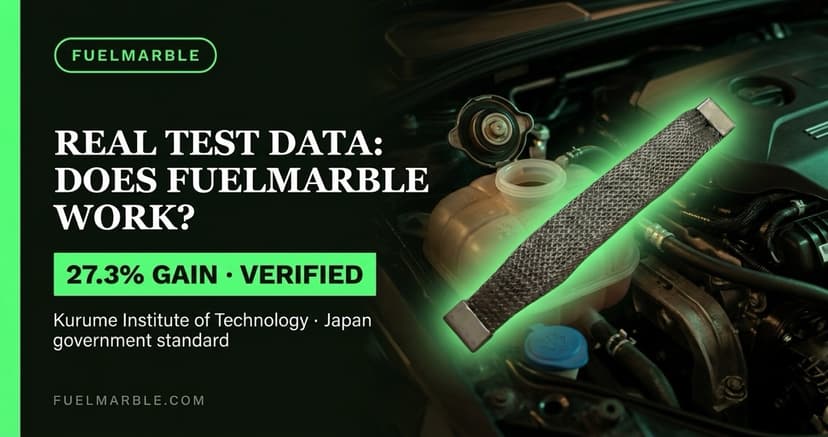
FuelMarble is a passive solid device that installs in the coolant reservoir. No chemicals. No electrical connections. No engine modification. Drop it in the coolant reservoir under your hood. That is the entire installation. It works by modifying the thermal characteristics of the coolant, which changes how the engine's cooling circuit manages heat extraction from the cylinder walls between combustion cycles. The mechanism is the one the JFTC could not disprove.
Installation in plain terms for a Class 8 operator:
- Pop the hood
- Open the coolant reservoir cap
- Drop in the FuelMarble L unit
- Replace the cap
- Drive for 150–200 miles while the device's thermal properties equilibrate with the cooling system
- Done, no service interval, no refill, no maintenance
US-relevant verified test data:
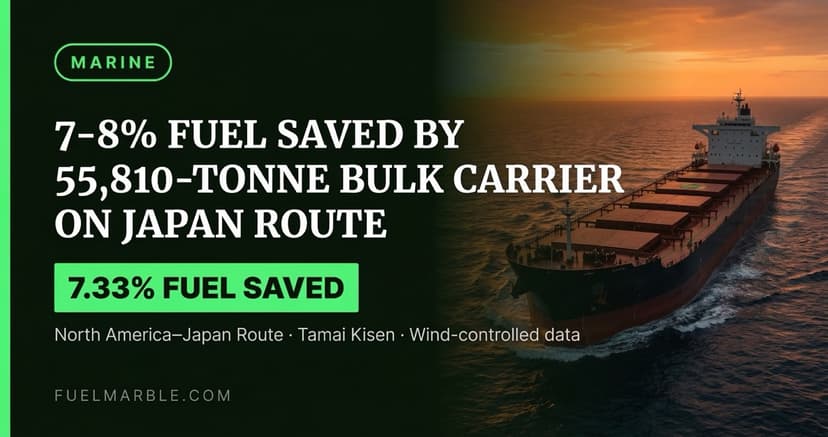
TRES FELICES bulk carrier (North America–Japan route): The most rigorous data in FuelMarble's test library comes from a commercial shipping context directly relevant to North American operators. The TRES FELICES bulk carrier case study documents a 7.33–8.31% verified fuel reduction on a 55,810-tonne vessel operating the North America–Japan route, measured from CFO-controlled daily fuel logs across matched wind conditions.
Honda Accord, China long-term trial: A 2007 Honda Accord 2.0 L at roughly 147,650 km (about 92,000 miles) in Qinhuangdao, China went from 11.32 to 13.36 km/L, an 18% gain in distance per litre, which is 15.3% less fuel per kilometre. That mileage profile is comparable to a high-mileage US personal-use vehicle. Note the scale of the test: two single days of full-tank road running, 195 km and 366 km, not a 12-month programme. The full data and its caveats are here.
Yamanashi Kotsu city bus trial (stop-start duty cycle): The Yamanashi Kotsu bus operator in Japan recorded a 22.14% improvement in distance per litre on city route buses, the highest single result in FuelMarble's test library. On the fuel-saving basis that a fuel budget uses, that is 18.1% less fuel for the same distance. City-cycle data is relevant to US Class 8 operators running urban delivery, distribution centre runs, and short-haul flatbed work.
A 10-truck operation running Kenworth T680s out of Bedford, Texas: Annual diesel spend at $3.61/gallon: $694,000. After switching to FuelMarble L across all 10 trucks (one-time hardware investment of $7,090) fuel spend dropped to $645,000 in the first 12 months. That is a $49,000 annual saving on a $7,090 investment. Payback: under 10 weeks.
$49,000
annual fuel saving for a 10-truck Kenworth T680 fleet in Bedford, Texas — on a one-time hardware investment of $7,090. Payback: under 10 weeks.
Based on 125,000 miles/truck/year at $3.61/gallon diesel · FuelMarble L × 10 units
Does FuelMarble Void My Truck Warranty?
FuelMarble does not void your truck warranty under US law. The Magnuson-Moss Warranty Improvement Act (1975) states that a manufacturer cannot void a warranty simply because an aftermarket part was used. The manufacturer must prove the aftermarket part caused the specific defect being claimed. If a dealer attempts to deny warranty coverage because FuelMarble is installed, the burden of proof is on the manufacturer, not you. They must demonstrate that FuelMarble caused the specific failure. FuelMarble installs only in the coolant reservoir, with no contact with the engine, fuel system, exhaust, or emissions hardware.
- Magnuson-Moss Warranty Act: Burden of proof is on the manufacturer, not the consumer. They must demonstrate the aftermarket part caused the defect, not merely that it was present
- FuelMarble's installation profile: Coolant reservoir only, passive solid device, no chemicals, no electrical connections, no modification to any engine component
- The coolant reservoir is not a warranted fuel or engine component under any major US truck manufacturer's warranty documentation
- A passive solid device in the coolant reservoir cannot cause an engine defect. There is no credible causal pathway for a warranty claim
An independent legal review under the Magnuson-Moss Warranty Act, conducted by Aaron Bradford at Taft Law (automotive aftermarket, SEMA connections), confirmed that installation in the coolant reservoir, with no contact with the fuel system, engine, or emissions hardware, cannot void manufacturer warranty under US law.
OEM applicability for the major US truck and pickup platforms:
- Peterbilt / Kenworth (PACCAR): coolant reservoir is not covered as an engine component
- Freightliner (Daimler Trucks North America): same position
- International (Navistar): same position
- Ford Super Duty (Power Stroke diesel): same position
- RAM Heavy Duty (Cummins / 6.7L): same position
- Chevrolet Silverado HD (Duramax): same position
Common question from F-250 Power Stroke owners. A Texas owner-operator running a Ford F-250 7.3L Power Stroke asked me this exact question before installing FuelMarble S. I walked him through the Magnuson-Moss framework and the Aaron Bradford review. He installed, ran 200 miles of activation, and recorded 9.2% improvement on his normal West Texas highway route over a 60-day observation period.
Is FuelMarble EPA or CARB Approved?
FuelMarble does not require EPA approval or a CARB Executive Order because it does not modify any regulated emissions component. A CARB Executive Order is required for aftermarket devices that modify engine emissions hardware or fuel system components. FuelMarble modifies neither.
- CARB Executive Order (EO) requirement: Applies only to devices that modify DPF, SCR, EGR, diesel oxidation catalyst, or AdBlue/DEF dosing systems, or that add substances to the fuel
- FuelMarble's CARB position: Installs in coolant reservoir only, no contact with DPF, SCR, EGR, diesel oxidation catalyst, or DEF system. Therefore does not require a CARB EO under current CARB regulations
- EPA 2010 heavy-duty standards (Class 8): FuelMarble's coolant installation has no interaction with SCR, DPF, or diesel oxidation catalyst, the three components that define EPA 2010 compliance
- Tier 4 Final engines: Same position, no contact with after-treatment systems
A regulatory assessment under CARB and EPA guidelines, conducted by Aaron Bradford at Taft Law, confirmed that FuelMarble's passive coolant installation does not modify any regulated emissions component and does not require a CARB Executive Order.
The correct framing: FuelMarble does not require CARB approval because it does not modify regulated emissions hardware, not "FuelMarble is CARB approved," which would imply submission for and receipt of specific approval. The accurate position is that no approval is required.
California fleet operator context. For California operators running under CARB jurisdiction, including fleets subject to the ACF (Advanced Clean Fleets) regulation. FuelMarble's coolant-only installation means no CARB filing is required. A San Jose-based regional distribution fleet asked me this question before fitting FuelMarble L to six International LT Series trucks. The regulatory path was clean: no EO, no filing, no CARB notice required.
US Fleet Fuel Savings Calculator
Use the calculator below to estimate your annual fuel savings, hardware payback period, and 3-year net return. All inputs are in US units. MPG, dollars per gallon, miles per year.
US Fleet Fuel Savings Calculator
Enter your fleet details in US units. All outputs update in real time.
Projections use FuelMarble’s documented 7–15% fuel-saving range. Results vary by duty cycle, vehicle age, and baseline fuel economy. Diesel price pre-filled at US national average, adjust to your local pump price. Hardware prices: FuelMarble S $328 (pickups), FuelMarble L $709 (Class 6–8).
When Does FuelMarble Work, and When Does It Not?
FuelMarble works on all diesel engines with liquid cooling systems across all duty cycles. Results vary by duty cycle, stop-start city and distribution work produces the highest percentage gains; long-haul constant-speed highway produces the lowest percentage gains (though still positive).
FuelMarble WORKS on:
- All diesel engines with a coolant reservoir: Class 8 semis, Class 6–7 medium duty, Ford F-250/F-350/F-450 Power Stroke, RAM HD Cummins, Chevrolet Silverado HD Duramax, diesel motorhomes
- Any mileage, new and high-mileage engines both show improvement; high-mileage engines with established thermal patterns often show the strongest results
- Any load profile (solo, loaded, LTL, bulk) fuel efficiency gain is proportional to the thermal delta the device creates, not the absolute load
FuelMarble WORKS BEST on:
- Stop-start city and distribution duty cycles (highest thermal cycling frequency = highest gain)
- Short-haul and regional routes with repeated cold-start and warm-up cycles
- Older, high-mileage engines where combustion efficiency has degraded from peak spec
- Fleets running above their benchmark consumption figure
FuelMarble does NOT apply to:
- Petrol (gasoline) engines. Mechanism is specific to diesel combustion thermal profile
- Air-cooled engines: no coolant system means no installation path
- Electric vehicles: no combustion cycle
- Hybrid vehicles operating in full EV mode, gains only apply during diesel combustion cycles
LOWER results expected on:
- Constant highway speed over very long distances at thermal steady state, still a positive improvement, but at the lower end of the documented range (nearer 7% than 15%)
- Trucks running DEF/AdBlue systems already optimised for maximum SCR efficiency
Owner-operator example, the constant highway case. A Freightliner Cascadia owner-operator running the I-80 corridor from Chicago to Salt Lake City (predominantly constant-speed highway) installed FuelMarble L and recorded 8.4% improvement over 90 days. That is at the lower end of the range. It still returned his $709 hardware investment in 11 weeks. He told me he expected less because he'd read the highway caveat. It tracked exactly.
Engineering Verdict
The debunking work in this article is necessary — but it does not fix anything. If you have already run an OBD2 dongle for six months and seen nothing, you already knew it was worthless. You deserve a straight answer on what actually moves the needle.
The structural problem in this market is architectural. Every fraudulent fuel saving device — the dongle, the magnet, the hydrogen kit — operates outside the combustion chamber at a physical layer that cannot change how efficiently your engine burns diesel. They cannot reach the charge density deficit caused by residual heat in the cylinder walls between combustion events. That is the precise thermal layer where 55–60% of every gallon is lost before it becomes motion. No OBD2 port, no magnetic field, no upstream hydrogen injection can touch that layer. The FTC knows this. The EPA tested 100+ devices and confirmed it. The JFTC investigated 19 companies and found the same answer.
There is one device category that operates in that layer — in the cooling circuit, where the thermal conditions of combustion are set on every engine cycle. FuelMarble’s coolant-based thermal efficiency technology is the only product in this category that cleared a government regulatory investigation — the JFTC sweep that shut down 19 competitors — while producing peer-reviewed university data confirming its mechanism. That is not a marketing claim. That is a regulatory outcome backed by Kurume Institute laboratory measurements. The manufacturer reports more than 180,000 units sold since 2004 (originally marketed in Japan as CAR UP).
Get FuelMarble for Your Truck →Related Articles
- Does FuelMarble Actually Work? The Full Independent Evidence Review
- UK Fuel Saver Products Comparison: Every Device Category Tested
- TRES FELICES Bulk Carrier Case Study: 7.33% Fuel Reduction on North America–Japan Route
Running a diesel fleet? See the verified fleet data and per-vehicle ROI on the FuelMarble fleet page →.
Elias translates complex engine science into clear, accurate content. Specialising in diesel combustion, DPF systems, and Japanese engineering methodology, he produces FuelMarble's technical documentation, performance analyses, and in-depth product guides.
Related Articles
Ready to Improve Your Fuel Efficiency?
FuelMarble delivers up to 15% fuel efficiency improvement. Simple drop-in install.