
The Ultimate Haulage Terminology Guide 2026
Page Summary
Haulage terminology is not just industry jargon. It is the language that determines whether loads move efficiently, legally, and profitably. From the difference between an articulated lorry and a rigid to understanding cabotage rules post-Brexit, precise terminology prevents costly misunderstandings at every level of fleet operations.
This glossary accompanies the complete guide to UK haulage and logistics 2026 (use it alongside that guide for full context) and defines the most essential terms in the industry.
This guide covers the 23 most essential terms in UK haulage, with comparisons to US, Australian, and European equivalents. Whether you are a new driver navigating your first logistics role or a fleet manager building team knowledge, this reference gives you the language to operate confidently in 2026.
The guide also includes an animated four-stroke diesel cycle explainer, because understanding how the engine in your lorry converts fuel into motion is the foundation for every conversation about fuel efficiency, emissions compliance, and DPF maintenance.
Why Terminology Matters in Haulage
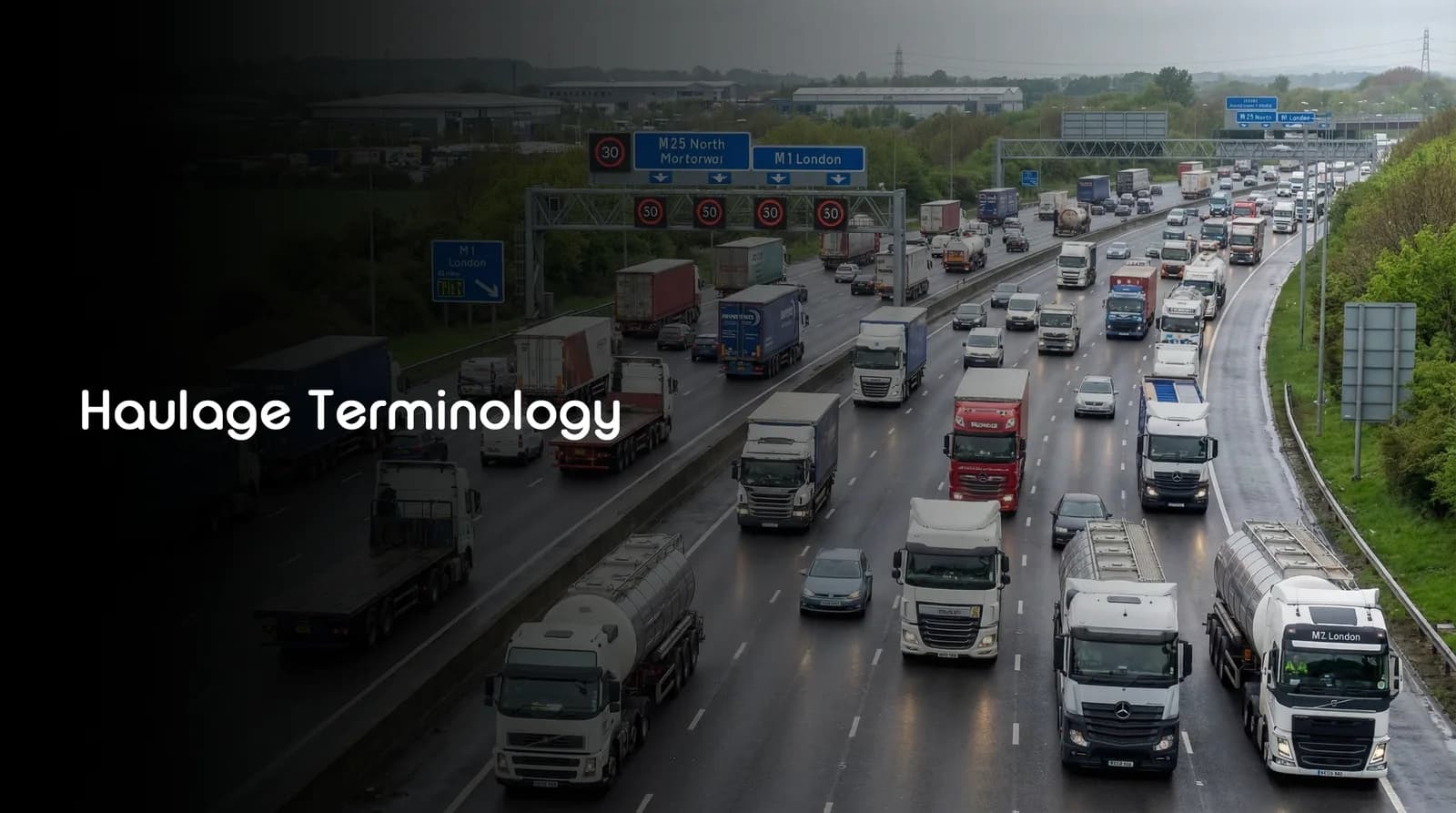
The UK haulage industry employs over 300,000 drivers and contributes more than £13 billion annually to the UK economy. It is an industry built on precision, precise weights, precise delivery windows, precise compliance requirements. The terminology that underpins those requirements is not optional knowledge. It is operational infrastructure.
Three specific reasons why precise haulage terminology matters in practice:
1. Regulatory compliance. Cabotage rules, operator licensing categories, CMR documentation requirements, and DGN paperwork all have specific legal definitions. Using the wrong term in the wrong context (particularly when crossing international borders) creates delays, fines, and legal exposure.
2. Commercial accuracy. Whether a load is classified as FTL or groupage determines how it is priced, routed, and insured. Whether a vehicle is an HGV or a van determines which licence the driver requires and which roads are accessible. Imprecision creates commercial risk.
3. Team communication. A shunter in a UK depot yard is doing a fundamentally different job from a tramping driver. A night-out run has different regulatory implications than a day return. When a fleet manager and a logistics coordinator share precise vocabulary, instructions are unambiguous and operations run smoother.
UK vs US: The Same Vehicle, Different Words
One of the most common sources of confusion in international freight is the gap between UK and US terminology. A British haulier talking to a US logistics partner will find that terms they consider industry standard are entirely unfamiliar, and vice versa.
The most important UK vs US distinction is the vehicle structure:
| Feature | UK Term | US Term | Definition |
|---|---|---|---|
| Two Parts | Articulated Lorry (or 'Artic') | Semi-Truck / Tractor-Trailer | A tractor unit attached to a detachable trailer via a pivoting joint. |
| One Part | Rigid Lorry | Straight Truck / Box Truck | The cab and the cargo area are fixed onto the same chassis (non-detachable). |
Beyond the vehicle itself, the broader industry uses entirely different language across regions:
| Category | UK & Ireland | US / Canada | Australia |
|---|---|---|---|
| Industry Term | Haulage | Trucking | Trucking |
| General Vehicle Term | Lorry | Truck | Truck |
| Articulated Vehicle | Articulated Lorry (Artic) | Semi-Truck / Tractor-Trailer / 18-Wheeler | Prime Mover |
| Rigid Vehicle | Rigid Lorry | Straight Truck / Box Truck | Rigid Truck |
| Legal Classification | HGV / LGV | Heavy Duty Truck (Class 7–8) | Heavy Vehicle |
A practical note on HGV vs LGV: In the UK, both terms refer to the same class of vehicle, a goods vehicle over 3.5 tonnes GVW. HGV (Heavy Goods Vehicle) is the older term, commonly used in everyday speech. LGV (Large Goods Vehicle) is the technically correct EU-aligned classification. Both require the same Category C or C+E driving licence. The confusion arises because in some European contexts, "LGV" is used to refer to light goods vehicles, precisely the opposite of UK usage.
Vehicle Types: Articulated vs Rigid

Articulated lorry (artic): The tractor unit and the semi-trailer are separate components connected by a fifth wheel. The trailer detaches for loading, swapping, or storage. Maximum legal length in the UK is 16.5m. Maximum weight is 44 tonnes on five or more axles. The driver requires a Category C+E licence.
Rigid lorry: The cab and cargo area are permanently fixed to the same chassis. There is no detachable trailer. Maximum legal length in the UK is 12m. Maximum weight ranges from 7.5 to 32 tonnes depending on axle configuration. A Category C licence covers rigid lorries up to 32 tonnes.
Curtain sider: A trailer variant with flexible plastic curtains instead of solid side panels. The curtains slide open to allow side-loading with a forklift, making them the most common trailer type for palletised delivery operations where rear-loading is impractical.
Flatbed: A trailer or rigid body with no sides or roof. The load is secured directly to the flat platform. Used for oversized items, machinery, and construction materials that cannot be enclosed.
For fleet operators, the key practical difference between articulated and rigid configurations is flexibility: an artic operator can leave trailers at a customer site for loading while the tractor unit is redeployed elsewhere. A rigid operator cannot. This makes artics more capital-efficient for high-volume operations with varied collection and delivery timings. For the practical cost implications of each vehicle class, see UK HGV fuel consumption benchmarks 2026.
How a Diesel Engine Works: The Four-Stroke Cycle
Every HGV on UK roads (from a 7.5-tonne rigid to a 44-tonne artic) runs on the four-stroke diesel cycle. Understanding the four strokes is not just theoretical knowledge: it is the foundation for understanding fuel efficiency, DPF loading, EGR operation, and AdBlue consumption.
Air charge drawn in as piston descends. Intake valve open.
The four strokes, in sequence:
1. Intake: the piston descends, drawing air into the cylinder through the open intake valve. Diesel engines draw only air on this stroke (unlike petrol engines, which draw an air-fuel mixture).
2. Compression: the piston rises, compressing the air charge to roughly 1/20th of its original volume. This compression raises the air temperature to approximately 700°C, hot enough to ignite diesel fuel on contact, without a spark plug.
3. Power: diesel is injected directly into the compressed, heated air. The fuel ignites spontaneously and the rapid combustion forces the piston down, producing the mechanical power that drives the wheels. This is the stroke that consumes fuel and produces emissions.
4. Exhaust: the piston rises again, pushing burned gases out through the open exhaust valve into the exhaust aftertreatment system, specifically, the DOC, DPF, and SCR catalyst on a Euro VI vehicle.
Why this matters for fuel efficiency: The compression stroke determines how completely the fuel burns on the power stroke. If the charge air is not dense enough, because the cylinder wall is too hot and the incoming air has expanded. Less oxygen is available and combustion is incomplete. More fuel exits the cylinder as unburned hydrocarbon (HC) rather than converting to mechanical energy.
FuelMarble addresses this by reducing cylinder wall temperature by 8–12°C (Kurume Institute data), allowing denser charge air and more complete combustion. The result is documented as 7–15% efficiency improvement in field testing. For the full technical explanation, see the FuelMarble technology page.
For fleet operators managing Euro VI compliance costs, addressing combustion efficiency reduces both soot output and fuel consumption simultaneously.
Understanding the diesel combustion cycle also unlocks the fuel efficiency conversation. For operators looking to reduce what each combustion cycle costs across a fleet, the haulage costs breakdown and fuel efficiency guide explains where the margins are.
The Complete Haulage Glossary A–Z

The 23 terms below cover the core vocabulary of UK haulage, including industry-specific terms that do not exist in US or Australian freight, and international terms that UK operators encounter when moving goods across borders.
| Term | Definition | Region |
|---|---|---|
| AdBlue | Emissions-reducing fluid injected into the exhaust of diesel engines to cut NOx (called DEF in the US). | UK/EU/Aus |
| Backhaul | A return load transported on the return journey to avoid empty dead mileage. | All |
| Bill of Lading | A legal document between the shipper and carrier detailing the type, quantity, and destination of goods. | US/Canada |
| Cabotage | The transport of goods between two points in the same country by a vehicle registered in another country. | EU/UK |
| Cabover | A truck configuration where the cab sits directly over the engine (flat front, common in Europe due to length laws). | UK/EU |
| CMR | Standard insurance and consignment note for international road transport in Europe. | Europe |
| Cross-Docking | Unloading materials from an incoming truck and loading them directly into outbound trucks with minimal storage. | All |
| Curtain Sider | A trailer with flexible plastic curtains on the sides that slide back for easier side-loading and forklift access. | UK/EU |
| DGN | Dangerous Goods Note, mandatory paperwork for transporting hazardous materials by road. | UK/EU |
| Fifth Wheel | The horseshoe-shaped coupling device on the tractor unit that connects to the trailer's kingpin. | All |
| FTL | Full Truck Load, using the entire truck capacity for one specific shipment. Safer and faster than LTL. | All |
| Groupage | Combining small shipments from different customers into one consolidated load to fill a trailer. | UK/EU |
| IRU / IFTA | International Road Transport Union (IRU) and International Fuel Tax Agreement (IFTA), governing bodies and tax agreements for cross-border haulage. | All |
| Jackknife | A dangerous skid where an articulated trailer swings out and folds against the tractor unit like a pocket knife. | All |
| JIT | Just-In-Time, a logistics strategy where goods are delivered exactly when needed, minimising inventory cost. | All |
| Kingpin | The metal pin underneath the front of a semi-trailer that locks into the tractor's fifth wheel coupling. | All |
| Last Mile | The final leg of the delivery process from a distribution hub to the end recipient. | All |
| LTL | Less Than Truckload. Shipping freight that does not fill an entire trailer; freight is consolidated with other shipments. | US/Canada |
| Night Out | When a driver is required to sleep in the cab overnight away from their home base. | UK |
| POD | Proof of Delivery, a receipt signed by the consignee confirming goods were received in satisfactory condition. | All |
| Shunter | A driver or vehicle dedicated to moving trailers within a yard or depot rather than on public roads. | UK |
| Telematics | Technology that monitors vehicle location, driver behaviour, fuel use, and engine diagnostics in real-time. | All |
| Tramping | Long-distance haulage where the driver lives in the cab for days or weeks at a time. | UK |
Post-Brexit note on CMR and Cabotage: Since January 2021, EU-registered hauliers operating in the UK are subject to the same cabotage limits as other non-UK operators, a maximum of 2 cabotage operations within 7 days of an international delivery. UK operators entering the EU are similarly restricted under EU cabotage rules. CMR consignment notes remain valid for international road haulage across both UK-EU and EU-EU movements; the UK's withdrawal from the EU did not affect the validity of CMR documentation.
For fleet operators navigating UK haulage regulations and costs in 2026, the UK haulage and logistics guide covers industry structure, licensing requirements, and current cost pressures in full.
Conclusion: Terminology as Competitive Advantage
In a competitive market where margins are thin and regulatory requirements are complex, terminology precision is a genuine operational advantage. A fleet manager who communicates with precision, who knows the difference between groupage and FTL, between HGV and LGV, between dead mileage and backhaul. Makes fewer expensive mistakes and trains teams who perform more consistently.
The glossary and reference tables in this guide cover the 23 most important terms across the full haulage vocabulary. Bookmark it as a reference, share it with new team members, and use it to bridge the terminology gap when working with US or European logistics partners.
For fleet operators applying these terms in a cost management context, the most direct action available is reducing per-cycle fuel consumption through a coolant-based combustion device, no driver retraining, no route changes, no engine modifications.
For deeper context on the economics and regulations shaping UK haulage in 2026, see:
- The complete UK haulage and logistics guide
- How haulage costs are rising, and what to do about it
- How to improve fleet management company profitability
- Global Haulage Trends 2026
- Is the UK Diesel Lorry Ban Real?
- The Ultimate Guide to Heavy-Duty Truck Maintenance & Emission Systems
Calculate your fleet's fuel saving potential, or shop FuelMarble for your HGV fleet.
Related Articles
Sienna brings the FuelMarble story to life through driver-focused content. From real-world fuel saving tips to fleet management insights, she covers everything from everyday driver experience to EV transition trends and sustainable transport.
Ready to Improve Your Fuel Efficiency?
FuelMarble delivers up to 15% fuel efficiency improvement. Simple drop-in install.