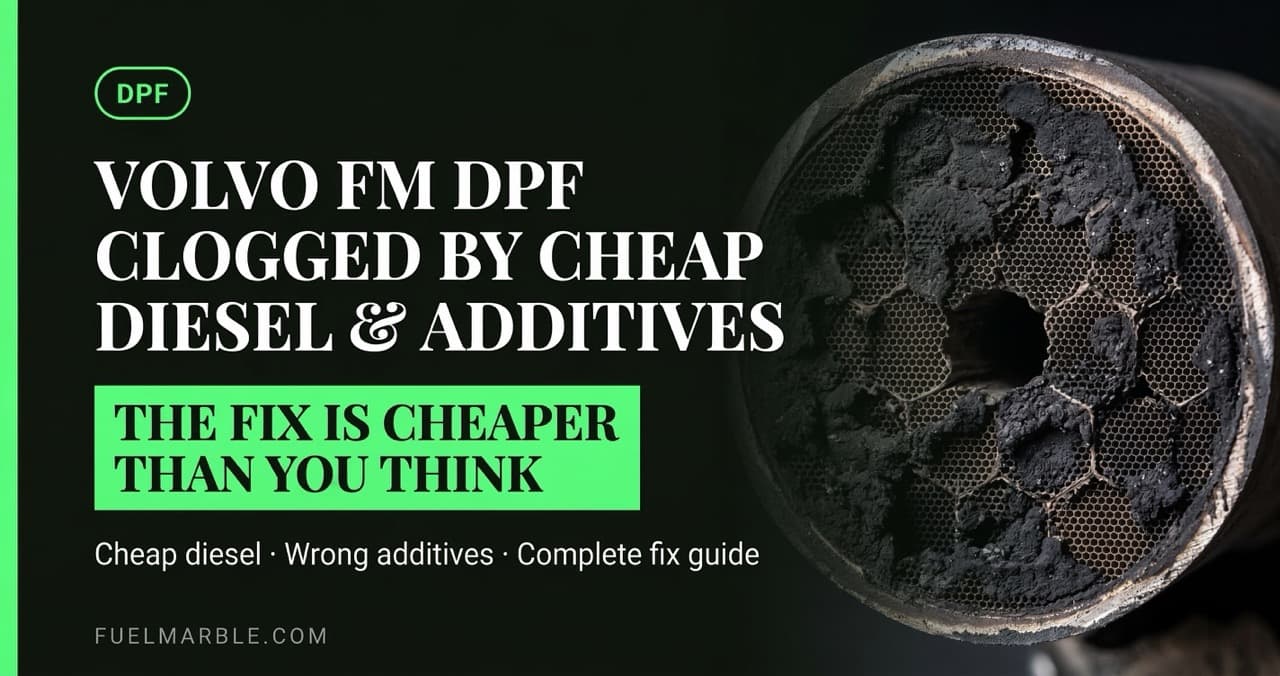
Volvo FM DPF Clogged After Using Cheap Diesel and Fuel Additives — Complete Fix Guide
Page Summary
This guide covers why budget diesel and incorrect fuel additives block Volvo FM diesel particulate filters, how to identify and fix the damage, and how to calculate the true total cost of the cheap diesel path for UK fleet operators.
| Section | What You'll Learn |
|---|---|
| Why Cheap Diesel Clogs | Cetane ratings, soot production chemistry |
| Hidden Costs | Premium vs. budget diesel true cost analysis |
| Additives Guide | Cerium vs. iron, what to buy |
| Regen Strategy | Passive, active, and parked regeneration |
| Red Diesel | HMRC enforcement and penalties |
| TCO Analysis | Real annual cost comparison |
Introduction
The Volvo FM D13 engine is one of the most capable diesel platforms in European haulage. This article is part of the heavy duty truck emission system maintenance guide, covering the specific case of Volvo FM DPF failure after cheap diesel and additive use. But its Euro 6 aftertreatment system — including the diesel particulate filter — operates within a narrow chemical tolerance. Budget diesel breaks this tolerance daily.
UK fleet operators running cheap supermarket diesel or agricultural-grade fuel face DPF replacement costs of £2,500–£4,000 per filter. With fuel expenses accounting for 30–40% of haulage operating budgets, the pressure to find cheaper sources is understandable. The problem is that the cost-per-litre saving is dwarfed by the downstream damage — particularly when incorrect fuel additives accelerate the chemistry of DPF substrate destruction.

Why Cheap Diesel Clogs DPFs
Budget diesel contains lower cetane ratings (48–50 vs. the legal minimum of 51 for Euro 6 compliance), higher aromatic hydrocarbons, and residual sulfur or metallic contaminants. In the Volvo D13 combustion chamber, these characteristics cause:
- Delayed ignition timing — the fuel doesn't combust at the optimal crank angle
- Incomplete combustion — unburnt carbon escapes the cylinder as black soot particles
- Dense black carbon deposits — mixed with crystallised ash, these resist standard regeneration cycles
Cheap diesel produces 30–40% more particulate matter per litre than premium fuel. Over 50,000 miles annually, this creates an extra 2.8 kg of soot accumulation — enough to block a DPF in under 18 months of normal operation.
- •Cetane: 55+ for rapid ignition
- •Additives: Detergent additives clean injectors
- •Lubricity: Enhancers protect fuel pumps
- •Soot Output: Combustion improvers reduce soot by 20–35%
- •Cetane: 51 (Legal Minimum)
- •Additives: Zero or minimal additive package
- •Aromatics: High aromatic content (up to 35%)
- •Soot Output: Produces 30–40% more PM per litre
The Hidden Cost of Cheap Diesel
Premium diesel from Shell, BP, and equivalent suppliers includes detergent additive packages and combustion improvers not present in budget fuels. These additives reduce soot production by 20–35% and keep injector tips clean, maintaining fuel spray patterns within the 5–10 degree tolerance required for efficient combustion.
The cost difference between premium and budget diesel is approximately £465 per year on a typical 50,000-mile Volvo FM — but this saving evaporates when compared against the maintenance consequences.

A "DPF Fridays" motorway protocol — one 30-minute sustained motorway run per week at 70+ km/h — reduces forced regeneration frequency by 60% and dramatically extends filter life without any hardware changes.
Diesel Fuel Additives: Solution or Snake Oil?
Not all diesel additives are created equal. Three categories exist, with fundamentally different purposes:
Improves ignition quality and combustion efficiency. Reduces future soot formation by 15–25% but will not clear an existing DPF blockage.
Cerium or iron-based compounds that lower soot burn-off temperature from 600°C to 450°C. The only category capable of assisting with active blockages.
Detergents designed to clean injectors and prevent carbon buildup. Critical for long-term engine health, but irrelevant during a DPF emergency.
The critical distinction is between preventive and curative additives. Cetane boosters prevent future soot formation but cannot clear an existing blockage. DPF regeneration catalysts address active blockages — but only if the correct chemistry is chosen.
Cerium-based (CeO₂) fuel-borne catalysts are safe. Iron-based catalysts are not. The difference: cerium caps combustion at 550–650°C; iron can push temperatures to 1,200°C, melting the cordierite ceramic DPF substrate permanently.
The chemistry behind why cheap diesel additive use causes this specific failure mode is documented in detail in how cheap diesel additives destroy commercial DPFs.

How to Choose the Right DPF Cleaner for Volvo FM
The Volvo FM D13 and D11 engines require additives meeting specific criteria:
Must contain Cerium or Iron compounds to lower soot ignition temperature to ~450°C.
Verified non-damaging to SCR catalysts, oxygen sensors, and AdBlue dosing systems.
Specifically formulated for high-displacement HD engines (11L–13L displacement).
Additives containing sodium, calcium, or zinc compounds must be avoided — these metallic residues produce ash that packs permanently into DPF channels and accelerates filter saturation beyond what cleaning can recover.
Proper DPF Regeneration Strategy for UK Volvo FM Operators
A healthy regeneration cycle requires sustained exhaust temperatures above 350–450°C for passive regeneration, or 550–650°C for ECU-triggered active regeneration. Cheap diesel compromises both thresholds by producing cooler, less efficient combustion.
The Volvo FM differential pressure sensor monitors soot loading. When backpressure exceeds 70–85 mbar, active regeneration triggers automatically. When it reaches 300 mbar, the ECU initiates limp mode — limiting power to protect the turbocharger from exhaust restriction damage.
Weekly motorway protocol: A 30-minute sustained run at 70–100 km/h generates sufficient exhaust temperature for complete passive regeneration, clearing accumulated soot without active intervention.
The Red Diesel Temptation: Legal Consequences for UK Operators
From April 2022, red diesel became illegal for use in road vehicles in the UK. Despite this, HMRC roadside checks catch operators attempting to blend or substitute red diesel into commercial vehicle tanks.
HMRC uses the Accutrace S153 chemical marker — a compound that cannot be removed by filtering, dilution, or tank additives. The consequences of detection are severe:
- Immediate fixed penalty fine up to £250 per vehicle
- Back-duty charges at 52.95p per litre over up to 4 years
- Vehicle seizure pending payment
- Criminal prosecution for serious cases — up to 2 years imprisonment
A Birmingham fleet received a £47,000 back-duty assessment after 3 vehicles were found to contain red diesel traces during a single roadside check.
Balancing Fuel Cost vs. Maintenance Expense: The Real ROI
- Fuel Cost (50k mi):£10,937
- DPF Cycle (100k mi):£2,800
- Regen Downtime:£640
- Fuel Cost (50k mi):£11,562
- DPF (Annualised):£1,120
- Regen Downtime:£160
The annual total cost comparison makes the economics clear. The "cheap diesel" path costs significantly more once DPF replacements, downtime, and increased fuel consumption are factored in. The premium diesel + maintenance protocol represents the rational economic choice — not the luxury option.

For the full verified test data confirming what combustion improvement looks like on a real-world fleet engine — evidence worth reviewing before any hardware purchase.
Recommendations
- •Switch to Premium Fuel
- •60-min Highway Regen Run
- •Source Euro 6 Additive
- •Maintenance Protocol
- •Driver Regen Training
- •Deploy OBD Monitoring
- •Audit Fuel Suppliers
- •TCO Profitability Audit
- •FuelMarble Optimisation
The three-phase action plan covers immediate switching to compliant fuel, implementing weekly regeneration protocols, and establishing long-term maintenance schedules that protect filter investment.
The only upstream fix for DPF clogging is reducing soot output at combustion source. FuelMarble L installed in the Volvo FM coolant reservoir improves combustion completeness, reduces particulate output, and lowers DPF loading — no engine modification, no fuel system changes.
Related reading:
- The Chemistry: How Cheap Diesel Additives Destroy Commercial DPFs
- Top 5 Symptoms of a Clogged DPF in Volvo FM Trucks
- How to Force a Manual DPF Regen on a Volvo FM
- Why Your Volvo FM Manual DPF Regen Keeps Failing on the Highway
- The Ultimate Guide to Heavy-Duty Truck Maintenance & Emission Systems
- How to Improve Fleet Management Company Profitability
Related Articles
Elias translates complex engine science into clear, accurate content. Specialising in diesel combustion, DPF systems, and Japanese engineering methodology, he produces FuelMarble's technical documentation, performance analyses, and in-depth product guides.
Ready to Improve Your Fuel Efficiency?
FuelMarble delivers up to 15% fuel efficiency improvement. Simple drop-in install.