Why Your Volvo FM Manual DPF Regen Keeps Failing on the Highway
Page Summary
This guide explains why Volvo FM DPF regeneration repeatedly fails on UK motorways — covering the core technical causes, hardware fault diagnosis, roadside triage steps, and long-term prevention strategies.
| Section | What You'll Learn |
|---|---|
| Regen Logic | Passive vs. active vs. parked — what runs when |
| Four Causes | Low EGT, 7th injector, stop-start, thermostat |
| Hardware Faults | DPS drift, EGR carbon, NOx sensor contamination |
| Software | ECU calibration updates and SAPS oil impact |
| Triage | Lamp behaviour → fault codes → drivability → parked regen |
| UK Factors | B10 diesel, MOT opacity test, climate impact |
| Prevention | Driving habits, cleaning intervals, ECU checks |
Introduction
This is one of four Volvo FM DPF guides — for the full DPF system overview, see the Euro VI emission system maintenance guide.
Your Volvo FM's manual DPF regen fails on the highway because manual regeneration — parked regeneration — cannot be initiated while the vehicle is moving. If your Volvo FM DPF regen keeps failing on the highway, you are looking at one of several root causes covered in the heavy duty truck emission system maintenance guide. This is a deliberate safety design. What should occur at speed is passive or active regeneration; when these fail repeatedly, the ECU escalates to a parked regen request.
The confusion stems from older Euro 5 systems where some manufacturers allowed driver-initiated active regens at speed. Volvo Euro 6 does not. If the truck is moving, the system relies exclusively on passive or auto-triggered active modes.
Getting the cause right matters: a £4,200 DPF replacement quote can become a £180 sensor cleaning if the real fault is a differential pressure sensor blocked with carbon particulate — or a fuel chemistry issue quietly preventing regen from completing.
Understanding DPF Regeneration Logic
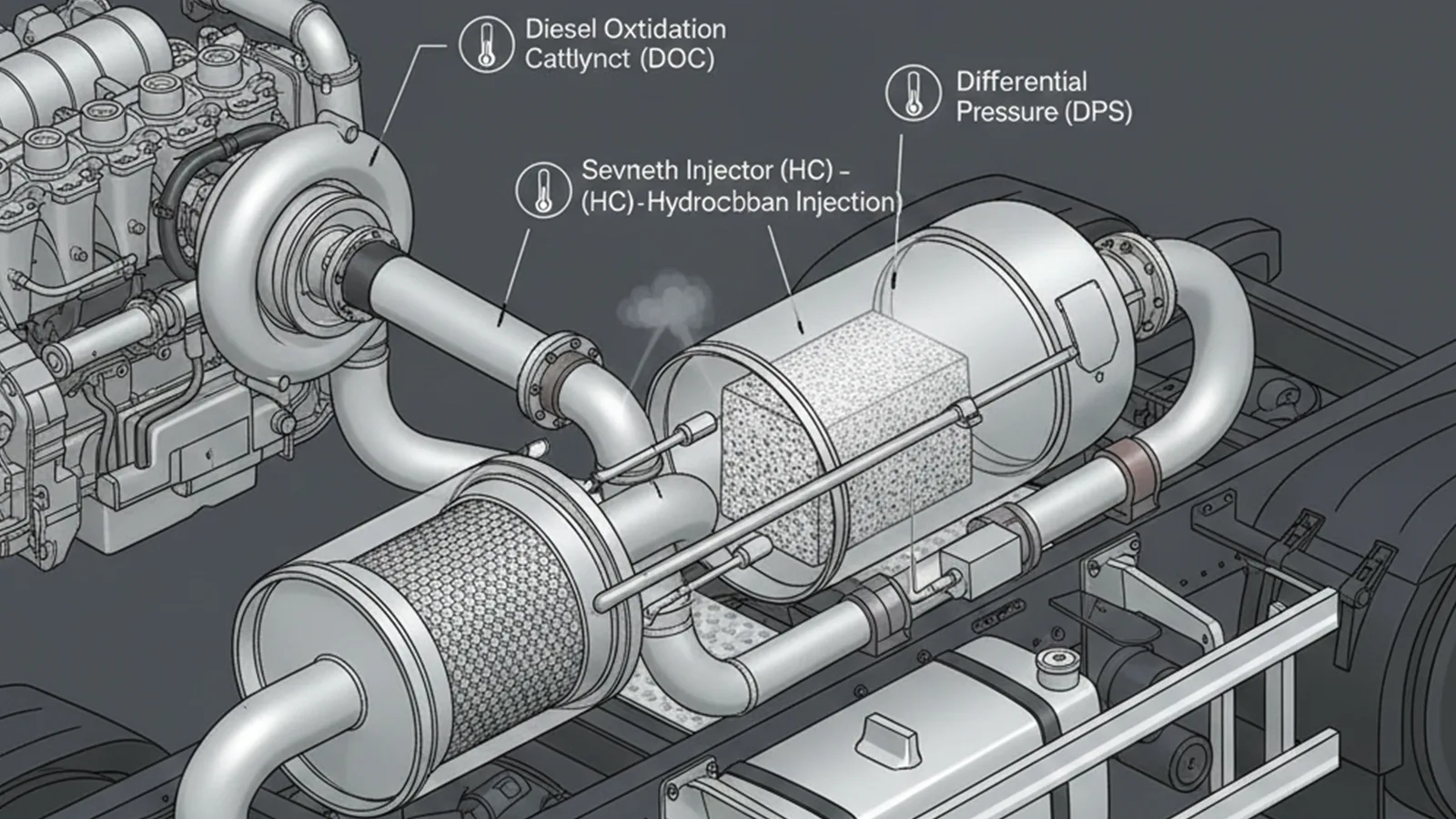
Volvo FM DPF systems use three regeneration types:
- Passive regen — Occurs automatically during sustained highway driving above 250°C EGT. Soot particles oxidise continuously with no driver input or fuel penalty.
- Active regen — ECU-triggered when passive conditions are not met. The 7th injector sprays diesel into the exhaust to spike EGT to 600–650°C.
- Parked regen — Manual, stationary process requiring parking brake engagement, neutral gear, and idle RPM. The only mode where the dashboard "Initiate Regen" button takes effect.
The "Initiate Regen" button only functions when completely stationary with the parking brake engaged. At any road speed, the ECU ignores the request. Highway regen relies entirely on passive or automatically triggered active modes.
Why Highway Driving Fails to Trigger Successful Regeneration
Running empty or on flat terrain keeps exhaust gas temperature at 200–300°C — far below the 550°C+ needed for soot oxidation. The ECU aborts passive regen automatically.
Carbon buildup from cheap diesel or biodiesel blends clogs the hydrocarbon injection nozzle. Without it, active regen cannot raise EGT to 600–650°C.
The M25, M6, and M62 congestion zones interrupt the 15–30 minutes of continuous high EGT required. After 3–4 failed cycles, the ECU escalates to a parked regen request.
A failing thermostat prevents the D13 from reaching its 85–95°C operating window. Cold engines mean cold exhaust — dropping EGT by 50–80°C and blocking passive regen entirely.
Highway driving fails to regenerate the DPF when exhaust gas temperatures remain below 550°C due to light loads, faulty 7th injectors, congested motorway interruptions, or thermostat failures.
1. Insufficient EGT Despite Speed
A Volvo FM running empty or cruising flat terrain with minimal throttle input produces EGT of only 200–300°C — well below the 550°C+ required. The ECU monitors pre- and post-DPF temperature sensors. If the 550°C threshold is not sustained for 15–20 continuous minutes, passive regen aborts.
2. 7th Injector Failure
When functioning, the hydrocarbon injection system raises EGT to 600–650°C. Carbon buildup from cheap diesel clogs the nozzle; a faulty solenoid prevents actuation entirely. Diagnostic check: during an active regen attempt, exhaust temperatures should spike 100–150°C above baseline within 2–3 minutes. If they don't, suspect the 7th injector.
3. M25 / M6 Stop-Start Interruptions
Variable-speed zones and congestion cause EGT to plummet every time speed drops below 40mph. The ECU counts these interruptions. After 3–4 failed regen attempts, it escalates to a parked regen request.
4. Thermostat Stuck Open
A failing thermostat prevents the D13 from reaching its 85–95°C operating window. Cold engines mean cold exhaust. In UK winter conditions (2–8°C ambient), a stuck-open thermostat can drop EGT by 50–80°C, making passive regen nearly impossible.
A coolant-system approach that improves combustion temperatures and reduces soot output addresses the regen frequency problem at the source.
Before troubleshooting regen failure, confirm you have identified the correct symptom set using the top 5 symptoms of a clogged DPF in Volvo FM trucks.

Common Hardware Faults: Sensors and Valves
Differential Pressure Sensor (DPS) Drift
The DPS measures backpressure across the DPF (clean: 2–5 kPa; clogged: 15–25+ kPa). After 150,000+ miles, the sensor or its sample lines can drift or block with carbon particulate. A blocked DPS can report false clean readings — the ECU never triggers regen and soot builds to critical levels. Or it reports false clogged readings, triggering unnecessary regens every 80 miles.
One UK case: a Volvo FM at a Slough depot was triggering regen requests every 80 miles despite correct maintenance and premium diesel. VCADS showed 22 kPa at idle with a visually clean DPF. The sample lines were completely blocked. Sensor replacement and line cleaning cost £180. The same depot had been quoted £4,200 for a new DPF by a main dealer.
EGR Valve Carbon Buildup
A stuck-open EGR valve recirculates excessive exhaust gas into the intake, lowering combustion temperatures and increasing soot production. This creates a vicious cycle: more soot → more regen attempts → more heat stress on the turbo and DPF.
NOx Sensor Contamination
Contaminated upstream/downstream NOx sensors send faulty readings from ash (low-quality AdBlue) or oil ingress. The ECU may limit active regen cycles to protect the aftertreatment system, leaving the DPF clogged with no way to clear it on the road.
Before replacing the DPF, inspect the differential pressure sensor sample lines for carbon blockage. A £180 sensor replacement has resolved what appeared to be a £4,200 DPF failure on multiple UK fleets.
Software and Maintenance Factors
ECU Calibration Updates
Volvo released multiple software patches between 2018–2024 addressing regen timing bugs in Euro 6 D13 engines. A 2021 update extended the passive regen window from 10 to 15 minutes, allowing completion before congestion interruptions. Trucks running pre-2021 calibrations frequently show premature regen aborts.
Check software version via VCADS: Navigate to Vehicle Info → ECU Version. Authorized dealers can flash updates in 30–45 minutes.
Low-SAPS Oil: The Silent DPF Killer
SAPS (Sulfated Ash, Phosphorus, Sulfur) in engine oil contributes non-combustible ash that accumulates permanently — regeneration cannot remove it. Using conventional 15W-40 instead of ACEA E9 / VDS-4.5 can deposit 200–400g of irreversible blockage over 100,000 miles, equivalent to forcing a DPF cleaning interval from 640,000 km down to 160,000 km.
Critical chemical limits for VDS-4.5: ≤1.0% sulfated ash, ≤0.12% phosphorus, ≤0.4% sulfur.

Diagnostic Guide: Roadside Triage
Soot load 80–90% full. Continue at motorway speeds (50mph+) to attempt passive regen. ~50–100 miles before escalation.
Soot load >90%. Parked regen required within 20–30 miles. Find a safe location (service station, layby).
Critical failure. Stop immediately. Engine may derate to 1,200 RPM max.
Continue to services and initiate a parked regen.
Call breakdown service. Forcing regen in limp mode can crack the DPF substrate.
- 1.Park on level ground, apply parking brake
- 2.Ensure ½ tank fuel minimum (process uses 1–2 litres)
- 3.Navigate to Vehicle Settings → Service Regen on dashboard
- 4.Confirm initiation — process takes 25–45 minutes
- 5.Do not interrupt — turning off ignition mid-regen causes thermal shock damage
When the amber DPF lamp illuminates, check fault codes (P2002, P242F, P2463), confirm whether the truck has entered limp mode, and assess whether you can safely reach services for a parked regen.
Solid amber = continue at motorway speeds. Flashing amber = find services within 20–30 miles. Red DPF + wrench = stop immediately. Never force a parked regen in limp mode — it can crack the DPF substrate.
UK-Specific Considerations
B10 Diesel and FAME Content
Since 2022, UK forecourts shifted to B10 diesel (10% biodiesel). FAME (Fatty Acid Methyl Esters) has lower calorific value and higher moisture retention than mineral diesel, producing:
- 5–8% reduction in EGT at equivalent load
- Increased 7th injector coking
- Accelerated microbial contamination ("diesel bug") in fuel tanks
Source fuel from major operators (Shell, BP, Esso) with better FAME quality control for commercial applications.
MOT Smoke Opacity Test
Since May 2018, UK MOT includes a diesel smoke opacity test. A partially blocked DPF can cause an instant failure at 1.5 m⁻¹. Many operators only discover DPF issues at annual test — by which point damage may be irreversible.
Climate Impact
British weather (8–15°C average, high humidity) suppresses EGT compared to continental Europe. A Volvo FM operating in Scotland may struggle to reach 550°C EGT even on the A9. UK fleets see 20–30% more DPF-related breakdowns than warmer EU regions — making proactive maintenance non-negotiable.

Prevention: Extending Volvo FM DPF Lifespan
Compressed air purge, chemical rinse, 4-hour bake cycle. Cost: £400–£800. Required earlier (160,000–240,000 km) on severe-duty urban cycles.
Check hydrocarbon injection nozzle for carbon fouling. Inspect differential pressure sensor sample lines for particulate blockage. Replacement sensor: ~£180.
Confirm ACEA E9 / VDS-4.5. Max 1.0% sulfated ash, 0.12% phosphorus, 0.4% sulfur. Non-compliant oils deposit 200–400g of irreversible ash over 100,000 miles.
Verify regen algorithm version via VCADS (Vehicle Info → ECU Version). Volvo issued updates 2018–2024 extending passive regen window from 10 to 15 minutes.
Driving Habits
A loaded Volvo FM cruising at 55–60mph under moderate load generates sufficient EGT for passive regen continuously. Operators should:
- Schedule a weekly 60+ minute motorway run at 55–60mph under load
- Avoid ignoring early amber warnings — each ignored lamp adds 10–20% soot
- Prevent short urban trips without a weekly motorway clear-out
Volvo extended the DPF ash cleaning interval to 400,000 miles (~640,000 km) for long-haul D11/D13 applications with correct VDS-4.5 oil and EN 590 fuel. Professional ash cleaning costs £400–£800 and should not be needed before 240,000 km on well-maintained trucks.
Addressing Root Cause
Constant regen cycles indicate incomplete combustion generating excess soot before it reaches the DPF. FuelMarble's thermal stabilization system, by optimising coolant temperature consistency, creates more stable combustion conditions — independent testing shows potential reductions in unburnt hydrocarbons of up to 95% and CO of up to 100%. Cleaner combustion reduces DPF loading and extends passive regeneration intervals.
The only upstream fix for DPF clogging is reducing soot output at combustion source. FuelMarble L installed in the Volvo FM coolant reservoir improves combustion completeness, reduces particulate output, and lowers DPF loading — no engine modification, no fuel system changes.
Related reading:
- How to Force a Manual DPF Regen on a Volvo FM
- Volvo FM DPF Clogged After Using Cheap Diesel and Fuel Additives
- Top 5 Symptoms of a Clogged DPF in Volvo FM Trucks
- The Ultimate Guide to Heavy-Duty Truck Maintenance & Emission Systems
- How to Improve Fleet Management Company Profitability
Related Articles
Elias translates complex engine science into clear, accurate content. Specialising in diesel combustion, DPF systems, and Japanese engineering methodology, he produces FuelMarble's technical documentation, performance analyses, and in-depth product guides.
Ready to Improve Your Fuel Efficiency?
FuelMarble delivers up to 15% fuel efficiency improvement. Simple drop-in install.