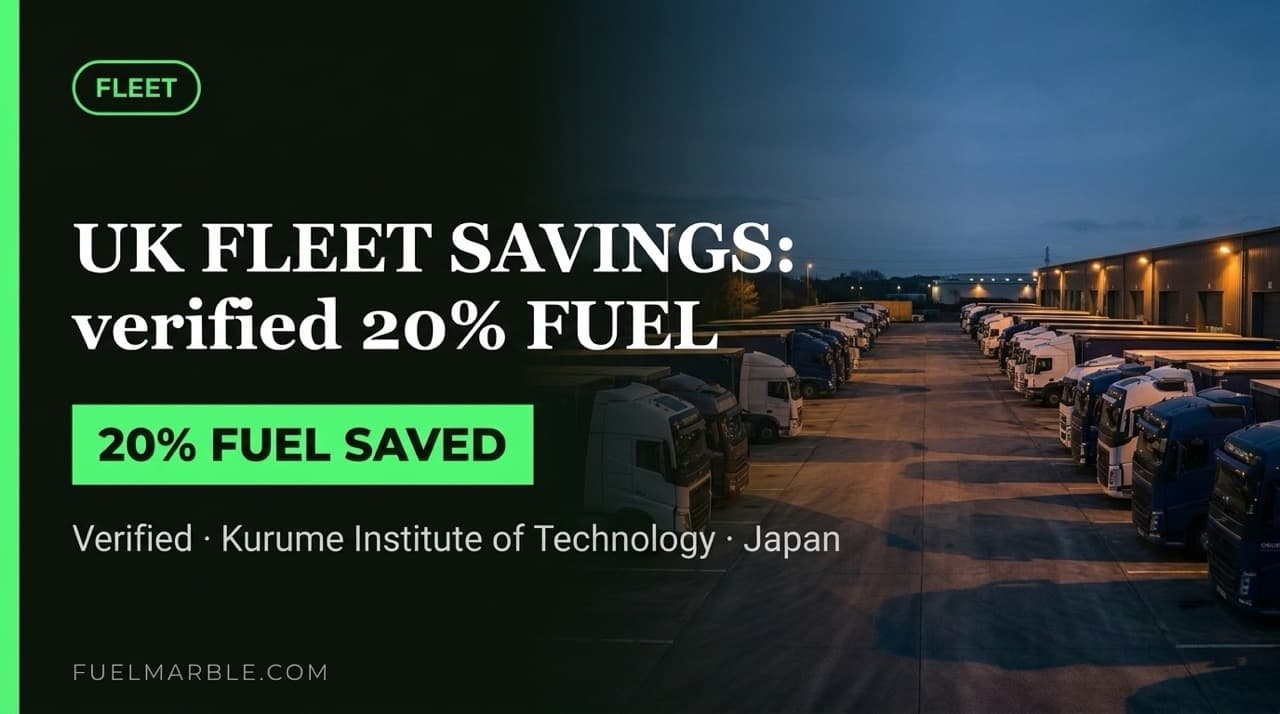
Diesel Price Spike Mid-Contract: What Fleet Managers Can Do Now
When diesel prices spike after your annual fuel contract is already locked, you have one real question: which levers can you actually pull without renegotiating supplier terms, cutting routes, or reducing driver hours? The answer is a tiered action plan ordered by speed of implementation and return — and it sits inside a broader framework for managing fleet fuel efficiency long-term. The purchasing side of your fuel spend is largely fixed in the short term. The consumption side is not. This plan starts there.
Why Does a Diesel Price Spike Hurt More Than the Percentage Suggests?
Diesel Spike Multiplier Calculator
See how fleet inefficiency amplifies the true cost of a diesel price spike.
- A typical HGV past 50,000 miles runs 3–7% above optimal combustion efficiency due to gradual cooling system degradation, injector carbon build-up, and reduced charge air density
- A fleet of 50 vehicles each burning 5% excess fuel at £1.70/litre over 100,000 miles annually wastes approximately £42,500 per year before any price spike occurs
- When diesel rises 10%, that same waste now costs £46,750 — the spike amplified the pre-existing inefficiency, not just the base cost
- The inefficiency degrades slowly and invisibly across the fleet; it only becomes a budget emergency when an external price event hits
This applies when your fleet has vehicles past 40,000–50,000 miles operating in normal mixed-cycle conditions — it does NOT apply if your fleet was recently refreshed with vehicles under 20,000 miles and has verified consumption baselines on record.
In my experience sitting in a budget review where the fuel line came in 18% over forecast — not 10%, not the price spike alone — the conversation changed the moment we separated the price variable from the consumption variable. The board had been treating the entire overage as a market problem. Half of it was. The other half was a fleet problem we had never measured.
Before You Run the Action Plan — Do You Know Where Your Fleet Actually Sits?
- Pull the last 90 days of fuel card data by vehicle, not by total fleet average
- Calculate litres per 100km (or MPG) per vehicle and sort lowest-to-highest efficiency
- Flag any vehicle running more than 8% below your fleet average — these are your highest-ROI intervention targets
- Cross-reference against route type: motorway-heavy routes will show better mpg than urban multi-drop; normalise before comparing
This applies when you have vehicle-level fuel card data available — it does NOT apply if your telematics system already produces per-vehicle efficiency reports, in which case use those directly.
The HGV Fleet Fuel Consumption Benchmarks for 2026 give you the UK and European industry averages you need to calibrate against — before you assume the price spike is the whole problem.
Action Tier 1 — What Can You Implement in the Next 72 Hours (Zero Cost)?
- Speed policy enforcement: Reducing average motorway speed from 56 mph to 52 mph reduces aerodynamic drag roughly by the cube of the speed reduction — fuel consumption at 52 mph is approximately 8% lower than at 56 mph for a loaded 44-tonne artic
- Idle reduction: An idling HGV burns 1.5–2.5 litres per hour. A fleet of 50 trucks idling 45 minutes per day collectively burns 56–94 litres daily — equivalent to £95–£160 at current UK pump prices, every single day
- Tyre pressure compliance: Under-inflated tyres at 10% below specification increase rolling resistance by approximately 1%, adding 0.5% to fuel consumption; across a fleet, this compounds across every tyre on every axle
- Load planning review: Partial loads on large vehicles are a significant efficiency drag — routing one unnecessary partially-loaded vehicle per day onto a more fuel-efficient asset is immediately recoverable
This applies when your fleet has active telematics capable of monitoring idle time and speed profiles — it does NOT apply if your vehicles lack real-time monitoring, in which case you will need a manual check-in process before these savings are measurable.
Concrete example: A 30-vehicle UK haulage fleet that reduced average fleet speed from 57 to 53 mph and implemented a 5-minute idle-stop policy across all vehicles recovered £28,000 in fuel spend over 12 weeks — without a single route change.
72-Hour Zero-Cost Fleet Action Checklist
Tick off each action as you complete it. No budget required.
Action Tier 2 — What Can You Implement in the Next 30 Days (Low-Cost Hardware)?

- How the technology works: FuelMarble is a precision-engineered mineral device placed inside the coolant reservoir. It works by reducing the surface tension of engine coolant, improving heat transfer through the combustion chamber walls, and increasing the density of air entering the cylinder — producing a more complete fuel burn without any engine modifications
- Fleet deployment: The FuelMarble L unit is sized for heavy-duty diesel fleets — 1 unit for up to 2-tonne vehicles, 2 units for 4–13-tonne vehicles, 3 units for over-13-tonne haulage. Installation takes under 60 seconds: place the unit inside the coolant reservoir, and it begins working within 150–200km (about 95–125 miles) of circulation — heavier units can take longer — for example around 300km (185 miles) — which varies with the coolant system
- Real-world marine validation: On the bulk carrier TRES FELICES (55,810 tonnes, North America–Japan route, grain cargo), FuelMarble's marine-application device cut total fuel consumption by 7.33% year-on-year and 8.31% against the preceding two-month baseline, under controlled wind condition comparisons
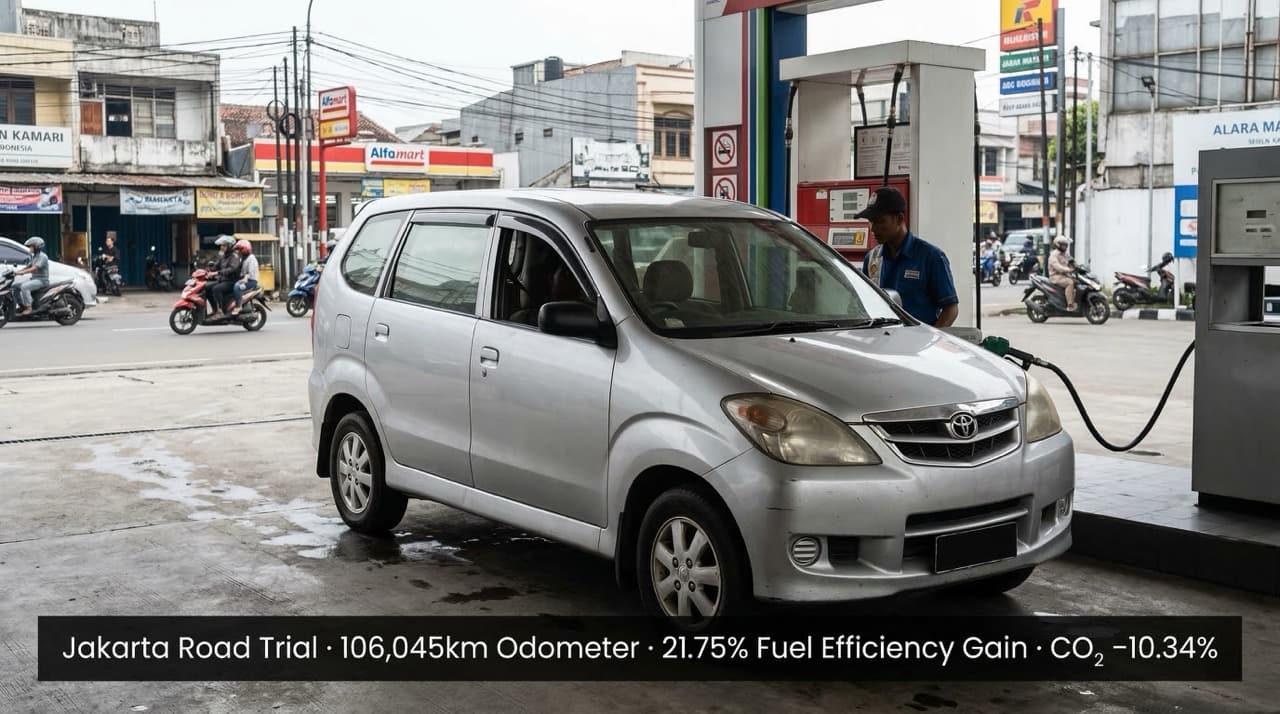
- Road vehicle validation: A Jakarta driving trial on a Honda Freed MPV (1500cc, 106,045km odometer), independently audited by licensed engineer Ir. Steve Rion, recorded a 21.75% fuel efficiency improvement over a 12-week test period, with CO₂ emissions down 10.34%
FuelMarble — Verified Real-World Results
Independent tests across road vehicles, fleets, and commercial vessels.
| Vehicle / Asset | Application | Location | Fuel Gain | Auditor |
|---|---|---|---|---|
| TRES FELICES Bulk Carrier 55,810T · Grain cargo | Marine · Heavy fuel oil | North America–Japan | 7.33–8.31% | Wind-condition controlled · 2024–25 |
| Honda Freed MPV 1500cc · 106,045km | Road vehicle · 12-week trial | Jakarta, Indonesia | 21.75% · CO₂ –10.34% | Ir. Steve Rion · Licensed Engineer |
| Honda Accord Fleet 2000cc · 2007 model | Road vehicle · Fleet test | Qinhuangdao, China | 18% | Shiao Moto / Qinhuangdao Ecological Environment Bureau |
| Mercedes-Benz C-Class 3500cc | Road vehicle | Japan | 28–30% | TRIAS 71-2001 |
| Volkswagen Golf | Road vehicle | Japan | 17.6% | TRIAS 71-2001 |
This applies to water-cooled internal combustion diesel engines — HGVs, LGVs, and fleet vehicles with a standard coolant reservoir. It does NOT apply to air-cooled engines or vehicles with sealed, non-serviceable cooling circuits.
The TRES FELICES data is the most credible proof point available for fleet managers sceptical of laboratory claims. A 55,810-tonne bulk carrier on a commercial transoceanic route is not a test cell — it is a real operating asset, under variable wind force conditions, with full cargo loads, achieving a 7–8% consumption reduction. If FuelMarble works under those conditions, it works on a diesel artic running the M6.
Are Rising Diesel Prices a Temporary Spike or a Structural Trend You Need to Plan Around?
- UK diesel pump prices averaged 153.9p/litre in 2023, compared to 114.7p/litre in 2019 — a 34% structural floor increase before any volatility premium
- European wholesale diesel is exposed to Brent crude correlation, refinery margin compression, and carbon pricing mechanisms under the EU ETS — all of which continue to apply structural upward pressure
- Fleet operators who treated the 2022 energy spike as a one-time event and returned to pre-spike fuel budgeting have already been caught twice more since
Read the full structural analysis in Haulage Costs Are Rising — it directly answers whether the lever you pull today needs to be a short-term tactic or a permanent fleet infrastructure change.
This applies when your fleet contract renewal is within the next 6–18 months and fuel cost exposure forms more than 28% of your operating cost base — it does NOT apply if you are already operating under a fixed-price fuel supply agreement with locked pricing through Q4.
Action Tier 3 — What Are the Structural Decisions for the Next Quarter?
- Route optimisation: Modern TMS platforms routinely find 4–8% distance reduction on multi-drop networks through algorithmic routing. On a 50-vehicle fleet running 500 miles/day per truck, a 5% route efficiency gain saves approximately 1,250 miles/day — at 8 mpg, that is 156 gallons, roughly £850 per day in diesel at UK pump prices
- Fleet composition review: If your current fleet profile skews toward larger vehicles for historical capacity planning reasons, but your actual load profile has shifted toward lighter, more frequent deliveries, you are paying a significant per-mile fuel penalty on excess capacity
- Vehicle replacement scheduling: Diesel HGVs lose approximately 1.5–3% fuel efficiency per 100,000 miles of engine wear under normal operating conditions. A vehicle at 400,000 miles is burning 6–12% more fuel per mile than the same vehicle at 100,000 miles
This applies when fleet average age exceeds 4 years or average mileage exceeds 250,000 per vehicle — it does NOT apply if fleet renewal has occurred within the last 24 months, in which case Tier 1 and Tier 2 actions will deliver faster ROI.
⚡ Why Diesel Price Spikes Keep Hurting the Same Fleets
The fix in this article works. Behavioural changes, combustion efficiency hardware, and route optimisation together can recover 10–20% of fuel spend without touching your supplier terms, routes, or headcount. Fleets that execute all three tiers consistently reduce their P&L exposure to diesel volatility in a measurable, reportable way.
But here is the number your board has not seen yet. Vehicles past 50,000 miles routinely run 3–7% above optimal combustion efficiency — not because of driver behaviour or routing, but because the engine's cooling system degrades gradually and the combustion cycle becomes progressively less complete. In stop-and-go urban traffic, engines spend 30–40% of operating hours in thermal compensation mode, with the ECU continuously over-fuelling as a defensive response to heat spikes. On a fleet of 50 vehicles each doing 100,000 miles annually at UK diesel prices, that inefficiency baseline costs £40,000–£85,000 per year before any price spike occurs.
That consumption baseline is exactly what FuelMarble targets at the root cause. FuelMarble is a precision-engineered mineral device — not a fuel additive, not a chemical — that sits inside your coolant reservoir and improves heat transfer through the combustion chamber walls, densifies incoming charge air, and produces a more complete fuel burn on every cycle. No engine modification. No maintenance. No refills. Drop it into the coolant reservoir in under 60 seconds, and it is working within 150–200km (about 95–125 miles) — heavier units may take longer, for example around 300km (185 miles), which varies with the coolant system. The FuelMarble L unit is engineered specifically for heavy-duty diesel applications. Those are the consumption numbers your fleet could be running — instead of the ones amplifying your next price spike.
Diesel Price Spike: Complete 3-Tier Fleet Action Plan
Ranked by speed of implementation — modelled on a 50-vehicle fleet running 100,000 miles/vehicle/year at UK diesel prices
- ›Enforce 52 mph motorway cap — saves ~8% vs 56 mph on loaded artic
- ›Implement 5-minute idle-stop policy across all vehicles
- ›Audit tyre pressures fleet-wide — each 10% underinflation = +0.5% fuel burn
- ›Review load planning — eliminate partially-loaded large vehicle runs
- ›Not a fuel additive — mineral device placed in the coolant reservoir in under 60 seconds
- ›Improves heat transfer → denser charge air → more complete burn per cycle
- ›FuelMarble L: 1 unit (≤2T) · 2 units (4–13T) · 3 units (13T+ haulage) · Active after 150–200km (≈95–125 mi; larger units e.g. ~300km, varies by coolant)
- ›TRES FELICES (55,810T bulk carrier, N. America–Japan): 7.33–8.31% fuel reduction
- ›Jakarta road trial (Honda Freed, 106,000km, audited): 21.75% gain · CO₂ –10.34%
- ›TMS route optimisation — typically 4–8% distance reduction on multi-drop networks
- ›Fleet composition audit — right-size vehicles to actual load profiles
- ›Replacement scheduling — HGVs lose 1.5–3% efficiency per 100,000 miles
FuelMarble is a precision-engineered mineral device — not a fuel additive or chemical. Results based on independent real-world trials. Individual outcomes vary by fleet profile, route type, and vehicle age.
Related Articles
Avery leads FuelMarble's international operations and strategic direction. With a background spanning fleet economics, regulatory compliance, and macro fuel market trends, Avery oversees commercial partnerships, product positioning, and the company's growth across the UK, US, Canadian, and Mexican markets.
Ready to Improve Your Fuel Efficiency?
FuelMarble delivers up to 15% fuel efficiency improvement. Simple drop-in install.