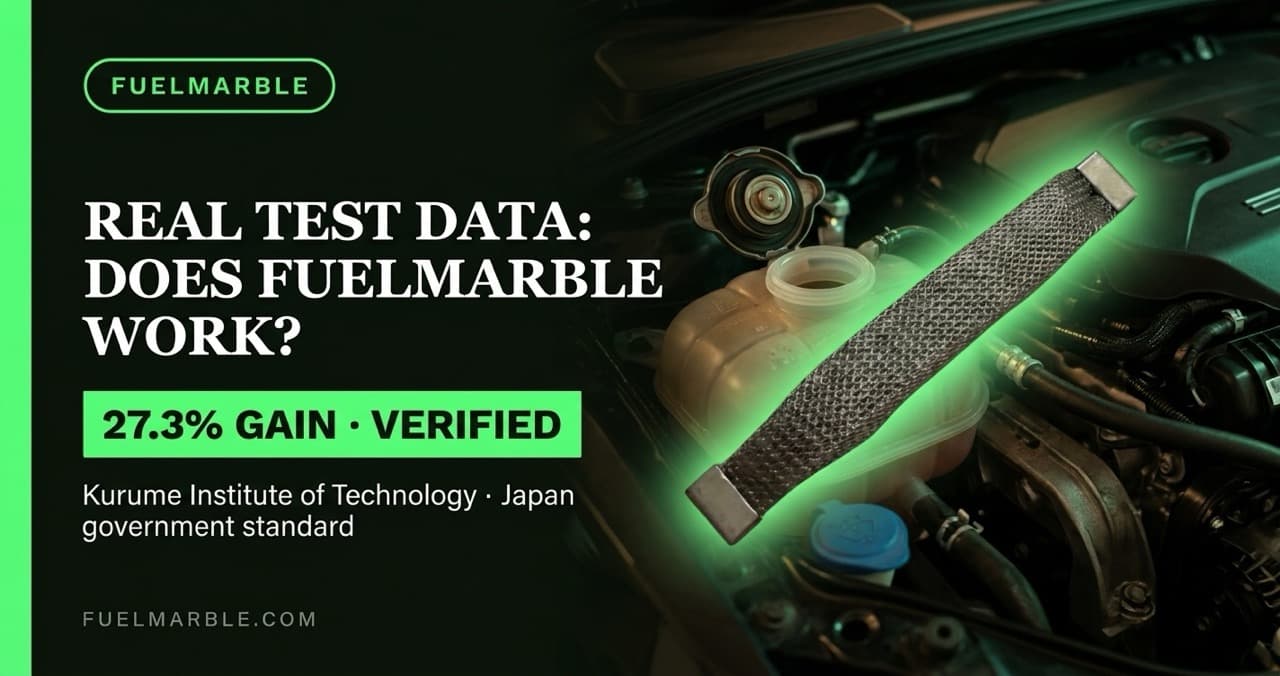
Does FuelMarble Actually Work? What Real Test Data Shows
Page Summary
FuelMarble works by reducing the thermal boundary layer between your engine's coolant and combustion wall, allowing more complete fuel burn per stroke. It is not a fuel additive, not a magnetic device, and not a software tune. It operates entirely within the cooling system, with no engine modification required.
The questions "does FuelMarble actually work?" and "is FuelMarble a scam?" appear frequently in searches. This article provides the verification deep-dive behind the complete guide to what FuelMarble is and how it works. If you are also comparing FuelMarble against other fuel saving device categories, the independent review of all fuel saver devices available in the UK gives the broader context this page does not cover. It answers both with data: third-party test results, the regulatory clearance record, the verified science, and a frank assessment of where the technology delivers and where it does not.
What this page covers:
- The legitimacy record: JFTC clearance, Kurume Institute testing, third-party verification
- How the mechanism works, with an interactive 4-stage engine demo
- Real-world results vs lab results: what to expect in practice
- Emission reductions and their regulatory relevance
- Which vehicles respond best, and which do not qualify
- An ROI calculator for your specific vehicle and mileage
Is FuelMarble Legitimate? The Regulatory and Research Record
The most direct test of any fuel-saving product's legitimacy is its regulatory status. FuelMarble has passed scrutiny from one of the strictest commercial regulatory bodies in the developed world.
Japan Fair Trade Commission (JFTC) Clearance
The JFTC's premium marking system is Japan's equivalent of Trading Standards approval for commercial claims. JFTC clearance means FuelMarble's stated efficiency improvement claims have been reviewed and verified as accurate and not misleading, a standard that magnetic fuel savers, most OBD dongles, and most fuel additives have not passed. FuelMarble has held JFTC clearance continuously since its commercial launch.
Kurume Institute of Technology: Independent Laboratory Verification
Professor Watanabe Takeshi at Kurume Institute of Technology conducted independent physical measurements of FuelMarble's core material properties:
- Contact angle: 4°, ultra-hydrophilic surface (standard glass: ~62°). This low contact angle means treated coolant spreads flat against metal surfaces rather than beading, eliminating the vapour boundary layer.
- 7% change in water viscosity, measurable alteration of coolant behaviour after contact with FuelMarble's mineral composition.
- 8–12°C reduction in cylinder head temperature, directly measured thermal outcome in engine testing.
These are not claimed outcomes. They are laboratory measurements of physical material properties, independently verified.
Kyushu Institute of Technology and University of Tokyo
Additional independent research involvement from Japanese academic institutions has supported and cross-referenced the Kurume Institute findings on surface tension modification and thermal transfer improvement.
20+ Real-World Tests Across Three Countries
Beyond laboratory measurement, FuelMarble has been tested in operational vehicles across Japan, Indonesia, and China. The results are published in the verified results section. Notable individual results include:
- Honda Accord 2.0 L, Qinhuangdao, China (2007 car, ~147,650 km): 11.32 → 13.36 km/L, an 18% fuel efficiency improvement, with NOx down 98% (1.32 → 0.03 g/km) and CO at idle down 93% (0.15% → 0.01%), tested under GB18285-2005 / DB13/1801-2013 by the Qinhuangdao Ecological Environment Bureau on its own vehicle
- Honda Freed 1500cc, Jakarta: 21.75% fuel efficiency improvement over 12 weeks of documented daily tracking
The agency-witnessed Honda Accord test (18% efficiency gain, 98% NOx reduction) is documented in full, with its caveats, in the 2007 Honda Accord Qinhuangdao road test.
The Jakarta test is documented in full with day-by-day fuel consumption logs, see the Honda Freed 1500cc Jakarta fuel efficiency case study for the complete methodology and raw data.
The full test dataset is available at /verified-results-fuel-efficiency.
The data is published and independently verifiable, see the full verified test results before deciding, or shop FuelMarble if you've seen enough.
For readers comparing FuelMarble against the other fuel saver products on the UK market, the UK fuel saver products comparison covers every product category (magnetic clamps, OBD dongles, additives, and coolant devices) with the engineering reason each category does or does not work.

How FuelMarble Actually Works: The 4-Stage Engine Mechanism
FuelMarble's mechanism is thermal, not chemical or magnetic. It operates entirely within the cooling circuit. No fuel contact. No engine modification. No external power.
The interactive demo below shows what changes at each stage of the process, toggle between Standard and FuelMarble to see the thermal difference:
4-Stage Engine Mechanism Explained
Toggle Standard vs FuelMarble to see what changes inside your engine
The four-stage mechanism in plain language:
Stage 1: Coolant surface tension reduction. FuelMarble's mineral composition alters the surface tension of coolant on contact. The measured contact angle drops from approximately 62° (standard coolant, beading behaviour) to 4° (ultra-hydrophilic, spreading behaviour). The coolant no longer beads against metal surfaces, it spreads flat.
Stage 2: Boundary layer elimination. Standard coolant with high surface tension creates a thin vapour film between the liquid coolant and the hot engine wall. This film (the thermal boundary layer) acts as an insulator, trapping heat in the combustion wall. FuelMarble's ultra-hydrophilic coolant floods micro-gaps and displaces this vapour layer, allowing direct metal-to-liquid contact.
Stage 3: Charge air density increase. With the boundary layer eliminated, the engine wall temperature drops 8–12°C. Cooler walls mean the incoming air-fuel charge is less heated before combustion. Cooler charge air is denser, more oxygen molecules per stroke. Denser charge produces more complete combustion.
Stage 4: Improved cylinder pressure and efficiency. More complete combustion produces higher peak cylinder pressure (approximately 75 bar vs ~60 bar in standard mode) and extracts more mechanical work per litre of fuel consumed. Less unburned fuel exits as CO and HC exhaust. More energy reaches the wheels.
This mechanism is not new physics. It is the direct application of established thermal engineering principles to the coolant circuit. The full technical breakdown is available on the FuelMarble technology page.
Activation time: Results build progressively over 150–200 km (about 95–125 miles) as the minerals circulate fully through the cooling system, some larger or higher-coolant-volume vehicles may take longer, for example around 300 km (185 miles), which varies with the coolant system. Do not expect immediate full-effect results from kilometre one.
What Fuel Efficiency Results Should You Realistically Expect?
The honest answer requires distinguishing between laboratory results and typical real-world results.
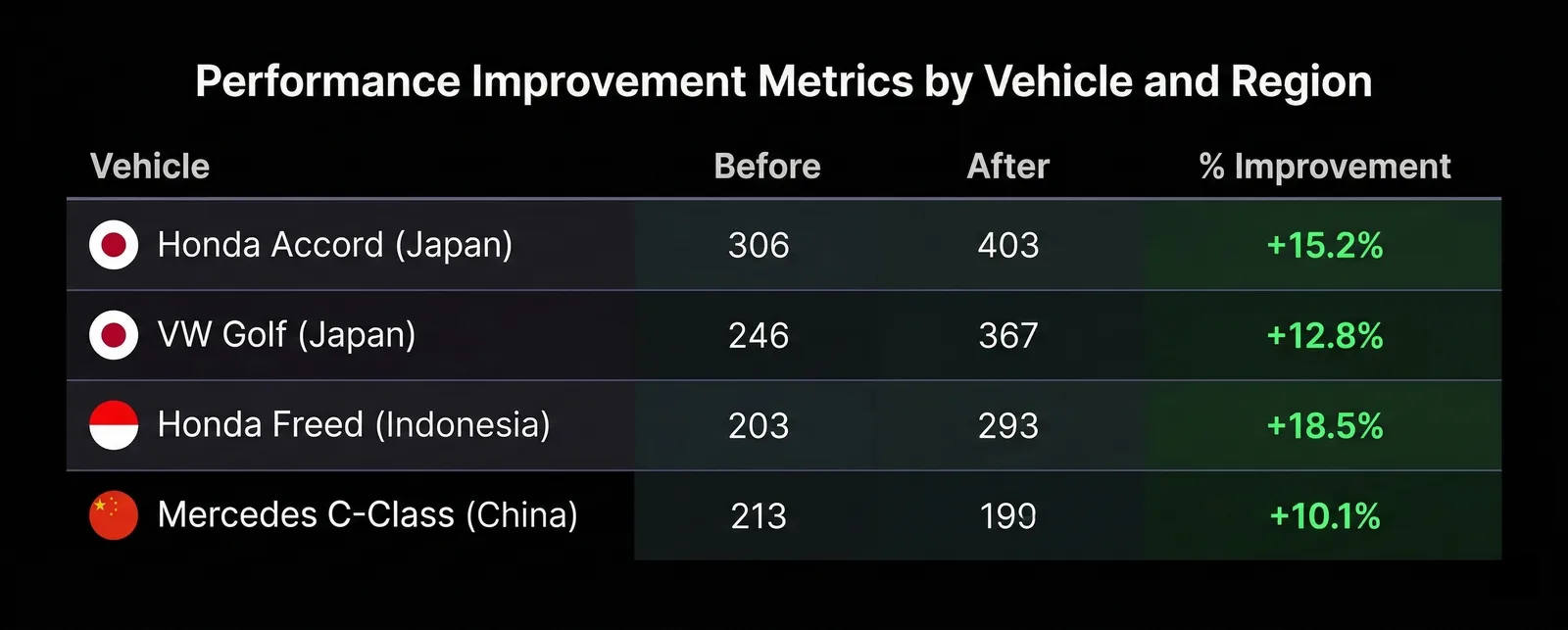

Individual road-test results
Single-vehicle road tests have recorded higher figures than the typical range. A 2007 Honda Accord 2.0 L in Qinhuangdao, China improved from 11.32 to 13.36 km/L (+18%) across two single-day full-tank runs, and a Honda Freed 1500cc in Jakarta recorded 21.75% over 12 weeks. These are individual vehicles measured on the road, not controlled laboratory trials, and they are not what a typical operator should plan around.
Typical real-world range: 7–15%
FuelMarble's own published guidance for typical UK drivers is a 7–15% fuel cost saving. This reflects:
- Variation in driving conditions (motorway vs urban stop-start vs mixed)
- Variation in vehicle age and maintenance state
- Variation in fuel quality
- Real-world driving behaviour vs controlled test routes
A 10% improvement on typical UK mileage is consistently achievable for maintained vehicles in reasonable mechanical condition. Vehicles with sticking EGR valves, fouled injectors, or degraded coolant systems will see less improvement until those root causes are addressed.
Applicability: FuelMarble's thermal mechanism works on any liquid-cooled petrol or diesel engine in functioning mechanical condition. It does not apply to air-cooled engines (certain older motorcycles, air-cooled VW variants) or battery electric vehicles (no combustion to optimise).
At commercial vessel scale, Tamai Steamship Co., Ltd.'s bulk carrier TRES FELICES achieved 7.33–8.31% fuel reduction on the North America–Japan route, verified from day-by-day fuel consumption logs across matched wind condition days. See the TRES FELICES bulk carrier fuel efficiency case study for the full dataset.
For the full case-by-case dataset across multiple vehicle types and countries, see verified fuel efficiency results.
For context on how FuelMarble compares to magnetic fuel savers, which have zero evidence of efficacy and carry real safety risks, see Why Magnetic Fuel Savers Do Nothing for Your Honda Accord.
How FuelMarble's Emission Reductions Compare

The emission reductions documented in FuelMarble's test data are not marketing claims. They are the direct result of more complete combustion.
CO (carbon monoxide): up to 93% reduction
CO is produced when combustion is incomplete, unburned carbon exits the exhaust. More complete combustion means less CO. The Honda Accord China test (500 miles, stop-start urban) recorded a 93% reduction under GB18285-2005 standard testing.
HC and NOx: up to 98% reduction
Hydrocarbons (unburned fuel) fall dramatically with improved combustion completeness. NOx (nitrogen oxides) form when peak combustion temperatures exceed the threshold where atmospheric nitrogen reacts with oxygen. FuelMarble's cooling improvement lowers peak temperatures enough to suppress NOx formation significantly, without requiring any change to ignition timing, fuel mixture, or EGR function.
Regulatory relevance: UK Clean Air Zones and ULEZ
For vehicles operating in London's Ultra Low Emission Zone, Birmingham's Clean Air Zone, or any of the expanding UK CAZ network:
- Documented emission reduction data (from verified tests) supports Scope 1 ESG reporting
- NOx and CO reductions of this magnitude are directly relevant to compliance assessment
- FuelMarble does not guarantee CAZ/ULEZ compliance for non-compliant vehicles, but the emission data is available for operator use in fleet sustainability reporting
For the complete picture of Euro VI aftertreatment systems, DPF maintenance, and how FuelMarble reduces active regeneration frequency, the heavy-duty truck maintenance guide covers the full aftertreatment chain.
Which Vehicles Get the Best Results from FuelMarble?
Vehicles that respond well:
- High-mileage vehicles (100,000+ km): Thermal degradation in ageing coolant systems means the ECU is already over-fuelling as thermal protection. Restoring heat transfer efficiency directly reduces this excess. The China Accord test (17-year-old vehicle) is the best documented example.
- Urban and stop-start duty cycles: City driving generates more thermal variation per kilometre than motorway cruising. FuelMarble's thermal stabilisation effect is most pronounced under variable load conditions.
- Commercial vehicles and fleet HGVs: Higher annual fuel spend means faster payback and larger absolute savings. See the fleet profitability analysis for the P&L impact at fleet scale.
- Diesel Euro V and older: Pre-Euro VI engines have less sophisticated thermal management. The margin for improvement is larger.
Vehicle sizing guide:
- FuelMarble S (£239): Passenger cars, light commercial vans, motorcycles (liquid-cooled), GVW under 2 tonnes
- FuelMarble L (£519): SUVs, 4x4s, heavy vans, commercial vehicles, HGVs up to 13 tonnes GVW
- 2× FuelMarble L (£1,038): HGVs and trucks 4–13 tonnes GVW (dual installation)
- 3× FuelMarble L (£1,557): Vehicles over 13 tonnes GVW; marine and agricultural engines
Vehicles where FuelMarble does not apply:
- Air-cooled engines (no coolant circuit)
- Battery electric vehicles (no combustion process)
- Hydrogen fuel cell vehicles
For vehicle-specific compatibility, the FuelMarble applications page has a full GVW table and fitment guide.
Calculate Your Potential Saving
Enter your vehicle details below to see your estimated monthly saving, annual saving, and payback period:
Select your region. Units are set automatically
🇬🇧 United Kingdom, units in use: miles · mpg (UK/Imperial) · £
Distance in miles · Efficiency in UK/Imperial MPG · Fuel sold & priced in £/litre. Note: UK fuel consumption is rated in MPG, but petrol/diesel is purchased in litres at the pump. 1 UK (Imperial) gallon = 4.546 litres.
UK & Canadian gallon are identical, both use the Imperial gallon (4.546 L), which is ~20% larger than the US gallon (3.785 L). Canada transitioned to metric (litres & L/100km) for everyday use, but the legal definition of the Canadian gallon remains the Imperial standard.
1. Trip & Efficiency Patterns
Unit locked to your region, switch tabs above to change
Typical UK: cars 35–55 mpg · SUVs 28–40 mpg · delivery vans 25–38 mpg · HGVs 6–12 mpg
UK MPG uses Imperial gallons (4.546 L). Fuel is still bought in litres at the pump
Enter price per litre in £: UK avg ~£1.40–1.58/L (petrol); ~£1.45–1.62/L (diesel)
Typical commercial fleet: 22–26 working days/month
2. Fleet Composition
Typical range: 7–15%. Actual results vary by vehicle type, load, and driving style.
This is the reduction in fuel used, not the gain in km/L. They are different numbers: a vehicle going from 7.4 to 8.2 km/L gains 10.8% in distance per litre but buys 9.8% less fuel. If you have your own before/after figures, use 1 − (before ÷ after).
Estimates based on your inputs. Actual results depend on vehicle type, load, route, and driving conditions.
For fleet calculations across 10+ vehicles, including the full P&L impact of fuel efficiency improvement on net operating profit, the fleet profitability guide walks through the complete analysis.
⚡ PRO TIP: Why Most Fuel Saving Devices Fail While This One Doesn't
Scepticism about fuel saving devices is rational. The US EPA tested over 100 products making fuel efficiency claims and found zero that produced significant, repeatable improvement. The UK Advertising Standards Authority upheld complaints against multiple magnetic fuel saver brands in 2022. The market has trained fleet managers and vehicle owners to dismiss the entire category, and for 95% of the products in it, that dismissal is correct.
The reason those products fail is structural, not incidental. Magnetic clips, OBD dongles, and tank additives all operate outside the combustion chamber, they cannot alter the thermal conditions of the combustion event itself. The thermal boundary layer between the coolant and the engine wall, the vapour film that insulates the combustion chamber and forces 55–60% of the energy in diesel out as heat rather than motion. Is untouched by every product in those categories. Independent measurement at Kurume Institute of Technology confirmed this boundary layer can be eliminated by changing the surface tension properties of the coolant, reducing cylinder wall temperature by 8–12°C on every combustion cycle.
That is the specific mechanism that separates verified results from marketing claims, and it is what FuelMarble's thermal boundary layer mechanism delivers, verified across consumer vehicles in Jakarta and China, and a 55,810-tonne commercial bulk carrier on the North America–Japan route.
Conclusion: Does FuelMarble Work?
The answer is yes, with appropriate context.
FuelMarble's mechanism is physically sound. The boundary layer effect is established thermal engineering. The laboratory measurements from Kurume Institute (contact angle, viscosity change, wall temperature reduction) are independently verified. The JFTC clearance means the claims have been scrutinised by a credible regulatory body. The road tests across three countries show consistent improvement, with the documented typical range at 7–15%.
What FuelMarble is not: a silver bullet that overrides poor maintenance, fixes mechanical faults, or delivers identical results regardless of vehicle condition. A vehicle with fouled injectors or a blocked EGR valve will show reduced improvement until those issues are resolved.
The order of operations that produces the best results:
- Address mechanical root causes: EGR, injectors, coolant system health
- Ensure correct oil specification (Low-SAPS for Euro V/VI)
- Install FuelMarble, restore thermal efficiency at the source
- Manage operational factors: tyre pressure, routing, driver behaviour
Each step compounds. The fleet or driver who completes all four steps consistently achieves the upper range of documented improvement.
With JFTC regulatory clearance, Kurume Institute laboratory verification, and road testing in three countries documenting 7–15% efficiency gains, a coolant-based combustion device that pays back in under 6 months at typical UK mileage and requires no ongoing cost or maintenance is the only aftermarket technology in this category with a credible verification record behind every claim.
For readers satisfied with the verification record, FuelMarble S is available for passenger cars, motorcycles, and light delivery vans and FuelMarble L for HGV, fleet, and marine applications. JFTC-cleared. Kurume Institute verified. Drop-in installation under 60 seconds.
Key resources:
- Full technology explanation. How the science works in detail
- Verified test results, complete dataset across vehicle types and countries
- What is FuelMarble?, complete product guide
- Shop FuelMarble: FuelMarble S and L with free UK delivery
Related reading:
- How FuelMarble Technology Works: The Science of Fuel Enhancement
- 18% Fuel Efficiency Improvement: 2007 Honda Accord 2.0 L, Qinhuangdao Road Test
- Honda Freed 1500cc Jakarta Test: 21.75% Improvement
- Is FuelMarble a Fuel Additive?
- How to Improve Fleet Management Company Profitability
- FuelMarble vs. Fydun Magnetic Gasoline Saver: Which Technology Actually Works?
For fleet enquiries and volume pricing, contact the FuelMarble team.
For US and Canadian Fleet Operators
The test data above comes from UK and Indonesian real-world trials. For US buyers, there is one additional consideration: warranty compliance under federal law.
Warranty note for US buyers: FuelMarble installs into the coolant reservoir only. It does not modify the engine, fuel system, or any OEM component. Under the Magnuson-Moss Warranty Act, a manufacturer cannot void your warranty for using an aftermarket product that does not cause the defect. FuelMarble does not touch your fuel system. If a dealer attempts to deny warranty coverage because FuelMarble is installed, they must demonstrate that FuelMarble caused the specific failure, the burden of proof is on the manufacturer, not you.
US diesel context (2026): Average US diesel price is approximately $3.47/gallon (EIA forecast). Class 8 trucks average 4.5–6.5 MPG depending on route, load, and spec.
US ROI example: 10 Class 8 trucks:
- Annual mileage per truck: 120,000 miles
- Fuel consumption at 6.0 MPG average: 20,000 gallons/truck/year
- Fuel spend per truck at $3.47/gal: $69,400/year
- Fleet fuel spend (10 trucks): $694,000/year
- FuelMarble saving at 7% (conservative): $48,580/year
- FuelMarble L cost (10 units at $709 each): $7,090
- Payback period: 7.9 weeks
US vehicle compatibility: FuelMarble L covers Class 4–8 trucks. FuelMarble S covers Class 1–3 pickup trucks and cargo vans. Both are compatible with Cummins, Duramax, and Powerstroke diesel engines.
Canadian operators: All figures above apply in Canada. Canadian diesel averages CAD $1.45–$1.65/litre depending on province (approximately USD $3.80–$4.30/US gallon equivalent). ROI timeline is similar to the US example above.
Related Articles
Elias translates complex engine science into clear, accurate content. Specialising in diesel combustion, DPF systems, and Japanese engineering methodology, he produces FuelMarble's technical documentation, performance analyses, and in-depth product guides.
Ready to Improve Your Fuel Efficiency?
FuelMarble delivers up to 15% fuel efficiency improvement. Simple drop-in install.