Does Tyre Pressure Affect Fuel Economy? UK Drivers Guide
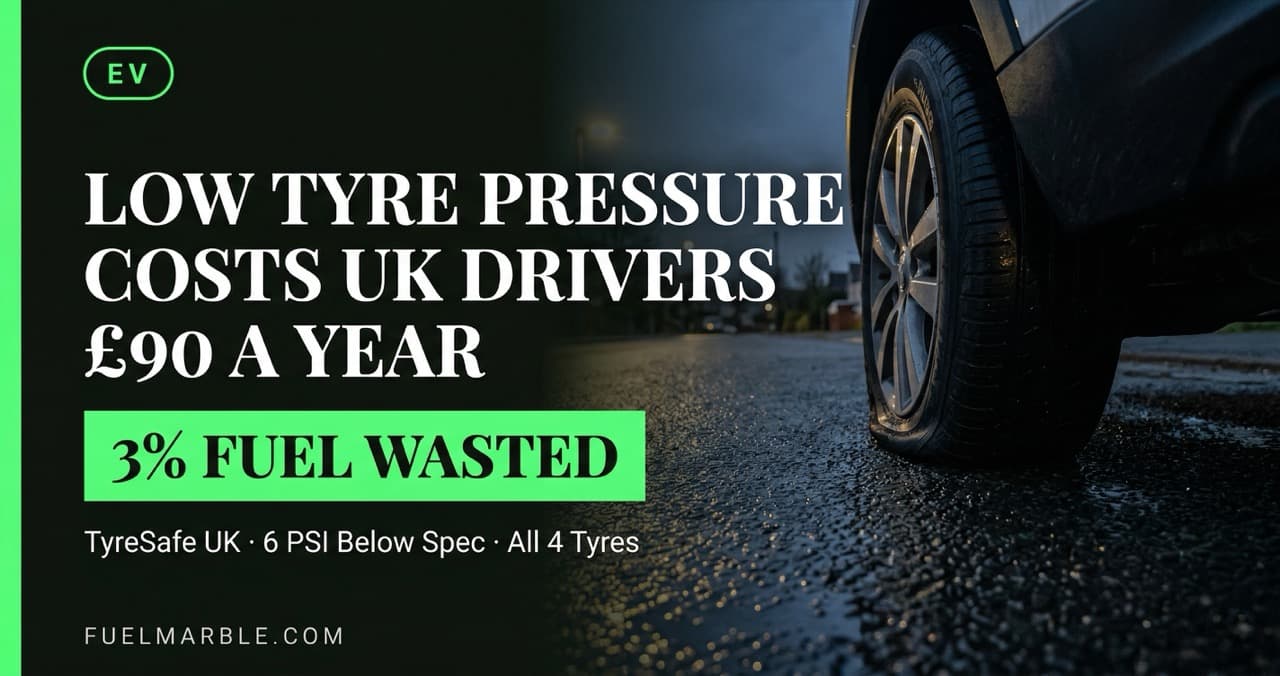
Yes, tyre pressure directly affects how much fuel your car burns on every journey. Even a modest drop of 6 PSI across all four tyres increases fuel consumption by around 3%, according to UK charity TyreSafe. If you drive an average of 7,500 miles per year and diesel costs 178p per litre, that 3% gap costs you roughly £90 annually, for a fault that takes two minutes and nothing to fix. For the full picture on how car servicing decisions affect your running costs, the how car maintenance affects fuel economy guide covers the complete cost breakdown across every major maintenance variable.
This article focuses specifically on tyre pressure: how much it costs you in fuel, why the physics works the way it does, how to check pressure correctly in the UK, and (critically) what tyre pressure alone cannot fix about your car's fuel consumption.
How Much Fuel Does Low Tyre Pressure Actually Waste?
- 6 PSI below spec across all four tyres: ~3% more fuel consumed (TyreSafe)
- 4.3 PSI below spec: ~1.5% fuel economy loss (Continental Tyres research)
- At 40 mph on 50%-deflated tyres: up to 10% greater fuel consumption in controlled testing
- 20% of UK motorists run all four tyres underinflated: estimated annual fuel waste of £140 per driver (GB Car Leasing industry analysis)
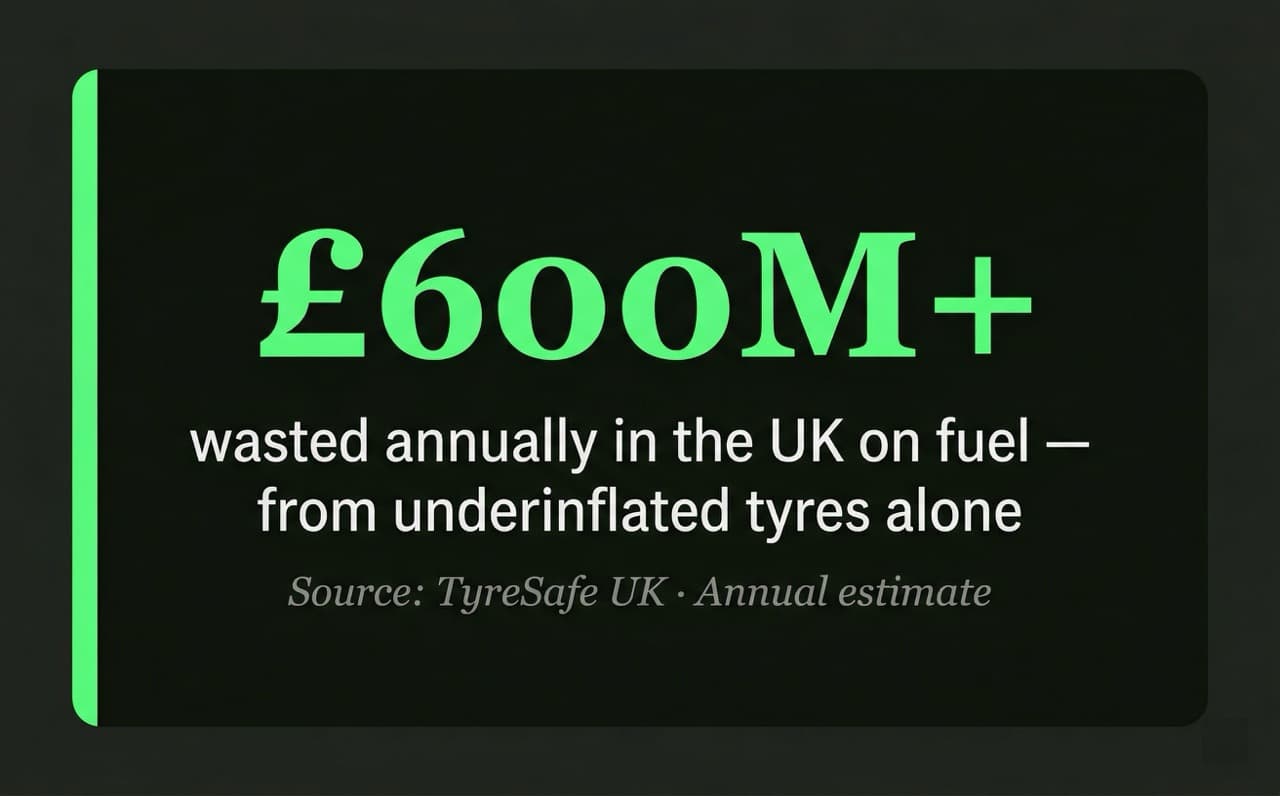
- Collective UK impact: TyreSafe estimates UK drivers waste over £600 million per year in excess fuel from incorrect tyre pressures
This applies when all four tyres are consistently below the correct pressure for the vehicle. It does NOT apply if only one tyre is slightly low, the effect on overall fuel consumption is roughly proportional to the number of underinflated tyres and the severity of the drop.
A concrete example: a petrol car with a 55-litre tank, driven 7,500 miles per year, consuming an average of 7.5 litres per 100km, and running tyres 6 PSI low will burn an extra 67 litres of fuel annually. At 150p per litre, that is £100.50, wasted entirely on a tyre pressure problem that a forecourt pump would have corrected in under two minutes.
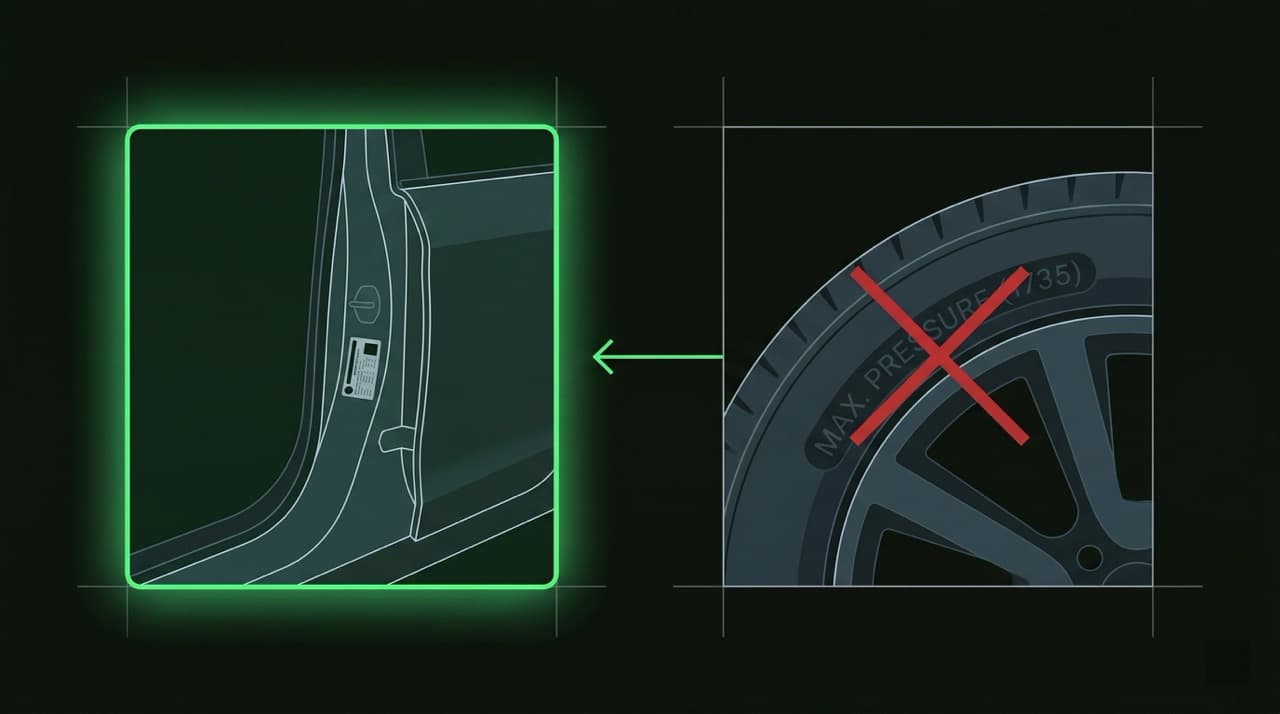
UK Tyre Pressure Rule: The correct pressure for your vehicle is always found on the driver's door jamb sticker or the owner's manual. Never use the maximum pressure moulded into the tyre sidewall. That is the tyre's structural limit, not the manufacturer's operating recommendation. Many vehicles specify different pressures for front and rear tyres.
Why Does Underinflated Rubber Burn More Fuel?
- Increased contact patch size: a deflated tyre spreads wider on the road surface, multiplying the friction the engine must overcome
- Sidewall flex heat loss: each rotation causes the sidewall to compress and rebound, converting fuel energy into waste heat, not wheel rotation
- Steering load increase: the engine management system detects greater resistance and runs a slightly richer fuel mixture to compensate
- Cold-weather amplification: at temperatures below 10°C, tyre pressure drops approximately 1 PSI for every 10°F (~5.5°C) of temperature loss, meaning winter mornings silently compound the problem
This applies when tyres are below the minimum recommended operating pressure. It does NOT apply in the opposite direction, over-inflating beyond the manufacturer's spec reduces the contact patch too aggressively, which harms grip without meaningfully improving fuel economy and is not recommended.
A Volkswagen Golf on standard 195/65 R15 tyres at the recommended 32 PSI front / 30 PSI rear has a defined contact patch of approximately 30cm². At 26 PSI front / 24 PSI rear (just 6 PSI low) the contact patch expands by roughly 15%, and rolling resistance increases in proportion. The driver notices nothing. The fuel gauge tells a different story over 3,000 miles.
How Widespread Is the Problem in UK Cars?
- 2.15 million vehicles (2,152,849) failed their MOT due to tyre defects in the 2023–24 testing year, the highest figure on record, per TyreSafe analysis of DVSA data
- 1 in 5 UK motorists drives with all four tyres underinflated, per GB Car Leasing industry survey data
- Tyre defects are consistently among the top three causes of MOT failure across all vehicle categories in the UK
- The RAC and AA both recommend checking tyre pressure at minimum once per month, surveys suggest the majority of UK drivers check less often than this
Part of the problem is that modern cars feel normal to drive on tyres that are 5–8 PSI below spec. Tyre Pressure Monitoring Systems (TPMS), fitted as standard on vehicles registered in the UK from November 2014 onward, typically only warn at 25% below recommended pressure, by which point fuel economy has already suffered significantly.
This applies particularly to UK drivers who check pressure only at MOT time or during annual servicing. It does NOT apply to drivers using dedicated digital gauges monthly and logging their readings, this group consistently reports better fuel economy and tyre longevity.
In a monitored trial by a South East England fleet operator (12-van delivery fleet, 2023–24), implementing weekly tyre pressure checks and maintaining correct inflation across all vehicles reduced monthly diesel consumption by 2.7% over six months, without any changes to route planning, loading weights, or driving behaviour.
TPMS Warning does not mean optimal pressure: Your Tyre Pressure Monitoring System (TPMS) warning light illuminates only when pressure drops 25% or more below the recommended level. A tyre running 10–15% below spec (enough to meaningfully increase fuel consumption) will show no warning light at all. Monthly manual checks remain necessary.
When Correct Tyre Pressure Isn't Enough
A petrol or diesel engine burns fuel most efficiently within a precise operating temperature range: roughly 90°C to 104°C coolant temperature. Below this range (during cold starts, short urban journeys, or winter commutes) the engine management unit runs a richer fuel mixture and combustion efficiency drops. Research published in Applied Thermal Engineering confirms that engines operating at 10°C below their designed coolant temperature show measurable increases in specific fuel consumption, independent of driving style or road conditions.
This is the combustion inefficiency that tyre pressure cannot touch. You can inflate your tyres to the precise manufacturer's specification, check them cold, and still find your real-world MPG sitting consistently below the manufacturer's combined figure, because the engine never reaches or sustains its thermal optimum on the kinds of journeys most UK drivers actually make.
FuelMarble's automotive fuel efficiency system was designed specifically for this gap. By raising and stabilising engine coolant operating temperature within the optimum band, FuelMarble reduces the duration and severity of thermally inefficient combustion cycles, the ones that burn the extra fuel tyre pressure alone cannot recover. Independent testing recorded fuel efficiency improvements of 17% to 27.3% across petrol and diesel vehicles in verified trials, including a 27.3% improvement on a Honda Accord and 18%–21.75% in separate China and Indonesia tests. These gains are in addition to (not instead of) correct tyre inflation.
How to Check Tyre Pressure Correctly in the UK
- Cold means cold: the car must have been stationary for at least three hours, or driven fewer than two miles at low speed in the preceding three hours
- Use a digital gauge: dial gauges and forecourt gauges can read 2–5 PSI inaccurately; a quality digital gauge costs under £15 and reads to ±0.5 PSI
- Check all four individually: front and rear pressures often differ by 2–4 PSI as specified by the manufacturer; never apply a single figure to all four tyres unless the owner's manual specifies this
- Check the spare: a spare tyre that has lost pressure during storage is useless precisely when it is needed most
- Re-check after 24 hours: newly inflated tyres stabilise; a fresh check confirms no valve stem leak
The correct pressure is NOT the maximum figure moulded into the tyre sidewall. That number is the tyre's structural pressure limit, not the manufacturer's recommended operating pressure. The correct figure is on the door jamb sticker (driver's side door, visible when the door is open) or in the owner's manual. Many vehicles specify separate pressures for light loads versus full-load/motorway driving, use the appropriate setting for your journey type.
What the UK Data Says About Tyre Pressure and Running Costs
Take a 2023 Ford Focus 1.5 TDCi diesel estate, driven 9,000 miles per year, averaging 48 MPG on a mix of urban and motorway. Diesel at 178p per litre. Total annual fuel spend: approximately £1,250.
- At correct pressure: £1,250 fuel spend
- Running 6 PSI low across all four tyres: 3% extra consumption = £37.50 extra per year
- Running 10 PSI low (still no TPMS warning): up to 7% extra = £87.50 extra per year
A driver buying a tyre inflator for home use (£25–£45 for a reliable 12V unit) recovers the investment in under two years from fuel savings alone, before accounting for the extended tyre life, improved wet-weather braking distances, and reduced risk of a blowout that correct inflation also delivers.
UK drivers who have decided diesel and petrol vehicles remain their practical choice, a position explored in detail in the context of the UK's retreating EV transition. Have every incentive to extract maximum efficiency from their existing vehicles. Tyre pressure is the lowest-hanging, highest-return item on that list.
The Hidden Cost of Flat Tyres
Drag the slider to see how under-inflation drains your wallet (based on £1,800/yr fuel spend)
Monthly pressure check: ~2 minutes. Annual savings: £37–£90. Equipment needed: a £12 digital gauge. Of all the fuel economy improvements available to a UK car owner without any mechanical work, correct tyre inflation delivers the best return-per-minute of effort. The only condition: the check must be done cold.
The Complete Picture on Tyre Pressure and Fuel Economy
Tyre pressure has a real, measurable, and consistent effect on fuel economy in UK cars. A 6 PSI shortfall costs roughly 3% in fuel consumption. Correct inflation costs nothing and requires only a two-minute monthly check. The financial and safety case is unambiguous.
But tyre pressure is a rolling-resistance problem, not a combustion problem. A car whose engine does not reach or sustain its thermal operating range will consume excess fuel independently of tyre condition. The two efficiency losses stack, and fixing one does not fix the other.
For UK drivers serious about recovering real-world fuel economy (not just the portion that tyre pressure is responsible for) the next lever to examine is engine thermal performance.
Avery leads FuelMarble's international operations and strategic direction. With a background spanning fleet economics, regulatory compliance, and macro fuel market trends, Avery oversees commercial partnerships, product positioning, and the company's growth across the UK, US, Canadian, and Mexican markets.
Ready to Improve Your Fuel Efficiency?
FuelMarble delivers up to 15% fuel efficiency improvement. Simple drop-in install.