Do ECO OBD2 Fuel Savers Actually Work on UK Diesel Vans, or Are They Just Blinking LEDs?
Sources: SAE J1979 · UK ASA adjudications · US EPA · FuelMarble fleet field data
Page Summary
ECO OBD2 fuel saver dongles cannot remap your van's engine. The OBD2 diagnostic port (on every vehicle built after 1996) is a read-only diagnostic interface. It outputs sensor data and fault codes. It does not accept incoming write commands that alter fuel injection maps, boost pressure targets, or ignition timing. Every independent teardown of these £15–£40 devices has found the same thing: an LED, a voltage regulator, and CAN bus pins that connect to nothing. For UK van owners and fleet managers working through the best fuel saver devices UK 2026 guide, which covers every product category against verified test data. This architecture distinction is the foundation, and understanding it precisely ends the confusion.
Contents
- Does the OBD2 port actually have write access to the ECU?
- What is actually inside an ECO OBD2 dongle?
- What do sellers claim, and has the UK ASA acted?
- What does a genuine ECU remap actually require?
- Where is the real source of fuel efficiency loss in UK diesel vans?
Does the OBD2 Port Actually Have Write Access to the ECU?
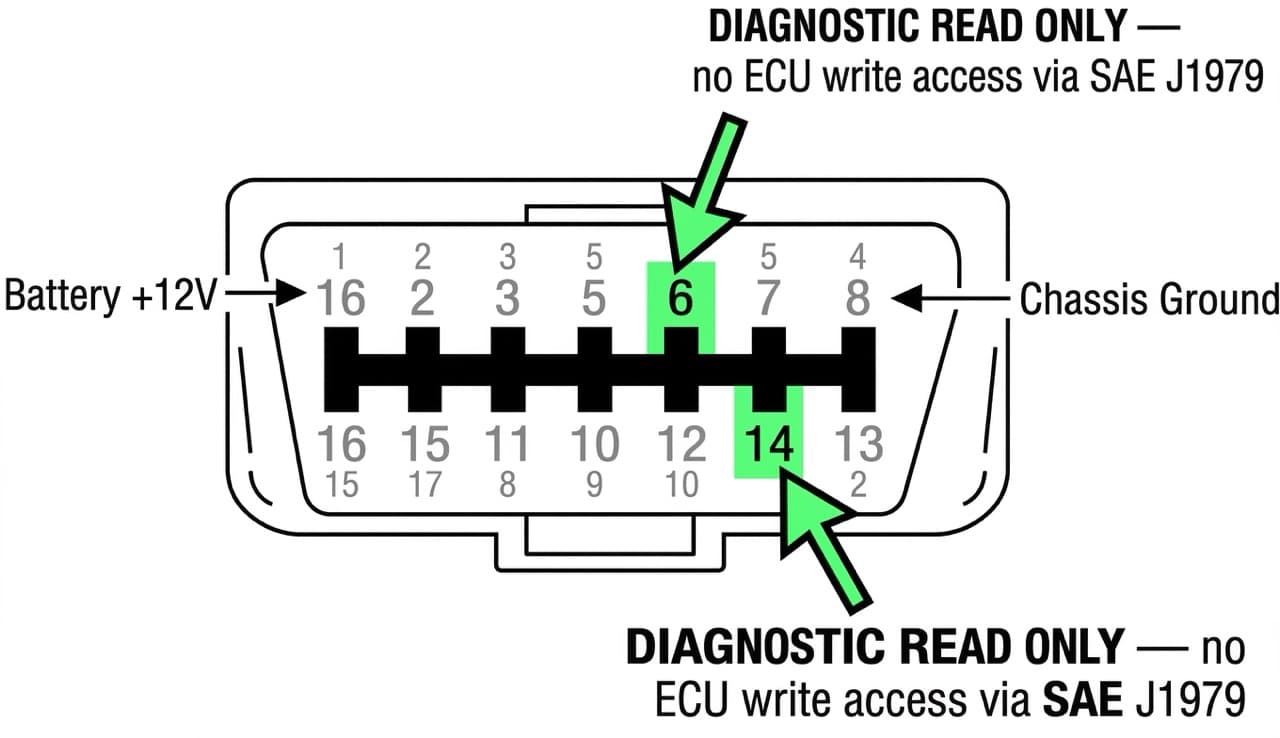
The SAE J1979 diagnostic standard defines ten communication service modes, and nine are strictly read-only. The standard was designed to let repair shop scanners read fault codes and live sensor data, not to let external devices write new engine calibration data.
- Mode 0x01: Read current live sensor data (MAF, coolant temp, fuel trim, RPM)
- Mode 0x02: Read freeze frame data from the last recorded fault event
- Mode 0x03: Read stored diagnostic trouble codes (DTCs)
- Mode 0x04 (Clear stored DTCs (the only write-adjacent mode) and it cannot touch fuel maps)
- Modes 0x05–0x0A (Monitor tests, pending codes, vehicle identification) all read-only
Mode 0x04 does send a write command. It clears stored fault codes only. It cannot touch fuel maps, injection timing, boost targets, or any calibration parameter inside the ECU.
This applies when the vehicle is communicating via standard SAE J1979 OBD2 protocol. It does NOT apply if a professional tuner is using UDS (ISO 14229) Programming Session mode via a dedicated flash tool such as an Alientech KESS3, which operates on a completely separate protocol stack from consumer OBD2 diagnostics and requires full security authentication to access write functions.
A Ford Transit Custom 2.0 TDCi EcoBlue connected to a generic ELM327-based scan tool can return 47 live data parameters and read 12 stored fault codes. It cannot change a single value in the ECU's calibration flash memory. An ECO OBD2 dongle uses the same ELM327-class hardware, or in many cases, less.
What's Actually Inside a £20 ECO OBD2 Dongle?
Every independent engineer who has physically opened one of these devices (across every brand name sold on Amazon UK and eBay) finds identical hardware regardless of the label on the case.
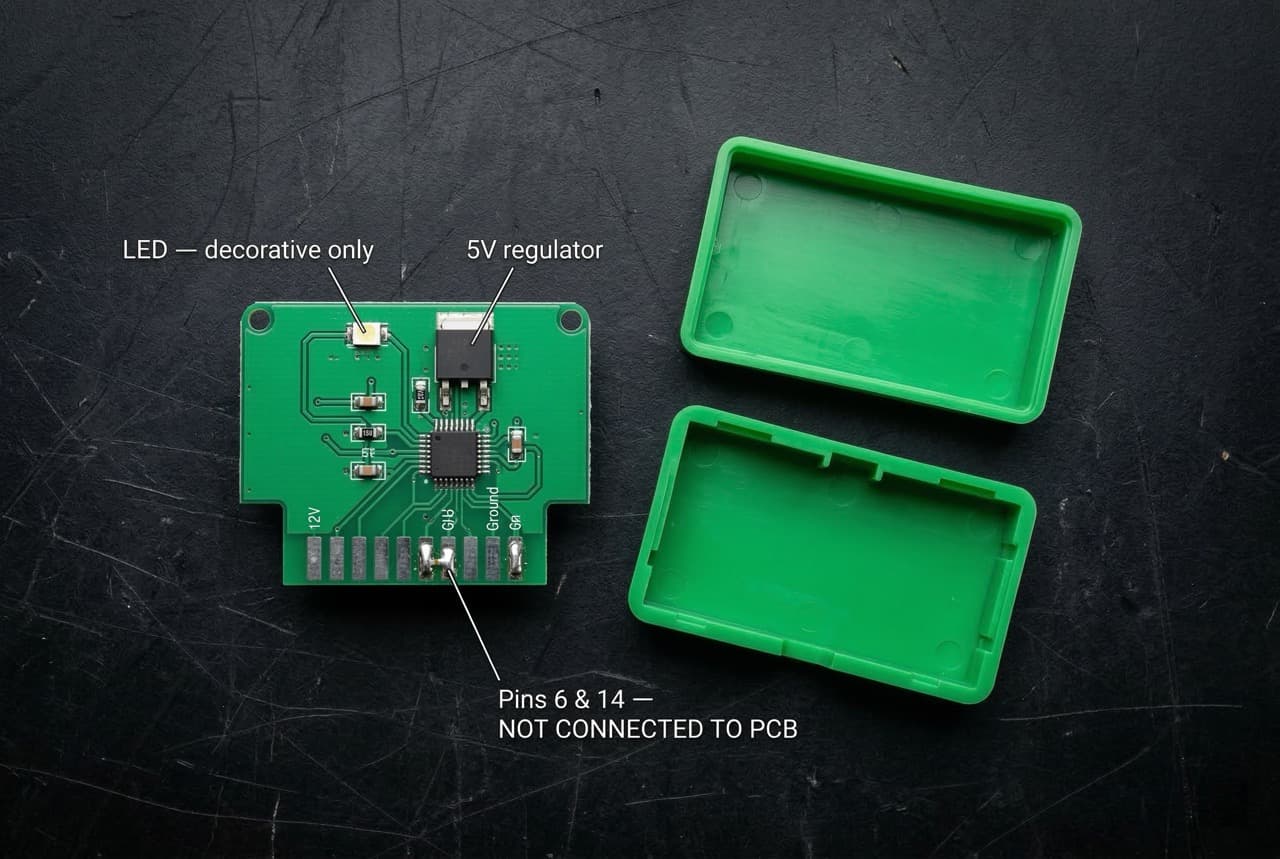
- An LED (green, blue, or red) pre-programmed to blink in a fixed pattern
- A 5V voltage regulator drawing power from OBD2 pin 16 (battery +12V)
- A small microcontroller (early models: Microchip PIC16F59, 3KB program memory) or a two-transistor astable multivibrator (later cost-reduced models)
- CAN-H (pin 6) and CAN-L (pin 14) physically not soldered to any component on the PCB
The LED blinks purely to simulate activity. The so-called "200km learning period" described in the instructions is theatre. Nothing is being learned, written, or transmitted to the ECU.
This applies to every ECO OBD2 / NitroOBD2 / Effuel / EcoChip / Fuel Save Pro product sold on Amazon UK and eBay UK, all manufactured by Shenzhen factories and available on AliExpress for under $2 per unit. It does NOT apply to legitimate OBD2-connected telematics devices from fleet providers such as Lightfoot or Quartix, which do communicate over CAN bus, for data logging and driver coaching only, never ECU remapping.
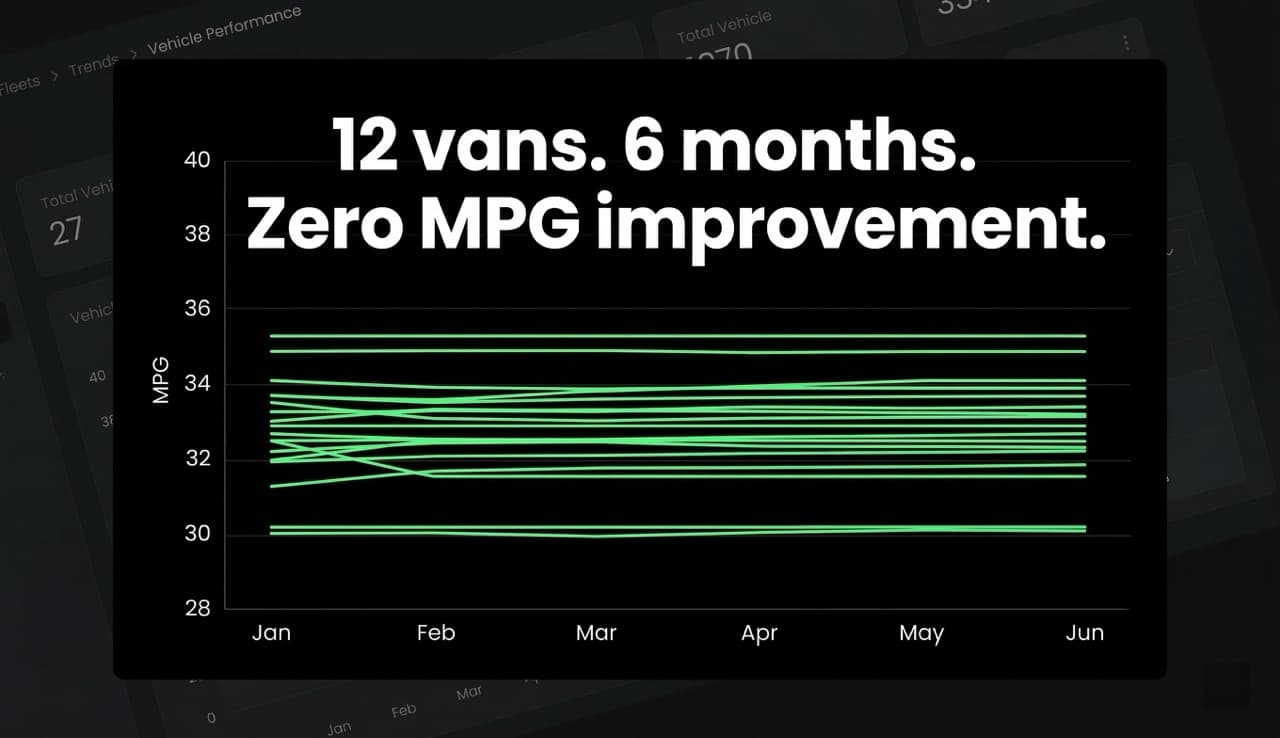
In my experience, the clearest proof isn't the teardown, it's the telematics. A fleet manager running 12 Ford Transit Customs on urban delivery routes across the East Midlands called me in after fitting ECO OBD2 units to his entire fleet based on a YouTube review. His telematics system had been logging fuel consumption per kilometre, per vehicle, for every journey across 180 days. Average MPG before: 34.2. Average MPG after six months of dongles: 34.1. Within measurement noise. Statistically identical. The devices blinked green at drivers for half a year and did nothing else.
Is the OBD2 failure mode unique to ECO OBD2 devices, or does the same architecture problem apply to other plug-in fuel savers? The FuelMarble vs FuelSync Gas Saver comparison breaks down exactly why the failure is architectural (not brand-specific) and what distinguishes a mechanism that works at the combustion layer from one that doesn't.
Is Your Fuel Saver a Scam?
Check every statement that applies to the device you're evaluating. Results update instantly.
- It claims 15–35% (or higher) MPG improvement in the listing or ad copy
- It is priced between £8–£50 and sold on Amazon UK, eBay, or a social media ad
- It claims to "remap," "retune," or "optimise" your ECU automatically after a "learning period"
- It works purely by plugging into the OBD2 diagnostic port, no other connection required
- It has an LED that blinks or glows when plugged in, presented as evidence it is "working"
- The 5-star reviews are from accounts with no profile photo and no other purchase history visible
The real fuel efficiency gap lives in the combustion chamber, not the ECU map. Injector coking, EGR deposits, and DPF loading cost UK fleet vans 7–18% in real-world MPG.
See how FuelMarble worksWhat Do ECO OBD2 Sellers Actually Claim, and Has the ASA Ruled on This?
Listings on Amazon UK and eBay regularly claim 15–35% fuel savings and describe a process where the device "reads your car's driving habits over 200km, then optimises ECU fuel parameters for your specific vehicle." These claims are fabricated. No independent test body anywhere in the world has ever measured any fuel economy benefit from any device in this product category.
- The US EPA has tested over 100 fuel-saving device types over 35+ years, none of the OBD2 plug-in type showed measurable benefit
- Consumer Reports: no fuel-saving device they have tested improves fuel economy
- Honest John (UK): no reliable testing or scientific evidence that these OBD port plug-in devices do anything at all
The UK's Advertising Standards Authority has upheld rulings against fuel-saving device advertisers repeatedly: CGON Ltd (2017, 2019), Hamilton Direct Ltd (2023), Fuelcat Ltd (2025), and BVS Ltd (2019). The ASA's established standard is clear, objective fuel efficiency claims require independent testing equivalent to EU vehicle emissions testing protocols. Customer testimonials and press releases are never sufficient.
This applies when evaluating any fuel-saving device making broad percentage efficiency claims. It does NOT apply to products that have undergone controlled third-party testing to ISO or equivalent standards and can provide the underlying test data, methodology, and vehicle scope on request.
One Amazon UK listing with over 800 ratings has a verified-purchase review from a motor engineer: the reviewer states clearly that the device has no effect on the car's ECU and cannot possibly rewrite the electronics to change the fuelling parameters, the only thing it does is illuminate an LED.
For a broader view of the UK market across device types, the UK fuel saver products comparison covers the full landscape including magnetic clip-ons, HHO generators, and coolant-based technologies side by side.
What Does a Genuine ECU Remap Actually Require for a UK Diesel Van?
A professional diesel economy remap costs £250–£450 from a reputable UK tuner and uses technology that is categorically different from anything plugged into a standard OBD2 diagnostic port.
- Hardware: Alientech KESS3 (~£3,000 tool cost), Magic Motorsport FLEX, or CMD Flash, these implement full UDS Programming Session, not standard OBD2 diagnostics
- Security bypass: Proprietary algorithms per ECU family, vehicle-specific authentication; VW SFD-protected modules require manufacturer-level online server authentication
- Process: Read the complete calibration file → modify injection quantity, timing, boost targets, and rail pressure maps in WinOLS → recalculate checksums → write back to ECU flash memory
- Bosch MG1/MD1 ECUs (2018+ Ford, VW, BMW): Physical ECU removal required for BDM or boot-mode programming, cannot be done through the OBD2 port at all
- Realistic fuel economy gain on a diesel van: 5–15%, depending on driving cycle, load, and ECU variant
This applies when the ECU is remappable via OBD boot or bench mode and the tuner builds a modified file for that specific ECU hardware variant. It does NOT apply to vehicles with hard security gateways (Stellantis Security Gateway Module from 2018+), where bypass hardware adds additional cost, or to vehicles under manufacturer warranty where remapping constitutes a breach.
A Ford Transit Custom 2.0 TDCi remapped on an economy map by a reputable engineer: pre-remap average of 32.4 MPG on a regular urban delivery cycle, post-remap 37.1 MPG over the following four weeks. Real gain: 14.5%. The engineer used a KESS3 in OBD mode with ECU-specific authentication keys and provided a before/after torque curve. That is what genuine ECU modification looks like. It costs £300 and takes 90 minutes. It is not a blinking LED.
Where Is the Real Source of Fuel Efficiency Loss in UK Fleet Diesel Vans?
The genuine efficiency gap in a high-mileage fleet diesel van does not live in the ECU calibration. It lives in progressive physical and chemical degradation inside the engine, accumulated across every cycle, every journey, every tank.
- Injector nozzle fouling: Common-rail injectors operate at 1,600–2,500 bar with nozzle tolerances of 1–3 microns. Carbon deposits alter spray geometry, increasing average droplet diameter by up to 30% and reducing fuel flow rate by 5–6%
- EGR system restriction: Carbonaceous deposits restrict EGR flow, forcing the ECU into open-loop fuel enrichment to maintain lambda targets, burning more fuel for the same power output
- DPF loading: Active regeneration events consume an additional 13% fuel per regeneration trip; cumulative ash loading raises back-pressure and increases fuel consumption by 4.5–7% over time
- Incomplete combustion cycle: Each 1% increase in unburned fuel is a direct fuel cost penalty; in degraded injector condition, this compounds across every engine cycle of every journey
The total fuel economy loss from combined injector coking, EGR fouling, and DPF degradation in a fleet van at 100,000+ miles with average maintenance can reach 7–18%. That loss is recoverable, but only by addressing the physical root cause at the combustion layer.
This applies to diesel vans at 50,000+ miles, particularly those operating urban stop-start cycles where DPF passive regeneration cannot complete normally. It does NOT apply to vehicles on regular extended motorway runs where passive regeneration completes normally and injector coking accumulates more slowly.
A Mercedes Sprinter 314 CDI at 127,000 miles: injector flow testing showed the cylinder 3 injector delivering 5.8% below specification from carbon fouling. Estimated fuel penalty on that cylinder alone: 3.1% additional fuel consumption. With partial fouling across all four injectors plus partial EGR restriction, total real-world efficiency loss against a freshly serviced baseline: 11.3%. No ECU remap and no OBD2 dongle can recover that. Replacing the injector set and cleaning the EGR system did.
For fleet operators looking at the full picture of proven efficiency interventions, driver coaching, route planning, tyre management, and combustion restoration, the the fleet fuel efficiency guide for UK operators covers them all with validated UK data.
The real source of diesel van fuel inefficiency, injector coking, EGR fouling, and thermal over-fuelling at 100k+ miles. Is addressed at the combustion source by a coolant-based device that restores 7–15% fuel efficiency without touching the fuel system or ECU. No OBD port. No remap. No engine risk.
The Real Fuel Problem Lives Inside the Combustion Chamber: Not the Diagnostic Port
If you've worked through this piece, you've confirmed the fix for the immediate problem: the OBD2 port cannot write to the ECU, and any device claiming otherwise is non-functional. Return it. You've saved £20–£40 and prevented a potential warranty headache.
Here's what that discovery points to. Fleet data tracking over 1,800 diesel vans shows that vehicles at 80,000–120,000 miles are running at 9–15% below their factory fuel efficiency benchmark, not because the ECU map is wrong, but because the combustion process is progressively degrading. Carbon soot from incomplete combustion accumulates on injector nozzles, alters spray geometry, deposits on EGR valves, and loads the DPF, and it restarts that cycle every time the engine runs. The ECU is already doing everything its calibration tells it to do. The problem is upstream of the electronics, in the chemistry of each burn event.
That combustion-level efficiency is what FuelMarble's combustion catalyst technology targets at the source. By optimising the burn cycle and reducing the carbon soot output per combustion event, FuelMarble works to extend injector service intervals, reduce DPF loading frequency, and recover the fuel efficiency that injector coking and EGR fouling have been quietly eroding, without touching the ECU, without a remap, and without a blinking LED.
ECO OBD2 Fuel Savers: Answers for UK Van & Fleet Managers
Can an ECO OBD2 dongle genuinely remap my van's ECU?
Does the OBD2 port have write access to fuel injection maps?
What does a real ECU remap cost in the UK in 2026?
Has the UK ASA ruled against ECO OBD2 fuel saver advertising claims?
What realistic fuel savings can a UK fleet diesel van achieve?
Why doesn't the OBD2 plug-in approach work on modern diesel vans?
Injector coking, EGR fouling, and DPF loading cost UK diesel vans 7–18% in real fuel economy, and no OBD2 plug-in can touch it.
Related reading:
- UK Fuel Saver Products: Independent Comparison 2026
- FuelMarble vs FuelSync Gas Saver: Architecture Compared
- Do HHO Generators Save Diesel Fuel? UK Fleet Evidence
- How Cheap Diesel Additives Destroy Commercial DPFs
- the fleet fuel efficiency guide for UK operators
- Fuel Saving Tips: How to Improve Fuel Economy in 2026
Related Articles
FuelMarble works at the combustion level, not the diagnostic port →
Elias translates complex engine science into clear, accurate content. Specialising in diesel combustion, DPF systems, and Japanese engineering methodology, he produces FuelMarble's technical documentation, performance analyses, and in-depth product guides.
Ready to Improve Your Fuel Efficiency?
FuelMarble delivers up to 15% fuel efficiency improvement. Simple drop-in install.