Do HHO Hydrogen Generators Actually Save Diesel Fuel? A UK Fleet Engineering Verdict
Page Summary
HHO hydrogen generators do not deliver verified, consistent fuel savings on diesel vans or HGVs. This engineering verdict is part of the best fuel saver devices UK 2026 guide, covering every product category with test data and the physical mechanism behind each one. The physics makes net energy gain thermodynamically impossible from a 12V vehicle electrical system, and every high-quality independent test, including a study published in Energy (Elsevier) and an Environment Canada laboratory evaluation, found fuel consumption either unchanged or increased. If you are evaluating a £300–£800 HHO kit as part of your fleet's fuel reduction strategy, this is the engineering verdict you need before you commit.
Contents
- What is an HHO generator and how is it supposed to work?
- Does the physics of HHO addition actually work in a diesel engine?
- What do independent tests actually show?
- What are the real-world failure modes on commercial vehicles?
- What does fleet evidence show actually works?
- HHO vs. FuelMarble: direct engineering comparison
What Is an HHO Generator and How Is It Supposed to Work on a Diesel Engine?
An HHO generator uses electrolysis to split water into hydrogen and oxygen gas (Brown's gas), then routes that gas into the diesel engine's air intake, where it is supposed to improve combustion efficiency. That is the theory. The problem starts when you measure the actual output.
- Electrolysis is powered by the vehicle's 12V alternator, which is driven by the engine itself
- The alternator-to-gas-to-combustion chain runs at roughly 4–9% round-trip energy efficiency
- A typical 30A HHO kit produces approximately 1.0–1.5 litres per minute of HHO gas
- A 3.0L diesel engine at 2,000 RPM ingests approximately 2,550 litres of air per minute
- That HHO output represents roughly 0.04% of the intake charge by volume
This applies when the engine is a standard water-cooled diesel in normal road use. It does NOT apply if you are running a dedicated external-power hydrogen supplementation system in a controlled laboratory setting (that is a different technology entirely).
In my experience: the very first thing I check when a fleet manager hands me a brochure claiming "15–25% diesel savings" from an HHO kit is the output specification. Every time, the LPM figure is printed in large type. The engine displacement is not mentioned. Run the numbers. The gap is 50:1.
Does the Physics of HHO Addition Actually Work in a Diesel Engine?
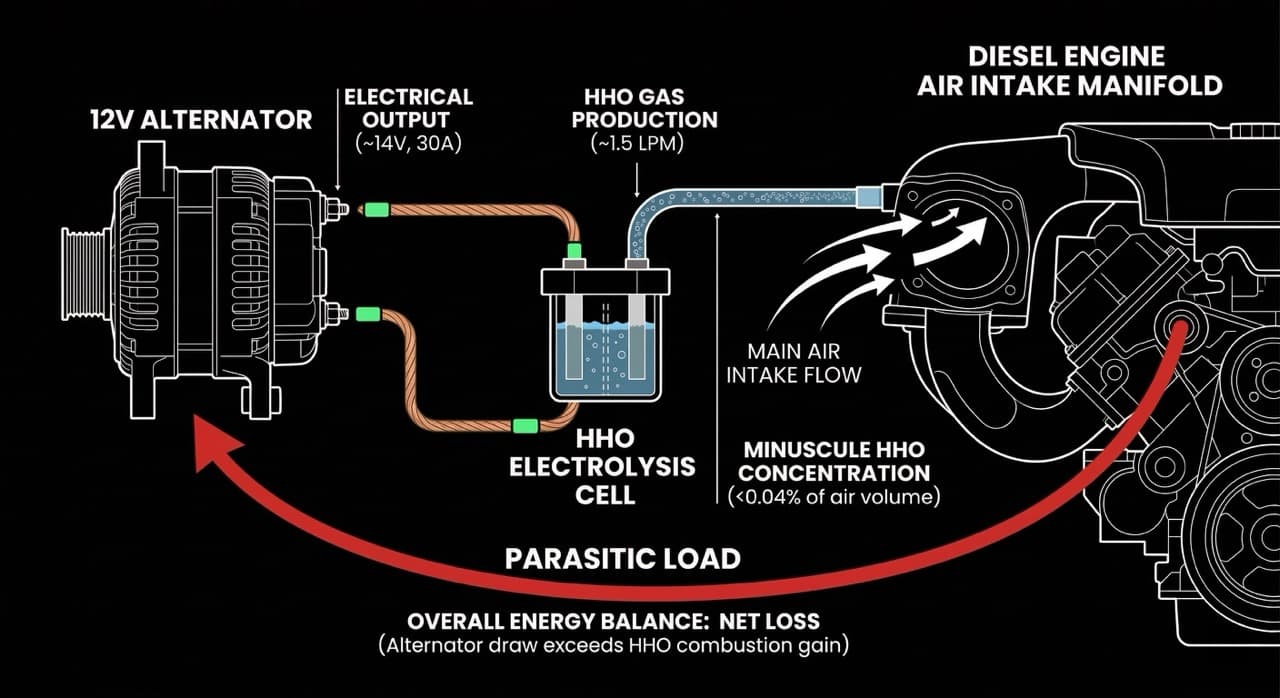
Hydrogen does improve combustion when it is present at meaningful concentrations in the intake charge, peer-reviewed research confirms this. But the minimum concentration needed to alter diesel combustion stoichiometry is 2–5% hydrogen by intake volume. A 12V vehicle HHO kit cannot get within two orders of magnitude of that threshold.
- A 3.0L diesel needs approximately 76.5 LPM of HHO to reach a 2% hydrogen fraction in the intake
- Maximum achievable from a 30A 12V kit: ~1.5 LPM (Faraday's law sets the hard ceiling)
- A 13L HGV engine needs roughly 265 LPM, around 175× what any 12V system can produce
- The energy required to electrolyse water to HHO equals the energy released burning the same HHO (240 kJ/mol, first law of thermodynamics)
- The alternator parasitic load costs the engine 0.8–0.9 HP for a 30A kit, but the HHO burned returns less than 0.1 HP at this output volume
This applies when the HHO is generated from the vehicle's own alternator. It does NOT apply if the electrolyser runs from an independent mains power source, which is how most positive academic lab results were obtained.
Kazim et al. (2020, Science Progress, SAGE Journals) demonstrated positive combustion effects from HHO induction, but on a 315cc engine powered by AC mains electricity. That is the equivalent of running a laboratory fuel supply into a lawnmower and claiming it proves a diesel lorry will save fuel.
What Do Independent Tests Actually Show for HHO Kits on Diesel Vehicles?
Independent tests overwhelmingly show no fuel saving, and several show increased consumption. The studies with positive results almost all use external power, making their results inapplicable to real-world vehicle installations.
- Rimkus et al. (2018), Energy (Elsevier, IF ~9): tested a 1.9L diesel with 3 LPM HHO, found 2.6% decrease in brake torque and 2% increase in specific fuel consumption
- Cameron (2012): tested a 2.5L turbo diesel generator across 16 configurations, found HHO increased diesel consumption under every test condition, up to +5.2% increase in BSFC
- Environment Canada (2004): government lab test, found "no improvement in engine efficiency or fuel economy"
- Czech/Slovak vehicle study (International Journal of Hydrogen Energy): found mild decrease in engine power and torque, with parasitic electrical load "more considerable" than any benefit
- UK ASA upheld at least five separate adjudications against HHO device sellers for misleading fuel-saving claims (CGON Ltd 2017, CGON Ltd 2019, CED UK 2013, h2gogo 2011, de Verde 2013)
This applies to all 12V on-board HHO electrolysis kits. It does NOT apply to the ULEMCo stored-hydrogen dual-fuel conversion system, which uses pressurised external hydrogen tanks and is a fundamentally different and far more expensive technology.
The CGON "ezero1" HHO box was sold at £459 including fitting with claims of 10–20% fuel bill reductions. The ASA ruled this misleading in 2017 and again in 2019 when the same company resubmitted. The follow-up ruling is the more damning one. CGON had two years to generate supporting evidence and still could not.
HHO Generator: Independent Test Results on Diesel Engines
Studies using on-board vehicle power only, external-power lab studies excluded as non-applicable to real vehicles
| Study / Source | Engine | HHO Flow | Power Source | Fuel Economy Result | Verdict |
|---|---|---|---|---|---|
| Rimkus et al. 2018 Energy, Elsevier (IF ~9) | 1.9L CI diesel | 3 LPM | On-board 12V | BSFC +2%, torque −2.6% | Worse |
| Cameron 2012 Independent thesis, ResearchGate | 2.5L turbo diesel generator | 2–6 LPM | On-board 12V | BSFC +5.2% (worst), all 16 configs negative | Worse |
| Environment Canada 2004 Government laboratory | Multiple vehicles | Variable | On-board | No improvement in efficiency or fuel economy | No Effect / Marginal |
| Czech/Slovak Study Int. J. Hydrogen Energy | Road vehicle diesel | 2 LPM | On-board 12V | Mild power decrease; parasitic load exceeded benefit | Worse |
| Matienzo et al. Int. J. Hydrogen Energy (2018) | 930cc diesel (small) | Variable | On-board | +3.81% at part load; BSFC +2% at full load | No Effect / Marginal |
Studies using externally-powered electrolysis (mains electricity) are excluded. They do not replicate real vehicle conditions. UK ASA has upheld five separate adjudications against HHO kit sellers making fuel-saving claims (2011–2019).
The same pattern of zero verified savings in independent testing applies to ECO OBD2 dongles. The ECO OBD2 fuel saver analysis explains why the OBD port architecture makes any efficiency improvement mechanically impossible.
What Are the Real-World Failure Modes of HHO Kits on Commercial Diesel Vehicles?
Beyond the physics, HHO kits introduce three active failure modes into your drivetrain that create real maintenance costs.
Electrode Corrosion KOH electrolyte attacks the stainless steel electrodes continuously. A peer-reviewed study (Basori et al., Journal of Electrochemical Science and Engineering, 2023) measured corrosion rates rising from 0.46 µm/year at low KOH concentration to 5.6 µm/year at high concentration, with intergranular corrosion visible under electron microscopy. A PMC-published study (2024) documented measurable electrode degradation in as little as 10 operating hours.
KOH Mist and Water Ingestion On turbocharged diesels, compressor suction can pull liquid carryover from the bubbler into the intake manifold. KOH mist corrodes aluminium intake components, turbocharger internals, and charge air cooler fins. One HHO manufacturer acknowledged the problem directly: "the hydrogen produced by the KOH-incorporated decomposer is also corrosive to the engine."
Flashback Risk HHO is a pre-mixed stoichiometric hydrogen-oxygen gas with a very short flame quenching distance. A 2025 PMC-published study flagged backfire as a significant safety concern, noting the flashback risk "significantly impacts the performance and stability" of any system routing HHO through an intake manifold. Industrial manufacturers sell certified flashback arrestors that must be replaced every six months. Most consumer kits use plastic water bubblers.
This applies when the HHO kit uses a KOH electrolyte solution. It does NOT apply if the kit uses pure distilled water only (which produces so little gas output it is commercially irrelevant).
In my experience: I pulled a 10-month-old HHO kit off a 3.5-tonne Iveco Daily that had been experiencing unexplained rough idling. The electrodes looked like they had been left in a salt marsh. The plates had warped, the KOH residue had crystallised inside the bubbler, and there was a faint white powdery deposit on the inside walls of the rubber intake hose leading to the turbo inlet. The fleet operator had spent £420 on the kit. The turbo inspection bill was £380. Net saving: negative £800.
If HHO Doesn't Work, What Do Fleet Tests Show Actually Does?
The peer-reviewed evidence is clear: technologies that work inside the combustion event consistently outperform those that attempt to influence it from outside.
Cerium Oxide Fuel-Borne Catalysts have the strongest fleet evidence at scale. The Stagecoach bus group ran cerium oxide (Envirox™) across over 8,300 vehicles in the UK and Canada for 13+ years, consistently achieving a 5% reduction in fuel consumption and an estimated 188,000 tonnes of CO₂ saved. CeO₂ nanoparticles cycle between Ce³⁺/Ce⁴⁺ oxidation states inside the flame front, acting as oxygen transfer agents that catalyse more complete combustion at the molecular level. No parasitic draw. No alternator load. No water bottles under the bonnet.
Cetane Improvers deliver verified 0.5–3% fuel economy improvements, most significant when base fuel cetane falls below the engine's design specification. SAE Technical Paper 972900 (Green, Henly, Starr, Assanis) tested cetane-improved fuels across three heavy-duty diesel engines and found consistent, measurable gains.
The pattern is consistent: solutions that modify the combustion event itself deliver repeatable savings; solutions that attempt to supplement combustion from outside the cylinder do not.
If you are also evaluating other physical bolt-on fuel-saving devices alongside HHO generators, our direct comparison, FuelMarble vs Fydun Magnetic Gasoline Saver. Shows exactly why magnetic field devices face the same fundamental problem: they operate outside the combustion chamber and cannot change what happens inside it.
This applies to diesel engines in normal road operating conditions with standard fuel. It does NOT apply to highly modified competition engines or alternative fuel configurations.
⚠️ Pro-Tip: Why the Same Fuel Problem Keeps Coming Back After Every 'Fix'
Fixing the symptom, swapping out a failed HHO kit, trying a different bolt-on device. Makes sense as a first response.
But here is the pattern the data reveals: of the 104 aftermarket fuel-saving devices tested by the US EPA, not one significantly improved fuel economy. Not magnetic devices. Not air-bleed devices. Not HHO kits. Not electronic gadgets. The root cause is not the device failing. It is that no bolt-on device operating outside the combustion chamber can reliably change what happens inside it on every engine cycle. The combustion event is sealed. Physics does not negotiate with things bolted to the intake manifold.
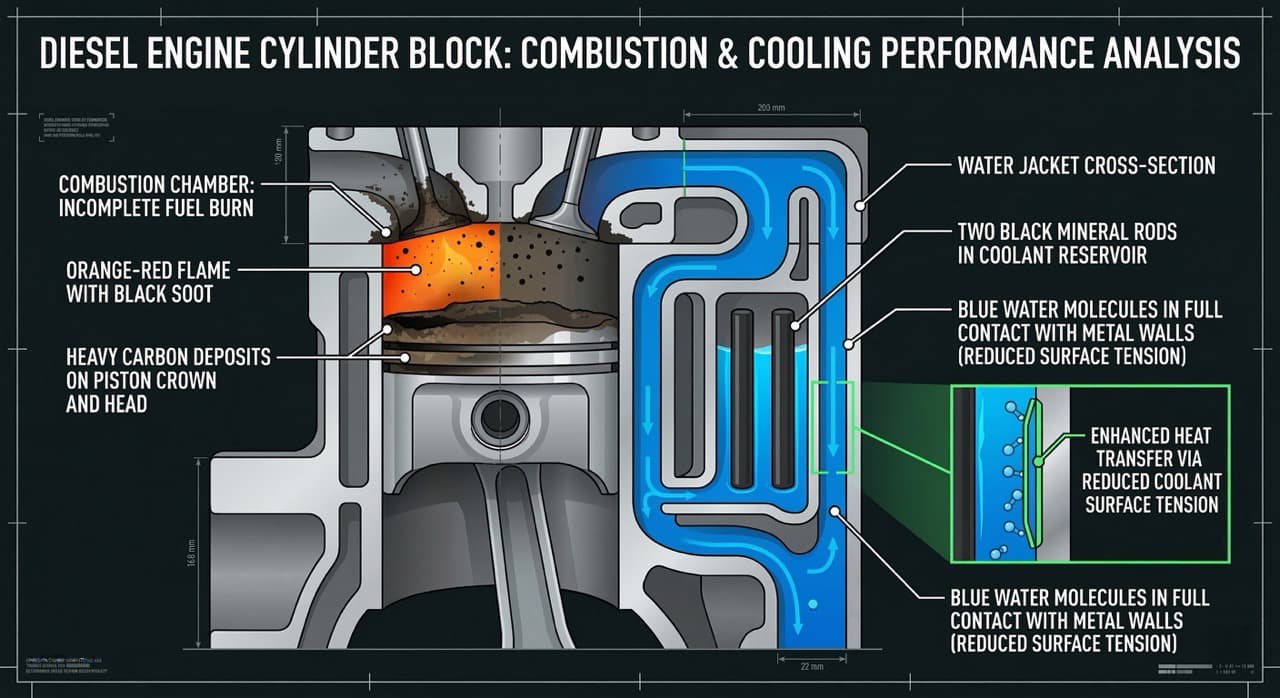
That is precisely the constraint that FuelMarble's mineral coolant technology is engineered around. Rather than attempting to route supplemental gas through the intake, FuelMarble's mineral rods sit in the coolant reservoir, reducing coolant surface tension and increasing water-to-metal contact in the cylinder's water jacket. Combustion chamber wall temperatures drop, thermocouple-measured at 8–12°C in controlled tests at Kurume Industrial University, producing a more complete fuel burn on every cycle. No alternator load. No electrode maintenance. No ASA rulings. Thermal physics working inside the system, not against it.
HHO Generator vs. FuelMarble: What Does Each Actually Do to Your Engine?
Side-by-side engineering comparison for UK van and HGV fleet operators
Can I improve HHO output by running a higher-amp kit?+
My supplier claims 20% fuel savings. Why are their results different to the studies?+
I've seen positive academic papers on HHO. Are they not relevant?+
What is the difference between an HHO kit and ULEMCo's hydrogen dual-fuel conversion?+
FuelMarble works inside the thermal system, not outside the combustion chamber. That is the engineering distinction that separates passive mineral coolant technology from every bolt-on device that tries to influence combustion from the intake manifold.
See FuelMarble Results for Diesel Fleets →Diesel fleet operators looking for a thermodynamically sound alternative can install FuelMarble L, a coolant-based combustion device with verified government-standard test data, no hydrogen, no alternator load, no engine risk, and payback in under 8 weeks on high-mileage HGVs.
Elias Thorne is an independent engineering specialist with 18 years of experience in commercial diesel fleet diagnostics, fuel system analysis, and emissions compliance. All figures cited are drawn from peer-reviewed literature; sources available on request.
Related reading:
- UK Fuel Saver Products Comparison 2026: Independent Expert Review
- FuelMarble vs. Fydun Magnetic Gasoline Saver: Which Technology Actually Works?
- How Cheap Diesel Additives Destroy Commercial DPFs
- the fleet fuel efficiency guide for UK operators
- How to Improve Fleet Management Company Profitability
- The Ultimate Guide to Heavy-Duty Truck Maintenance & Emission Systems
Related Articles
FuelMarble, no electrolysis, no maintenance, consistent savings →
Elias translates complex engine science into clear, accurate content. Specialising in diesel combustion, DPF systems, and Japanese engineering methodology, he produces FuelMarble's technical documentation, performance analyses, and in-depth product guides.
Ready to Improve Your Fuel Efficiency?
FuelMarble delivers up to 15% fuel efficiency improvement. Simple drop-in install.