
A 30-Vehicle Diesel Fleet Spent £26,400 Last Year on a Fuel Additive Programme. Here Is the 3-Year Spreadsheet That Ended It.
The additive-versus-hardware verdict is settled, which is why this article does not relitigate it. If you still need that evaluation, it lives in the full review of fuel saver products available to UK fleet operators, in the context of the UK fleet diesel fuel efficiency guide. The mechanism difference between FuelMarble and fuel additives is covered in full in why FuelMarble is not a fuel additive. This article starts where that one ends: at the cost comparison. Specifically, the question nobody asks at procurement time. What does continuing an additive programme actually cost across 36 months when every cost is on the table, not just the treatment price?
£8,400. That Is the Line Item Missing From Every Additive Purchase Order on a 30-Vehicle Fleet.
A 30-vehicle diesel fleet running any standard additive programme carries £8,400 per year in statistically expected DPF replacement liability, and that number does not appear anywhere on the supplier invoice, the per-treatment price, or the annual consumables budget line.
The liability calculation is straightforward:
- Industry average DPF failure rate on commercial diesel fleets running metallic-catalyst additives: 1 per 15 vehicles per year
- Per-incident cost: £4,200 at the conservative floor (parts, labour, and vehicle downtime combined)
- 30 vehicles ÷ 15 = 2 expected failures per year × £4,200 = £8,400 annual liability
- This liability is invisible at point of purchase because it lands in the maintenance budget, not the consumables budget, a different P&L line, a different approval cycle, a different manager
This applies when the fleet runs metallic-catalyst or organometallic cetane additive treatments on Euro V or Euro VI commercial diesel vehicles with DPF systems. It does NOT apply to older pre-DPF Euro III fleets where the failure mode does not exist.
A 20-vehicle fleet at that same failure rate carries £5,600 in annual DPF liability. One failure per year eliminates the entire claimed annual saving of the additive programme on that fleet. Two failures puts the programme in negative ROI. The treatment price per unit never shows you this, because the supplier's liability ends at the pump.
The financial model above uses a conservative failure probability. For the full chemistry of why metallic catalyst additives accelerate DPF failure specifically on commercial diesel engines (and why the ash deposits are non-regenerable once formed) how cheap diesel additives destroy commercial DPFs explains the mechanism in detail.
£18,000 in Annual Additive Spend. £26,400 in Actual Annual Cost. The Gap Is Called Dosing Non-Compliance.
When I inherited a 30-vehicle fleet additive programme, the previous fleet manager's records showed £18,000+ in annual additive spend. The headline number looked reasonable, roughly £600 per vehicle per year, unremarkable in a fleet consumables budget of that scale.
The audit told a different story. Cross-referencing telematics data against purchase receipts revealed dosing compliance of 67%. One in three treatments purchased had never entered a tank. £5,940 of that annual spend had produced zero measurable effect, paid for, logged, and never administered across a multi-driver fleet where no individual driver is accountable for every fill.
Add the two DPF failures that year: £4,200 each. The 30-vehicle programme's real annual cost was £26,400. Not £18,000. Not £600 per vehicle. £880 per vehicle when every cost is on the same slide.
The dosing compliance numbers are not unusual:
- Independent fleet telematics data consistently shows 20–35% of additive treatments go unadministered in multi-driver commercial fleets
- Drivers refuel at different stations, at different times, with different levels of process discipline
- No fleet management system flags a missed additive dose the way it flags a speeding event or a harsh brake
- The financial consequence is silent: the fleet pays full programme cost and receives 65–80% of the treatment volume it purchased
This applies to any multi-driver commercial fleet running a voluntary additive dosing protocol. It does NOT apply to a single-owner-operator who personally doses every fill and can verify compliance with their own receipts.
The Hardware Side Has Three Independently Verified Results. The Additive Side Has Zero Equivalent Evidence at Fleet Scale.
A 30-vehicle fleet switching from additive programme to FuelMarble hardware carries a one-time cost of £15,570, against a 3-year additive programme total of £33,300–£34,920. That is the number. But the more important asymmetry is the evidence base supporting each side of it.
The hardware evidence across three independent verified sources:
- Light vehicle: Honda Freed MPV (1500cc, 2012, Jakarta). Independent 12-week CAR UP driving test, witnessed by Ir. Steve Rion, January–March 2023. +21.75% fuel efficiency improvement. Exhaust CO₂ reduction: 10.34%. Instrument-measured, documented across sequential fill-to-fill runs.
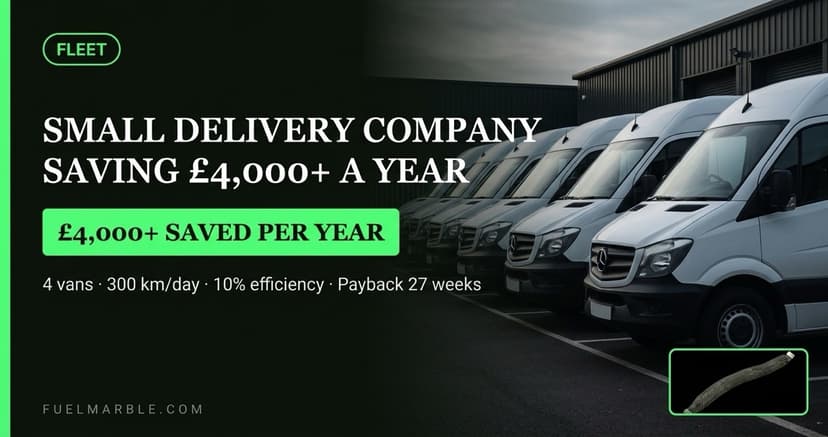
- Commercial van fleet: Verified FuelMarble performance data on a UK 4-van delivery fleet, modelled annual saving exceeding £4,000 per year across 4 vehicles at documented real-world consumption rates.
- Marine vessel: Tamai Steamship Co., Ltd. bulk carrier TRES FELICES (55,810 DWT gross tonnage). Day-by-day fuel consumption log, wind conditions recorded and controlled. Result: 7.33–8.31% fuel reduction. Combined annual saving: ¥13.5M, approximately £70,000 on a single vessel.
The same hardware mechanism scales to commercial vessel operations: Tamai Steamship Co., Ltd. recorded a 7.33% fuel reduction on a 55,810-tonne bulk carrier, generating ¥13.5M (£70,000) in combined annual savings on a single vessel. See the TRES FELICES bulk carrier case study for the day-by-day fuel log data.
Now consider the additive side. Every major cetane booster and fuel additive brand sold in the UK relies on manufacturer claims, controlled laboratory bench tests, or single-vehicle anecdotal data. There is no independently witnessed, instrument-verified, multi-vehicle fleet dataset for any additive product at any scale. The asymmetry in the evidence base is total. One side has an external auditor's name on the document. The other side does not.
This applies when comparing hardware against standalone fuel additive programmes on commercial diesel fleets. It does NOT apply to a direct comparison with OEM-approved fuel system maintenance treatments included in manufacturer-endorsed service schedules.
The 3-Year Board Slide: £34,920 vs £15,570. One Number Stays Flat. The Other Compounds.
For a 30-vehicle diesel fleet, the 3-year additive programme total reaches £33,300–£34,920. The hardware alternative costs £15,570 once, with £0 in years 2 and 3. The 3-year net saving by switching: £17,730–£19,350 at minimum.
The board-level summary for a 30-vehicle fleet:
| Additive Programme | FuelMarble Hardware | |
|---|---|---|
| Year 1 | £11,100–£11,640 | £15,570 |
| Year 2 | £11,100–£11,640 | £0 |
| Year 3 | £11,100–£11,640 | £0 |
| 3-year total | £33,300–£34,920 | £15,570 |
| 3-year saving | : | £17,730–£19,350 |
| Payback period | Never (perpetual cost) | ~8 weeks |
The payback uses the conservative 8% saving, the lower bound of FuelMarble's documented 7.33–21.75% verified range. At average UK commercial diesel at £1.35/litre and a 30-vehicle HGV fleet averaging 35,000 km/year at 3.2 km/litre, 8% saving generates approximately £1,969 per vehicle per year, £59,063 across the fleet in year 1 alone. Hardware cost recovered in the first two months of operation.
When the 3-year spreadsheet went on the table, the board conversation took four minutes. The additive programme's line items were familiar, small, recurring, buried in consumables. The hardware column had one number in year 1 and two zeros below it. No finance director needed to ask why the switch made sense. The slide answered the question before anyone opened their mouth.
This applies when comparing TCO across a 24–36 month fleet planning horizon where the operator carries full maintenance liability. It does NOT apply to short-cycle vehicle leases where DPF replacement liability sits with the lessor under contract terms.
The same TCO discipline applies to the largest fuel-driven capital decision a fleet faces, replacing the trucks themselves. How brand fuel-efficiency differences compare to a fleet replacement runs that maths and finds the brand-to-brand economy gap rarely justifies the capital outlay a renewal cycle demands.
The Real Cost That Procurement Never Sees
A cetane booster does what its chemistry allows. It raises cetane number, shortens ignition delay, and produces a marginally cleaner burn at the point of combustion on that fill. For a single vehicle, with a compliant driver, correctly dosed. That mechanism is real. Give the programme full credit for the symptom it addresses.
The problem is structural, not chemical. Three compounding failure modes operate simultaneously and invisibly: recurring cost that compounds without ceiling; DPF failure liability never priced at point of purchase but landing at £4,200–£8,000 per incident; and driver-dependent dosing compliance averaging 67–80% in multi-driver fleets, meaning 20–33% of every year's treatment budget purchases nothing. Scale all three to 30 or 50 vehicles simultaneously and you have the £26,400 figure. The additive is not the problem. The procurement model is.
That is what FuelMarble's cooling-system combustion optimisation eliminates, all three failure modes at once. It operates in the cooling circuit, not the fuel tank. There is no dosing protocol. There is no recurring purchase. Driver behaviour is irrelevant to its function. One cost. Year 1. Then nothing.
These are modelled figures based on documented fleet costs. For a real-world example of what the hardware saving looks like on an actual 4-van delivery fleet, a small delivery fleet saving £4,000+ per year shows the before and after in practice. For the full operator case and per-vehicle numbers, see the FuelMarble fleet page.
Fuel Additive Programme vs Hardware: 3-Year Total Cost of Ownership
FuelMarble L (£519/unit) for HGV/commercial fleet. Additive: £12–18/treatment × 6/year. DPF failure: 1 per 15 vehicles/yr × £4,200. Hardware payback at conservative 8% consumption saving.
Key Numbers| Fleet Size | Annual Additive Cost | DPF Risk/yr | Total Annual Cost | Hardware (One-Time) | 3-Yr Additive Total | 3-Yr Hardware Total | 3-Yr Saving | Payback |
|---|---|---|---|---|---|---|---|---|
| 5 vehicles | £450–£540 | £1,400 | £1,850–£1,940 | £2,595 | £5,550–£5,820 | £2,595 | £2,955–£3,225 | ~7 wks |
| 10 vehicles | £900–£1,080 | £2,800 | £3,700–£3,880 | £5,190 | £11,100–£11,640 | £5,190 | £5,910–£6,450 | ~7 wks |
| 20 vehicles | £1,800–£2,160 | £5,600 | £7,400–£7,760 | £10,380 | £22,200–£23,280 | £10,380 | £11,820–£12,900 | ~7 wks |
| 30 vehicles | £2,700–£3,240 | £8,400 | £11,100–£11,640 | £15,570 | £33,300–£34,920 | £15,570 | £17,730–£19,350 | ~8 wks |
| 50 vehicles | £4,500–£5,400 | £14,000 | £18,500–£19,400 | £25,950 | £55,500–£58,200 | £25,950 | £29,550–£32,250 | ~7 wks |
† Van/car fleets using FuelMarble S (£239/unit): 10-van hardware cost falls to £2,390, stronger payback against identical DPF liability. †† DPF failure at £4,200/incident (conservative lower bound; real-world HGV range: £4,000–£8,000).
The 3 Compounding Failure Modes Invisible at Point of PurchaseOne Cost. Year 1. Then Nothing.
FuelMarble L (£519/unit), installed once in the cooling system. No dosing protocol. No recurring purchase. No DPF liability from metallic ash. Verified 7–21% fuel efficiency improvement across independent tests.
Avery leads FuelMarble's international operations and strategic direction. With a background spanning fleet economics, regulatory compliance, and macro fuel market trends, Avery oversees commercial partnerships, product positioning, and the company's growth across the UK, US, Canadian, and Mexican markets.
Related Articles


Ready to Improve Your Fuel Efficiency?
FuelMarble delivers up to 15% fuel efficiency improvement. Simple drop-in install.