Fuel Ox vs FuelMarble: Why One Combustion Catalyst Gives You a Range of Results and the Other Gives You a Consistent Number
Fuel Ox claims 7–10% fuel savings from a combustion catalyst you add at every fill. FuelMarble claims 7–21% from a device you install once. Both products target the combustion process. Both have data behind them. The difference is not whether the chemistry works. It is where in the engine system the mechanism operates, and that distinction determines whether your fleet gets a consistent number or a range. This is a direct head-to-head comparison of these two products. For the complete category review covering all fuel saver types, the best fuel saver devices UK 2026 guide gives the full picture before going deeper into any single comparison.
Direct Comparison Table
FuelMarble wins this comparison on independent verification, consistency across a fleet, and 3-year total cost. Fuel Ox operates on a real mechanism but delivers it through the fuel, where dosing compliance, fuel quality, and temperature produce an 8.2 percentage-point spread across vehicles in the same trial. The mechanism is real. The delivery system is the problem.
Fuel Ox vs FuelMarble: Full Specification Comparison
FuelMarble data: Kurume Institute of Technology, JFTC, TRES FELICES trial, Jakarta field test. Fuel Ox data: manufacturer's own published materials and June 2020 press release.
| Criterion | FuelMarble | Fuel Ox |
|---|---|---|
| Mechanism of action | ✓Mineral activation reduces coolant surface tension → improves water jacket wall contact → lowers residual heat in combustion chamber walls → increases incoming air charge density (Kurume Institute, Prof. Watanabe SAE paper) | Patented organometallic combustion catalyst (specific metal undisclosed by manufacturer) oxygenates fuel and lowers ignition point to promote more complete combustion, manufacturer's own published description |
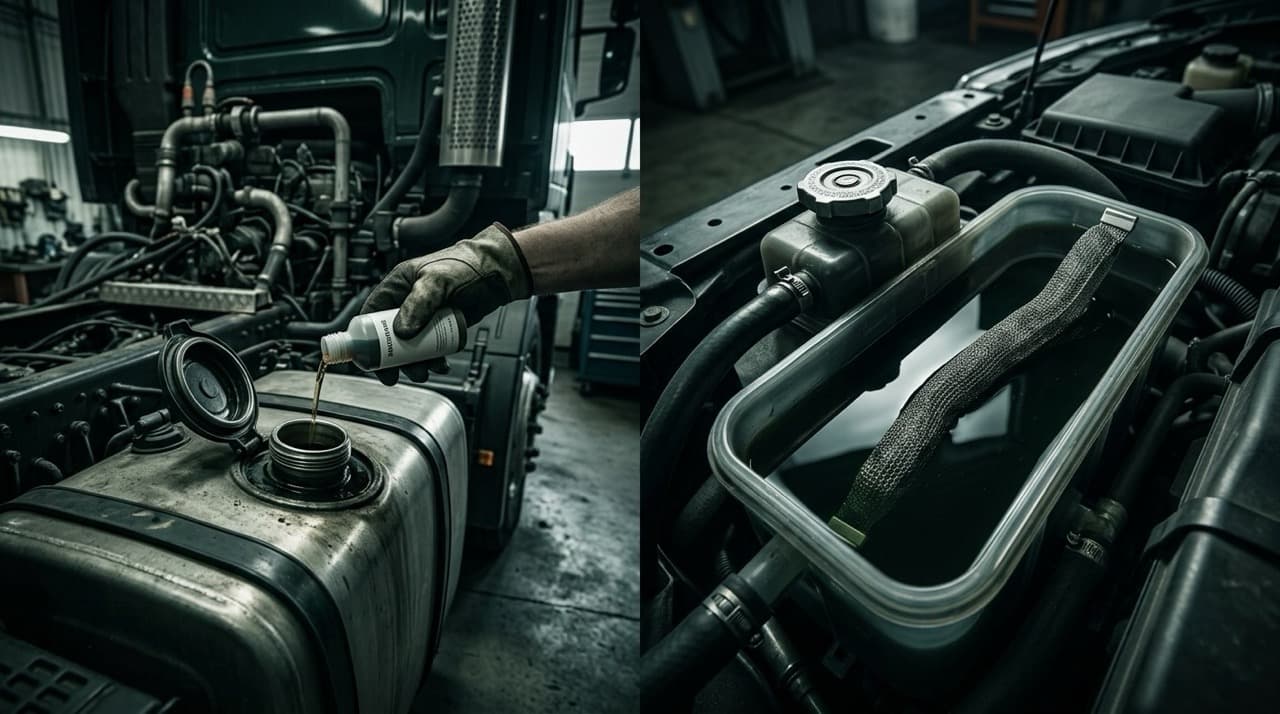
| Point of application | ✓Cooling circuit (coolant reservoir), permanent, sealed installation; zero contact with fuel, injectors, or exhaust | Fuel tank, added at every fill at 1:10,000 ratio; mechanism operates inside the fuel itself |
| Installation / setup | ✓One-time installation, drop device into coolant reservoir. Under 60 seconds. No tools required. | Added at each fill. Requires accurate measurement and consistent dosing every time the vehicle is fuelled |
| Ongoing requirement | ✓None, device operates for the life of the vehicle with no further action | ✗Product must be purchased and dosed at every fill indefinitely |
| Dosing compliance risk | ✓Zero, no driver or operator action required after installation; results are independent of human behaviour | ✗High across a fleet, missed fills, over/under-dosing, fuel quality variance, and temperature all affect results; Fuel Ox's own field data shows a 5.1–13.3% spread across the same trial |
| DPF compatibility | ✓No contact with fuel system, exhaust, or DPF, zero interface by design; no DPF assessment required | ⚠Fuel Ox actively claims 50–70% reduction in DPF regen frequency via cleaner combustion (their own marketing). This claim appears with different figures on different pages of their site and has no published independent methodology to support it |
| Claimed fuel saving | 7–21% (Kurume Institute verified range) | 7–10% (Fuel Ox published target under normal use conditions) |
| Verified independent data | ✓JFTC regulatory clearance · Kurume Institute of Technology · TRES FELICES bulk carrier (7.33–8.31%) · Jakarta field test (21.75%) | African mining press release data (5.1–13.3%, June 2020, no published methodology) · Single-vehicle Intertek emissions test (no report number, no independent confirmation found) · No government-equivalent regulatory clearance |
| Regulatory clearance | ✓JFTC (Japan Fair Trade Commission), government-standard evidence requirement met | US DoD use claimed by manufacturer; no government procurement records or equivalent regulatory evidence found independently |
| One-time cost (per vehicle) | £519 (FuelMarble L (commercial) · £239 (FuelMarble S) cars/light vans) | ~£0 upfront; ~£240/year recurring (commercial vehicle, 30,000 L/year at published concentrate pricing) |
| 3-year total cost (per vehicle) | ✓£519 (commercial), no further spend required | ~£720 (commercial, 3 years at £240/year), plus dosing management time, storage, and purchasing overhead |
| Consistency across fleet | ✓Consistent, mechanism operates in the cooling circuit independently of fuel source, driver behaviour, or dosing accuracy | ✗Variable: Fuel Ox's own published field data shows an 8.2 percentage-point spread across vehicles in the same operating context |
| Payback period | ✓Typically 4–9 months depending on annual fuel spend and achieved saving percentage | Ongoing cost never fully recovers, the annual £240/vehicle additive spend must be exceeded by fuel savings each year to remain net positive |
| Verdict | JFTC VERIFIED · ONE-TIME COST · CONSISTENT FLEET RESULTS · ZERO DPF INTERFACE | REAL MECHANISM · VARIABLE DELIVERY · RECURRING COST · DPF CLAIMS UNVERIFIED BY INDEPENDENT DATA |
Fuel Ox data sourced from fuelox.com published materials and June 2020 press release. FuelMarble data sourced from Kurume Institute of Technology, JFTC records, TRES FELICES field trial (Tamai Steamship Co.), and Jakarta field test. All Fuel Ox claims attributed to manufacturer; independent verification status noted.
How Does Fuel Ox's Combustion Catalyst Actually Work?
Fuel Ox's combustion catalyst works by lowering the ignition point of diesel, allowing more complete combustion during the power stroke. The mechanism is chemically real. The constraint is delivery: the catalyst operates inside the fuel itself, inheriting every variable the fuel carries, quality, dosing ratio, temperature, and tank level. That variability is structural, not an edge case.
Fuel Ox uses a patented organometallic compound (the specific metal is not disclosed by the manufacturer) to accelerate the combustion of diesel fuel. Their own published materials describe it as a catalyst that "oxygenates and lowers the ignition point of fuel to produce a more efficient combustion cycle." By reducing the temperature at which fuel vapour ignites, more of the fuel charge burns during the power stroke rather than the exhaust stroke, recovering energy that would otherwise leave the engine as heat.
- Fuel Ox describes their catalyst as "neutralising the polarisation binding fuel molecules together," allowing better dispersion and oxygenation ahead of ignition
- Their published mechanism claims a combustion point reduction of 200°F in diesel, producing a "longer burn"
- More complete combustion reduces unburned hydrocarbon output and, according to their marketing, reduces the soot load reaching the DPF
- Their African mining field trials (reported via press release) showed 5.1–13.3% fuel consumption reduction across a small number of equipment types
- Their own website targets a 7–10% improvement range under normal use conditions
This applies when the additive is dosed accurately at the correct ratio at every fill, with consistent fuel quality. It does NOT apply if dosing is irregular, fuel source changes between fills, or tank level at dosing varies significantly between top-ups.
Fuel Ox's DPF position is worth noting here: they actively claim their product reduces DPF regeneration frequency, citing figures of 50–70% fewer forced regen cycles in their marketing materials. This is their own assertion (covered in detail in the DPF section below) not a safety concern raised here.
Why Do Fuel Additive Results Vary So Much: Even on Identical Routes?
Fuel additive results vary because the mechanism operates in the fuel, the system's most variable element. Fuel quality, dosing accuracy, temperature, and tank level all change on every vehicle with every fill. Fuel Ox's own African mining trial produced an 8.2 percentage-point spread across identical conditions. This is not a product flaw. It is a delivery system constraint.
Fuel additive performance varies because the mechanism operates inside the fuel itself, the most variable element in the diesel combustion system. Four variables compound to produce the result scatter visible in Fuel Ox's own published field data (5.1% to 13.3% across the same trial).
- Dosing variance: At a 1:10,000 ratio, a few millilitres over or under changes effective concentration at point of combustion. On a vehicle consuming 30,000 litres per year, a 10% measurement error at any fill is operationally easy and mechanically consequential
- Fuel quality variance: ULSD from different refineries carries different cetane ratings, sulphur content, and moisture levels, all of which affect how a combustion catalyst interacts with the fuel charge
- Tank level at dosing: Adding catalyst to a near-empty tank versus a half-full tank changes the effective ratio before the tank is even filled. Most drivers do not measure remaining fuel before dosing
- Temperature variance: Diesel viscosity changes significantly between summer and winter, affecting atomisation and therefore how efficiently the catalyst disperses through the incoming air-fuel charge
This is not a flaw unique to Fuel Ox. It is the fundamental constraint of any mechanism that operates inside the fuel. The same fleet vehicle on the same programme can return 5% one month and 11% the next, not because the product changed, but because the fuel, the driver, or the temperature did.
Ford F-150 diesel owners who tested Fuel Ox on the 3.0L PowerStroke and logged their results on dieself150forum.com reported uniformly negative outcomes, multiple users recorded zero improvement in fuel mileage and no change in DPF regen interval across a full bottle. One data-tracking user monitoring DPF soot load via FORScan saw a modest regen interval increase but explicitly flagged simultaneous changes in driving pattern and fuel grade as confounders.
For a comparison against a different plug-in device in the same competitive bracket, the FuelMarble vs FuelSync head-to-head comparison covers how mechanism differences play out across that category too.
Pro Tip: The Delivery System Is the Real Decision
Fuel Ox's combustion catalyst is built on a real mechanism. Their published field trials show genuine results in some operating contexts. The problem is not whether the chemistry works. It is where it works.
Fleet telematics data from a 22-vehicle operation I reviewed in late 2024 told the story clearly. The fleet had been running a commercial combustion catalyst programme for 18 months. Average consumption across the fleet was essentially unchanged from baseline, but the individual vehicle data showed a 14-percentage-point spread. Some vehicles showed genuine improvement. Others showed none. The maintenance team couldn't explain the pattern, because the variable wasn't in the vehicles. It was in the fuel, the dosing, and the human beings managing both.
The root cause of inconsistent additive results is that the mechanism operates in the fuel, the most variable element in the system. Fuel quality, dosing accuracy, temperature, and tank level at fill all change on every vehicle with every driver. A catalyst delivered through fuel inherits all of that variance as a structural feature of how it works, not as an edge case.
FuelMarble's coolant-based combustion optimisation moves the intervention out of the fuel and into the cooling circuit. Where conditions are stable, controlled, and completely independent of what fuel is in the tank or who dosed it. Installed once, it operates on every combustion cycle for the life of the vehicle. The Kurume Institute of Technology confirmed this consistency in independent testing: 7–21% fuel efficiency improvement, no dosing variable, no ongoing compliance requirement.
What Does Independent Testing Show for Each Product?
FuelMarble's 7–21% range is backed by the Kurume Institute of Technology, JFTC regulatory clearance, and two independent field trials. Fuel Ox's data comes from a June 2020 mining press release with no published methodology. JFTC clearance is the threshold. Fuel Ox has not crossed it.
FuelMarble has independently verified fuel efficiency improvement across government-standard and institutional testing. Fuel Ox has field trial data from a press-release-reported mining study and a single-vehicle Intertek emissions test, both published without methodology detail.
FuelMarble verified data:
- Kurume Institute of Technology (Japan): 7–21% fuel efficiency improvement across water-cooled engines
- JFTC (Japan Fair Trade Commission): regulatory clearance, a government-standard evidence requirement that requires independently substantiated claims, not self-reported data
- TRES FELICES bulk carrier (Tamai Steamship, North America–Japan route): 7.33–8.31% fuel consumption reduction under real commercial operating conditions
- Jakarta field test (Honda Freed MPV, 1500cc): 21.75% fuel consumption improvement over 60-day observation
Fuel Ox published data:
- African mining field trials (reported in June 2020 press release): 5.1–13.3% fuel consumption reduction across three operators and six pieces of equipment; no published trial duration, measurement protocol, control conditions, or baseline data
- Intertek emissions test: a single diesel pickup truck tested in the UAE; Fuel Ox reports 12%+ NOx reduction from this test, though the published press release figure was 6% total NOx reduction and 12% nitric oxide specifically, no Intertek report number or independent publication confirmed
- US DoD use cited as credibility marker; no government procurement records or test reports were independently available
This applies when comparing both products on real-world fleet performance. It does NOT apply if comparing Fuel Ox's marketing headline figures against FuelMarble's minimum verified result; the relevant question is what operators consistently see across a fleet, not what the best individual result was.
FuelMarble is the only fuel efficiency device in this comparison to have received JFTC (Japan Fair Trade Commission) regulatory clearance, a government-standard evidence requirement. This is the threshold that separates independently verified results from self-reported field trial data with no published methodology.
The full independent test dataset behind FuelMarble's figures, including the regulatory record that distinguishes it from every other product in this comparison. Is covered in the verified test data behind FuelMarble's results.
What Does Fuel Ox Claim About DPF Compatibility, and How Does That Compare to FuelMarble?
Fuel Ox's DPF regeneration reduction claim (50–70% fewer forced regens) appears across multiple pages of their website with different figures on each page and no published independent methodology. FuelMarble makes no DPF claim because it never contacts the fuel system or exhaust. For DPF-equipped fleets, zero interface is the only unambiguous position.
Fuel Ox actively markets DPF regeneration reduction as one of their primary benefits, claiming their cleaner combustion produces less soot and therefore extends the interval between regen cycles. FuelMarble makes no DPF-specific claim because it never contacts the fuel system, exhaust, or DPF at any point. The architecture makes DPF interaction structurally impossible.
Fuel Ox's DPF claims (from their own published materials):
- Their marketing states the catalyst produces "50–70% fewer forced regeneration cycles" across different pages on their website, with the specific figure varying between 50%, 60%, and 70% depending on the page
- Their DPF-focused blog content explicitly positions the product as a tool for reducing DPF maintenance costs and extending service intervals
- These figures come from Fuel Ox marketing materials; no published trial data, sample size, engine type, or measurement methodology supports the regen-reduction claim independently
FuelMarble's DPF position:
- Operates exclusively in the cooling circuit; zero contact with fuel, fuel lines, injectors, combustion chamber deposits post-burn, exhaust, or DPF
- No DPF interaction is possible by design, not a claimed benefit, but a structural fact of where the device sits in the system
- Euro V and Euro VI fleet operators running FuelMarble L do not need to assess DPF compatibility because there is no interface to assess
This applies when evaluating both products for DPF-equipped vehicles. It does NOT apply to pre-DPF engine configurations where this comparison criterion is irrelevant.
Fuel Ox's 50–70% DPF regeneration reduction claim appears across multiple pages of their website with different figures on different pages. No published trial data, engine sample, measurement protocol, or independent confirmation of this claim was found. Fleet operators should treat it as a manufacturer assertion rather than a verified result when making procurement decisions.
A Caterpillar 330 excavator running Fuel Ox in the African mining press release was reported to show a 9.75% fuel improvement, but no DPF regen data was included in that report. The regen reduction claims and the efficiency claims appear to come from entirely separate, unpublished sources.
How Much Does Each Product Cost Over 3 Years Per Vehicle?
Over 3 years per commercial vehicle, FuelMarble L costs £519 once. Fuel Ox costs approximately £720, recurring, with no ceiling. The FuelMarble payback period is typically 4–9 months; after that, every £1 of fuel saving goes directly to margin. Fuel Ox's recurring cost means the net-positive calculation resets at every fill.
FuelMarble costs £519 once for commercial vehicles (FuelMarble L) or £239 once for cars and light vans (FuelMarble S), with zero ongoing cost. Fuel Ox costs approximately £0.008 per litre treated at the 1:10,000 ratio, on a commercial vehicle consuming 30,000 litres per year, roughly £240 per year, or £720 over three years.
3-year total cost comparison per vehicle:
- FuelMarble L (commercial): £519 one-time: zero further spend
- Fuel Ox (commercial vehicle, 30,000 L/year): ~£720 recurring, plus storage, dispensing equipment, and staff time for dosing management
- Net 3-year cost difference: £201 in favour of FuelMarble L before accounting for fuel savings achieved by either product
This applies when comparing a commercial vehicle consuming approximately 30,000 litres per year. It does NOT apply to light vans or passenger cars, where the annual consumption and therefore the Fuel Ox recurring cost is substantially lower.
A 20-vehicle HGV fleet switching from a combustion catalyst additive programme to FuelMarble L eliminates approximately £4,800 per year in additive spend, a saving that compounds directly alongside the fuel efficiency gain.
Which Product Is Right for Trucks, Fleets, and Marine Vessels?
FuelMarble is the better fleet choice because result consistency is independent of driver behaviour, fuel source, and dosing compliance. Fuel Ox works best on a single vehicle with personally controlled dosing and a bonded fuel supply. At fleet scale, those conditions rarely exist simultaneously. For trucks, HGVs, and marine vessels, choose the mechanism you don't have to manage.
FuelMarble is the better choice for any application where result consistency across a fleet matters more than peak performance under ideal individual conditions. Fuel Ox may deliver results on a single vehicle where dosing is personally controlled, but fleet environments are not ideal individual conditions.
Choose FuelMarble L if:
- You are managing more than 3 vehicles and cannot guarantee dosing compliance across all operators
- Your fleet uses multiple fuel suppliers or fuel grades across different depots
- Your vehicles are Euro V or Euro VI with DPF systems and you want a zero-interface architecture
- You are operating commercial vessels (FuelMarble Marine variant applies)
- You want a one-time cost with zero ongoing purchasing, storage, or compliance requirement
Choose Fuel Ox if:
- You are running a single vehicle where you personally control and measure every fill
- You have a consistent, bonded fuel supply from a single depot
- You can log every dose with precision and maintain the 1:10,000 ratio accurately
- You have verified regen compatibility independently for your specific engine and DPF configuration
This applies when comparing both products for real-world commercial fleet use. It does NOT apply if evaluating for a controlled research context where dosing precision and fuel consistency can be maintained throughout the trial.
In my experience, the fleets where additive programmes actually work are the exception: a single operator, bonded fuel, disciplined dosing logs. The moment you scale to 10 or 20 vehicles with multiple drivers across different fuel stops, the dosing variable alone produces enough scatter to make the results unreadable, and unmanageable.
Elias translates complex engine science into clear, accurate content. Specialising in diesel combustion, DPF systems, and Japanese engineering methodology, he produces FuelMarble's technical documentation, performance analyses, and in-depth product guides.
Ready to Improve Your Fuel Efficiency?
FuelMarble delivers up to 15% fuel efficiency improvement. Simple drop-in install.