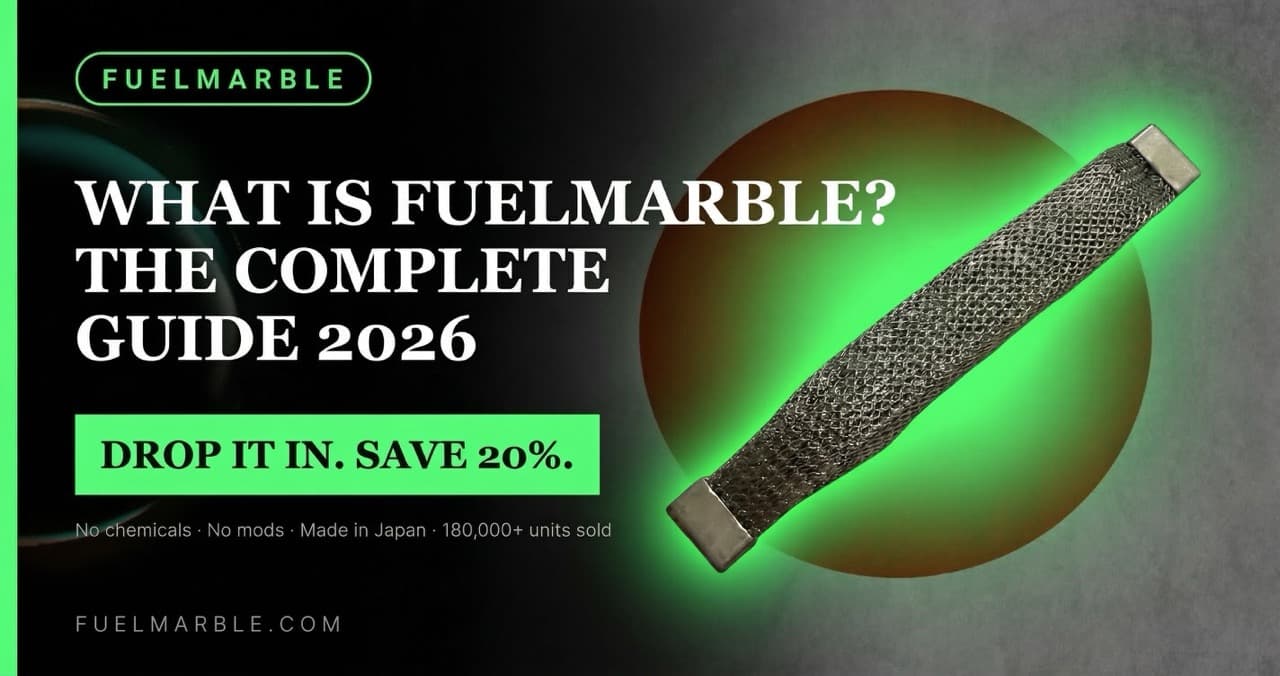
What is FuelMarble? The Complete Guide (2026)
Page Summary
FuelMarble is a ceramic glass mineral sphere you drop into your coolant reservoir. Its mineral surface lowers the coolant's surface tension, which removes the insulating vapour film at the cylinder wall, improves heat transfer, and allows more complete combustion. The result: 7–15% fuel savings and lower emissions, with no chemicals, no ECU changes, and no engine modifications.
With fuel prices driven by conflict in the Middle East, OPEC production decisions, and supply chain disruption, every percentage point of fuel you save is a direct hedge against costs you cannot control. Most fuel-saving approaches treat symptoms, driving style, tyre pressure, route planning. FuelMarble treats a root cause: the cooling system bottleneck that has been stealing energy from every combustion cycle since the vehicle left the factory.
This guide covers what FuelMarble is, how it works at a physics level, what the real-world numbers look like across cars, commercial trucks, agricultural equipment, and marine vessels, and exactly how to pick the right unit for your application.
What is FuelMarble?
FuelMarble is a precision-engineered ceramic glass and mineral sphere that you place directly into your vehicle's coolant reservoir tank. No tools. No draining. No plumbing. Installation takes under 60 seconds.
The device works through two simultaneous physical mechanisms:
1. Lower surface tension. The mineral surface is ultra-hydrophilic, a stable physical property of the material that requires no power source and does not deplete. Kurume Institute of Technology measured the contact angle of treated water dropping from 62° to 4°, and surface tension falling 2–5%: the liquid wets metal instead of beading on it.
2. Mineral ion exchange. The mineral composition releases trace ions that gently adjust the coolant's pH and raise its redox potential, conditions that further improve the coolant's wetting behaviour against metal surfaces.
The practical outcome of both effects: coolant that previously bridged over microscopic imperfections in the cylinder wall now makes direct, full-surface contact. The thermal boundary layer, the thin film of vapour between the coolant and the engine wall that blocks efficient heat transfer. Is eliminated.
FuelMarble applies to any liquid-cooled internal combustion engine with a coolant reservoir: passenger cars, SUVs, vans, trucks, buses, tractors, combine harvesters, and marine vessels. Air-cooled engines without a coolant reservoir are outside the application range.
A 2012 Honda Freed MPV (1,500cc) in Jakarta recorded a 21.75% fuel economy improvement over a 12-week field test. That is one vehicle; the documented typical range is 7–15%. Installation: drop into coolant reservoir. Done.
For the full technical breakdown of the glass composition, contact angle measurement, and combustion pressure data, see the FuelMarble technology page or the complete science of fuel enhancement article.
When Will You See Results?
Most drivers notice measurable fuel economy improvement after 150–200 km (about 95–125 miles) of driving following installation. This is not a delay. FuelMarble begins conditioning the coolant immediately. The 150–200 km window is the time required for the treated coolant to fully circulate, stabilise, and for the engine's combustion cycle to consistently reflect the improved heat transfer conditions.
The conditioning timeline:
- 0–50 km: The mineral surface begins acting on the circulating coolant. Ion exchange starts adjusting pH and surface tension
- 50–150 km: Treated coolant progressively replaces the old thermal boundary layer across all cylinder surfaces. You may notice slightly smoother idle or throttle response
- 150–200 km: Coolant conditioning is fully stabilised. Fuel consumption measurements taken from this point reflect the true, consistent improvement
- Beyond 200 km: Savings are continuous. Every fill is cheaper than without FuelMarble
Some vehicles take longer to reach full effect, those with larger engines, higher coolant volume, or heavy-duty and marine use can need for example around 300 km (185 miles), or the equivalent in operating hours, which varies with the coolant system.
Larger engines (trucks, buses, marine vessels) with higher coolant volumes may need slightly longer to reach full equilibrium: for example around 300 km, or the equivalent operating hours, which varies with the coolant system. Do not evaluate FuelMarble's performance on the first tank of fuel alone.
What Problem Does FuelMarble Solve?
FuelMarble solves the thermal boundary layer problem, the thin film of inefficiency between the coolant and cylinder walls that steals energy from every combustion cycle.
Most engines waste 30–40% of their fuel energy as heat. A significant fraction of that loss originates in the cooling system, not in the fuel, and not in the ECU. Standard coolant (typically a 30% antifreeze mix) has surface tension properties that prevent it from fully wetting cylinder wall surfaces. That incomplete contact creates a heat transfer bottleneck that is never addressed at a standard service.
The downstream consequences:
- Boundary layer friction: Coolant that does not fully wet metal surfaces creates thermal resistance, heat generated in the combustion chamber cannot efficiently transfer into the coolant
- Suboptimal combustion timing: Inefficient heat transfer causes combustion gases to cool too quickly, shortening the effective power stroke
- Excess fuel use: The ECU compensates for heat loss by injecting more fuel to maintain power output, you pay for energy that leaves as exhaust heat, not as forward motion
- Higher exhaust emissions: Incomplete combustion pushes unburned hydrocarbons, NOx, and soot into the exhaust, clogging the DPF faster and increasing emissions test failure risk
- DPF degradation: Every incomplete combustion event deposits more particulate matter in the filter. More deposits mean more forced regeneration cycles and accelerated filter failure
FuelMarble addresses this root cause directly. No fuel additive fixes it because the problem is not in the fuel. No ECU tune eliminates it. The ECU is compensating for the thermal bottleneck, not removing it.
How Does FuelMarble Work?
The surface chemistry change triggered by FuelMarble cascades through the engine in a documented four-stage chain:
Stage 1: Coolant surface tension drops. Contact with the mineral surface reduces the coolant's surface tension, measured at Kurume Institute of Technology as a contact angle falling from 62° to 4°. The mineral ion exchange simultaneously adjusts coolant pH and viscosity (approximately 7% increase in viscosity modification, measured at Kurume Institute of Technology).
Stage 2: Boundary layer is eliminated. With lower surface tension, the coolant makes direct contact with the engine wall rather than bridging over it with a vapour film. The effective heat transfer area increases significantly. Heat moves from the engine wall to the coolant more efficiently.
Stage 3: Cylinder wall temperature falls 8–12°C. This is the core measurable thermal outcome, verified directly on metal test surfaces at Kurume Institute of Technology. A cooler cylinder wall means cooler incoming charge air, and cooler air is denser, containing more oxygen and fuel vapour molecules per unit of volume. Charge air density increases by approximately 12%.
Stage 4: Combustion is more complete. More oxygen in the cylinder means a higher proportion of the fuel burns during the power stroke. Fewer unburned hydrocarbons pass into the exhaust. More chemical energy from the fuel converts to mechanical work, and less leaves as exhaust gas, soot, and waste heat.
The academic combustion pressure data (presented at the 2008 Japan Society of Automotive Engineers autumn conference by Professor Watanabe) shows this directly: with FuelMarble active, peak combustion pressure is higher, the power stroke is longer, and exhaust gas temperature is lower, the textbook signature of more complete combustion with the same quantity of injected fuel.
The mechanism is entirely passive and continuous. FuelMarble begins working as soon as coolant circulates past it. It does not react with standard antifreeze additives.
Drivers and fleet operators ready to install can shop FuelMarble: S for passenger cars and light vans, L for HGV and commercial fleets. Drop-in coolant reservoir installation. Under 60 seconds. No tools required.
What Results Has FuelMarble Produced?
Field tests across passenger vehicles, commercial fleets, and marine vessels document fuel savings ranging from 5.8% to 21.75%. The most rigorously controlled tests show consistent results in the 14–22% range for passenger cars, and 7–8% for large marine vessels operating on heavy fuel oil.
Laboratory: Kurume Institute of Technology, Japan:
- 7% measured increase in water viscosity modification under controlled conditions
- 8–12°C reduction in engine surface temperature, measured directly on metal test surfaces
- Contact angle reduction from 62° (control) to 4° (FuelMarble-treated surface)
Field Test: Honda Freed 1,500cc, Jakarta, Indonesia (12 Weeks):
- 7–15% measured improvement in fuel economy across standardised test periods
- Peak controlled test result: 21.75% over the two-month standardised cycle
- Same vehicle, standardised routes, before/after fuel consumption logs auditable line by line
Field Test: Honda Accord 2007, Qinhuangdao, China:
- Day 1 without FuelMarble: 195 km driven on the same fuel volume
- Day 2 with FuelMarble: 366 km driven on the same fuel volume
- 87% increase in driving range on equivalent fuel
Marine Vessel: RES FELICES (55,810 DWT Bulk Carrier, Japan, 2024–2025):
- 20 FuelMarble units installed in the vessel's main cooling circuit
- Pre-installation average daily fuel consumption: 15.96 MT/day (November 2024 baseline)
- Post-installation average daily fuel consumption: 14.79 MT/day (November 2025)
- Approximately 7.3% reduction in daily fuel burn
- CO₂ reduction calculated at approximately 2,385 kg per operational day
- 12 months of daily consumption logs with wind force conditions recorded
Results vary with engine type, load profile, operating conditions, and fuel quality. The 21.75% figure is from a light passenger vehicle on a controlled urban/suburban cycle. Marine and heavy commercial results trend lower but remain economically significant at scale.
For the full detail on individual test results, the does FuelMarble actually work? article covers every independent test with methodology, data, and a frank assessment of where the technology delivers and where it does not.
The Jakarta case study, 21.75% efficiency gain over 12 weeks in stop-and-go city traffic. Is covered in full in the Honda Freed 1500cc fuel efficiency test.
Is FuelMarble a Fuel Additive?
No. FuelMarble is not a fuel additive. It never contacts the fuel at any point in its operation.
A fuel additive is a liquid compound added directly to the fuel tank (consumed with each fill) intended to alter how the fuel burns or how deposits accumulate. FuelMarble is a solid mineral device placed once in the coolant reservoir. It contains no chemicals, releases no compounds into the fuel system, and does not alter fuel composition in any way.
Why this distinction matters practically:
- It does not deplete with each tank of fuel. FuelMarble has no rated service limit. The mineral retains its properties indefinitely. You install it once. You do not purchase it repeatedly.
- It does not introduce anything into the fuel or exhaust stream. Certain metallic fuel additives leave ash residues in DPFs that accumulate permanently. FuelMarble adds nothing to the exhaust. It is DPF-safe by design.
- It does not require any change in your fuelling routine. No measuring, no pouring, no remembering at each fill.
- It is not subject to fuel additive regulations in any jurisdiction reviewed. Fleet compliance officers can confirm: FuelMarble sits in the coolant reservoir tank only, no different in principle from placing a supplemental corrosion inhibitor float in the overflow bottle.
For the full regulatory and technical distinction, including a direct comparison against liquid fuel additive categories, see the dedicated article: Is FuelMarble a Fuel Additive? Full Answer.
Which Size Do I Need?
FuelMarble is sized by gross vehicle weight (GVW), not engine displacement. Over-sizing does not improve results. Under-sizing reduces effectiveness. When in doubt between categories, always choose the larger size.
| Vehicle GVW | Typical Examples | FuelMarble | Units |
|---|---|---|---|
| Under 2 tonnes | Compact cars, small SUVs | S (£239) | 1× |
| 2–4 tonnes | SUVs, large saloons, light vans | L (£519) | 1× |
| 4–13 tonnes | Medium trucks, heavy minibuses | L | 2× |
| Above 13 tonnes | Heavy trucks, coaches, buses | L | 3× |
| Agricultural equipment | Tractors, combine harvesters | Contact team | Custom |
| Marine vessels | Fishing boats to bulk carriers | Contact team | Custom |
Agricultural and marine applications should contact the FuelMarble technical team, coolant system design varies significantly across these sectors, and some open-circuit farm engine cooling systems require specific placement guidance.
Use the size selector on the FuelMarble store or contact the team for commercial, agricultural, and marine configuration.
How is FuelMarble Different From Cheap Fuel-Saving Gadgets?
The fuel economy gadget market is saturated with products, magnetic fuel conditioners, tornado air intakes, fuel ionisers, OBDII eco-maximisers, that share one feature: no peer-reviewed evidence of efficacy and no controlled field test data with auditable before/after fuel logs.
FuelMarble's evidence base:
- Academic validation: Presented at the 2008 Japan Society of Automotive Engineers autumn conference, peer-reviewed, not a promotional white paper
- Published mechanism: Measured changes in coolant surface tension, oxidation-reduction potential and viscosity, not vague "molecular alignment" claims
- Controlled field tests: Jakarta test ran January 25 to March 25, 2023, two full months, same vehicle, standardised routes, daily fuel logs
- Marine operator data: 12 consecutive months of daily consumption entries on the RES FELICES, with wind force conditions recorded for each day
- Independent laboratory measurement: Contact angle reduction (62° → 4°) is a standard, reproducible measurement, not a manufacturer claim
Comparable gadgets target fuel chemistry or air intake: FuelMarble targets the thermodynamic efficiency of heat transfer, which is where 30–40% of engine energy is actually lost.
For a head-to-head comparison against specific competing product types, including OBDII fuel savers and magnetic conditioners, see why a Honda Civic's MOT emission test can be made worse by cheap fuel saver gadgets and the Honda Accord mpg gadget test.
Conclusion: The Root Cause, Not the Symptom
Most drivers focus on the symptoms of a fuel problem, high bills, emissions failures, DPF warnings. The root cause, in most liquid-cooled engines, is a cooling system that has never been thermodynamically optimised. Surface tension in the coolant creates a thermal bottleneck that compounds with every fill.
No fuel additive fixes this (the problem is not in the fuel. No tune eliminates it) the ECU compensates for it, not around it. FuelMarble addresses it directly: one permanent installation, operating passively for the life of the vehicle, improving combustion efficiency from the first 150–200 km (about 95–125 miles) onward.
The chain is measurable at every step:
- Mineral surface contact → reduced coolant surface tension
- Reduced surface tension → eliminated boundary layer
- Eliminated boundary layer → 8–12°C cylinder wall temperature reduction
- Lower wall temperature → denser charge air
- Denser charge air → more complete combustion
- More complete combustion → up to 21.75% measured fuel efficiency improvement
Each link is independently verifiable. The data is available. The mechanism is documented physics, not a marketing claim.
⚡ PRO TIP: The Installation That Pays Back in Weeks, Not Years
Every litre of diesel or petrol you buy contains more energy than your engine extracts from it. A diesel engine converts 40–45% of fuel energy into motion under ideal conditions. The rest leaves as heat through the exhaust and engine block. This is not a design flaw in your specific vehicle. It is the thermodynamic reality of every internal combustion engine currently in operation.
The largest single recoverable portion of that waste is the thermal boundary layer, the vapour film between the coolant and the engine wall that insulates the combustion chamber on every power stroke. Independent laboratory measurement at Kurume Institute of Technology confirmed that eliminating this layer reduces cylinder wall temperature by 8–12°C, shifting peak cylinder pressure from approximately 60 bar to 75 bar without any engine modification or additive.
That is exactly what FuelMarble's coolant-based thermal efficiency technology delivers, a single installation in the coolant reservoir, operating passively for the life of the vehicle, recovering the fuel efficiency that the thermal boundary layer has been costing you on every single combustion cycle since the day your vehicle left the factory.
Related reading:
- Is FuelMarble a Fuel Additive? Full Answer
- the fleet fuel efficiency guide for UK operators
- How FuelMarble Unleashes Your Engine's Full Potential
Related Articles
Elias translates complex engine science into clear, accurate content. Specialising in diesel combustion, DPF systems, and Japanese engineering methodology, he produces FuelMarble's technical documentation, performance analyses, and in-depth product guides.
Ready to Improve Your Fuel Efficiency?
FuelMarble delivers up to 15% fuel efficiency improvement. Simple drop-in install.