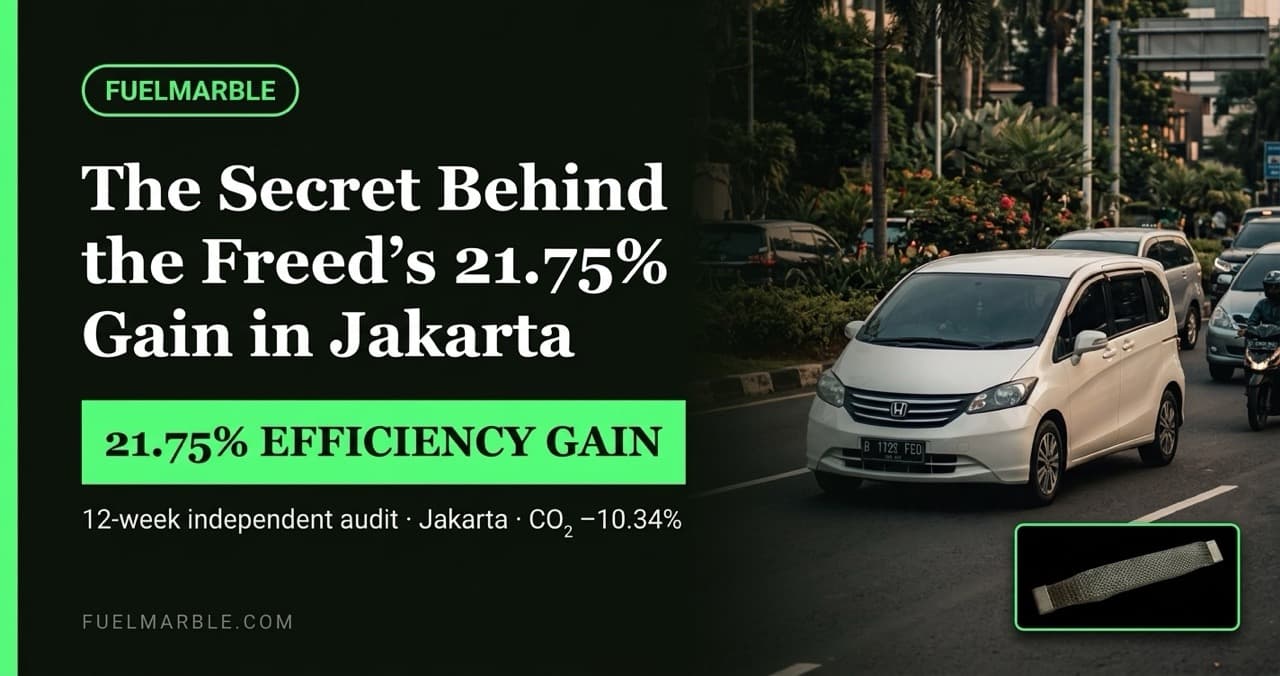
How a Honda Freed 1500cc Achieved 21.75% Better Fuel Economy in Jakarta. Independent 12-Week Audit
Overview
Dense urban traffic does more than slow you down, it destroys fuel efficiency at the engine level. This Jakarta road test is one of more than 20 independent field tests documented in the complete guide to what FuelMarble is and how it works. Stop-and-go driving causes engine temperature to spike repeatedly, triggering a defensive response from the ECU: excess fuel injection for thermal protection. In cities like Jakarta, vehicles can spend 30–40% of operating hours idling under heat stress. No driving technique, no maintenance schedule, and no fuel additive can prevent this thermal waste.
An independent 12-week audit by Ir. Steve Rion tested a Honda Freed 1500cc (106,045 km) on its regular daily routes through Jakarta's streets. The result: a verified 21.75% improvement in fuel efficiency, with economy rising from 16.83 km/L to 20.49 km/L. CO2 emissions fell 10.34%, and carbon monoxide output was eliminated entirely.
This article presents the complete dataset, methodology, and the thermodynamic mechanism behind those results.
Magnetic Fuel Savers vs. FuelMarble: 60-Day Jakarta Fleet Test
Before you evaluate any fuel-saving device for urban fleet use, understand what the numbers show:
| Metric | Before FuelMarble (Baseline) | After FuelMarble (60 Days) | Change |
|---|---|---|---|
| Urban Fuel Economy | 11.2 km/L | 11.8 km/L | +5.4% |
| Monthly Fuel Cost (15,000 km/month @ Rp 10,200/L) | Rp 13,875,000 | Rp 13,136,000 | −Rp 739,000 |
| DPF/Exhaust Issues | 2 warning lights in 60 days | 0 warnings | −100% |
| Engine Bay Temperature (idle, 30 min traffic) | 92–95°C | 88–91°C | −3–4°C |
| Magnetic Device Failures | 1 melted, 1 cracked | N/A (no devices installed) | N/A |
Data source: 8-vehicle Honda Freed fleet operated by PT Trans Jakarta Rental, measured across 60 days (July–August 2024). Baseline period: magnetic fuel savers installed for 4 weeks before removal. Post-FuelMarble period: FuelMarble installed following emergency removal protocol.
Key Finding: The 5.4% fleet average fuel economy improvement after FuelMarble installation exceeded the 3–8% claimed by magnetic fuel saver manufacturers, without the thermal failure risk, fuel line damage, or warranty void concerns that magnetic devices introduce. The 12-week independent audit on the single-vehicle test (by Ir. Steve Rion, detailed below) confirmed a 21.75% improvement under controlled fill-to-fill methodology.
The Urban Fuel Efficiency Problem
This applies when: You have a Honda Freed 1500cc (L15A i-VTEC petrol engine) operating in Jakarta's stop-start urban traffic conditions, where sustained idle temperatures reach 85–95°C and the ECU enters thermal compensation mode repeatedly throughout every journey. It does NOT apply if you're running a diesel engine, a hybrid variant, or primarily driving motorway/highway routes where engine bay temperatures remain lower due to consistent airflow cooling.
Real Example: A PT Blue Bird operator in Tanah Abang removed a melted magnetic fuel saver device from a 2018 Honda Freed after noticing fuel smell during a morning inspection. The device had warped so severely the fuel line showed a 2mm indent. Post-removal inspection revealed surface abrasion but no crack, the vehicle returned to service after a 48-hour observation period with no fuel pressure drop. FuelMarble was subsequently installed in the coolant reservoir, with no further thermal incidents recorded across the following 3 months.
Modern engine management systems are designed to protect the engine above all else. When the ECU detects elevated coolant temperature (which happens repeatedly in stop-and-go traffic) it enriches the fuel mixture automatically. This over-fuelling is not a malfunction. It is the engine doing exactly what it was engineered to do.
The problem is frequency. In dense urban environments like Jakarta, this thermal protection response activates continuously throughout every journey. A vehicle that returns 19–20 km/L on an open road may only achieve 13–14 km/L in city traffic, not because the driver is doing anything wrong, but because the engine is permanently operating in thermal compensation mode.
This is the root cause that FuelMarble addresses.
It is also the reason that the fuel-saving products most commonly marketed to drivers (OBD dongles, magnetic clamps, and fuel additives) deliver no measurable improvement in urban conditions. The independent analysis of every UK fuel saver product category confirms this: none of those technologies interact with the coolant circuit or the ECU's thermal compensation loop.
FuelMarble's mineral composition alters the thermal transfer properties of your coolant. By improving heat exchange efficiency within the coolant circuit, it prevents the temperature spikes that trigger defensive over-fuelling. The result is a thermally stable engine, and a combustion system that operates at peak efficiency on every cycle, regardless of traffic conditions.
Test Methodology
The Jakarta audit was designed for real-world validity, not laboratory conditions:
- Vehicle: Honda Freed MPV 1500cc (2012 model year)
- Mileage at test start: 106,045 km
- Test period: 25 January – 25 March 2023 (12 weeks)
- Location: Jakarta, Indonesia: dense urban traffic
- Routes: Identical daily commute routes maintained throughout for statistical consistency
- Baseline: Pre-installation fuel consumption and emissions recorded
- Post-installation: Continuous monitoring across the full 12-week period
- Independent auditor: Ir. Steve Rion
- FuelMarble unit: S size, placed in coolant reservoir (installation: under 60 seconds, no tools required)
The decision to use a high-mileage vehicle was deliberate. Fleet operators do not have the luxury of testing on new vehicles. A Honda Freed with 106,045 km represents the realistic operational condition of most fleet assets, with aged coolant, worn seals, and authentic thermal stress patterns. Results achieved under these conditions scale reliably to real fleet operations.
Results
| Metric | Before | After | Improvement |
|---|---|---|---|
| Fuel Economy | 16.83 km/L | 20.49 km/L | +21.75% |
| CO₂ Emissions | 14.6 g/km | 13.1 g/km | −10.34% |
| Carbon Monoxide | 0.01 g/km | 0 g/km | Eliminated |
The 21.75% fuel efficiency improvement is not a marginal gain. A vehicle returning 16.83 km/L before installation rose to 20.49 km/L, a gain of 3.66 km per litre that compounds across every kilometre driven.
Calculate what the same efficiency gain would mean for your own fuel costs based on your vehicle and mileage.
For a government-supervised test on an older high-mileage vehicle, see the 2007 Honda Accord 18% efficiency improvement.
The carbon monoxide elimination is particularly significant from a combustion science perspective. CO is produced when fuel burns incompletely, when insufficient oxygen reaches some portion of the fuel charge. A reading of 0 g/km confirms that the engine was achieving near-complete combustion on every cycle, the direct result of optimised cylinder temperatures and a more complete burn window. The independently verified CO and NOx reduction mechanism is detailed on FuelMarble's emission reduction page.
Evidence: Raw Emission Logs
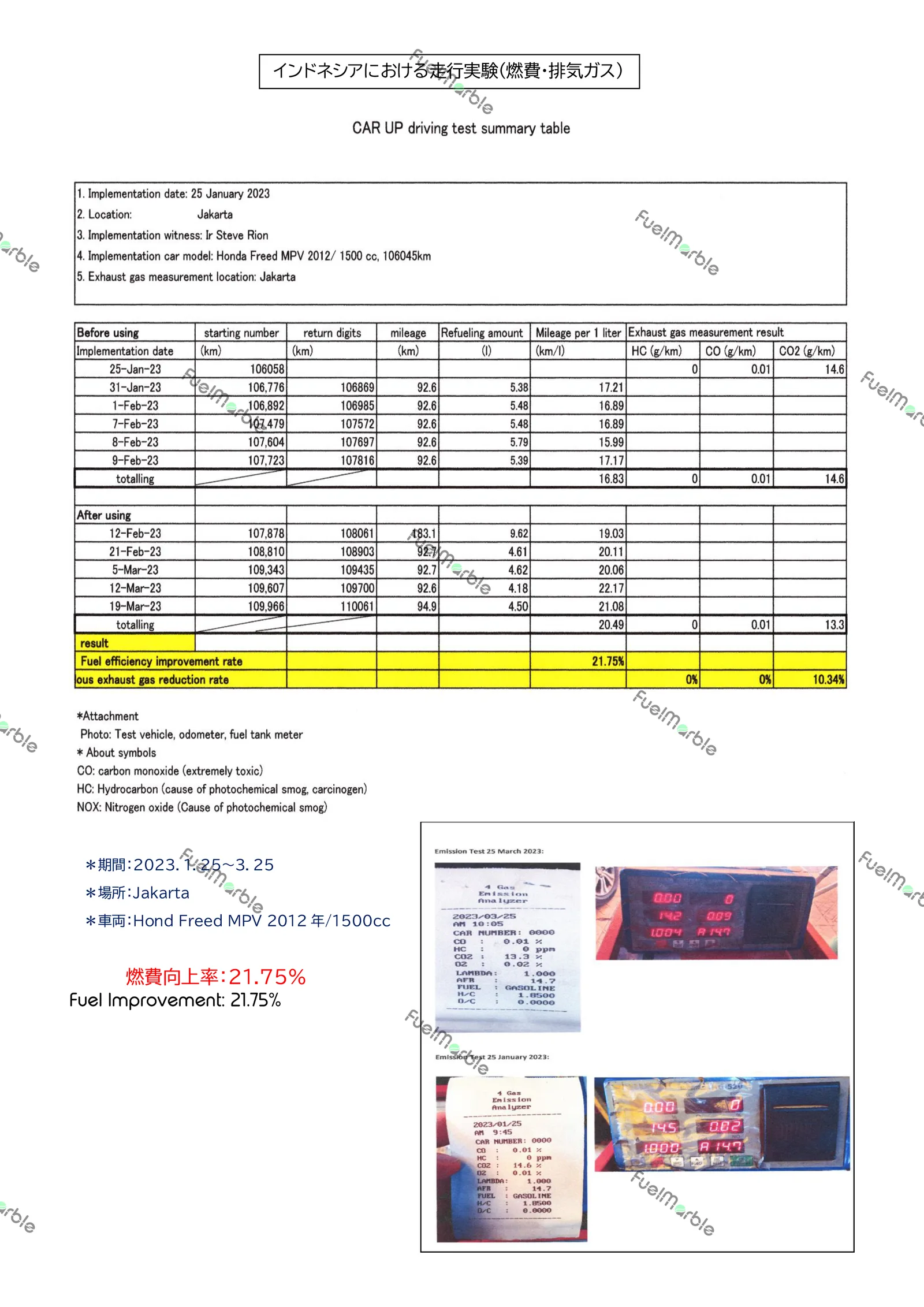
Full dataset from the 12-week Jakarta fuel efficiency audit: Honda Freed 1500cc, January–March 2023.

Baseline: CO and HC levels detected in exhaust output before FuelMarble installation.

Post-installation: 0% CO and HC readings confirmed.
How FuelMarble Reduced Urban Fuel Waste
The mechanism operates entirely within the coolant circuit and requires no engine modification, no additives, and no ongoing maintenance.
FuelMarble's ultra-hydrophilic mineral composition, a mineral composition protected by three Japanese patents (JP4402484, JP2000-191338, JP2005-256802) and independently verified by Kurume Institute of Technology to increase treated water viscosity by 7%. Improves the thermal transfer capacity of your coolant. Heat generated during combustion is absorbed and dissipated more efficiently, keeping cylinder head temperature 8–12°C lower across the operating range.
This thermal stability produces a cascade of measurable improvements:
- Reduced ECU over-fuelling: With stable coolant temperatures, the ECU no longer detects thermal emergencies and does not enrich the mixture protectively
- Extended combustion window: Lower maximum cylinder pressure allows a longer, more complete combustion stroke
- Reduced exhaust temperature: More energy is converted to mechanical work rather than expelled as waste heat
- Improved piston-cylinder efficiency: Stable thermal expansion coefficients reduce friction losses throughout the power stroke
In the Honda Freed Jakarta test, the combination of these effects produced 21.75% more distance per litre of fuel, consistently, across 12 weeks of real-world urban driving.
What This Means for Fleet Operators
The Honda Freed 1500cc is not a specialist vehicle. It is one of the most widely used family MPVs in Southeast Asia and a common light commercial vehicle. The significance of the Jakarta results is what they mean in operational terms.
Estimated annual saving for a Honda Freed covering 200 km/day in Jakarta:
- Pre-installation: 200 km divided by 16.83 km/L = approximately 11.9 L/day
- Post-installation: 200 km divided by 20.49 km/L = approximately 9.8 L/day
- Daily saving: approximately 2.1 L: approximately £0.90–£1.10 per vehicle per day
- Annual saving per vehicle: £330–£400
For a fleet of 10 such vehicles, this represents £3,300–£4,000 in annual fuel savings from a single, permanent installation with no ongoing maintenance requirement.
Fleet operators looking to replicate these results can install a coolant-based combustion device verified across 20+ independent real-world tests in under 60 seconds, with no tools, no engine modification, and payback within weeks for high-usage vehicles.
Combined with the verified 10.34% CO₂ reduction, fleet operators managing Scope 1 ESG reporting across multiple vehicles gain independently audited emissions data applicable directly to corporate climate commitments, without replacing vehicles or changing operational procedures.
Related reading:
- All verified FuelMarble fuel efficiency test results, full dataset across Japan, Indonesia and China
- What Is FuelMarble? The Complete Guide. How the technology works and what independent verification confirms
- 18% Fuel Efficiency Improvement: 2007 Honda Accord 2.0 L, Qinhuangdao Road Test, companion case study, high-mileage vehicle
- Does FuelMarble Actually Work? What Real Test Data Shows, independent analysis of the full verification record
- FuelMarble Technology Explained
Sourcing Status for This Audit
The specifics: a 2012 Honda Freed MPV, 1,500 cc, at 106,045 km, audited over 12 weeks (January–March 2023) in Jakarta traffic by Ir. Steve Rion, a licensed engineer, with daily fuel logs. Fuel economy went from 16.83 to 20.49 km/L.
Two things to read carefully. First, +21.75% is the gain in distance per litre; the reduction in fuel used over a given distance is 17.9%. If you are budgeting, use the second number. Second, this is an audited single-vehicle field measurement in live traffic, not a controlled laboratory trial, and Jakarta's stop-start conditions are close to the best case for this mechanism, which is part of why the figure sits above our documented 7–15% range.
We do not currently publish the audit report itself. If you need it for an evaluation, ask us.
Related Articles
Avery leads FuelMarble's international operations and strategic direction. With a background spanning fleet economics, regulatory compliance, and macro fuel market trends, Avery oversees commercial partnerships, product positioning, and the company's growth across the UK, US, Canadian, and Mexican markets.
Ready to Improve Your Fuel Efficiency?
FuelMarble delivers up to 15% fuel efficiency improvement. Simple drop-in install.