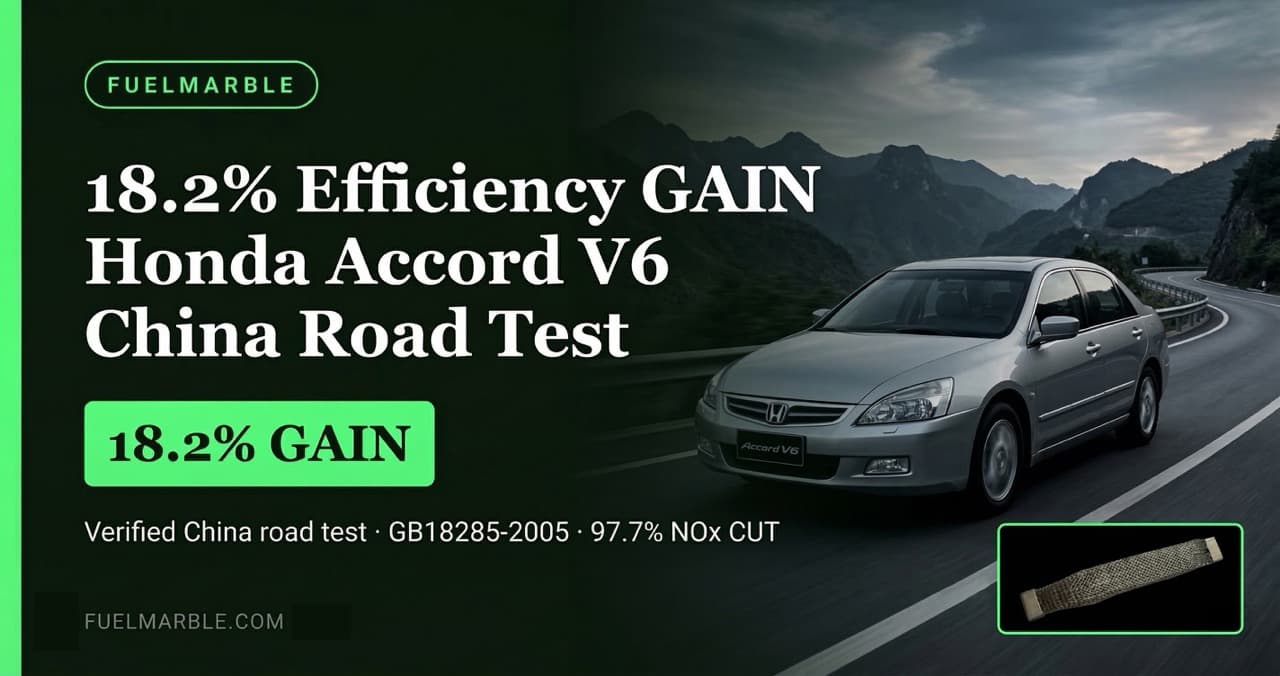
18% Fuel Efficiency Improvement: 2007 Honda Accord 2.0 L, Qinhuangdao Road Test
Overview
In April 2019 the Qinhuangdao Ecological Environment Bureau, in Hebei province, China, ran a two-day fuel and emissions comparison on one of its own official vehicles: a 2007 Honda Accord 2.0 litre petrol saloon with roughly 147,650 km on the clock. This case study is part of FuelMarble's verified fuel efficiency test series, the complete guide to what FuelMarble is and how it works.
Fuel economy rose from 11.32 km/L to 13.36 km/L, an 18% gain in distance per litre. Emission certificates issued under GB18285-2005 and DB13/1801-2013 recorded NOx down 98% (1.32 to 0.03 g/km) and CO down 93% at both idle and high idle.
This article sets out the full dataset, the method, and, just as importantly, what this test does not establish.
What Was Measured
It is worth being precise about the arithmetic, because the two ways of expressing this result differ by nearly three percentage points.
Distance per litre improved by 18%: (13.36 − 11.32) ÷ 11.32 = 18.0%.
Fuel burned per kilometre fell by 15.3%: 1 − (11.32 ÷ 13.36) = 15.3%.
If you are budgeting a fuel bill, the 15.3% figure is the one that matters, because a fuel bill is litres purchased, not kilometres per litre. The headline "+18%" is the efficiency gain, not the reduction in spend. Our fuel savings calculators work on the fuel-saving basis for exactly this reason.
Test Methodology
- Vehicle: 2007 Honda Accord, 2.0 litre petrol (K20A7, 1998 cc), automatic, front-wheel drive
- Odometer at test: approximately 147,650 km (about 92,000 miles)
- Operator: Qinhuangdao Ecological Environment Bureau, Hebei, China, on its own official vehicle
- Dates: 18 and 19 April 2019
- Fuel economy method: full-tank fill, one day per condition. Day 1 covered 195 km without FuelMarble; Day 2 covered 366 km with it, each from a measured fill
- Emission standard: GB18285-2005 and DB13/1801-2013, dual-idle method
- Emission certificates: Qinhuangdao Shiao Motor Vehicle Testing Co. (CMA-certified), report numbers 1303190105003801 and 1303190105003856
- FuelMarble unit: S size, placed in the coolant reservoir, no tools and no engine modification
The vehicle was chosen by the operating agency, not by us: it was simply the car the bureau ran. That is a strength for relevance (this is a working vehicle on ordinary roads) and a limitation for control, which the next section covers.
Results
| Metric | Before | After | Change |
|---|---|---|---|
| Fuel economy | 11.32 km/L | 13.36 km/L | +18% |
| Fuel used per km | Baseline | 15.3% lower | −15.3% |
| NOx | 1.32 g/km | 0.03 g/km | −98% |
| CO at idle | 0.15% | 0.01% | −93% |
| CO at high idle | 0.28% | 0.02% | −93% |
| HC at high idle | 24 ppm | 15 ppm | −38% |
| HC at idle | 22 ppm | 23 ppm | +1 ppm |
Single vehicle, two single-day runs of unequal length (195 km and 366 km) in different ambient conditions (17.9 °C / 57.7% RH and 22.6 °C / 21.7% RH). Agency-witnessed road and emissions testing under GB18285-2005 and DB13/1801-2013, not a laboratory dynamometer trial and not UK, EU or US certification.
The emission results are the more clear-cut half of this test, because they come from certificates issued by a CMA-certified testing company rather than from a road comparison.
NOx: 1.32 to 0.03 g/km. NOx forms when peak combustion temperature is high enough for atmospheric nitrogen to react with oxygen. A reading of 0.03 g/km indicates peak temperature was no longer reaching that threshold. The emission reduction mechanism is documented in full on FuelMarble's emission page. These are measurements made to Chinese standards in China; they are not UK, EU or US certification figures.
CO: down 93% at idle and at high idle. CO is a product of incomplete combustion, so a fall of this size points to a more complete burn per cycle.
Hydrocarbons: mixed, and reported as measured. HC at high idle fell from 24 ppm to 15 ppm. At idle, HC went the other way, from 22 ppm to 23 ppm. That is a one-part-per-million rise on a small base, well inside the noise you would expect between two days with different ambient conditions, but we report it because it is in the certificate. The source report labels this rise "+0.05%", which is wrong; the ppm values above are the figures to use.
For a comparison with a different vehicle in Indonesian traffic, see the Honda Freed 1500cc Jakarta case study.
Limits of This Test
We would rather state these plainly than have a reader discover them later:
- One vehicle, one test. A single car cannot establish a general effect size, however carefully it is measured.
- Two single-day runs of unequal length. Day 1 covered 195 km, Day 2 covered 366 km. Comparing a short day against a long one favours the long day, because a greater share of its distance is driven at a warm, settled operating temperature.
- The weather was not held constant. Ambient temperature was 17.9 °C on day one and 22.6 °C on day two; relative humidity was 57.7% and 21.7%. Both differences affect fuel economy independently of anything fitted to the car.
- Not a dynamometer test. The fuel figures come from full-tank road running witnessed by the operating agency, not from a laboratory under a repeatable drive cycle.
- Chinese standards, Chinese conditions. GB18285-2005 and DB13/1801-2013 are not UK, EU or US type-approval procedures, and this test says nothing about compliance in those markets.
Taken together, those caveats are why FuelMarble's published expectation remains 7–15%, and why this page presents 18% as one vehicle's measured outcome rather than as a forecast. If you want the sceptic's view of the whole evidence base, our review of what the test data does and does not show is the honest version.
Evidence: Raw Emission Logs

Emission certificates issued under GB18285-2005 and DB13/1801-2013 by Qinhuangdao Shiao Motor Vehicle Testing Co. (CMA-certified), report nos. 1303190105003801 and 1303190105003856.

Day 1 covered 195 km without FuelMarble; day 2 covered 366 km with it, each measured from a full-tank fill. Fuel economy rose from 11.32 to 13.36 km/L.
How FuelMarble Stabilises Combustion in High-Mileage Engines
FuelMarble requires no engine modification, no fuel system change and no ongoing maintenance. It operates entirely within the coolant circuit.
The mineral composition is protected by three Japanese patents (JP4402484, JP2000-191338, JP2005-256802) and its physical effects on treated water have been measured at Kurume Institute of Technology. The measured properties, set out in full on how the technology works, are:
- Surface tension falls sharply. The contact angle of treated coolant drops from 62° to 4°, which is what "ultra-hydrophilic" means in practice: the liquid wets the metal instead of beading on it.
- The vapour boundary layer is removed. Wetted metal transfers heat to the coolant instead of being insulated from it by a film of vapour.
- Cylinder head temperature falls 8 to 12 °C. Measured by thermocouple, this is the direct consequence of better heat transfer.
- More of the fuel's energy reaches the piston. Heat carried away by the cooling circuit falls from roughly 28% to 23% of fuel energy, and peak cylinder pressure rises from about 60 to 75 bar.
That chain is the mechanism. What this particular test adds is a measurement of the outcome on one high-mileage vehicle in ordinary service, alongside emission certificates from a certified testing company.
What This Means for Fleet Operators
The honest planning figure is FuelMarble's documented 7–15% range, not this vehicle's 18%. What the Accord test does give you is a worked example on real measured consumption rather than a manufacturer's round number.
Worked example, using this test vehicle's measured figures and a 150 km day:
- Before: 150 km ÷ 11.32 km/L = 13.25 litres per day
- After: 150 km ÷ 13.36 km/L = 11.23 litres per day
- Saving: 2.02 litres per day, which at £1.49/litre is £3.01 per day, about £1,100 per year
- Payback on a £239 FuelMarble S: approximately 79 days
Those figures are this vehicle's, on this duty cycle, at a stated fuel price. A vehicle improving at the middle of the 7–15% band on the same mileage would save closer to £1.50 a day and pay back in roughly five months. Fleet operators running high-mileage assets on urban duty cycles can fit a coolant-based combustion device with no engine modification required and run their own before-and-after measurement over a longer period than two days.
The emission results have regulatory relevance but also a hard limit. Fleet operators managing ULEZ and CAZ compliance should note that these are Chinese-standard measurements on one vehicle; they are evidence of a mechanism, not documentation that will satisfy a UK Clean Air Zone scheme or a Scope 1 reporting auditor on their own.
Related reading:
- What Is FuelMarble? The Complete Guide
- How FuelMarble Technology Works: The Science of Fuel Enhancement
- Honda Freed 1500cc Jakarta Test: 21.75% Fuel Efficiency Improvement
- FuelMarble Technology Explained
Want to measure this on your own vehicle? View all verified test results or shop FuelMarble.
Related Articles
Elias translates complex engine science into clear, accurate content. Specialising in diesel combustion, DPF systems, and Japanese engineering methodology, he produces FuelMarble's technical documentation, performance analyses, and in-depth product guides.
Ready to Improve Your Fuel Efficiency?
FuelMarble delivers up to 15% fuel efficiency improvement. Simple drop-in install.