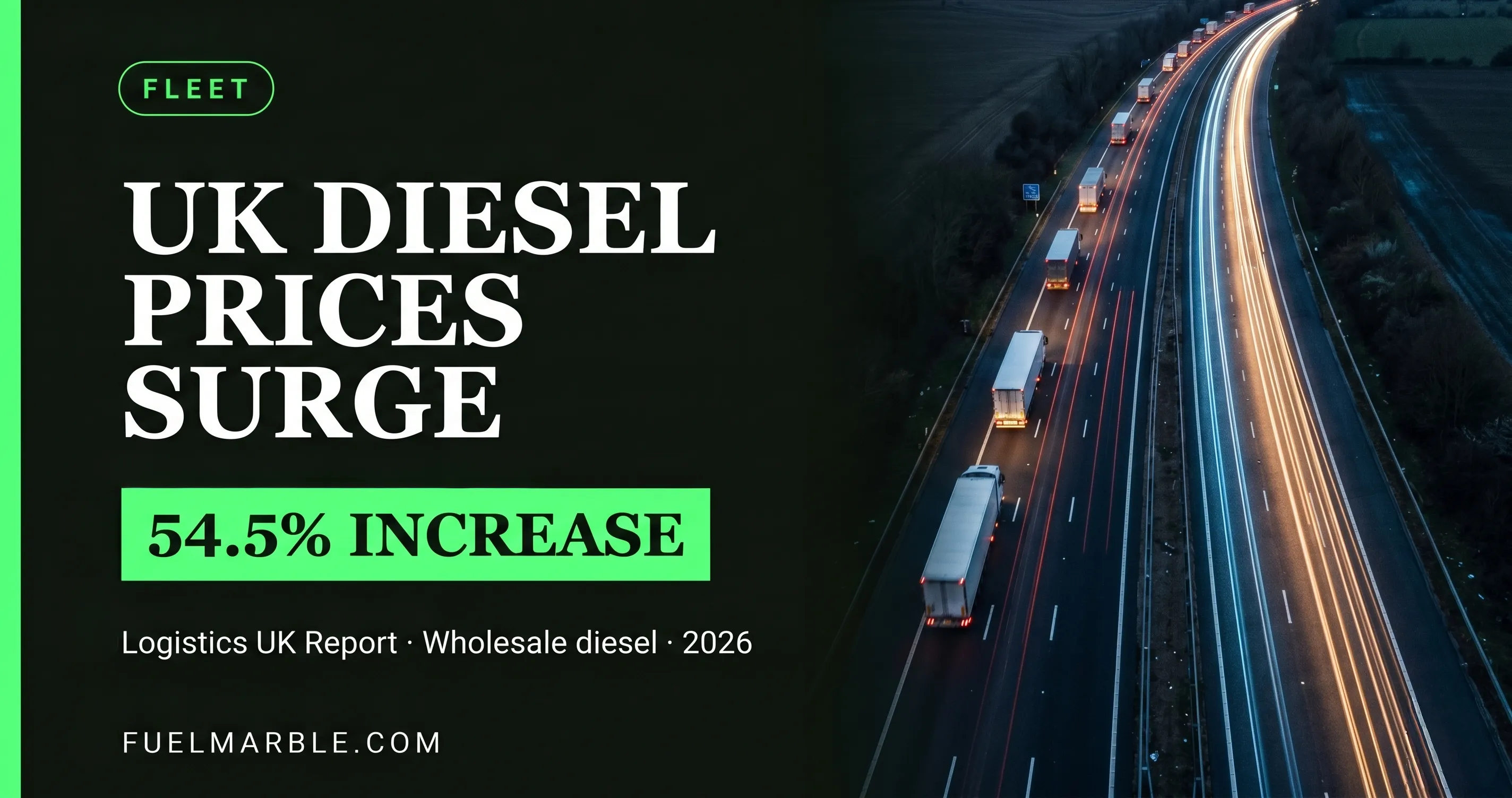
UK Diesel Prices Rose 36% in 2026: Here's What It Cost a 10-Truck Fleet
UK diesel is averaging 199.3p per litre right now (GOV.UK, week ending 19/10/2026). Petrol is 174.6p.
The calculations in this article are worked at 195.53p per litre, the rate as at September 2026. Diesel is now 1.9% higher than that, so scale the figures below accordingly.
See live UK fuel prices and cost per HGV →Update (September 2026): UK diesel has climbed again to 195.53p/L in the week commencing 21 September 2026 (GOV.UK weekly average), up 4.81p week-on-week. The cost pressure described below is ongoing, not a one-off spring spike. The figures have been recalculated against the corrected 2026 prices.
Page Summary
Logistics UK reports diesel costs rose 36% in the year to April 2026, while the Middle East conflict pushed pump diesel from about £1.42/L to a ~£1.91/L peak in mid-April, adding approximately £222,758 a year to a 10-truck HGV fleet's fuel bill. The only response that creates a permanent advantage is reducing consumption per vehicle.
One figure from Logistics UK's Manager's Guide to Distribution Costs 2026 should be on every fleet manager's desk right now: diesel costs rose 36% in the year to April 2026, the single largest driver of rising HGV operating costs. On the pumps, the conflict-driven spike took fleet diesel from about £1.42/L in February to roughly £1.91/L at its mid-April peak. For a sector already operating on wafer-thin margins, that is not a pricing adjustment. It is a structural shock. Understanding the full scope of that shock, in hard pound figures, is the foundation of any credible fleet fuel cost strategy, which is why it sits at the heart of the UK fleet diesel fuel efficiency guide every operator should be running against right now.
What you will find here:
- What actually triggered the 2026 diesel price spike
- The exact added cost to a 10-truck HGV fleet, calculated line by line
- The three responses available to fleet managers, and why only one is sustainable
- What a verified 7–15% efficiency gain is worth at peak 2026 diesel prices
- How the cost crisis and decarbonisation pressure point to the same intervention
What Actually Triggered the 2026 Diesel Price Spike?
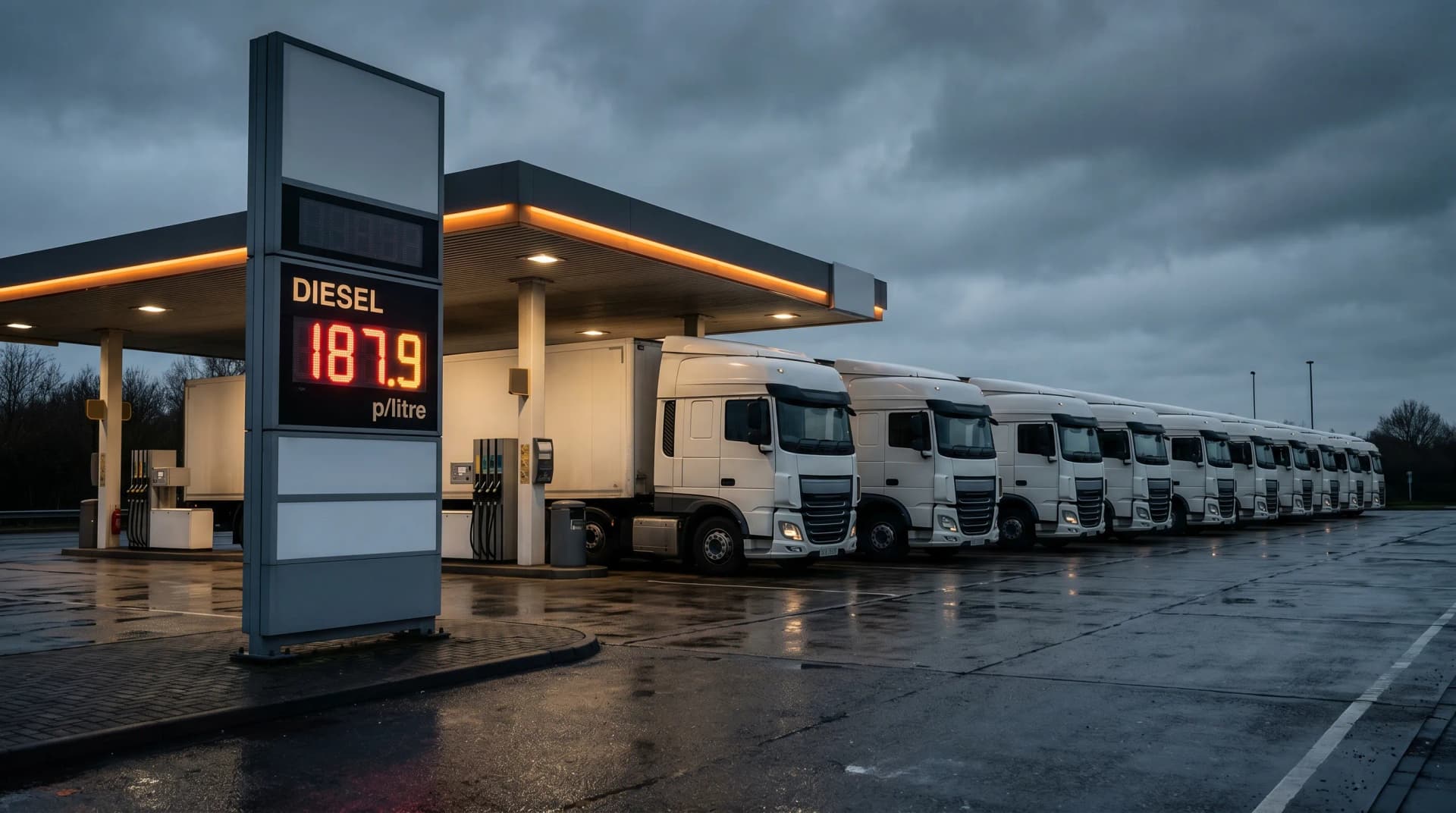
The conflict rapidly disrupted Strait of Hormuz oil flows. The International Energy Agency described it as an unprecedented disruption to global oil supply. Wholesale diesel follows crude pricing closely, and the spike fed through to UK pump prices within weeks.
- The conflict began February 2026; UK pump diesel peaked in mid-April 2026
- Hormuz handles roughly 20% of global oil supply, its disruption moves wholesale markets within days
- UK logistics operates on contracts where fuel price mechanisms often lag pump price changes by weeks
- Logistics UK notes prices "remained elevated and highly volatile" after the initial spike, not a one-week event
- The conflict move took pump diesel from about £1.42/L in February to roughly £1.91/L (191.54p) at the mid-April peak, a spike of about 35%, separate from and not to be confused with Logistics UK's 36% year-on-year operating-cost figure
This applies when you are modelling your fleet's 2026 fuel exposure against live pricing. It does not apply if you are comparing against DERV spot prices from 2025, which were on a broadly downward trend before the conflict.
Logistics UK reports the sector employs 2.6 million people and operates on margins so tight that fuel cost increases will ultimately feed through to prices more broadly if sustained. That is the mechanism by which a Strait of Hormuz disruption becomes a UK inflation event.
What Does the 2026 Diesel Increase Actually Cost a 10-Truck HGV Fleet?
The calculation is as follows for a 10-vehicle fleet, each covering 80,000 miles per year at 8 MPG:
- Annual litres per truck: ~45,460 litres (10,000 imperial gallons)
- Pre-conflict annual fuel bill per truck (£1.42/L): £64,554
- Peak annual fuel bill per truck (£1.91/L): £86,830
- Increase per truck: +£22,276
- Increase across the 10-truck fleet: +£222,758
- Total fleet fuel bill at peak diesel: £868,303 per year
This applies when your fleet is running Class 8 HGVs at approximately 8 MPG with standard annual mileage. It does not apply if your vehicles are Class 6/7 with lighter duty cycles or significantly higher fuel efficiency, where the absolute figures will be lower but the percentage shock is identical.
I have sat through enough budget reviews to know that a £222,758 variance line item, appearing mid-year, with no warning in the prior year's forecast. Does not just affect the fuel budget. It restructures the P&L entirely. In my experience, operators who had not stress-tested their contracts against a 30%+ fuel move faced two choices: renegotiate at a disadvantage, or absorb the loss. Neither is a good quarter-end conversation.

What Are the Three Options Fleet Managers Actually Have Right Now?
Option 1: Pass costs on to customers. Contractually possible in some cases, commercially dangerous in most. Logistics UK warns the increase will ultimately feed through to broader prices if sustained, but that is at sector level. At individual operator level, passing costs on risks contract loss to competitors who found another lever first.
Option 2: Absorb the increase. Impossible at scale. A £222,758 annual fuel increase on a 10-truck fleet cannot be absorbed on transport margins that Logistics UK reports typically run at 2–3%. This path leads to insolvency at sustained high diesel prices.
Option 3: Reduce consumption per vehicle. The only lever operators fully control, and the only one that creates a permanent structural advantage rather than a temporary fix.
- Consumption reduction does not require renegotiating contracts
- It does not expose you to customer pushback
- It does not depend on government policy (Fuel Duty delay, road tax holiday) remaining in place
- It is the only option that improves margin regardless of what diesel does next
This applies when your fleet is on fixed-price contracts with no fuel escalation clause. It does not apply if you have full fuel cost pass-through in your commercial agreements, in which case Options 1 and 3 can both run simultaneously.
If you are looking at the operational risk breakdown in depth, specifically the DPF cost exposure that compounds fuel spend under high-load running at elevated temperatures, our guide to HGV fuel consumption benchmarks for UK fleets in 2026 covers the MPG floor every diesel fleet should be defending right now.
What Is a 7–15% Fuel Saving Worth at Current 2026 Diesel Prices?
That range is based on FuelMarble's independently verified efficiency improvement, and the crisis has made the return faster, not slower.
| Scenario | Annual Fleet Fuel Bill | Annual Saving | Investment (10× L) | Payback |
|---|---|---|---|---|
| 7% efficiency gain | £868,303 | £60,781 | £5,190 | 31 days |
| 15% efficiency gain | £868,303 | £130,245 | £5,190 | 15 days |
| Scenario | Annual Fleet Fuel Bill | Annual Saving | Investment (10× L) | Payback |
|---|---|---|---|---|
| 7% efficiency gain | £645,540 | £45,188 | £5,190 | 42 days |
The payback period on a £5,190 investment has shortened from about 42 days to 31 days purely because of the diesel price move. This is the arithmetic that Logistics UK's "agility and ingenuity" framing is implicitly pointing toward, and it is the one decision variable fleet operators actually control.
This applies when you are running Class 8 HGVs at approximately 8 MPG across 80,000 miles/year. It does not apply if your vehicles run significantly higher MPG (newer Euro VI spec trucks on motorway routes) where baseline consumption is already lower, though the percentage savings still apply.
What Does Logistics UK's 2026 Reporting Say About Decarbonisation, and Why It Matters for Fuel Costs?
Domestic transport (the largest-emitting sector of UK greenhouse gas emissions) is the highest-profile regulatory pressure point for fleet operators. Logistics UK reports that EV deployment is increasing and low-carbon fuel uptake is growing, but "commercial viability, operational challenges and infrastructure demands remain key barriers."
- Fuel Duty delay and road tax holiday reduce short-term cost, but do not reduce per-litre consumption, see the confirmed UK fuel duty increases in 2026 and what they mean for fleet budgets
- Two thirds of logistics respondents investing in alternative fuels were prioritising battery electric vehicles, before the Middle East conflict
- The conflict has materially changed the EV transition calculus: capex for EVs now competes directly with elevated diesel cashflow pressure
- There is no decarbonisation pathway that does not require reducing diesel volume burned per mile
FuelMarble operates at the intersection of these two pressures simultaneously. A 7–15% reduction in diesel burned is a 7–15% reduction in CO₂ output, with no infrastructure dependency, no grid connection requirement, and no capex that competes with vehicle replacement cycles. It is the only decarbonisation intervention that also repairs the fuel cost line in the same move.
This applies when your fleet is under both cost pressure and emissions reporting obligations. It does not apply if you have already fully transitioned to BEV or HVO for a vehicle class, where the combustion mechanism is already absent.
For the immediate operational response, our companion guide covers the UK diesel fleet action plan, the short-term levers that protect margin while the market is volatile.
Government relief announced 20 May 2026: The planned Fuel Duty increase has been delayed from September 2026 to end of year. A 12-month road tax holiday for HGVs and reduced red diesel duty for rail freight were also confirmed. This reduces short-term operating costs, but does not reduce per-litre consumption, and provides no protection if diesel prices remain elevated into Q3/Q4 2026.
What Is the Single Intervention That Costs Less Than One Week's Fuel Saving?
- Cost per unit: £519 (FuelMarble L)
- Annual saving per truck at 7% (£1.91/L diesel): £6,078
- Payback per unit: 31 days
- Mechanism: coolant surface tension reduction improves heat transfer to the cylinder wall, lowers intake charge temperature, increases charge density, and improves combustion completeness, verified independently by the Kurume Institute of Technology and cleared by the Japan Fair Trade Commission in 2008
- Activation period: 150–200 km (about 95–125 miles) after installation, some larger vehicles, for example around 300 km (185 miles), which varies with the coolant system
- Units sold: the manufacturer reports more than 180,000 since 2004 (originally marketed in Japan as CAR UP)
This applies when you are running a water-cooled diesel engine. It does not apply to electric vehicles, as the combustion cycle is absent.
Pro Tip: From Avery
Cutting engine idling, optimising routes, and switching fuel cards are all solid moves. Every fleet operations manager worth their salary has already done them. They are also the first thing every competitor has done, which is why they no longer differentiate on cost.
The reason these interventions hit a ceiling is that none of them address what actually happens inside the combustion chamber. Fuel card negotiations change the price you pay per litre. They do not change how many litres the engine burns per mile. An engine running at sub-optimal combustion efficiency will keep burning that extra fuel regardless of pump price.
That is exactly the problem a coolant-based combustion efficiency device with verified 7–15% fuel savings for HGV fleets addresses at the source. No fuel contact. No engine modification. No downtime. At £1.91/L peak diesel, the investment pays back in about 31 days, then every litre you do not burn goes straight to the bottom line.
Avery leads FuelMarble's international operations and strategic direction. With a background spanning fleet economics, regulatory compliance, and macro fuel market trends, Avery oversees commercial partnerships, product positioning, and the company's growth across the UK, US, Canadian, and Mexican markets.
Related Articles
Ready to Improve Your Fuel Efficiency?
FuelMarble delivers up to 15% fuel efficiency improvement. Simple drop-in install.