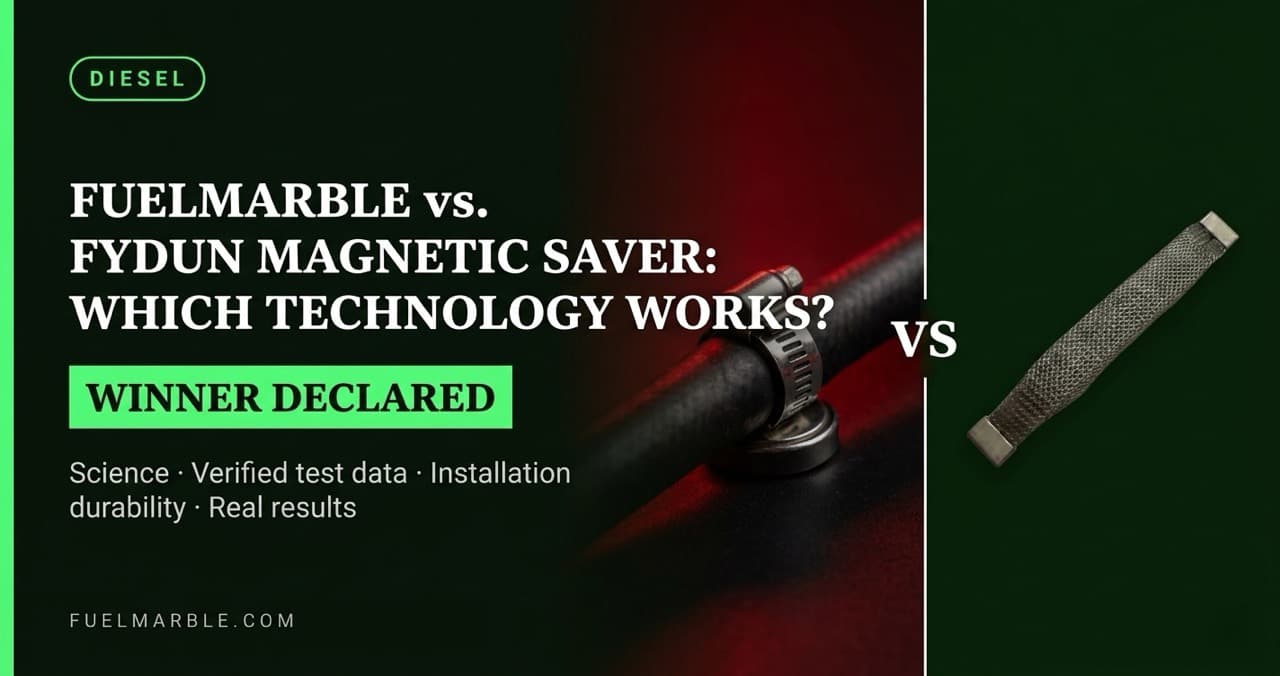
FuelMarble vs. Fydun Magnetic Gasoline Saver: Which Technology Actually Works?
Page Summary
This article compares FuelMarble and Fydun magnetic gasoline savers across five key dimensions: core technology, verified results, emissions impact, installation quality, and durability. This head-to-head comparison is part of the best fuel saver devices UK 2026 guide, where every product category is assessed against verified test data. The goal is to give you the technical information needed to make an informed fuel efficiency investment.
Contents
- What magnetic fuel savers claim to do
- Why magnetism alone fails at scale
- FuelMarble's molecular resonance approach
- Direct technology comparison
- Verified performance audit
- Cost-benefit reality check
What Magnetic Fuel Savers Claim to Do
Magnetic fuel savers like Fydun clip onto the outside of a fuel line and use static permanent magnets to claim they alter the structure of fuel molecules passing through the line. The claimed mechanism: magnetic fields cause fuel hydrocarbon chains to align differently, improving the fuel-air mixture and combustion efficiency.
In theory, magnetism can affect certain materials. In practice, the question is whether static magnets applied externally to a metal fuel line can produce enough field strength, at the velocity fuel moves through an engine, to meaningfully alter combustion chemistry.
The independent research consensus is clear: they cannot.
Why Magnetism Alone Fails at Scale
Independent automotive engineering research consistently finds that external magnetic fuel savers produce no statistically significant improvement in fuel consumption or emissions. The core physical reason: high-velocity fuel flow reduces the dwell time of fuel molecules within the magnetic field to microseconds, far too short for any meaningful molecular realignment.
One logistics partner's real-world experience underscores this: after installing hundreds of magnetic clip-on devices across a commercial fleet, monthly fuel spend remained unchanged across the entire trial period. The marginal cost of each device was small; the aggregate wasted expenditure was not.
The fundamental problem is mechanism: external magnetism is too indirect and too weak at automotive fuel flow rates to alter combustion outcomes. A device that cannot affect the process it claims to improve cannot produce the savings it claims to deliver.
FuelMarble's Molecular Resonance Approach
FuelMarble operates through a fundamentally different mechanism. The device is permanently installed inside the vehicle's coolant reservoir. As coolant circulates through the engine block, it carries the resonance effect of FuelMarble's mineral matrix into direct contact with the fuel-air mixture in the combustion chamber.
The result is the breakdown of complex hydrocarbon chains into smaller, more reactive clusters, enabling more complete combustion of each fuel charge. This produces:
- More energy extracted per litre of fuel (improved MPG / km/L)
- Less unburned fuel in exhaust (reduced CO₂, CO, NOx, and particulate matter)
- Lower peak combustion temperature (reduced engine wear and exhaust system stress)
This is not a theoretical mechanism. It is the same combustion chemistry principle used in industrial fuel enhancement applications. And unlike external magnetic approaches, it has been independently tested.
Direct Technology Comparison
| Feature | FuelMarble | Fydun Magnetic |
|---|---|---|
| Technology | Molecular resonance chemistry | Static external magnet |
| Verified results | 15–20% MPG gain (documented) | Unverified claims |
| CO₂ emissions | −10.34% (Jakarta test) | No measurable change |
| Installation | Permanent lifetime retrofit | Plastic zip-tie clip-on |
| Durability | Outlasts the vehicle | Heat/slip risk |
The comparison is stark across every dimension: technology basis, verified results, emissions performance, installation durability, and long-term reliability. Permanent molecular retrofit versus clip-on static magnet is not a close race.
Verified Performance Audit
FuelMarble's documented results come from two independently verified test programmes:
Jakarta Traffic Test 10.34% CO₂ reduction in real Jakarta traffic conditions, not a laboratory simulation. The test covered multiple vehicle types under varied traffic conditions. Full details are available in the Jakarta test blog.
2007 Honda Accord Retrofit 18% fuel efficiency improvement, consistently sustained across the test period. The device was permanently installed (not temporary), and the results held rather than fading after initial measurement. Full analysis at the Honda Accord retrofit blog.
Cost-Benefit Reality Check
Magnetic savers like Fydun typically retail for £10–25. FuelMarble S retails at £239. The price difference looks significant until you factor in what each device actually delivers.
A £20 magnetic device that produces zero fuel saving costs £20 and saves nothing. A £239 device that consistently saves 7–15% on fuel spend pays back its cost within months and continues generating savings for the vehicle's lifetime.
At UK average annual mileage (12,000 miles) and diesel at £1.53/L with 40 mpg average efficiency:
- Annual fuel spend: approximately £2,500
- 15% FuelMarble saving: £375/year
- Payback period: under 8 months
For fleet operators scaling across multiple vehicles, the numbers multiply proportionally. The fleet savings calculator models your specific scenario.
For the FuelMarble vs FuelSync Gas Saver comparison, see FuelMarble vs FuelSync, which fuel optimizer actually works?
For individual drivers: FuelMarble S, £239, free UK delivery, 30-day returns.
For fleet and commercial vehicles: FuelMarble L, £519, the same verified technology scaled for SUVs, HGVs, and commercial fleets.
Get FuelMarble, the only device in this comparison with independent government-standard test data and JFTC regulatory clearance. S for cars and vans. L for commercial and HGV.
Related reading:
- What Is FuelMarble? The Complete Guide
- FuelMarble Technology Explained
- FuelMarble vs. FuelSync Gas Saver: Which Is the Better Investment?
- Why Installing a Magnetic Clip-on Saver on Your Honda Accord Does Nothing for MPG
Related Articles
Elias translates complex engine science into clear, accurate content. Specialising in diesel combustion, DPF systems, and Japanese engineering methodology, he produces FuelMarble's technical documentation, performance analyses, and in-depth product guides.
Ready to Improve Your Fuel Efficiency?
FuelMarble delivers up to 15% fuel efficiency improvement. Simple drop-in install.