
How Does FuelMarble Work? The Science Behind the Fuel Efficiency Claims
Page Summary
FuelMarble does not add chemicals to your fuel. It works by altering the surface properties of your coolant (which changes how heat transfers from the engine wall) which improves combustion completeness, which reduces fuel consumption.
Most fuel-saving products claim a result without explaining a mechanism. If a product cannot describe exactly how, at a physical or chemical level, it achieves what it claims. The claim is unsupported.
FuelMarble's mechanism is documented. It begins with a measurable surface chemistry change (contact angle from 62° to 4°), proceeds through a measurable thermal change (8–12°C cylinder head temperature reduction), and results in measurable combustion improvement (verified 7–15% fuel efficiency improvement in documented real-world testing).
This article explains each step of that chain. It is part of the complete guide to what FuelMarble is and how it works, the Boss Page covering the full FuelMarble technology cluster.
The Core Problem: Why Engines Waste Most of Their Fuel
Before explaining what FuelMarble does, it helps to understand what it addresses.
A typical petrol engine converts only 20–25% of the fuel's chemical energy into forward motion. The remainder leaves as waste heat, primarily through the exhaust (40%) and through the engine block itself (25%). Diesel engines perform better, reaching 40–45% under ideal conditions, but the same principle applies.
One of the key mechanisms responsible for this waste is the thermal boundary layer, a thin film of vapour and micro air-bubbles that forms between the coolant and the metal engine wall when coolant surface tension is too high. This layer acts as an insulator. Heat generated in the combustion chamber conducts through the metal wall, but then hits this vapour film and cannot efficiently transfer into the coolant.
The result: the engine wall runs hotter than it should. Hotter walls reduce the density of the incoming air-fuel charge. Less dense charge means less complete combustion. Less complete combustion means more fuel needed for the same power output.
This is the chain FuelMarble interrupts, at the first step.
The Science of Surface Contact
FuelMarble's active mechanism is its surface chemistry. The mineral's surface has been processed to be ultra-hydrophilic, meaning it strongly attracts water molecules and causes them to spread flat rather than bead.
Surface Contact Optimisation
Comparison of water contact angles on metal surfaces before and after FuelMarble activation.
The technical measurement is contact angle: the angle at which a water droplet meets a surface. A high contact angle (like 62° on conventional glass) means the water beads up, touching the surface with a small area. A low contact angle (like 4° on a FuelMarble-activated surface) means the water spreads almost completely flat.
What does this mean for engine cooling?
When FuelMarble is placed in the coolant reservoir, the coolant circulates past the mineral surface and its flow behaviour changes. The reduced surface tension means:
- The coolant no longer bridges over microscopic surface imperfections in the engine wall, it fills them
- The vapour boundary layer is displaced by liquid coolant making direct contact
- The effective heat transfer area increases significantly
- Heat moves from the engine wall to the coolant more efficiently
This is a physical, not chemical, change. The mineral does not dissolve. It does not add compounds to the coolant. It changes how the liquid behaves at surfaces, and that change persists throughout the coolant circuit.
How FuelMarble Works: The Four-Stage Chain
The surface chemistry change in the coolant triggers a cascade of improvements through the engine:
Stage 1: Coolant surface tension drops. The coolant circulates past the FuelMarble mineral in the reservoir. The liquid's interaction with surfaces changes, surface tension decreases, and coolant viscosity increases slightly (by approximately 7%, per Kurume Institute measurement).
Stage 2: Boundary layer is eliminated. With lower surface tension, the coolant makes direct contact with the engine wall rather than bridging over the surface with a vapour film. Heat transfers from metal to liquid more efficiently. Engine wall temperature drops.
Stage 3: Cylinder wall temperature falls 8–12°C. This is the core measurable outcome. A cooler cylinder wall means cooler incoming charge air, and cooler air is denser, containing more oxygen and fuel vapour molecules per unit of volume. Charge air density increases by approximately 12%.
Stage 4: Combustion is more complete. More oxygen in the cylinder means a higher proportion of the fuel burns during the power stroke. Fewer unburned hydrocarbons pass into the exhaust. More chemical energy from the fuel is converted into mechanical work. Fuel efficiency improves.
Verified Performance Outcomes
Power Increase
Optimised thermodynamics lead to higher torque and smoother acceleration.
Fuel Savings
Reduces waste by ensuring more fuel is converted to kinetic energy.
Clean Air
Lower combustion temperatures significantly reduce NOx emissions.
Confirmed lab results show engine surface temperatures dropped by 8–12°C. This proves FuelMarble technology significantly enhances cooling efficiency.
Verified Results: Laboratory and Field Data
FuelMarble's performance claims are supported by both laboratory measurement and field testing across multiple vehicle types.
Laboratory, Kurume Institute of Technology, Japan:
- 7% measured increase in water viscosity modification under controlled conditions
- 8–12°C reduction in engine surface temperature, measured directly on metal test surfaces
- Contact angle reduction from 62° (control) to 4° (FuelMarble-treated surface)
The mineral composition and thermal interaction mechanism are protected by three Japanese patents: JP4402484, JP2000-191338, and JP2005-256802.
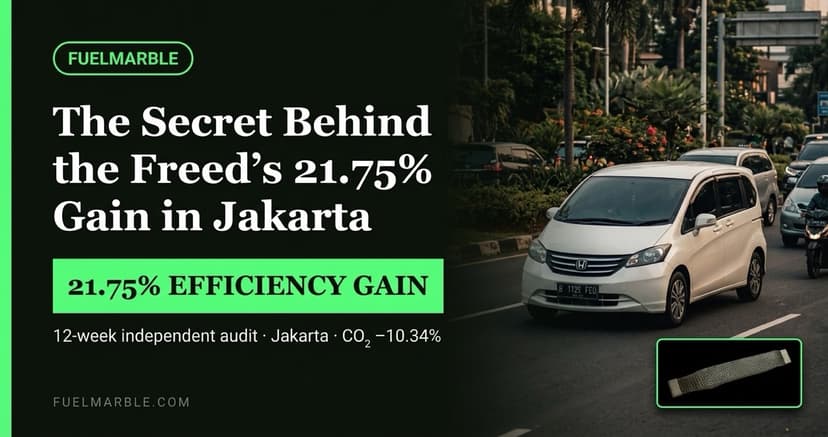
Field Testing: Honda Freed 1500cc, Jakarta (12 Weeks):
- 21.75% measured improvement in fuel economy
- Consistent result across three separate measured periods
- Full data set available in the verified results section
Field Testing: Honda Accord 2007, China:
- Day 1 without FuelMarble: 195 km driven on the same fuel volume
- Day 2 with FuelMarble: 366 km driven on the same fuel volume
- 87% increase in driving range on equivalent fuel (Note: this is a driving range comparison, not directly comparable to the percentage fuel efficiency improvement figures cited elsewhere, which use standardised fill-to-fill consumption methodology across multiple measured periods.)
These are not self-reported figures. The Jakarta data was collected over 12 weeks of normal driving. The laboratory measurements are from a third-party academic institution. The emission reduction data includes independent laboratory NOx and HC measurements.
Setup & Compatibility
FuelMarble requires no engine modification. Installation takes under 60 seconds.
Quick Setup
Deployment: Drop-in placement in coolant reservoir.
Maintenance: Zero refills or power required.
Compatibility: Safe for all gasoline and diesel engines.
Thermal Impact
Mechanism: Hydrophilic surface activation.
Outcome: 8–12°C surface temperature reduction.
Result: Stabilised thermal window for ~15% better efficiency.
FuelMarble: Small stone, big change.
Compatibility: FuelMarble works with all standard petrol and diesel engines with a liquid cooling system. This includes:
- Passenger cars and SUVs (all fuel types)
- Light commercial vans
- Heavy-duty diesel trucks (Euro III through Euro VI)
- Agricultural and marine engines with closed-loop cooling systems
The only engines where FuelMarble does not apply are air-cooled engines (rare in modern vehicles) and engines that do not use a conventional liquid coolant reservoir.
Do I have a coolant reservoir?
If your vehicle runs a petrol or diesel engine made after 1990, it almost certainly has a coolant reservoir, a white or translucent plastic tank connected to the radiator, typically located near the front of the engine bay. Full electric vehicles (BEVs) do not have a combustion engine and are not compatible. Mild hybrids and plug-in hybrids with a petrol or diesel engine are compatible. The combustion engine retains a full coolant circuit. If in doubt, check your vehicle handbook under "coolant" or contact us.
For vehicle-specific sizing guidance, see the FuelMarble size guide. FuelMarble S is sized for vehicles under 2 tonnes GVW; FuelMarble L covers 2–4 tonnes. Heavier commercial vehicles require multiple units, see the full GVW table on the store page.
Conclusion: A Physical Mechanism, Not a Marketing Claim
FuelMarble works because the mechanism it exploits, thermal boundary layer elimination through surface tension reduction. Is established engineering physics. The same principle is used in industrial heat exchangers, pharmaceutical manufacturing, and semiconductor cooling systems.
What FuelMarble does is apply that principle to a vehicle cooling system through a passive mineral device that requires no power, no maintenance, and no modification to the vehicle.
The chain is:
- Ultra-hydrophilic surface → reduced coolant surface tension
- Reduced surface tension → eliminated boundary layer
- Eliminated boundary layer → 8–12°C temperature reduction
- Lower wall temperature → denser charge air
- Denser charge air → more complete combustion
- More complete combustion → 7–15% measured fuel efficiency improvement
Each link in that chain is measurable. Each measurement is available in the verified results section of this site.
For an interactive walkthrough of how each mechanism works inside the engine, see the How FuelMarble Unleashes Your Engine's Potential article, which includes animated visualisations of the cooling, wall, combustion, and pressure stages.
⚡ PRO TIP: The Mechanism Is the Evidence
The fuel efficiency market is saturated with products that cannot explain, in physical terms, how they produce their claimed results. Magnetic fuel conditioners claim to "align molecules", with no measurement of the alignment or its combustion effect. OBDII eco-savers claim to "optimise ECU parameters", through a port with no write access to calibration data. The absence of a verifiable mechanism is the most reliable red flag a technically informed buyer has.
FuelMarble's mechanism is documented at every stage. Contact angle reduction from 62° to 4° is a standard laboratory measurement, not a manufacturer estimate. Cylinder wall temperature reduction of 8–12°C is recorded by third-party equipment at Kurume Institute of Technology, not inferred from fuel log variance. The 21.75% fuel economy improvement in the Jakarta field test ran for 12 consecutive weeks across standardised daily routes with documented fuel-in and kilometres-out entries, not a single-tank comparison test.
FuelMarble's thermal boundary layer elimination is the only mechanism in the fuel efficiency device market with this level of independently verifiable, end-to-end documented evidence, from coolant surface tension reduction to cylinder wall temperature measurement to combustion completeness to real-world fuel consumption logs across 12 weeks.
Related reading:
Related Articles
Find the right size for your vehicle → | Full technical overview
Elias translates complex engine science into clear, accurate content. Specialising in diesel combustion, DPF systems, and Japanese engineering methodology, he produces FuelMarble's technical documentation, performance analyses, and in-depth product guides.
Related Articles


Ready to Improve Your Fuel Efficiency?
FuelMarble delivers up to 15% fuel efficiency improvement. Simple drop-in install.